Friday Puzzler -- Circle's radius
Alex Y
What is the radius of the circle shown below?
While this may seem to be an irrational request, please give the exact radius. 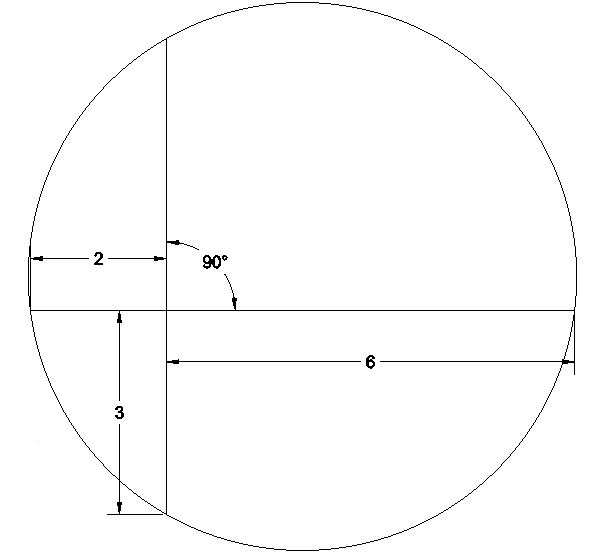
Knowledge You Can Build On — Est. 1998
Friday Puzzler -- Circle's radius
Alex Y
What is the radius of the circle shown below?
While this may seem to be an irrational request, please give the exact radius.

Re: Friday Puzzler -- Circle's radius
Alan Young
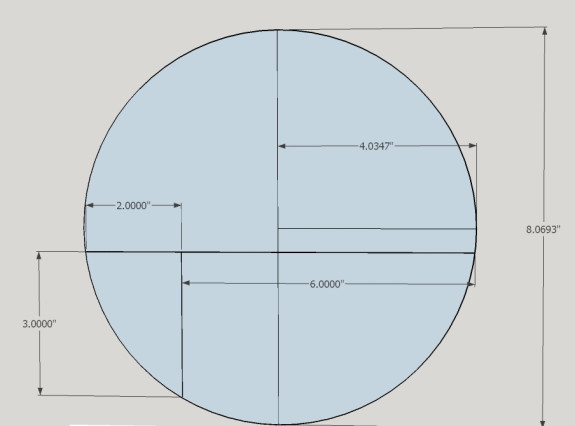
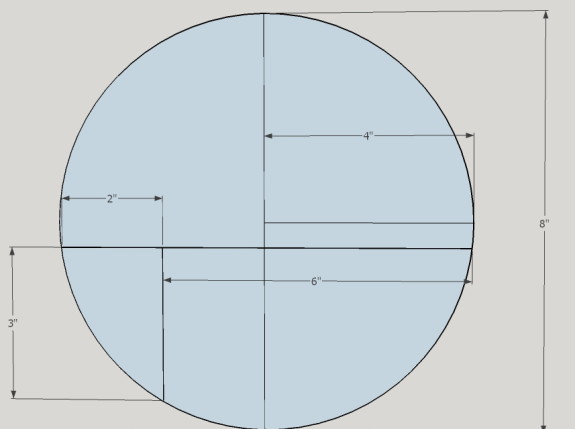
Not sure how accurate my method was but here is my result
Okay, but . . .
Henry Higginbotham
That's about the same answer I got (mine was 4.031), but I cheated and drew a circle by three points in MicroStation, so I didn't post it. I'm still looking at it occasionally to find a manual solution. I can't tell from the images how you did it.
VERY close
Alex Y
Nice job.
I'm not sure what your method was, but I guess from the diagram that you used a CAD or other graphic program to create a circle through the 3 points that are determined, then measured the circle. Your result is only off a very small amount, accurate to 2 decimal places. But what I am looking for is the EXACT answer, not an arbitrarily close approximation.
Yes and Yes
Alex Y
Henry, yes, the answer you got was correct to the 3 decimal places you showed .
And yes, I am looking for a computer-free solution that gives an exact answer.
A little closer
Henry Higginbotham
Looking at a few more decimal places, it seems to maybe be the square root of 16.25. But so far, that's no help to me.
Twenty-five years ago, or more, I knew how to manually calculate a bearing-bearing intersection. Assigning the intersection of the provided lines the coordinates (2,0), the midpoint of one hypotenuse is (1,-1.5) and the other at (5,-1.5). Perpendiculars from those points would intersect at the radius point.
But 25 years of having a computer do the work for me hasn't done much for my memory of how to manually do it. And besides, you've probably got a more elegant solution, anyway.
Re: Friday Puzzler -- Circle's radius
Larry Barrett
I don't have an exact solution; in fact so far I don't have any solution.
And I am not sure this sheds any light on the path to an exact solution. But in geometry there is a theorem called the Intersection Chords theorem. This theorem says that if two chords intersect and the two segments of one chord are a and b, and the two segments of the other chord are c and d, then a x b = c x d.
In this problem, the two segments of the horizontal chord are 2 and 6; one segment of the vertical chord is 3 but the other segment is not labeled; call it y. The theorem says that 2 x 6 = 3 x y, so y must be 4.
And the two chords are perpendicular, so that must also be important in finding R.
That's my two cents.
Correct answer, but why?
Alex Y
Larry's geometry theorem about chords (of which I was not aware) simplifies the math somewhat.
Re: Friday Puzzler -- Circle's radius
Larry Barrett
So continuing with this line of thinking, the total length of the horizontal chord is 8 and the the midpoint is at 4 (length of the chord from the midpoint to each end is 4). Similarly, for the vertical chord, the midpoint is at 3.5.Since the chords are perpendicular, we can construct a rectangle where the SW corner is where the chords intersect and the NE corner is at the center of the circle. The sides of the rectangle are .5 by 2.
Using Pythagoras, we can see that R^2 = 3.5^2 + 2^2 = 49/4 + 4 = 65/4.
So R = (sqrt65)/2.
Alternatively, R^2 = 4^2 + .5^2 = 16 + 1/4 = 65/4 and R = (sqrt65)/2.
Correct!
Alex Y
And without the theorem about intersecting chords, you can consider the perpendicular chords to be the x and y axes, and consider the center of the circle at (a,b). It is easy to see that a=2, and using the same two right triangles you identified, with the hypotenuses of r, we can get b^2+4^2 = r^2 = (3+b)^2 + 2^2. We can solve to find out that b=.5. But the property of intersecting chords you mentioned greatly simplifies the finding that b=1/2!
And one more solution
Alex Y
There is another theorem (also unknown to me) that for two intersecting perpendicular chords, the sum of the squares of the four segments is 4*(r^2). So once you have used 3*x=2*6 to find the unstated chord segment to be 4, this theorem says that:
4*(r^2) = 4^2 + 3^2 + 2^2 + 6^2
=16+9+4+36 = 65
So r = sqrt(65)/2
These two theorems that I didn't know about sure make this easier! 
Thank you, Larry and Alex!
Henry Higginbotham
I never knew that, either. I'm having trouble imagining where I'll ever use it (unless I see this puzzle again somewhere), but it's still cool.
LOL!
Alex Y
I think remembering these two theorems are not the best use of my limited brain cells, either. Hopefully I can free them up for something more useful, but I am probably stuck with this knowledge now.


