Friday Puzzler -- Circles
Alex Y
I'm going to do away with description that might have you looking for verbal clues that do not exist. The picture below is exactly what it appears to be.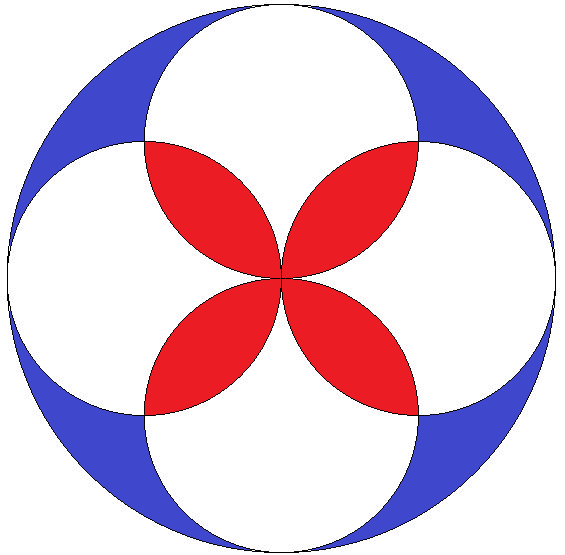
Which is larger, the blue or the red area?
Knowledge You Can Build On — Est. 1998
Friday Puzzler -- Circles
Alex Y
I'm going to do away with description that might have you looking for verbal clues that do not exist. The picture below is exactly what it appears to be.
Which is larger, the blue or the red area?
Re: Friday Puzzler -- Circles
Ed in Leaside
Same I think
Re: Friday Puzzler -- Circles
Alex Y
Looks that way. Convince me 
Re: Friday Puzzler -- Circles
Larry Barrett
Suppose large circle has radius r = 2, and area = A=πr^2 = 4π. (π is the symbol for pi).
Each smaller circle has radius r = 1, and area = π.
The small circles intersect each other at 90*.
If a line is drawn through the red area in a circle, it will be a chord and will create two segments, one in each overlapping circle. The formula for the area of a segment where the central angle is 90* is
½ ((πx90*/180*) - sin90*)) = ½(π/2 – 1). Thus each red area has a total area of 2(½(π/2 – 1) = π/2 – 1.
There are two of these red areas in each small circle. Therefore, the white (non-red) area in each small circle has an area = π – 2(π/2 – 1) = 2.
There are 4 of these white areas, and 4 of the red areas, so the total area of all of the white plus red areas is 4(2 + (π/2 – 1)) = 4+2π.
The blue area is the difference between the area of the large circle minus the area of the white and red areas.
Therefore the blue area is 4π – (4 +2π) = 2π – 4.
Since each red area is = π/2 – 1, the total red area is 4(π/2 – 1) = 2π – 4.
Thus the blue and red areas are equal.
Good job, Ed and Larry
Alex Y
I couldn't get all the areas Larry did without some research. But I think you can see it without calculating the areas.
The four small circles have exactly the same area (4n in Larry's explanation) as the large circle. When you overlap those small circles to fit into the large circle, you are reducing the area covered by those circles by the area of the overlaps. So the overlapped small circles in the drawing cover an area of 4n-red. The blue area is 4n-(4n-red) = red.
Re: Good job, Ed and Larry
Larry Barrett
Your answer reminds me of Martin Gardner's AHA puzzles. Easy if you just look at it the right way.


