WoodCentral Forums

Est. 1998 — 27 years of woodworking knowledge

Friday Puzzler -- 5 Pirates

Posts

Friday Puzzler -- 5 Pirates

#1

Friday Puzzler -- 5 Pirates

Alex Y

5 pirates of different ages have a treasure of 100 gold coins.

On their ship, they decide to split the coins using this scheme:

The oldest pirate proposes how to share the coins, and ALL pirates (including the oldest) vote for or against it.

If 50% or more of the pirates vote for it, then the coins will be shared that way. Otherwise, the pirate proposing the scheme will be thrown overboard, and the process is repeated with the pirates that remain.

As pirates tend to be a bloodthirsty bunch, if a pirate would get the same number of coins if he voted for or against a proposal, he will vote against so that the pirate who proposed the plan will be thrown overboard.

Assume that all 5 pirates are intelligent, rational, greedy, and do not wish to die, (and are rather good at math for pirates). Assume each pirate also knows that his fellow pirates have these characteristics.

What will happen?

Re: Friday Puzzler -- 5 Pirates

#2

Hint

Alex Y

.sdrawkcab kroW

Re: Friday Puzzler -- 5 Pirates

#3

Re: Hint

Henry Higginbotham

I considered that, since it seems pretty obvious what would happen if it came down to the last two pirates, with the older one needing only his own support for his plan. I have a hunch that the three older pirates, who also know this, will find a way to keep it from getting that far by finding a way to keep everybody dry. But I can't yet tell you how that's going to happen. :(

Re: Friday Puzzler -- 5 Pirates

#4

Re: Hint

Larry Barrett

Let the pirates be named A, B, C, D, E in that age order.

If it came down to D and E, we know (at least, Henry knows) what will happen then.

So before it gets to that point, C will think this way: If I propose to split the treasure equally, D will vote against it for sure; E, however, realizing that if he votes against it I (C) will be thrown overboard and it will come down to D and E, and in that case he (E) will get nothing, will vote for it. Thus the treasure will be split equally. C goes on to think that E will vote for any proposal that gives him more than nothing, so C proposes to give a small part to E, most to himself (C), and nothing to D. E will vote for this, as well as C so the treasure would be split this way. This seems to be the best strategy for C.

Moving back another step will need to wait until tomorrow.

Re: Friday Puzzler -- 5 Pirates

#5

Re: Hint - continuing

Larry Barrett

So now consider B's strategy. B would realize that he only needs to get one 'yes' vote from either C, D, or E. B would also quickly grasp what D would propose (if only D and E remain) and what C would also propose (one unit of treasure to E, none to D, and the rest to C) in order to win a 'yes' vote from E.

So B would see that he could likely win over E by offering two units of treasure to E, none to D or C, and the rest to B. E would see that two units of treasuer was clearly better than what C would offer, and way better than what D would offer.

So now consider what A would propose, after thinking through what B, C, and D would likely offer. A would realize that he needs to win a 'yes' vote from two of the other pirates; E would be a likely candidate and A should be able to win over E by offfering three units of treasure. But what about B, C, or D? Each of them, if they in turn were the oldest survivors, would stand to get almost all the treasure. A would reason that D, being third in line and likely to get nothing from B or C, might be the most likely to vote yes if A offered something, say one unit of treasure. So A would propose that E get three units of treasure, D get one unit, B and C get nothing, and A get the rest (96 units of treasure).

In the rules Alex set out, nothing was said about side bets, collusion, secret arrangements, etc. Sounds like modern politics (and ancient politics and power struggles, too). But for example consider how D might think, before A made his proposal. D would have reasoned as above for what A, B, and C might propose, and seen that his best chance of getting more treasure was to convince E to not vote 'yes' to what A (or B or C) was about to propose. So D might have whispered to E that he, D, would promise E that he would give E substantially more treasure than what A, B, or C would offer, say four units of treasure, if E would not vote yes to whatever A, B, or C might propose. Just to make sure, D might even promise to split the treasure 50-50 with E! Of course, B and C might start thinking along these lines and come up with their own secret offers to E. E might even end up with all the treasure if A, B, C, and D conclude that staying dry (as Henry put it) was better than any amount of treasure.

Re: Friday Puzzler -- 5 Pirates

#6

Close

Alex Y

And your third paragraph introduces some interesting considerations if there is collusion [mot du jour ;-) ]. But considering that there is no talking other than by the eldest pirate still aboard, the answer is slightly different from what you posted.

Re: Friday Puzzler -- 5 Pirates

#7

Re: Hint - continuing

Alex Y

So now consider B's strategy. B would realize that he only needs to get one 'yes' vote from either C, D, or E. B would also quickly grasp what D would propose (if only D and E remain) and what C would also propose (one unit of treasure to E, none to D, and the rest to C) in order to win a 'yes' vote from E.


B would also realize (as would C, D, and E) that if he went over, the coins would be distributed as proposed by C -- 99,0,1 to C,D,E. If and when B were making this decision, everyone would know that it would never get to D&E alone, so that case can be ignored (once it is used to determine what C would do)

So B would see that he could likely win over E by offering two units of treasure to E, none to D or C, and the rest to B. E would see that two units of treasuer was clearly better than what C would offer, and way better than what D would offer.
Is E the best ne to seek a vote from? Can't B keep more than 98 for himself?

Re: Friday Puzzler -- 5 Pirates

#8

Re: Hint - continuing

Larry Barrett

So with this additional hint, I think that B could indeed do better by offering D 1 unit of the treasure if he will vote with B. D, otherwise, will get 0 from B and so should be glad to get 1 from B. So B proposes 0 to C and E, 1 to D, and the rest, 99 units, to himself.

Re: Friday Puzzler -- 5 Pirates

#9

Yes!

Alex Y

And only one more step.

Re: Friday Puzzler -- 5 Pirates

#10

Answer

Alex Y

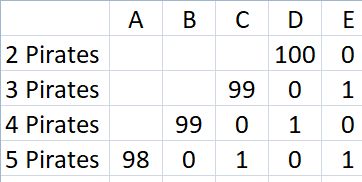
The oldest Pirate will take 98 coins for himself, and offer 1 coin each to the third and fifth oldest, who will accept that offer, knowing that they will get nothing if they vote to throw the oldest overboard, as Larry showed in his latest post.

Here is the decision tree they all consider. In each case, the rational choice is made considering what each pirate would get on that line versus what they would get if they vote against the then-oldest pirate, and get what is offered on the line above.


👍 This page answered my questions

Your vote helps other woodworkers quickly find the answers and techniques that actually work in the shop.