Friday Puzzle -- squaring a triangle
Alex Y
Can you cut an equilateral triangle into four pieces that can be reassembled (with no flipping) into a square?
Show how or why not.
Est. 1998 — 27 years of woodworking knowledge
Friday Puzzle -- squaring a triangle
Alex Y
Can you cut an equilateral triangle into four pieces that can be reassembled (with no flipping) into a square?
Show how or why not.
Observation
Larry Barrett
No answer yet, but an observation that the area of the square must equal the area of the equilateral triangle.
Area of the triangle, with side s, is (using A = 1/2 base x height) =
1/2 s x ((3*.5)/2) s = ((3*,5)/4)s*2
So side of the square must = ((3*.25)/2)s
Hints
Alex Y
Hint 1 (actually answer 1): It can be done, so don't bother with trying to prove it can't be.
Hint 2: All four corners of the square come from the interior of the triangle
More hints
Alex Y
Larry's observation is correct (although I was initially confused by the notation, using * for raised to the power, which is not one I am used to)
the cuts consist of one straight line going through the triangle, and two other cuts that meet this cut at right angles from different sides, and not at the same point.
The cuts can be constructed with traditional Euclidean geometric constructions (straight-edge and compass), but it is not easy.
Re: Friday Puzzle -- squaring a triangle
Alex Y
The four pieces consist of one right triangle and three quadrilaterals with only one right angle corner each.
Solution: squaring a triangle
Alex Y
This seems to be going nowhere.
There is a solution, and interestingly, the parts created don't have to be totally disconnected to rebuild them into a square.
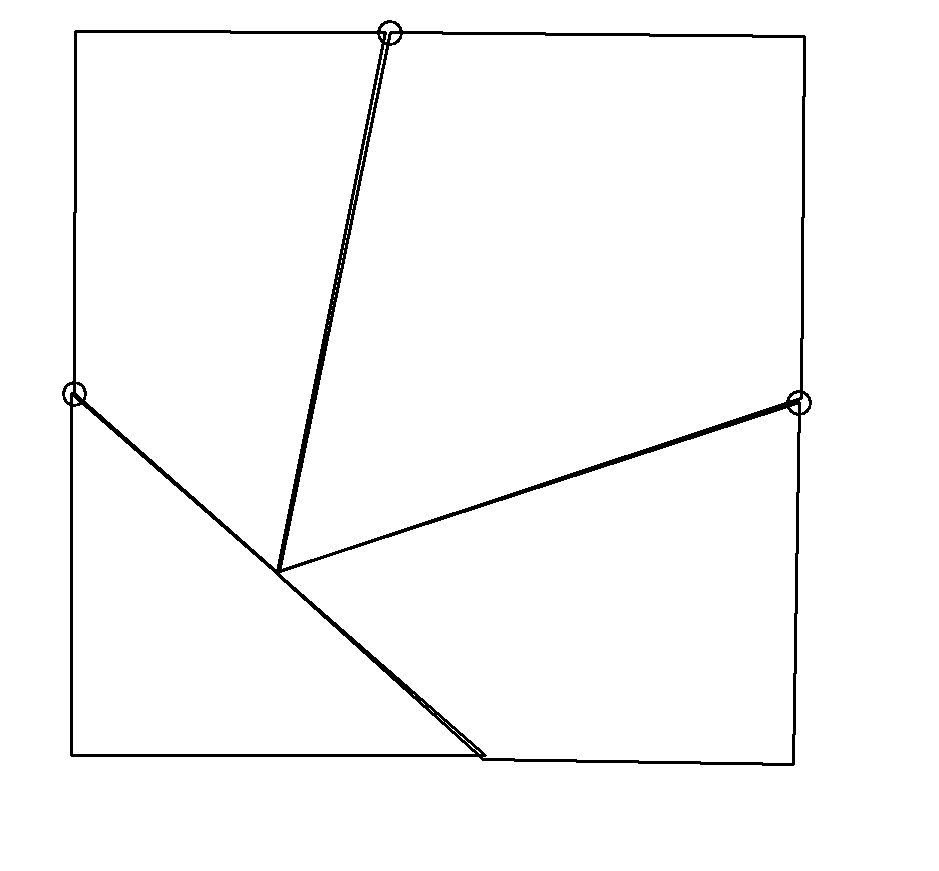
These are the cuts that are made to the equilateral triangle.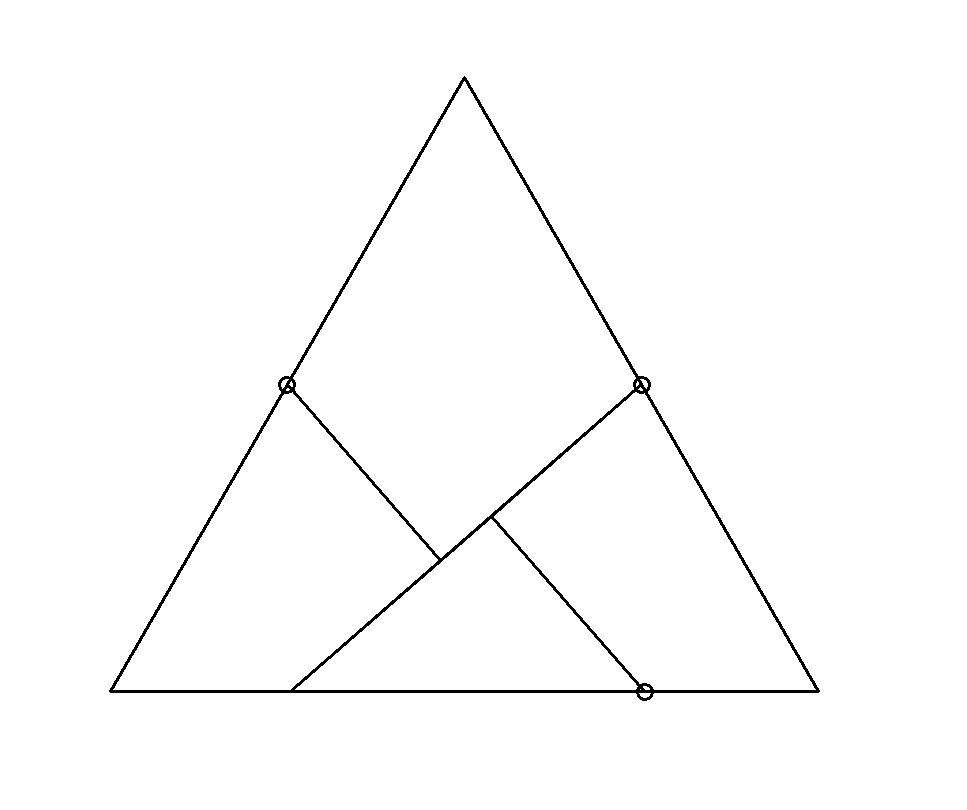 Imagine each of the little circles I have drawn to be a hinge pin connecting the parts at the three points shown.
Unwind it: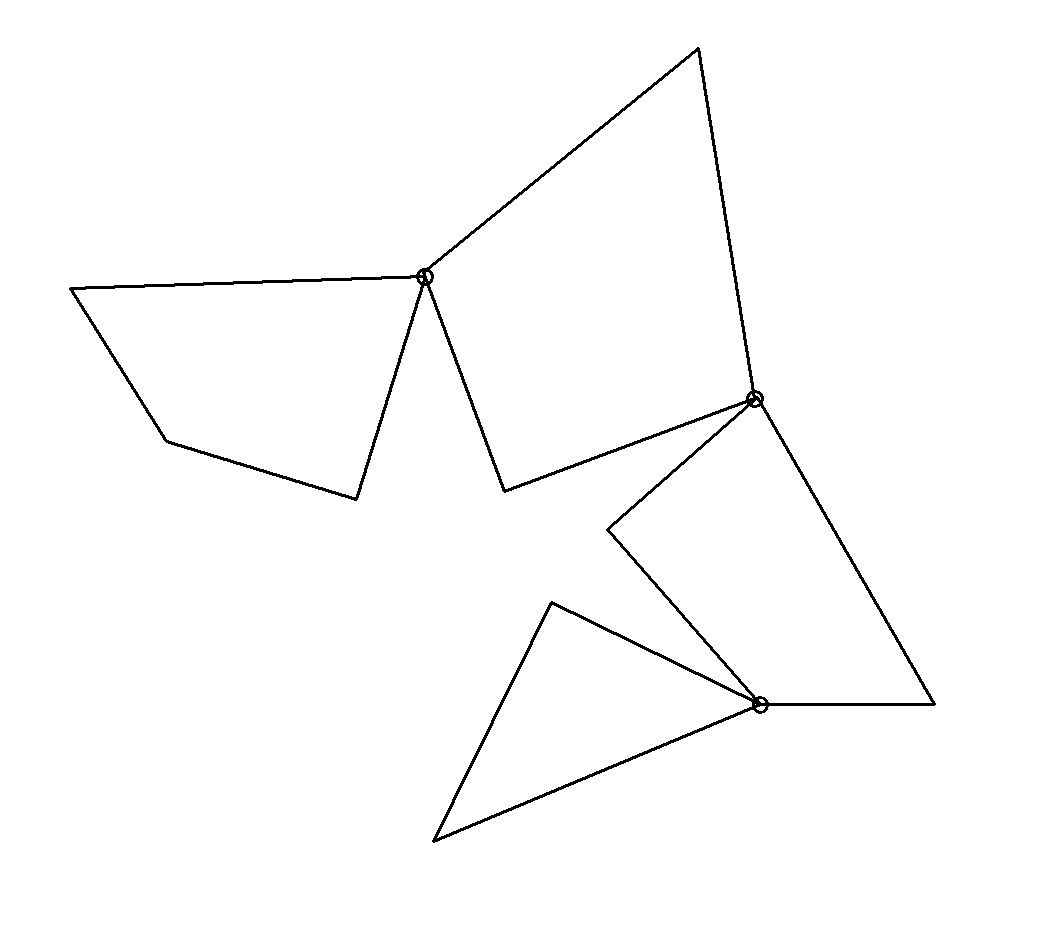
and you end up with a string of parts that if "wound up" one way form a square and the other way forms a triangle.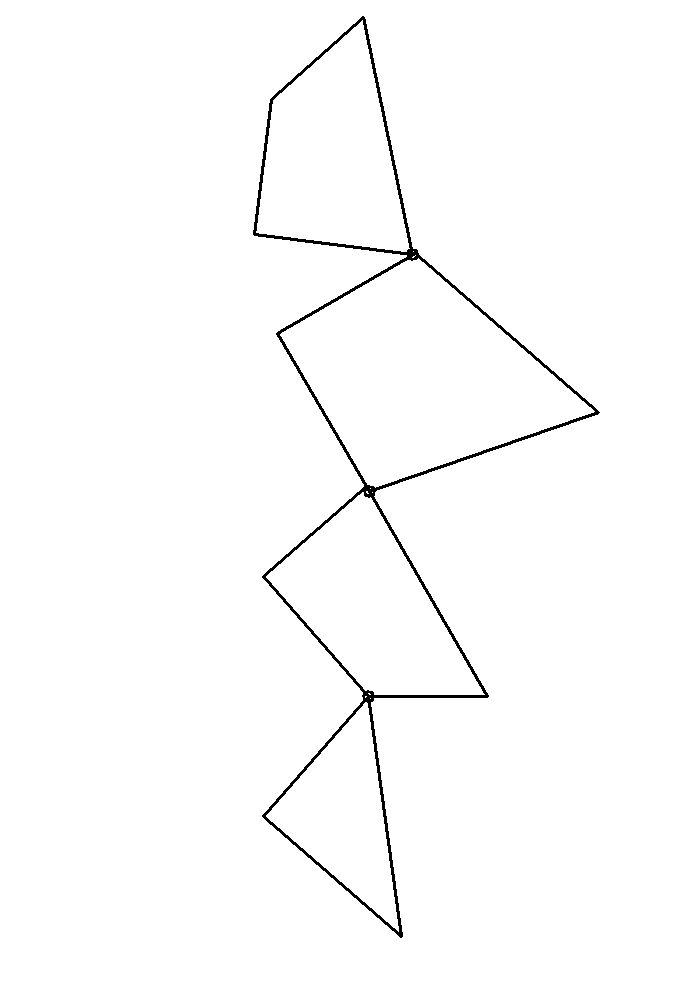
And becoming a square: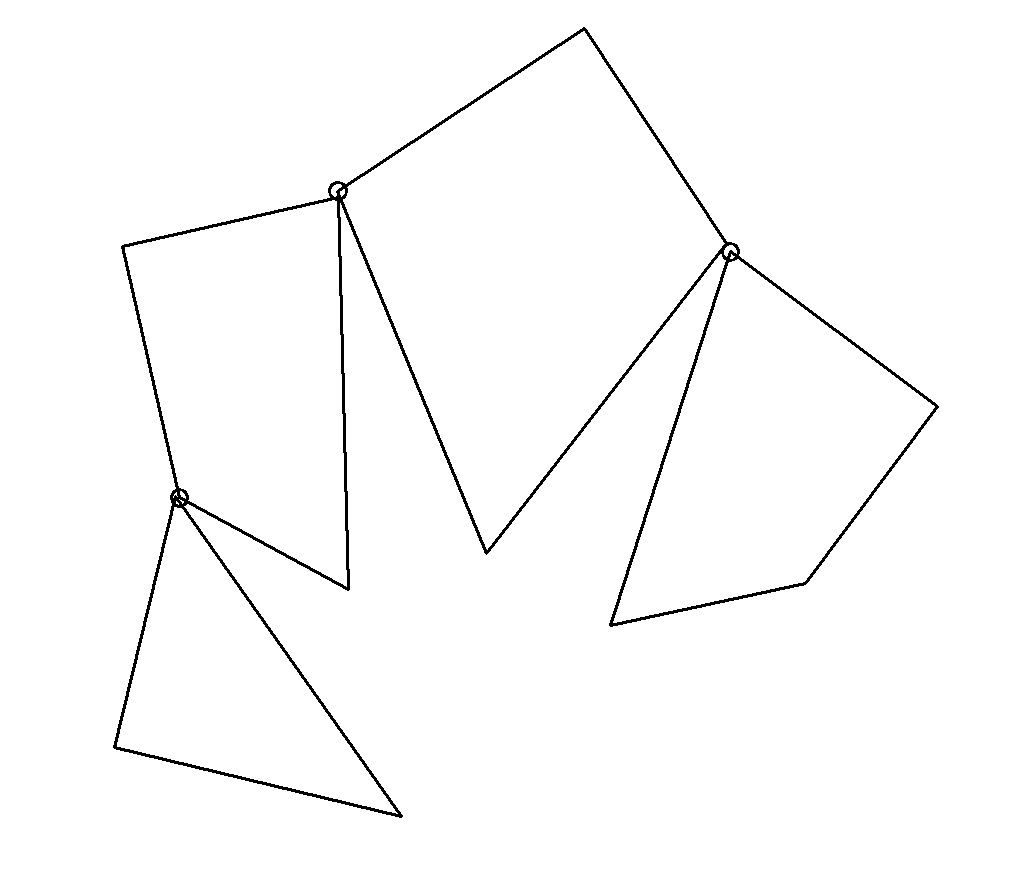
Re: Solution: squaring a triangle
Larry Barrett
You mentioned that this could be done with a straightedge and a compass. Any clues or links to how this could be done? If an equilateral triangle can be transformed into a square, can an isoceles triangle be transformed into a rectangle?
Re: Solution: squaring a triangle
Alex Y
I'll try to post the steps in the construction of these lines over the weekend. NOT very intuitive (at least to me), and lots of "construction lines" not used in the final result.
No idea whether it is possible to go from isosceles to rectangle.
Geometric Construction
Alex Y
I don't have time to prepare drawings for this, so get out paper, pencil, straightedge, and compass if you are interested.
Since you asked about construction, I'm going to presume the basics, like how to create an equilateral triangle, bisect a line, and draw a line from a point, perpendicular to another line. If anyone is interested in following this and needs instruction on any of those, speak up. But I'm guessing Larry is the only one reading this.
Start with an equilateral triangle, with a horizontal side on the bottom.
Label the vertices A,B,C, starting on the lower left and proceeding clockwise. (obviously, the orientation of the triangle and the order of labeling the vertices are irrelevant to the construction, but might help if any of these instructions need clarification.)
Bisect AB at point D and BC at point E.
Bisect angle A, extending the bisecting line beyond E.
Take the distance from E to B, and mark that distance from E to a point F on the bisecting line of A, beyond point E.
Find the midpoint m of AF.
Extend line CB beyond point B.
Take the distance from m to F and mark that distance from m to a point G on the extension of CB.
(I haven't verified this, but the source I have says that EG is the length of the side of the square--harking back to your first observation on the solution.)
With the compass point on E and the distance set to EG, mark the point H on AC that is the same distance from E.
HE is one of the cut lines.
Mark a point K between J and C, at a distance from J of 1/2 the triangle side (e.g., AD)
Drop perpendiculars from points D and K to line HE. These are the other two cuts.
Now, wasn't that obvious? (g,d,& r)
Re: Geometric Construction
Larry Barrett
I don't know why I didn't see this right away.
(I think in this line "Mark a point K between J and C, at a distance from J of 1/2 the triangle side (e.g., AD)" where you say "between J and C" you mean between H and C, since H was the point on line AC that you just located in the step before.)
Thanks for the explanation, and thanks for the puzzles every week. I really enjoy them, even the ones I can not figure out.
Correction is right
Alex Y
Or maybe I should claim that I threw that in there on purpose to see if anyone really followed this construction
Re: Geometric Construction
Larry Barrett
I haven't verified this, but the source I have says that EG is the length of the side of the square.
EG remarkably is the length of the side of the square:
mF = ½(AE + EF) = ½((3^.5/2)s + 1/2s) = ((3^.5 + 1)/4)s
mF= mA = mG
mE = AE – mF = ((3^.5/2) - ((3^.5 + 1)/4))s = ((3^.5 - 1)/2))s
BCm is a right angle
Therefore, EG = ((mG)^2 –(mE)^2)^.5 = ((((3^.5 + 1)/4)s)^2 –(((3^.5 - 1)/2))s)^2)^.5 =
(((3 + 2*3^.5 +1)/16)s^2) - (((3 - 2*3^.5 +1)/16)s^2))^.5 = (((3^.5)/4)s^2)^.5 = ((3^.25)/2)s
(lots of ((( and ))) and ^, so easy to mess up, but I think this is correct)
Thanks for figuring that out
Alex Y
You are a more patient man than I!