WoodCentral Forums

Est. 1998 — 27 years of woodworking knowledge

Friday Puzzler -- Crossnumber

Posts

Friday Puzzler -- Crossnumber

#1

Friday Puzzler -- Crossnumber

Alex Y

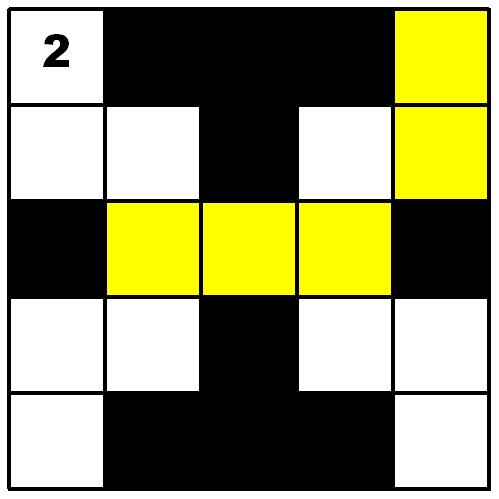
The following is "crossnumber" grid. Like a crossword, but instead of putting a letter in each box to form words, you will be putting a digit in each box to form numbers (no leading zeros).

You need to fill in this puzzle with two constraints:

Each number formed is prime

The sum of the digits in each column is the same.

What are the two shaded numbers?


source: New Scientist, January 2, 2013

Re: Friday Puzzler -- Crossnumber

#2

Re: Friday Puzzler -- Crossnumber -question

Larry Barrett

You say "you will be putting a digit in each box to form numbers" and you ask "what are the two shaded numbers".

By shaded numbers, I assume you mean the numbers in the yellow boxes.

There are shaded boxes in the first three rows. The third row has three consecutive boxes, so that would be one number. And the first row has a single shaded box, so that would be one number. How does the shaded box in the second row fit in?

Re: Friday Puzzler -- Crossnumber

#3

Re: Friday Puzzler -- Crossnumber -question

Alex Y

The three digits in the yellow boxes in the middle row form one "across" number, and the two digits in the shaded boxes in the right-most column form one "down" number.

Re: Friday Puzzler -- Crossnumber

#4

Re: Friday Puzzler -- Crossnumber

2B6

3 & 4 works to my way of thinking.

Re: Friday Puzzler -- Crossnumber

#5

Re: Friday Puzzler -- Crossnumber

Larry Barrett

The sum of the 5 digits in the 2 shaded numbers is 18.

Re: Friday Puzzler -- Crossnumber

#6

Re: Friday Puzzler -- Crossnumber

Alex Y

Okay, from the two responses so far, it looks like my statement of this problem was as clear as mud!

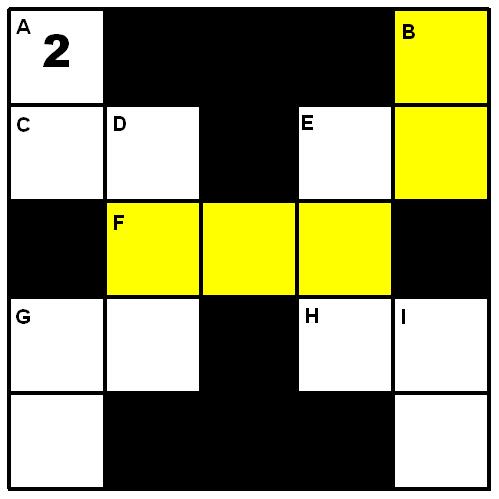
A crossword puzzle has numbered boxes at the start of each across and down word, and numbered clues for those words. In the puzzle redrawn below, I have lettered boxes that contain the first digits of the primes.


The Primes are:

Across

C: _ _

E: _ _

F: _ _ _

G: _ _

H: _ _

Down

A: _ _

B: _ _

D: _ _ _

E: _ _ _

G: _ _

I: _ _

I was asking specifically about the three-digit across prime starting in F. and the two-digit down prime starting in B.

In fact, you will have to get all eleven primes in order to answer the question.

Re: Friday Puzzler -- Crossnumber

#7

  Correct


Re: Friday Puzzler -- Crossnumber

#8

Re: Friday Puzzler -- Crossnumber *LINK*

Larry Barrett

This link is handy for this puzzle. For instance, you can see that A must be either 23 or 29. So C starts with either 3 or 9.


List of prime numbers

Re: Friday Puzzler -- Crossnumber

#9

Re: Friday Puzzler -- Crossnumber

Alex Y

Yes, that table of primes can make it easier to see. But it is solvable with no trial and error, assuming you can divide by seven in your head.

You are right that A has to be 23 or 29.

Then observe that the third column is a single digit. So the sum of the first column is less than 10.

That means that G down is 11, 13, or 31.

But if 13 or 31, then the sum of digits in column 1 is 9, which means that D down and E down will be multiples of 3. So G down is 11, the center column is a 7, and every column adds to 7.

From that, we can conclude that each of the primes ends in a "1" or "3". (must be odd; if it ends in "5" it is a multiple of 5; and if it ends in 7 or 9 those can't be part of a column that totals to 7)

C across has to be 31, and G across is 11 or 13

So D down is 133 or 151, but 133 is divisible by seven.

That makes F across 571 or 573, but for 573, the sum of digits is divisible by 3.

So to have sum of digits =7, odd, and not ending in 5, E down has to be 511 or 313, but 511 is divisible by 7.

So E and H across both have to be 31, and the only things that work to make the last column add to 7 are 41 and 11.
Re: Friday Puzzler -- Crossnumber

#10

Re: Friday Puzzler -- Crossnumber

Robert

In your original instructions, and later in the subsequent instructions, you never stated that the "sum of the digits" must be prime. You did state that the number formed must be prime. Therefore I am questioning your most recent statement "That makes F across 571 or 573, but for 573, the sum of digits is divisible by 3."

I am not questioning the accuracy because it is indeed divisible by 3. But as a hint it does not make sense, since I understood that the entire number formed must be prime, not the sum of the digits. If the sum of the digits in a number must be prime, then 11, 17, 23, 31 are just 4 examples of prime numbers that fail the test in your most recent statement.

Re: Friday Puzzler -- Crossnumber

#11

Re: Friday Puzzler -- Crossnumber

Larry Barrett

Robert, since Alex has not replied, I'll chime in and say that I think you are correct in saying that the last part of this statement "That makes F across 571 or 573, but for 573, the sum of digits is divisible by 3" is inconsistent with the original statement of the problem. I think what Alex meant is that 573 is divisible by 3, hence not prime, hence F must be 571. The phrase "sum of digits" only makes sense in terms of the sum of the digits in each column. With these caveats, the rest of Alex's derivation is correct and the two numbers he is looking for are F=571 and B=41.

Re: Friday Puzzler -- Crossnumber

#12

Re: Friday Puzzler -- Crossnumber

Alex Y

You are both right, of course. My statement that the sum of digits in 573 was divisible by 3 left unsaid the "therefore, 573 is divisible by three" that I was intending to imply. Three and nine both have the property that a number is divisible by three or nine if and only if the sum of digits of the number is divisible by three or nine. So to test a three-digit number for primeness, we need to see:

Is it odd?

Is the last digit non-5?

Is the sum of digits not divisible by 3?

At that point, you will have caught the vast majority of composite numbers before doing any significant divisions.

Testing for divisibility by 7 or 11 is pretty easy to do in your head as well, so you don't need to bring out the paper and pencil until you start testing for divisibility by 13, 17, 19, 23, 29, and 31. And we never had to go beyond testing for 7 to catch the non-primes in this puzzle (although we would have to try the other divisions, up to the square root of the number being tested, to confirm that the only numbers we had left were prime).

Re: Friday Puzzler -- Crossnumber

#13

Re: Friday Puzzler -- Crossnumber

Alex Y

Robert, you are right. See my reply to Larry's post.

You also said:

If the sum of the digits in a number must be prime, then 11, 17, 23, 31 are just 4 examples of prime numbers that fail the test in your most recent statement.

Well, at least 17 and 31 are examples that fail the test ;)

👍 This page answered my questions

Your vote helps other woodworkers quickly find the answers and techniques that actually work in the shop.