WoodCentral Forums

Est. 1998 — 27 years of woodworking knowledge

Late Friday Puzzler -- inscribed triangles

Posts

Late Friday Puzzler -- inscribed triangles

#1

Late Friday Puzzler -- inscribed triangles

Alex Y

Starting with an arbitrarily drawn triangle, I divide each of its sides by a common ratio, e.g., 1:4, 3:5, etc., and mark the division points. The same ratio was used to divide each of the sides. I drew a new triangle interior to the first, with these division points as vertices.

I then repeated the process on the second triangle, using the same ratio, and drew another triangle interior to the other two. I noticed that this last triangle looked like a smaller version of the original, and upon measuring, found that each side was exactly 52% of the length of the corresponding side in the original.

This process worked, no matter the angles of the original triangle.

What was the ratio I was using to divide the sides?
Re: Late Friday Puzzler -- inscribed triangles

#2

Picture

Alex Y

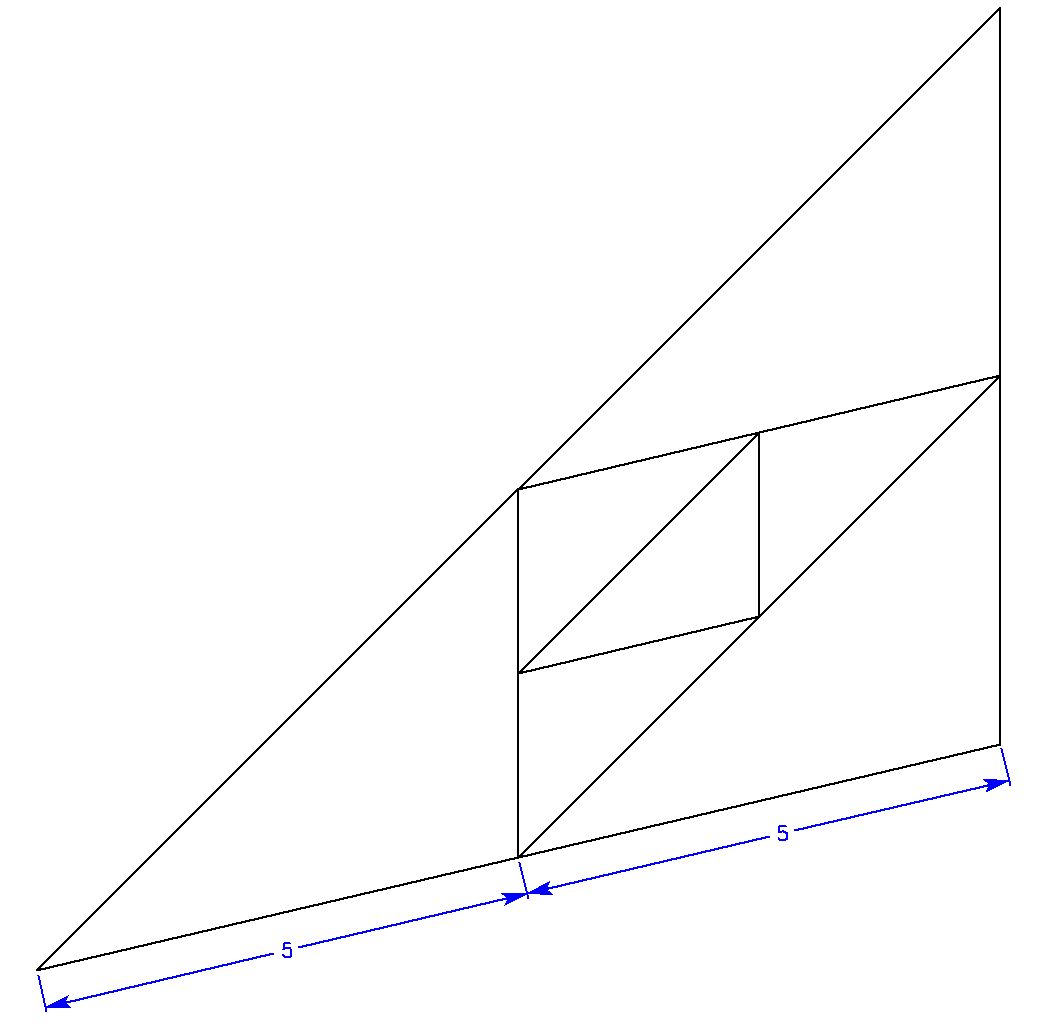
In case my verbal description was hard to follow, here is picture of a failed attempt at a solution, where the sides are divided in a 1:1 ratio. The linear dimensions of the smallest triangle here are much smaller than the desired 52% of the dimensions of the large triangle.


Re: Late Friday Puzzler -- inscribed triangles

#3

Re: Picture

Larry Barrett

I have made a few attempts; a 4:5 ratio seems to come pretty close to a 52% goal, but no real insight into how to get to the finish line. One thing I did discover is that you have to go in the correct direction in order to have the third triangle be similar to the first (starting position) triangle. For example, if the corners of the first triangle are labled A, B, C, and you establish the second triangle by moving from A -> B -> C, and corners of the second ate labled A1, B1, C1, then to establish the third triangle you need to proceed in the opposite direction (C1 -> B1 -> A1). This doesn't matter if the ratio is 1:1, so would not matter in the example, but does matter for other ratios.

Re: Late Friday Puzzler -- inscribed triangles

#4

Re: Picture

Alex Y

Correct on the reversing directions. The 1:1 ratio was chosen nefariously to hide that fact :)

I'm surprised that 4:5 came close. Might depend on the triangle chosen. But that is pretty close to cutting the sides in half, which results in a far smaller triangle, at least in the sample I drew..

Re: Late Friday Puzzler -- inscribed triangles

#5

Re: Picture

Larry Barrett

I should restate the ratio I am using. If yours is 1:1, mine is 4:1. If the length of one side of my original triangle is 5, then the length of the same side of second triangle is 4. Continuing around the triangle using the same ratio, and then creating the third triangle using the same ratio, the final result is close to 52%.

Re: Late Friday Puzzler -- inscribed triangles

#6

Re: Picture

Alex Y

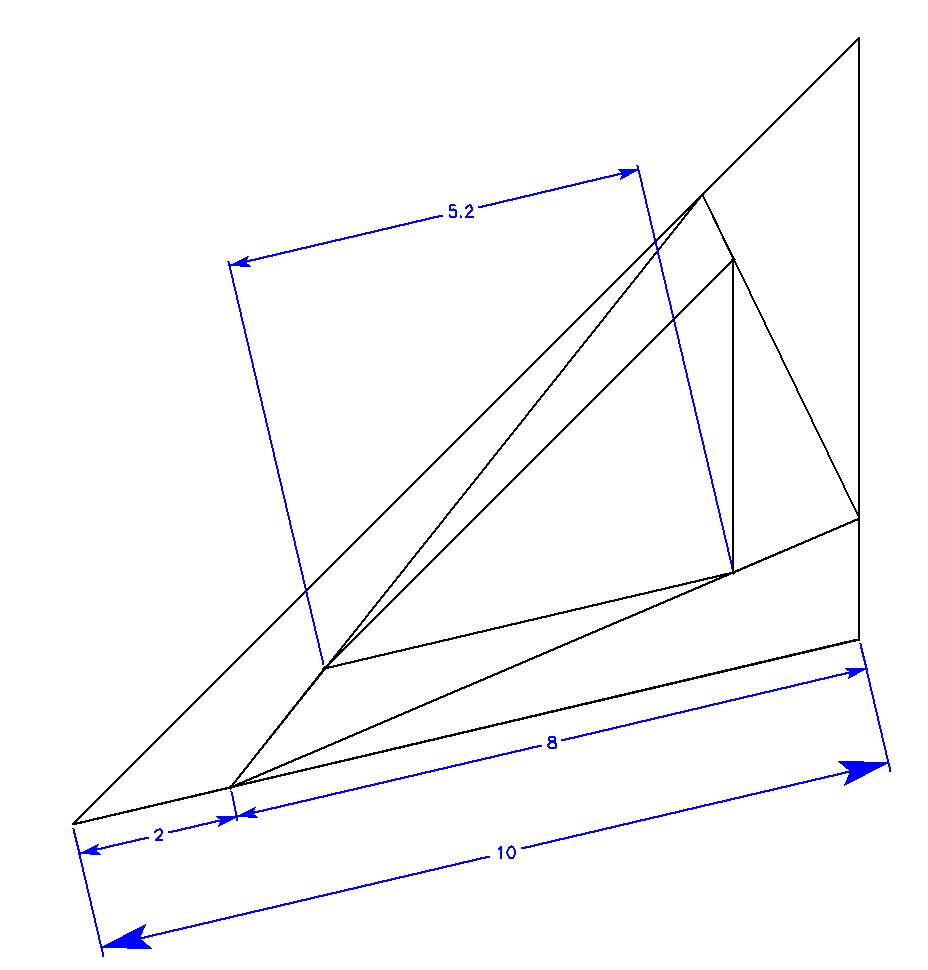
That's not quite the ratio I was referring to either. 4:1 would, for instance with the triangle I drew, divide the measured side into lengths of 2 and 8, and inscribe the second triangle from those points. The lengths of the sides of the second triangle will not be in 4:1 ratio to the first. Is that what you are doing?

Are you measuring on a drawn sample or using math to determine if you are at the 52%?

Re: Late Friday Puzzler -- inscribed triangles

#7

Re: Picture

Larry Barrett

I measured from A to B and marked a point .8 of that distance on line AB. Then I measured from B to C and marked a point .8 of that distance on line BC. Same from C to A. Then inscribed this triangle. Then repeated this, using same .8, but traveled in reverse direction. Then inscribed this triangle and observed it was similar to first triangle and had sides about .52 of original triangle. I was doing this with a drawn triangle and a ruler.

I now think I have a solution. A hero led to my answer, which curiously enough is a common rule of thumb.

Re: Late Friday Puzzler -- inscribed triangles

#8

Out with it, sir!

Alex Y

I now think I have a solution. A hero led to my answer, which curiously enough is a common rule of thumb.
I look forward to seeing it. Mine used analytic geometry and required too much algebraic manipulation.

Re: Late Friday Puzzler -- inscribed triangles

#9

Re: opps

Larry Barrett

I have to say oops. I confused the ratio used to create the two inner triangles with the ratio of the sides of these triangles to the original triangle.

But part of what I did is still correct and may be useful.

I used Hero's formula to compute the area of the original triangle and the second triangle and can relate the two areas because the side of the second triangle is .52 the side of the original triangle.

Hero's formula allows you to compute the area of a triangle knowing only the three sides and is given by

K (area) = sqrt(s(s-a)(s-b)(s-c)), where

s=1/2(a+b+c) and a, b, c are the length of the three sides.

So if K = area of original triangle, and K2 = area of the second triangle, K2 = K(.52)^2

Proceeding with my mistaken assumption, I ended up with the starting ratio to be 2.57:1 (and the length of side ratio to be .72 - hence the reference to the rule 72 used for compound interest calculations). Sorry for false alarm.

Re: Late Friday Puzzler -- inscribed triangles

#10

Hero

Alex Y

Hero's formula allows you to compute the area of a triangle knowing only the three sides and is given by

K (area) = sqrt(s(s-a)(s-b)(s-c)), where

s=1/2(a+b+c) and a, b, c are the length of the three sides.
They say you can't teach an old dog new tricks, but this is a new one to me. Thanks.

I ended up with the starting ratio to be 2.57:1 (and the length of side ratio to be .72
which is sqrt(.52), and would work if the intermediate triangle was similar to the original and final triangles.

Re: Late Friday Puzzler -- inscribed triangles

#11

Re: Hero

Larry Barrett

You are welcome; maybe you are not such an old dog after all. I can see how you could do this with analytic geometry, but I have not tried it. Since this works for all triangles, does it help to start with a nice one, like the right triangle in your picture, or an equilateral?

When I remembered that there was a formula for the area of a triangle knowing all three sides, it seemed like it would be the key to this puzzle. And the answer I got was close to what I found using a ruler. Too bad it was the key to the wrong lock.

Happy Thanksgiving!

Re: Late Friday Puzzler -- inscribed triangles

#12

Larry's Progress

Alex Y

Larry has correctly identified the fact that the division points are in opposite directions in the first and second inscribed triangle.

And he has found that for the triangle he drew, when he divided the sides in a 1:4 ratio, i.e. 20% of the original length on one side and 80% on the other side of the division point, the smallest triangle had sides that measured 52% of the original.

Here's an illustration showing both.


How can you tell if this is just a feature of the triangles Larry and I happened to pick for testing?

Re: Late Friday Puzzler -- inscribed triangles

#13

Solution outline

Alex Y

Larry got the right answer; the sides are divided in 1:4 ratio.

In solving it, we show something slightly stronger--that the small triangle is parallel to the larger one (meaning the corresponding sides are parallel).

Let the vertices of the outer triangle be A, B, and C. Each of these is an ordered (x,y) pair, but we can work at the ABC level.

Assume the sides are cut into pieces that are P and (1-P) times the original length.

The first inscribed triangle's vertices are

A' = A+P*(B-A)

etc.

The second inscribed triangle goes the opposite direction;

A'' = A'+P*(C'-A')

etc.

With a little algebraic manipulation (messy bits omitted here), you find that

A'' - B'' = (A-B)*(3*P^2 - 3*P + 1)

We want to solve for |A'' - B''| - .52 * |A - B|,

which means that (A'' - B'') - .52 * (A - B), since we have shown they are parallel.

This gives us 3*P^2 - 3*P +.48 =0

or 3*(P-.2)*(P-.8)=0

So P=.2 or .8, the ratio is 1:4, and the sides are parallel.

Re: Late Friday Puzzler -- inscribed triangles

#14

Re: Solution outline

Larry Barrett

Nice proof.

I think you meant to use = instead of - in these two lines:

We want to solve for |A'' - B''| = .52 * |A - B|,

which means that (A'' - B'') = .52 * (A - B), since we have shown they are parallel.

And showing that the two lines are parallel must be part of the messy bits that you omitted. I think that must involve showing that for A'' and A, and for B" and B the y component of the (x,y) pairs are equal.

Re: Late Friday Puzzler -- inscribed triangles

#15

Re: Solution outline

Alex Y

I think you meant to use = instead of - in these two lines:

We want to solve for |A'' - B''| = .52 * |A - B|,

which means that (A'' - B'') = .52 * (A - B), since we have shown they are parallel.
Yep. proofreading is not my strong point. ;)

And showing that the two lines are parallel must be part of the messy bits that you omitted. I think that must involve showing that for A'' and A, and for B" and B the y component of the (x,y) pairs are equal.
That's what I was thinking at first. But actually, any vector such as A-B multiplied by a scalar gives you a vector of different length in the same direction, so the corresponding line segments are parallel.

The way I originally did it was to prove that .2 worked. For that, I did the same math on the x components of the vertices, and found that the x component of the length of A''B'' is .52* the x component of the length of AB. Obviously the same math works for the y component,, so the distance is also .52 times.

👍 This page answered my questions

Your vote helps other woodworkers quickly find the answers and techniques that actually work in the shop.