Correct! *LINK*
Alex Y
Kudos to David on this tough one.
I'll suggest another way to see it:
If we are given only gender information, then there are two possiblities for the description of each child, so there are 2^2 = 4 family possible family compositions. If we are told that one of the children is a boy, we have eliminated the the G/G possibility, leaving a 1/3 chance that they are both boys, the answer that both Dan and Larry got.
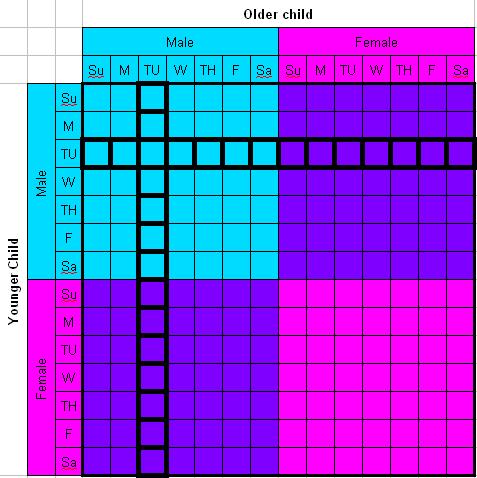
But we are given information about both gender and birth day of week. Using that information, each child could be one of 14 possibilities: BSu, BM, BTu, BW,... BSa, GSu, ... GSa, and the family could be be one of 14^2 possibilities. We are told that there is [at least] one boy born on Tuesday. That reduces the number of cases from 196 to 27: (BSu, BTu), (BM, BTu), ... (GSa, BTu), (BTu,BSu),... (not double-counting (BTu, BTu)). Of those 27 equally probable cases, 13 are families with two boys.
Graphically, the following picture shows both problems: The one where you are given only that one child is a boy lets you eliminate 1/4 of the cases (the pink square), while the Tuesday boy information lets you eliminate all but the bolded squares.
Here is a good write-up (from which I borrowed the graphical concept above) on the problem, including some other twists that I found of interest.
Some Thoughts on Tuesday's Child