Solution (Don't read this, Dan)
Alex Y
Bill gets a double prize, for speed of answering, and for hiding the answer so cleverly that others did not see it!
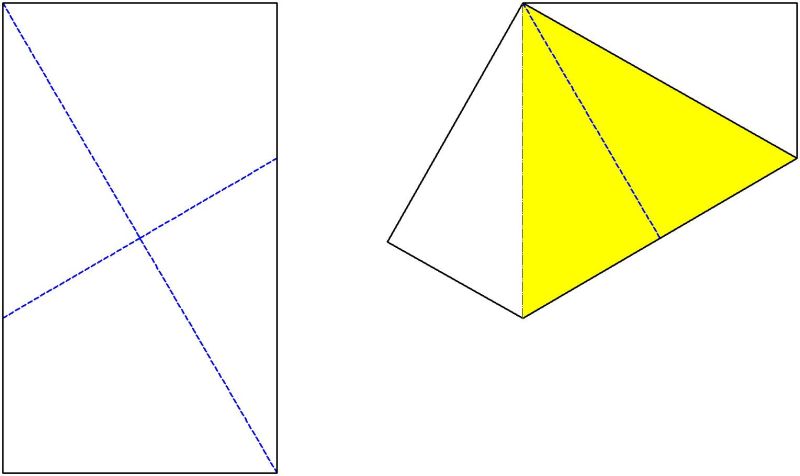
As Bill said, the key was properties of triangles. Shown below are the rectangle and pentagon. The yellow triangle is where the pentagon is two sheets thick. Since the pentagon has an area 2/3 of the rectangle, this yellow triangle must have an area of 1/3 of the total.
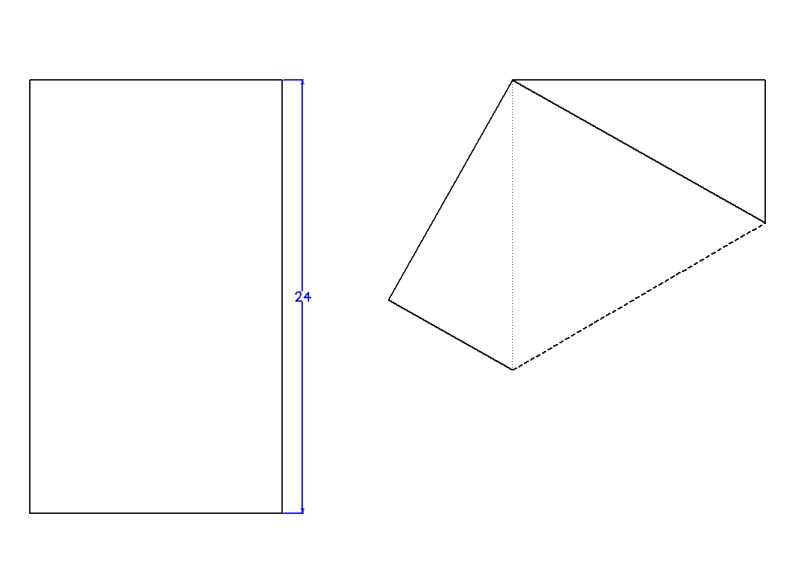
You should be able to convince yourself by symmetry that the two small triangles are identical (with reflection) and that the yellow triangle is isosceles (In fact, it is equilateral, but we don't know that yet.) The blue dotted line divides the yellow triangle into two right triangles, each of which have an area of 1/6 (of the rectangle) and the two small outer triangles also have an area of 1/6, Since these right triangles have the same area and share a hypotenuse, they have legs of the same length. Call the width of the rectangle "w" and the other leg of the triangles x. Then we have the area of six of these little triangles equal to the area of the rectangle. I.e., 24w = 6* (xw/2), which gives us x = 8.
So we know that the bottom of the yellow triangle is 16. Two of the other sides of the pentagon are of length 8. The other two are the width of the rectangle, and since this fold line is on an angle other than 90 degrees to the side, it is longer than w. So 16 is the length of the longest side of the pentagon.
QED