WoodCentral Forums

Est. 1998 — 27 years of woodworking knowledge

Friday Puzzle -- square cards

Posts

Friday Puzzle -- square cards

#1

Friday Puzzle -- square cards

Alex Y

You are given eight white and eight black cards. Each card has a number. There is a one on four white cards (W1 - 4). Using that same notation, the cards are:

W1 - 4

B1 - 6

W2 - 2

B2 - 2

W3 - 1

W4 - 1

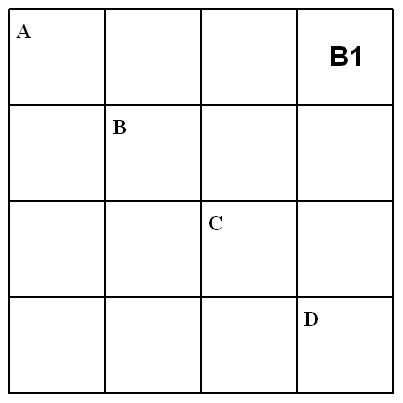
You are given a 4x4 grid, pictured below, and must put all sixteen cards on the grid such that a B1 card goes in the upper right corner, and for each square, the number on the card indicates the number of black cards in neighboring squares, looking horizontally and vertically, but not diagonally.

What cards go on Squares marked A, B, C, and D on this grid?


Re: Friday Puzzle -- square cards

#2

If I figure it out, do I get to scream, "Bingo!"?


Re: Friday Puzzle -- square cards

#3

Definitely, and post the celebration on YouTube 


Re: Friday Puzzle -- square cards

#4

Hint

Alex Y

In the original source of this puzzle, it was titled "So Logical".

The answer can be logically deduced, with no trial and error. But to do so required me to make one assumption not explicitly stated in the puzzle: the answer is unique. (Note that the answer is only what goes in the labeled spaces.)

As an add-on, once someone gets this, can you confirm or deny that the answer is unique, and is it possible to derive the answer without that assumption?

Re: Friday Puzzle -- square cards

#5

Hint 2

Alex Y

The two possible positions for a black card neighboring the one card given as a starting place suggests a symmetry in the solutions to the entire grid, and combined with the assumption that the solution for ABCD is unique, that symmetry tells you something about those values.

Re: Friday Puzzle -- square cards

#6

Final hints

Alex Y

Place the W4 first, and as you start to see what is forced, keep a count of the total number of black cards used.

Re: Friday Puzzle -- square cards

#7

Re: Final hints

Larry Barrett

No solution yet, but working on it. First, for reference, label the rows J, K, L, M and the cells in the J row J1, J2, J3, J4, etc. So the B1 card is in cell J4.

Some observations:

1.There must be a B card in either cell J3 or K4 (say J3), and a W card in the other cell (K4). Obviously could be reversed.

2.If the B card in cell J3 is a B1, then there must be a W card in cell J2 and in cell K3.

3.When a B2 card is entered, indicating 2 adjacent B cards, one of the adjacent cards must be in a horizontal cell and the other in a vertical cell. They cannot all be in a row or column because this would mean they would be B3 cards. So if the B card in cell J3 is a B2, then there must be a B card in cell K3 and a W card in cell J2.

3.Therefore the card in cell J2 is W.

3.Thus, the only cards that can be in cell J1 are a B1 or W1 or W2. A B2 in cell J1 would require a B card in cell J2 (and K1); a W3 in cell J1 would require a B card in cells K1, L1, M1 which would mean they would have to be B3 cards (not allowed); a W4 in cell J1 is not possible as long as there is a W card in cell J2.

That is it so far, even with the aid of your hints. With so many hints you would think it should be obvious, but not to me so far.

Re: Friday Puzzle -- square cards

#8

Re: Final hints

Alex Y

See comments on your solution to date:

No solution yet, but working on it. First, for reference, label the rows J, K, L, M and the cells in the J row J1, J2, J3, J4, etc. So the B1 card is in cell J4.

Some observations:

1.There must be a B card in either cell J3 or K4 (say J3), and a W card in the other cell (K4). Obviously could be reversed.


Yes, and that defines the symmetry of the solutions

3.When a B2 card is entered, indicating 2 adjacent B cards, one of the adjacent cards must be in a horizontal cell and the other in a vertical cell. They cannot all be in a row or column because this would mean they would be B3 cards.


That is a true statement about the B2 cards, but I'm concerned about the reasoning. Remember that "neighbors" do NOT include diagonals. So I don't see why having three black cards in a row means they would have to be B3 cards. I.e., a row could be W1-B1-B2-B1 if the ones above and below were white.

4.Therefore the card in cell J2 is W.


True, even if I don't follow the reasoning :).

W3 in cell J1 would require a B card in cells K1, L1, M1 which would mean they would have to be B3 cards (not allowed); a W4 in cell J1 is not possible as long as there is a W card in cell J2.


No, I think you have a different picture of "immediate neighbor" from what I intended. J1 has only two immediate neighbors -- J2 and K1. No other square touches J1 from a horizontal or vertical direction.

That is it so far, even with the aid of your hints. With so many hints you would think it should be obvious, but not to me so far.


Go back and see if the hints help more with this explanation of what was intended by "neighbor".

I'll probably post a solution this weekend, but will clearly label it in case you want to keep working on it. (I have one of Dan's written on paper that is now starting to yellow with age as I try to solve it!)
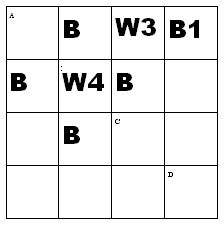
Re: Friday Puzzle -- square cards

#9

FINAL final hint 

Alex Y

One more hint from my proof of where W4 cannot be (which I originally based on an assumption of a unique answer).

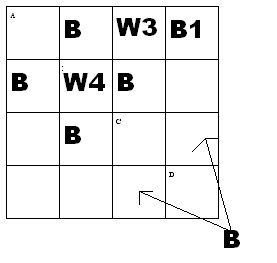
Using Larry's notation of row headings J,K,L, and M; and column headings 1-4, assume that the W4 card is on space K2. Then its four neighbors are all black. Filling those in shows us the place we need the W3 card, and our board looks like this:


Now, consider the cell M4. It has a number >0, so L4 or M3 (or both) must be black. Thus, L3 must be W3 (or W4), but we have already used both of those cards.


Therefore, the W4 card does not go on K2.

And a mirror image of that argument shows it doesn't go on L3.

Re: Friday Puzzle -- square cards

#10

My answer

Larry Barrett

With your explanation of what "neighbor" means (and it should have been obvious that it meant immediate neighbors in row or column, not continuing adjacent cells of same color in row or column), my answer is

cell A (or J1) is W1

cell B (or K2) is B1

cell C (or L3) is B1

cell D (or M4) is W1

I believe the W4 card can only go in one place, regardless of where you put the first B card. I looked at your Final final hint after getting my solution and agree with that hint.

Re: Friday Puzzle -- square cards

#11


Re: Friday Puzzle -- square cards

#12

Solution

Alex Y

Congrats to Larry for finding the answer. Here is a step-by step solution for any that are curious.

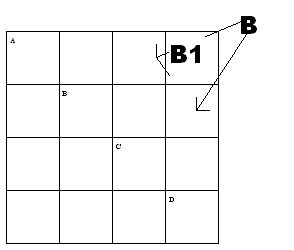
I'll use Larry's notation of Rows J-M and columns 1-4. The B1 on square M4 gives us two possible locations for another B:


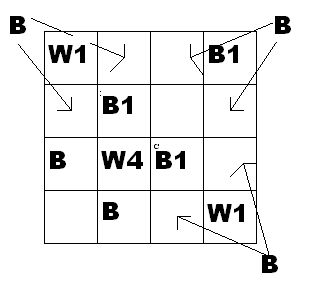
It is clear that any solution to the entire grid that has a black card on J3 has a mirror image solution with a black card on K4, and those mirror images are reflections in the diagonal from M4 to J1. That means that if the solution is unique, A=D and B=C. But I only used that in the next step, and justified that step in the "FINAL final hint" post, so if you are not comfortable with this stage of the argument, check that post.

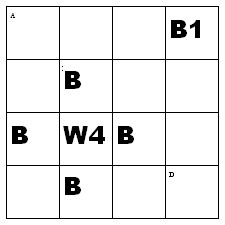
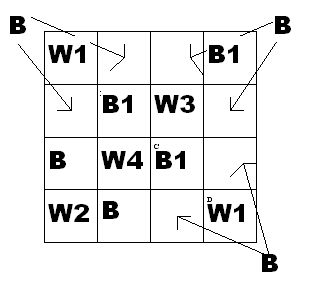
Now, look at the possible location of W4. It has to be on one of the interior squares in order to have four neighbors of any color. K3 is a neighbor to each of the neighbors of J4, one of which is white. And if the solution is unique, W4 couldn't be on B or C. So it must be on L2. Putting in it and its four black card neighbors gives us:


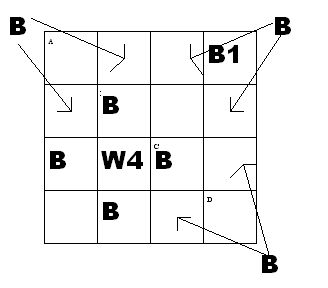
There are now five black cards placed (although we don't know which are ones and twos). Now consider that each of the corners has a number at least as great as 1. forcing one black card to be a neighbor of J! and one as a neighbor of M4, as well as the one we know is a neighbor of J4 uses up all of the black cards:


Now we know that A and D are white, and have one black card neighbor, and that B and D also have one black card neighbor, solving the puzzle:


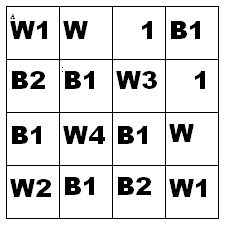
Going on to solve the rest of the grid, we can fill in the W3 at K3 and a W2 at M1


Finally, since L1 and M2 both need a black card on a neighboring squre, we can fill thsoe in, along with the rest of the grid, leaving blanks that are easily filled out depending on your choice of where to put the black card neighboring J4:


👍 This page answered my questions

Your vote helps other woodworkers quickly find the answers and techniques that actually work in the shop.