Guest can't vote.
Knowledge You Can Build On — Est. 1998

Guest can't vote.
I think the answer is that he has only one green hat.
Added later 4 d 18 h 03 min 26 s:
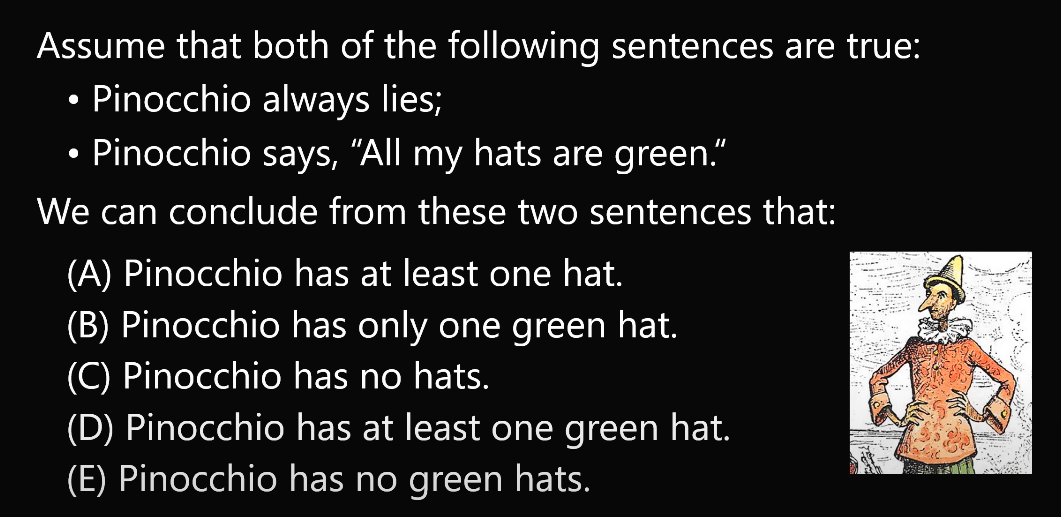
My reasoning is that since Pinocchio always lies, the statement "All my hats are green" must be false. Let's analyze what this means:
The statement "All my hats are green" being false implies that it is not true that every hat Pinocchio has is green. This means there is at least one hat that is not green, or Pinocchio has no hats at all.
Now, let's evaluate each option:
A) Pinocchio has at least one hat. This would be true if there is a hat that is not green, but we can't conclude this definitively without additional information. It's possible that Pinocchio has no hats at all.
B) Pinocchio has only one green hat. This cannot be concluded because the statement could be false even if Pinocchio has multiple non-green hats or no hats at all.
C) Pinocchio has no hats. If Pinocchio has no hats, then the statement "All my hats are green" is indeed false. This is a possible conclusion.
D) Pinocchio has at least one green hat. This cannot be concluded because the falsity of "All my hats are green" does not guarantee the existence of a green hat.
E) Pinocchio has no green hats. If Pinocchio has no green hats, then the statement "All my hats are green" is false. This is a possible conclusion. Since statements C and E both satisfy the condition of making the original statement false, but statement E is more specific than statement C, the best conclusion we can draw is:
E) Pinocchio has no green hats. And my head hurts. 


