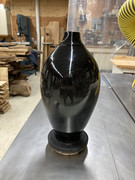
Last Piece
Posts
Re: Last Piece
#2
@Mark Mandell,Hi Mark..what do you mean 'the wood wouldn't take a glass lacquer finish?' Your rub out looks great, but I'm curious as to what happened with the lacquer.
Re: Last Piece
#3Hi Barb,
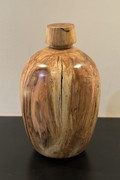
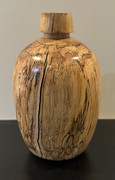
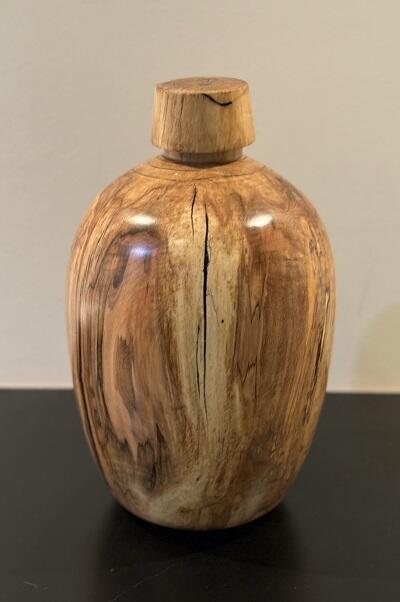
The tree was "full" of wind shake on top of fungi and spalting. While weak grain can be filled with lacquer /shellac, the fissures would not take the liquid. I even tried epoxy. I'm not a big fan of super high gloss finishes , so decided to make do with the rub-out and wax. A deep gloss lacquer finish would have lit up the colorations in the piece, but was beginning to look like plastic. Thus the rub-out and wax (my default turning finish) ruled the day.
I have done wet-look finishes like this
but they just take too long to do properly.
Re: Last Piece
#4
I see. Your wet-look is amazing, but I can see either way, it takes a surface free of defects.
Re: Last Piece
#5
Mark Mandell wrote:
Mark, I must say I am enameled…uhh..enamored by this finish!
Seriously though, that is quite impressive. I like high-gloss finishes on some things from the aspect of showing absolute flawlessness, but for most things wood, I like the sheen toned down for the simple fact that lower sheens break up reflections and glare, allowing beautiful grain patterns to be seen, and inviting touch. Your red maple form fits this bill nicely.
Thanks for sharing!
Jason
Re: Last Piece
Edited #6Thanks, Jason.
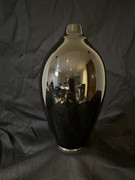
The black lacquer was a "challenge" project, first for the turning, then the finishing. While lacquer is regarded as fast drying, it takes time to release all the solvent and shrink to a final film. Thus to fill all the pores and defects, each coat had to sit for 24 hours before sanding back. Whole process was done on the lathe with the piece fixed with a waste block.
This is a pic of it about half way through the finishing so you can see the rough surface.
While I wasn't keeping score on coats, I used 2 rattle cans of lacquer, most of which was sanded off.