The brief is to build an 8-seater dining table to replace our existing 6-seater. We will retain the 6 vintage bentwood chairs, and I recently completed 2 (DC 09) chairs for use as carvers. Our taste in furniture runs towards the minimalistic, the clean lines of mid century designs from the 1930s, gentle curves. What is needed in a design is a way to link and blend the chairs with the table. In part this will be aided by the wood used for the table top: both the carvers and the top are Rock Maple. Another element will be the presence of the curves in the chairs, which will extend to the table. 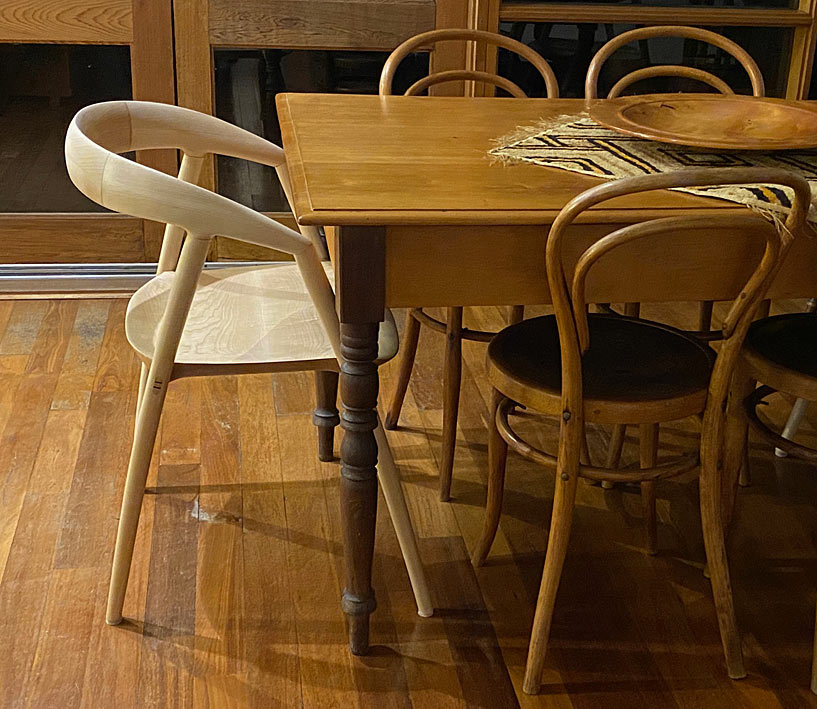
The old table was 200 years old and came with us from from South Africa when we moved to Sydney 40 years ago. The top was Yellow Wood (which resembles an aged Maple), and the legs were Stinkwood (a dark wood). The latter will be represented by Jarrah.
Another need for the new table is that is must be knock-down. We plan to move home in about 18 months, downsizing when I retire. The new home is similar in size, but with less garden to manage. Being knock-down cannot impose on the design, and cannot impact on the rigidity of the construction. Today I will show you what I came up with.
The old table was 1350mm (53") long, 850mm (33 1/5") wide and 775mm (30 1/2") high.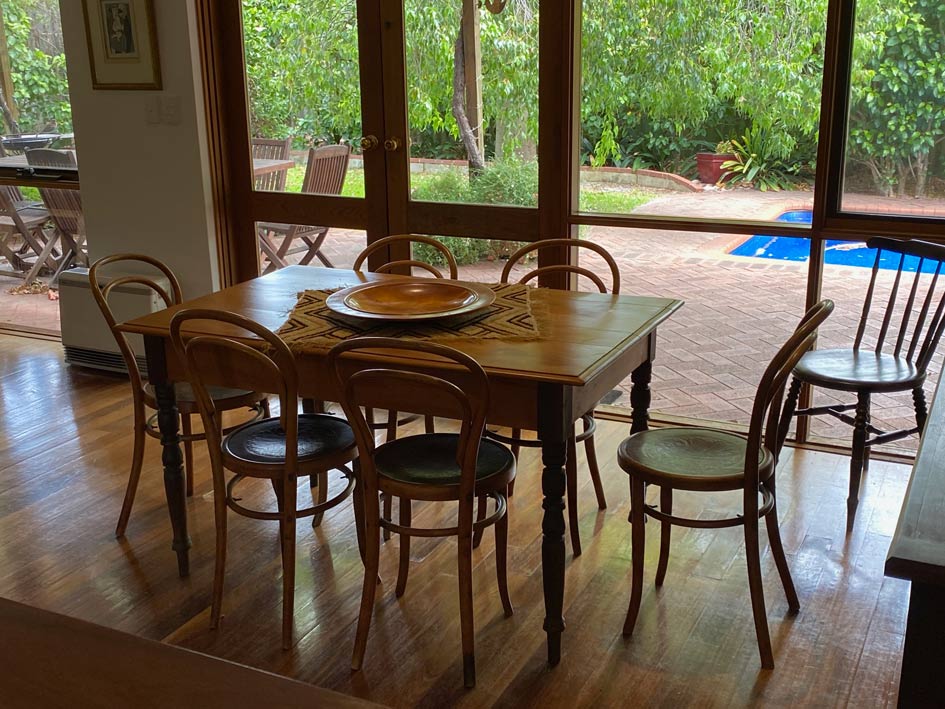
The new table will be 1780mm (70") long, 1020mm wide (40"), and 760mm (30") high.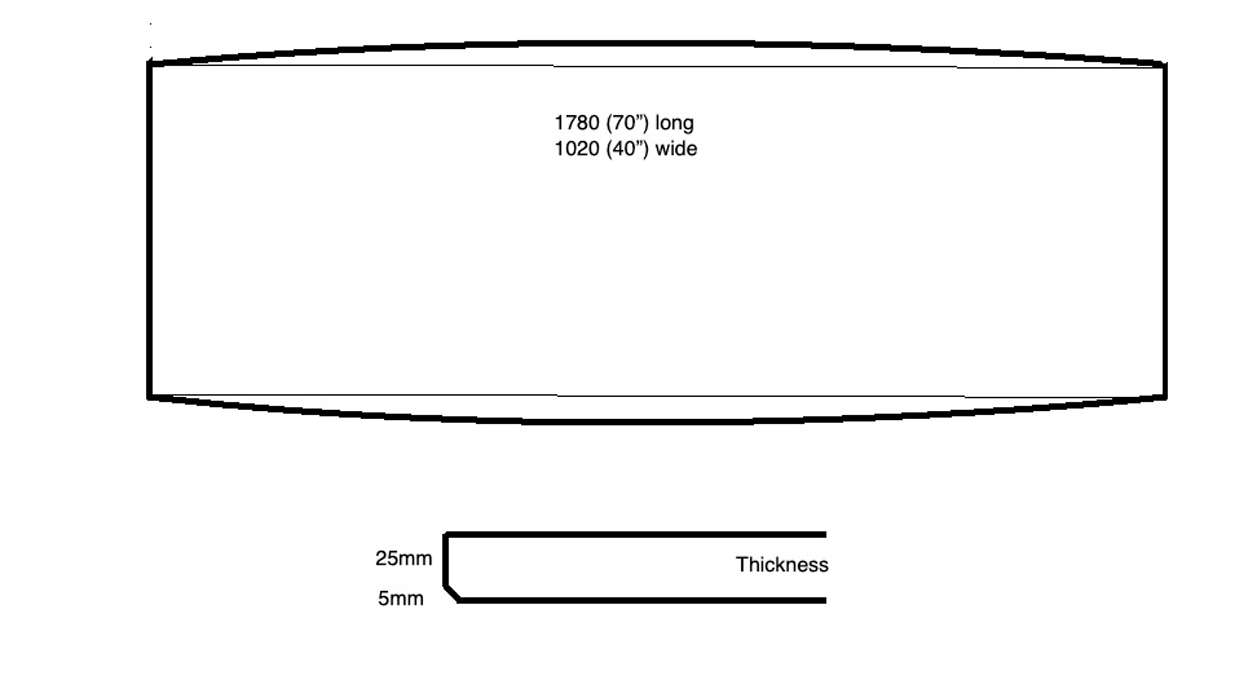 I found a photo of a table with similar proportions. This table has rectangular legs, but its silhouette creates the illusion that the legs are round, which will be the case in this build.
 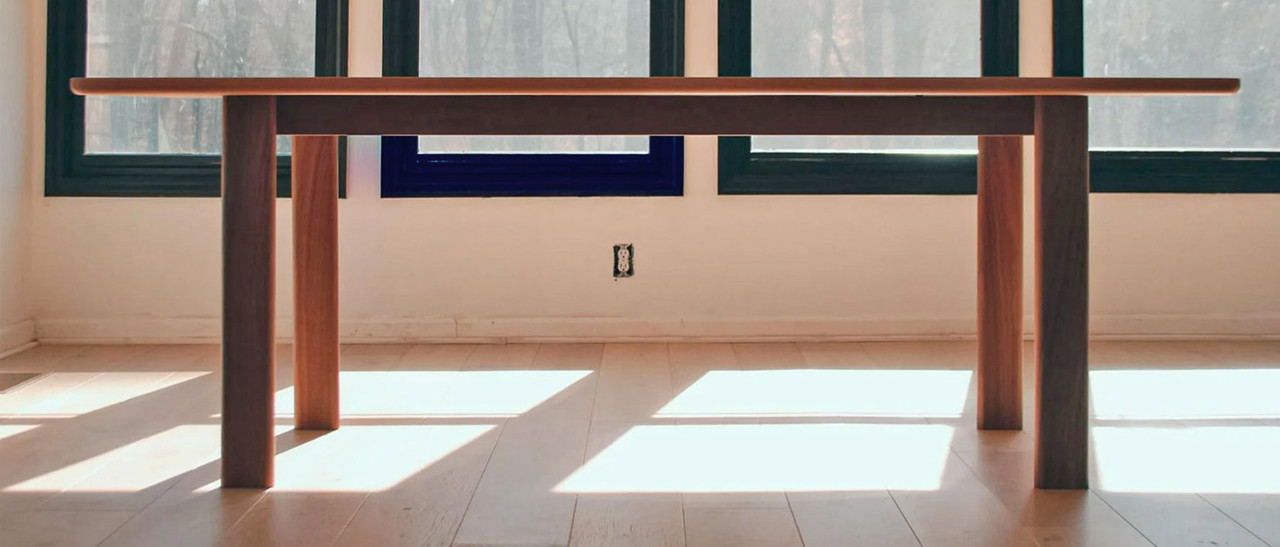 When I began test-building the leg-rail build, the legs were to have a 75mm (3") diameter with a rail of similar width. The legs ended up too chunky, and were subsequently reduced to 60mm (2 3/8") diameter. I am considering reducing the rails to 60mm as well (they are 75mm in the photos), but am concerned about a drop in rigidity. Having stated this, the rails are 30mm wide, Jarrah, and this is quite substantial.
So to the construction ...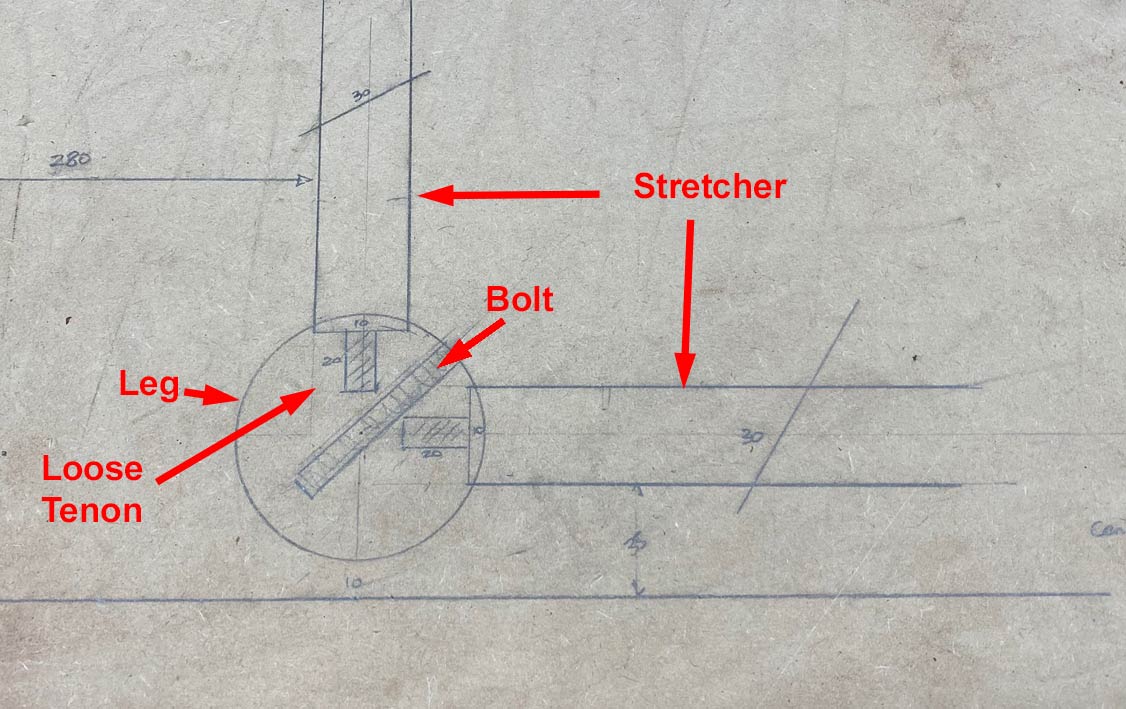 The rails (or stretcher) are connected to the legs with loose tenons. The tenons are glued to the end of the rails, but left unglued when connected to the legs.
To facilitate the knock-down, a steel mechanical connector is being used ... 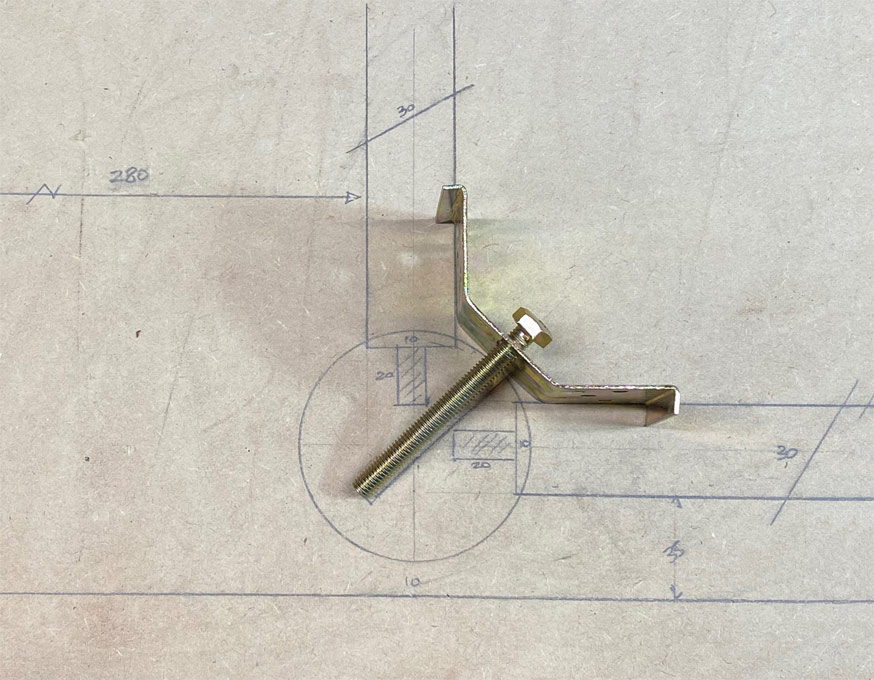
This requires the leg being tapped for a bolt, with the connector also screwed to the rails.
What follows is testing this out (some of the photos here have 75mm wide legs).
The 10mm x 55mm mortises in the legs were made with a router, and those in the rails made with a Domino. 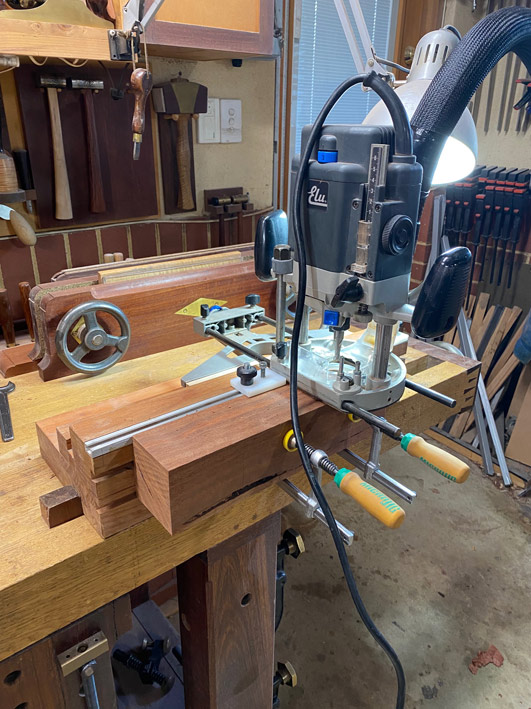
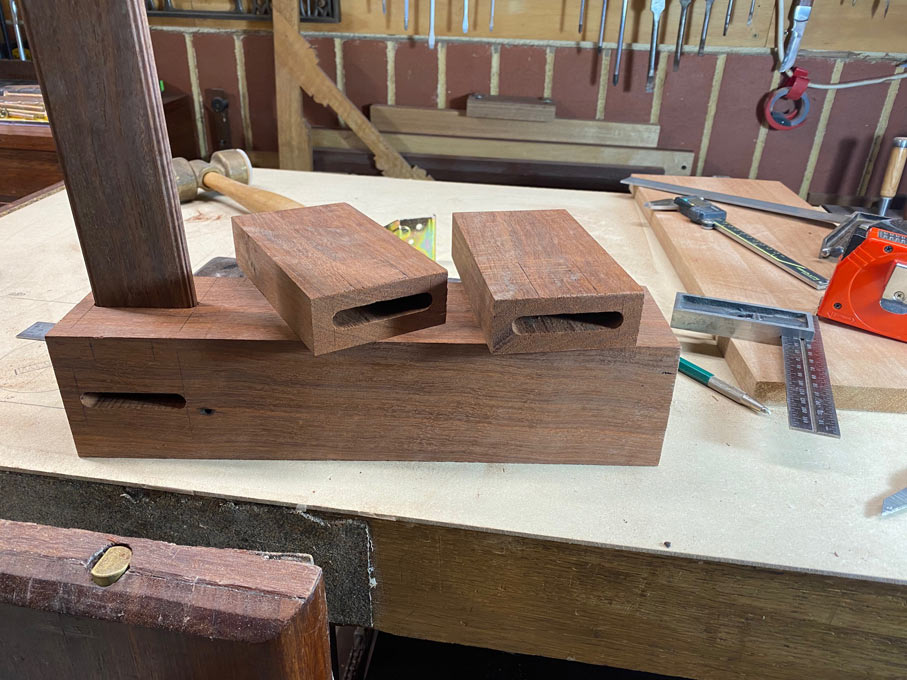
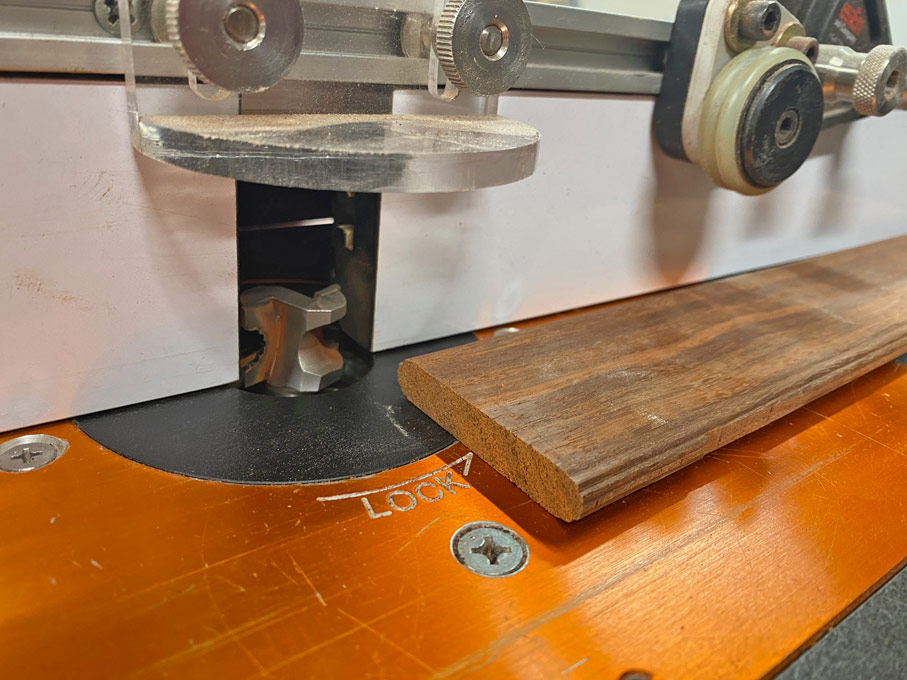
The loose tenons were shaped on the router table using the new Woodpecker router bits ...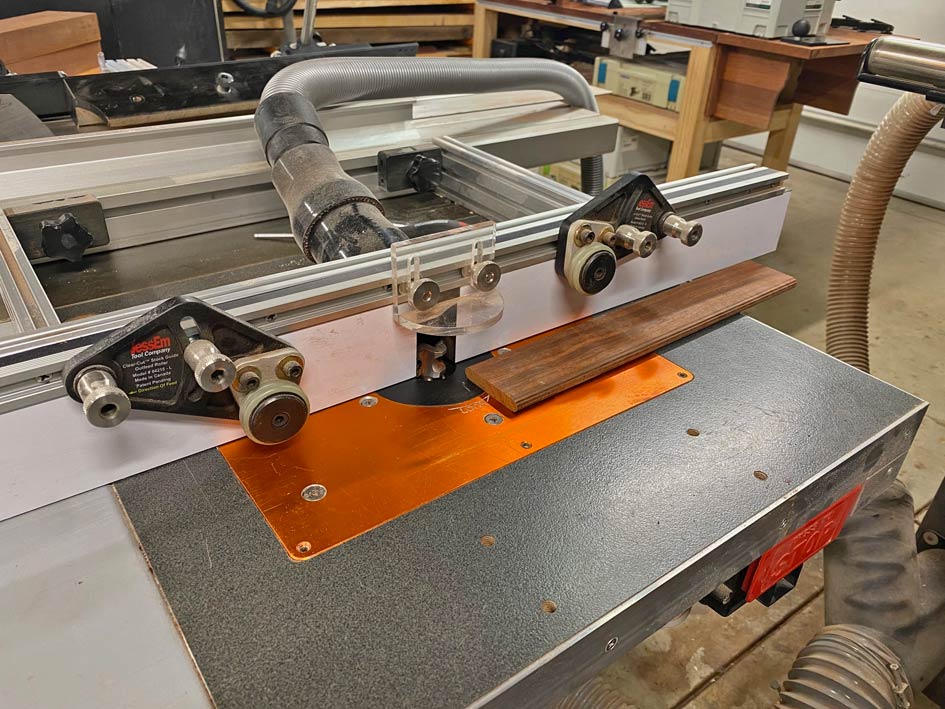
The legs were also mortised for the rails, themselves, to mate the two flush. Here I have gone down to a depth of 5mm. 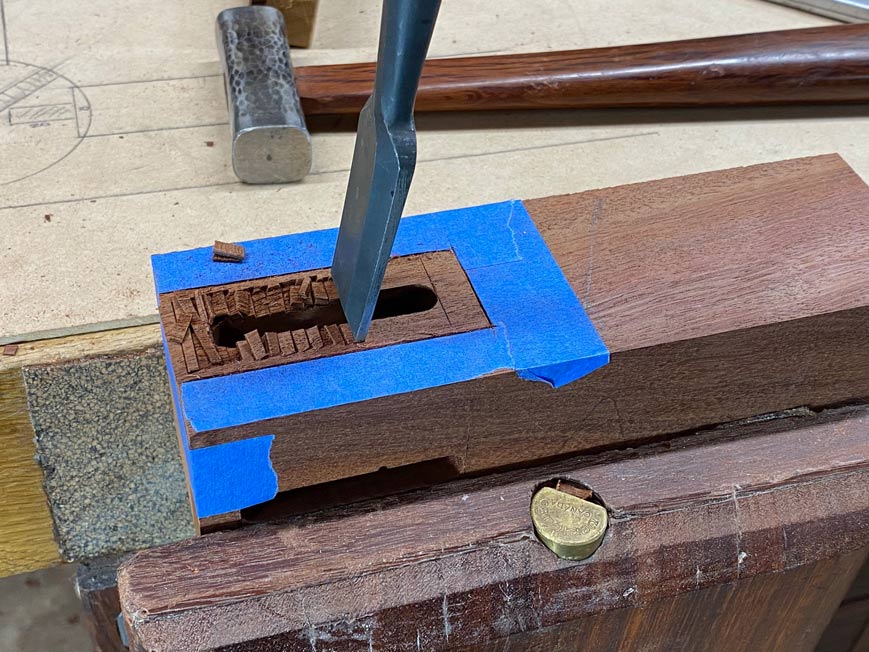
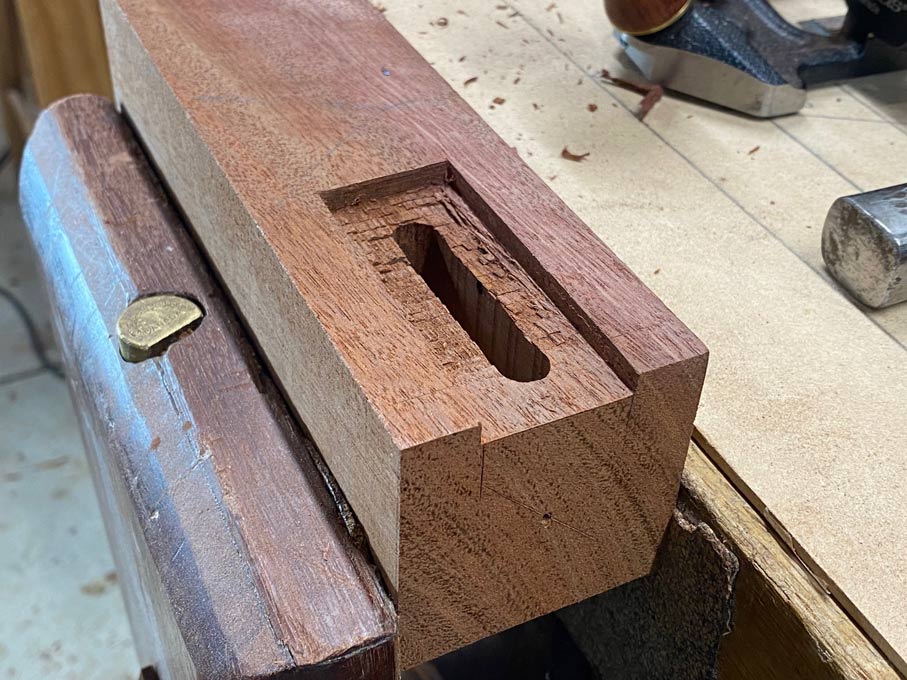
This looks fine here ...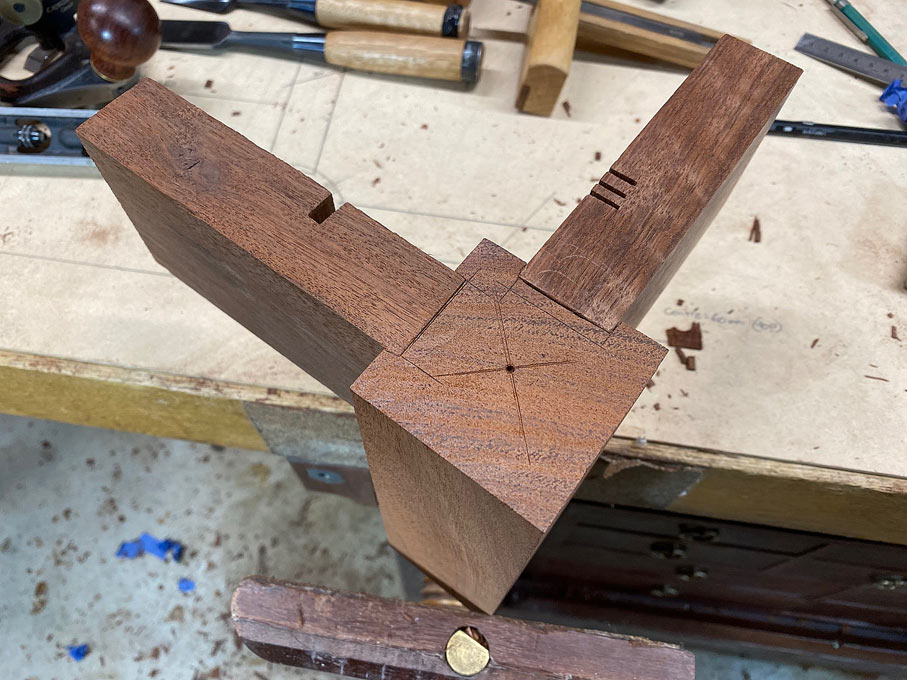
... but in future I shall mortise to a depth of 7mm. Once the leg is turned, there is minimal beauty depth ...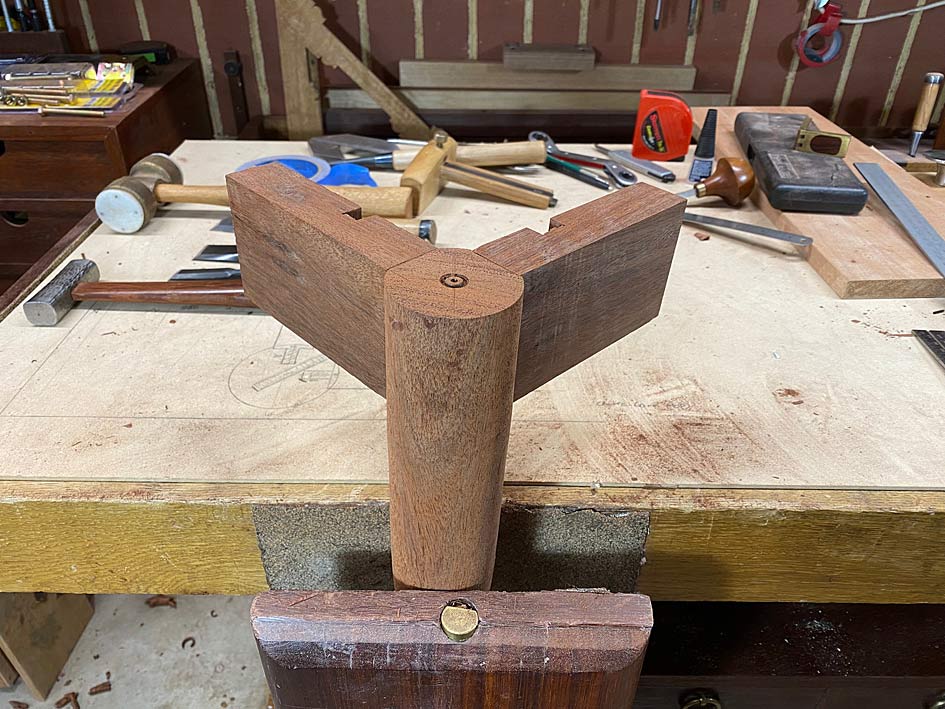
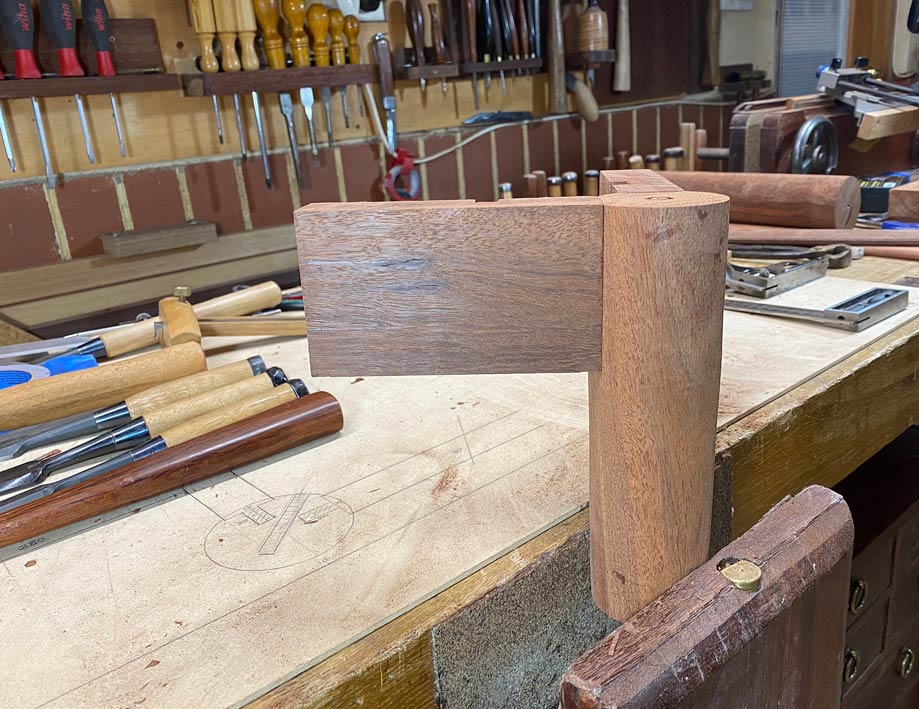
With the connector (ignore the chewed look - this was the result of trial-and-error) ...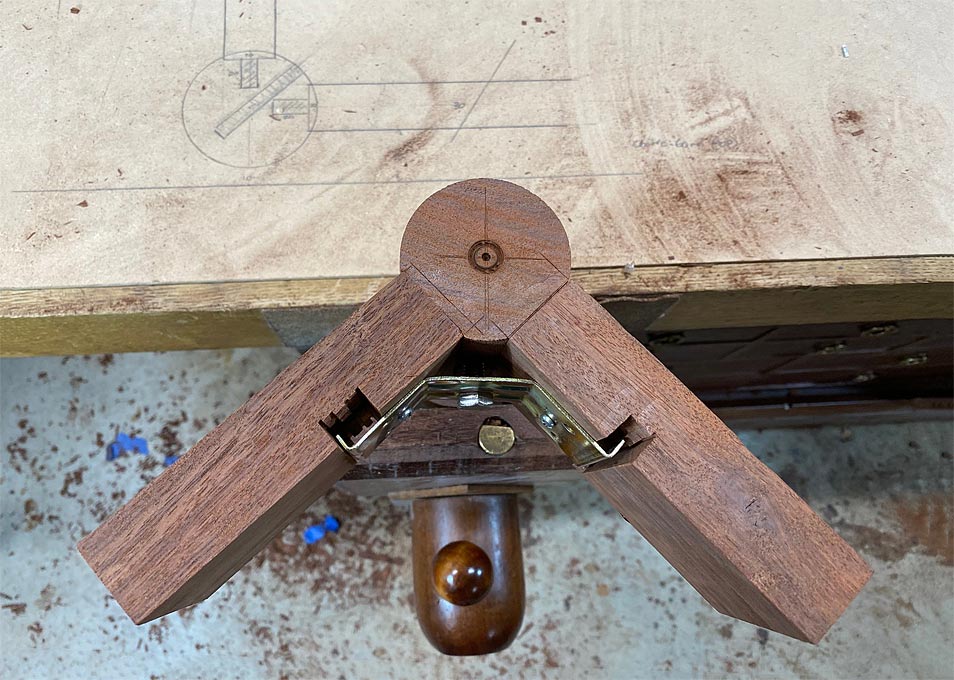
And here is the completed piece to judge the aesthetics of the sizing ...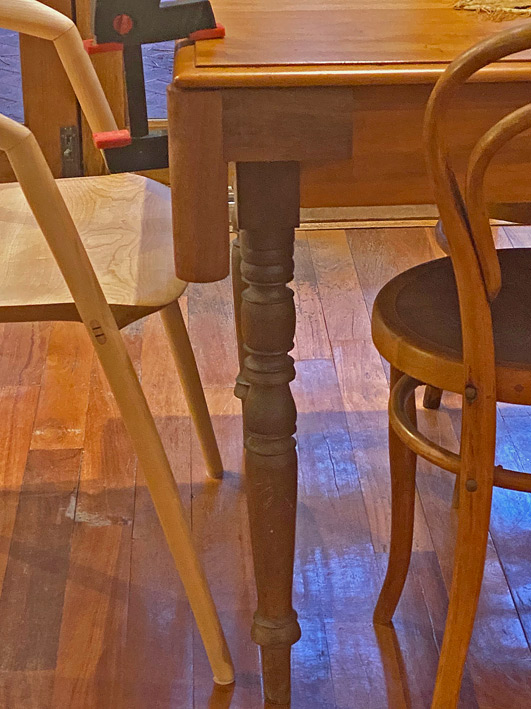
Thoughts?
Regards from Perth
Derek
Dining Table
Posts
Re: Dining Table
#2My own preference is to have a deeper apron because I like it to look stronger, but your sample in place does look quite nice. The the leg diameter is good. What if you curved the profile of the aprons a bit, so the ends were deeper than the center? That would increase the joint rigidity while keeping most of the thin look, and provide another subtle organic curve to suggest those of the chairs?
Re: Dining Table
#3Thanks for the feedback, Alan.
The aprons, per se, are not an issue as they will be connected to the table top, and together this creates a rigid construction.
My concern is to avoid any twist in the legs, which is complicated by the desire to have a knock-down construction for travel. I did consider other methods, such as joining the front rail/apron to the legs with a glued and pinned mortice and tenon (so the front and rear would be rigid units). Then just the side rails/aprons needed to be attached. My though was to do this with a sliding dovetail, which could be knocked out when the table was to be moved. Corner bracing would add the needed rigidity. It could be glued and permanent when the move is done.
Another was to forgo the knockdown design, and just go pinned mortice-and-tenon, with deeper tenons. Note that the tenons are 55mm x 10mm, and if 30mm into 60mm legs, this would be substantial.
Some have queried why I do not add a taper, splay or curve to the legs. There is a reason for the straight "cylinders". This is deliberate as it is the "quietest" design among chairs which are curvy, and near other furniture with curves. More curves will simply overwhelm. My aim is to find a balance, and that this will also allow the chairs to be featured.
I cannot start any actual build for a couple of weeks as I shall be away. The aim of posting now was to create some discussion about design and construction. I find this helpful.
Regards from Perth
Derek
Re: Dining Table
#4Your desired table reminds me of the one, dimensions too, at a Thanksgiving dinner we spent with friends. Having some personal goal the hostess, a dear old rugby player-type, pushed table from one end into her ex. at the other. Table, turkey, plates, and 15-month monster granddaughter folded on the apron hinge yours copies. It would have landed on the floor but for several knees and Ex's belly supporting it all. After some pleasant words Hostess then went to the head and "hinged" the top back to "level".
I mention this, not that I am fond of over design, but have respect for the true test of constructions. Of course, YMMV; the urchin probably won't be present.
Re: Dining Table
#5HB, that is a sobering thought! Mmmm.
Regrds from Perth
Derek
Re: Dining Table
#6Hi Derek,
2 ?s
A - Why not threaded inserts rather than tapping the legs? Should be stronger with heavier threads in the wood.
B - If you're screwing the corner irons to the stretchers, why those big dadoes with the end-hooks sort of hanging in the air?
Re: Dining Table
#7Thanks all for the effort to which you have gone with critical thinking and build suggestions. Comments here, and elsewhere, have helped identify some of the risk issues, such as whether the leg joinery will hold up over time.
As much as I am designing for myself and not others, and have spent time thinking about the aesthetic I want, eventually I come to a few conclusions ... aided by my wife threatening me with divorce, burning my record collection, and selling my tools while I am hospitalised for my neurosis.
Decision #1: why the heck am I building a knock-down table when it will go though a doorway on edge? Full on mortise-and-tenon joinery, and no connectors, is also sooo much easier to build! And no worries about joinery strength. I think that I will stick with loose tenon joinery here as it allows one to orientate the grain in the tenons (avoiding run out). I am comfortable building integrated tenons, which would be stronger if the grain is straight.
Decision #2: She hates the straight legs. The first clue I should have picked up was the reduction in diameter. Okay, I am a slow learner. She wants a taper. So be it ... but I not her way (she is not a designer). The legs will be round, and receive a taper (probably from 65mm down to 35 or 40mm), and be splayed (probably at about 2-3 degrees). I need to draw this up and see what it looks like.
Decision #3: The table top remains the same. The legs will need to be brought in-board a little (to account for the splay), which will alter the size of the apron/subframe. I wish I had CAD to work this out. For me it is drawing to scale on an MDF panel. The top is attached to the aprons with buttons, allowing for side movement but keeping the top flat.
We are away for the weekend, so there is time to consider and re-consider. This build is not a sprint. Tables are really straight forward, except when they aren't.
Thoughts?
Regards from Perth
Derek
Re: Dining Table
#8First, you rely too much on the fantasy of CAD. You just want longer triangles and T-squares; looks like you already use the workbench and MDF sheets. CAD simply buries you in the nightmare of detail, electronics, and a proper printer for the next 6 months. Forget about CAD.
I think you have two issues going on that I will try to tip-toe around.....
Everyone is fond of the old table but its style incompatibility (the aprons) with the new chairs will cause a train wreck. This calls for a change in design think: how about longitudinal central spine and batten-type ribs? Is that called fiddling with a trestle?
The spine is a box frame of two 5/4 x 5 - 6 inch trestles framed into two perpendicular leg frames. Make the depth of the leg frame (2) as deep as you can, as long as it is at least 5 inches. Measure the clearance of railings to the table above . . . where you can still sit at the table to assess the status. Unless a Rugby guest takes a flying dive, there will be no hinged legs to be supported on everyone's knees.
The battens and two aprons need to be dove-tailed into the top. Make absolutely certain that there is a full triangular blocked frame for the leg-to-"apron"-to-table connection. That's why you need the full depth of those members. .... And, throw away those metal clippy things; they are hinges.
You are good at these details. I tend to butter a six-inch gnat--on the monitor, I do CAD--when doing details so will let you go.
Bruce
Re: Dining Table
#9Derek, a Google search on Thonet dining chairs and tables yields a wealth of ideas on tables used with your chairs. Aesthetics is a personal thing, but to my eye, an overly minimalistic table is incongruous with your chairs. A pedestal style table would remove the legs from "front and center" view and not detract from the chairs, or adding a bent wood element at the leg to apron connections would tie the table design to the chair design (and also strengthen that joint). Of course, my opinion is worth exactly what you paid for it.
Re: Dining Table
#10Bruce and Pat
At this stage I have an idea how to develop the table design, but will communicate this in more detail once I have some scale drawings completed.
There are two elements that the table will carry to link all together. First, there is the table top, which will also be Rock Maple, as with the (DC 09) chairs sited at each end. Secondly, the table legs will need to match the angle and curve of these chairs as well. I am referring here to the curve of the back legs, and not its slimness. Matching the curve will reduce the mix of angles ...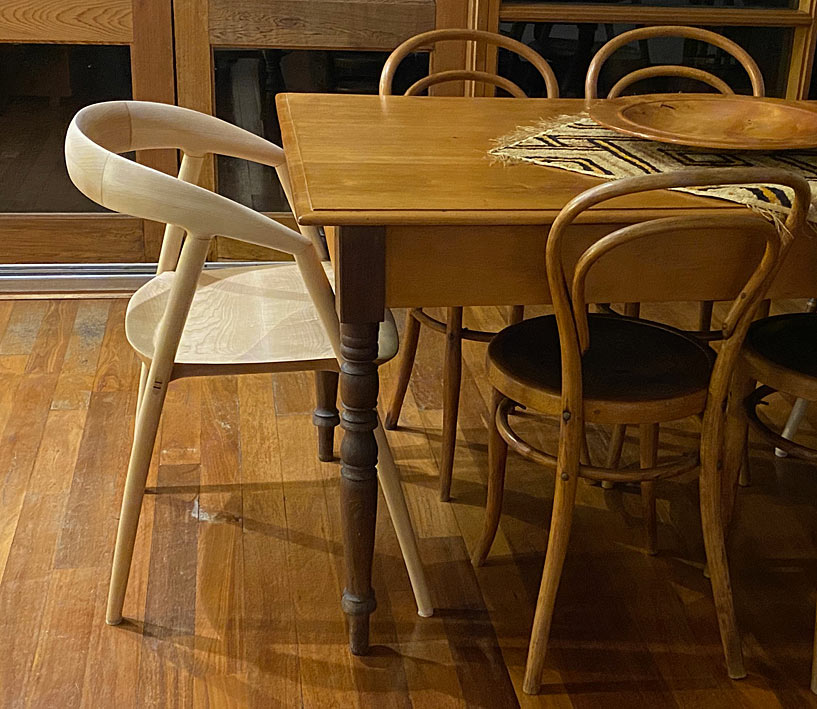
As a homage to the old table, the legs and aprons will be Jarrah.
Regards from Perth
Derek
Re: Dining Table
Edited #11

I think my taste leans towards minimalism and sharp lines over curves, and I really like this table.
But as a former electrican, the first thing that caught my eye is why isn't there a cover plate on that outlet? 
Re: Dining Table
Edited #12Another way of strengthening the corners is to glue in a plywood brace between the aprons........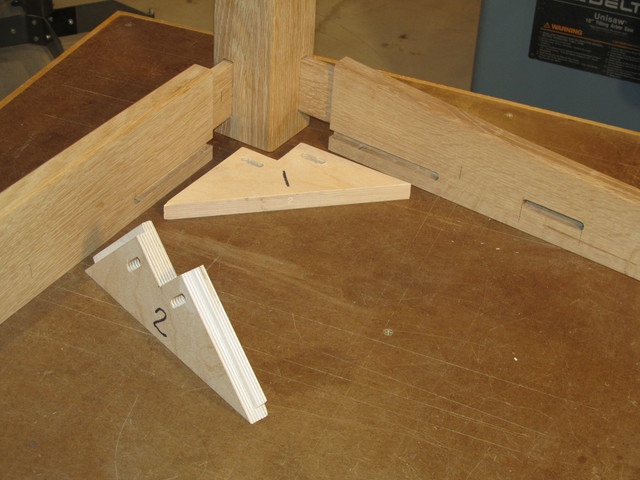
Re: Dining Table
Edited #13Peter Martin wrote:I think my taste leans towards minimalism and sharp lines over curves, and I really like this table.
But as a former electrican, the first thing that caught my eye is why isn't there a cover plate on that outlet?
Peter, clean lines are what attract me, both generally and here. This table is the closest I have come to a photo of my mental picture.
Regards from Perth
Derek
Added later 07 min 09 s:
roger lance wrote:Another way of strengthening the corners is to glue in a plywood brace between the aprons........
Roger, agree - I cannot imagine a table without corner brackets. I have done so with tables in the past. The earlier photo I posted here simply combined a metal connector and a corner bracket in one. I spread-eagled the test leg and aprons, and jumped on it! It held firm. Still, I now am not looking at a knock-down joint.
Regards from Perth
Derek
Re: Dining Table
#14Knock-down joints provides you and the furniture the ability to move and adjust.