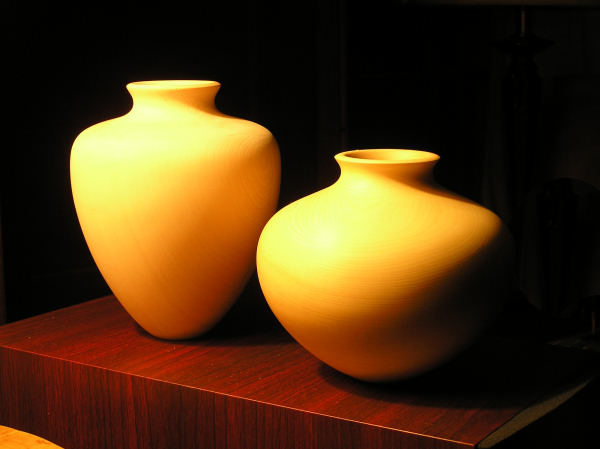
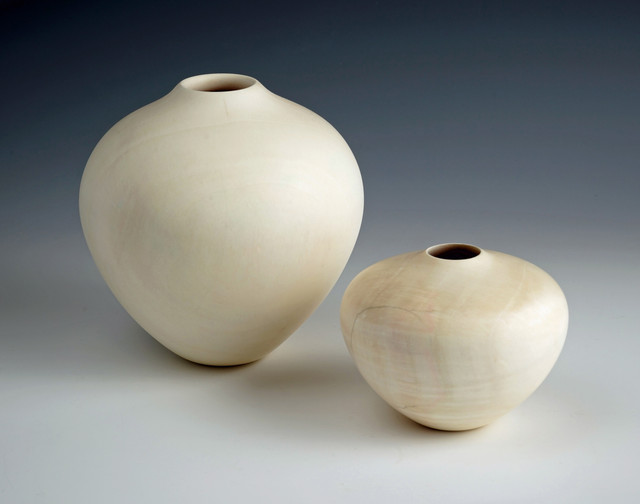
I've always been in the "round and brown" school of woodturning, since I enjoy letting the form speak for itself. On that note, I recently found this photo of two yellow cedar vessels I turned probably 20 years ago. I'd like to hear more discussion on the basic and decorative aspects of turning. Any thoughts?
My opinion is the form is the principal parameter. It isn't always that simple because the natural grain can provide some beautiful details that the observer notices first and uses to form an opinion. Then there are the embellishments such as color and texture that get added. I'll even go as far, at some peril to myself, that non-turners are more likely to get influenced by decorative features. I admit some embellishments can make a piece, either good or bad, more attractive. My wife has a collection of Kaiser pottery and every piece is a somewhat-flat white color. To me it really demonstrates how important the shape of the piece is because there isn't too much else although they do have patterns that isn't real obvious at a distance in a not brightly lit room. My test is the flat-black test, "Would you think it was so great if it were painted flat-black?". Your 2 pieces would past the test!
Very nice forms, Ellis. I was in the "brown & round" camp for many years, although I used a lot of colorful exotics as accent woods. Two decades (+) ago I started to dabble with a little texture - and then dabble with a little color. Now, most of my pieces since 2008 have texture and/or color - although I don't get in the shop very often anymore.
Other than some spin tops for charity and Christmas ornaments my last piece was made in 2022 - "Red, White & Blue Vessel" finished in time to post on 9/11 Patriot Day.
BTW - Ric Stang (remember him?), Bill Hilgendorf and I started the NJ Woodturners around 1990.
I rarely separate form and function when I turn wood. To me, part of the function of a piece - even a functional piece - is to bring comfort, joy, harmony, excitement, challenge, etc. to the user/viewer. To that end, I tend to follow these guidelines:
Paint it black. I try to visualize my work as if it were painted black. No grain. No figure. No color. No adornment. Just look at the profile. Is it pleasing or over-worked? An elegant ogee beats excessive beads and coves every time.
Practice and master "round and brown". Don't think that you have to try every new technique or tool because you can. Get really good at the basics before adding to your repertoire.
Simplicity is beautiful. Too many times, woodturners get caught up in too much ornamentation: beads and coves, piercing, colors, carving, etc. Don't get me wrong. I do all of these things, but they need to be done in balance with the whole piece.
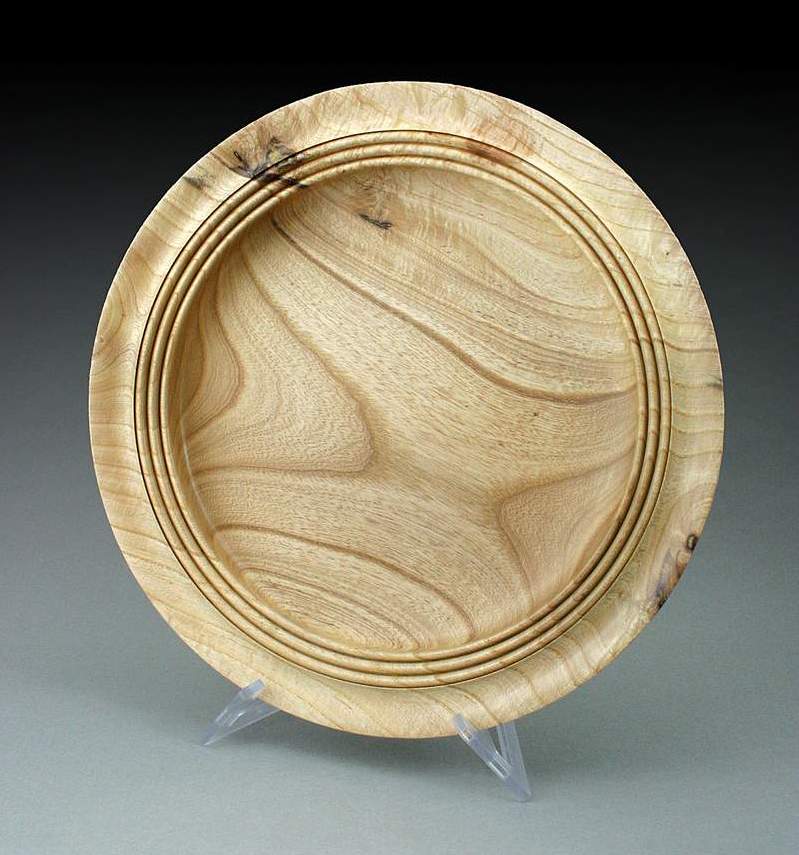
Don't ruin beautiful grain with excessive adornment. A lot of times, we get caught up in the grain of a piece, then add too many other details that detract. Kind of goes back to "paint it black".
Avoid the flat spots. To me, the best forms have flowing curves. In my opinion, two areas where turners falter is on the lower curve of a vessel/bowl and on the shoulder of a hollow vessel. Turners tend to flatten these sections instead of having subtle curves. Your pieces above speak to the subtle curves I like.
Adorn intentionally - not haphazardly.
Whatever you intend to do, practice the technique on scraps before ruining your good work. I cut scraps of various woods into 4" x 4" x 1/4" tiles to use for coloring, carving, burning practice. I try out techniques and write down what I did on the back side. I keep these as reference for what works and what doesn't.
I'm an airbrush guy. I color a lot. Before I color, however, I think about how the color will complement or detract from the piece. And, how the color will interact with the wood grain and color. A lot of people, for example, wipe dye onto their pieces but do not give thought to the interaction of the dye color with the wood color, nor do they consider the affect of dye on the end grain vs the side grain. When you put red dye on a piece, you will almost always get some variation of orange because many woods have yellow in their color. Blue dyes become versions or teal. If this is intentional, that is fine, but I bet the color is more often a happy or sad accident.
Most overused finish? Glossy poly or lacquer with inadequate polishing. If you want glossy, make it like smooth and polished glass - not a wet orange peel.
Most overused pyrography pattern? Molly Winton's spiral pattern.
Most overused piercing pattern? Random blobs.
Most overused carving technique? Random stippling with a power carver.
Epoxy resin is at risk to be overused to complement voids, burls and bark inclusions. Use it because you intend to - not because you have epoxy to pour. Pay attention to the color and effect the resin has on the overall aesthetic.
With all of these, sanding and finishing still matter. Be meticulous.
OK - that's my litany for now.
BTW, Ellis, I'd take those two vessels anytime. They are gorgeous.
Joe
Added later 02 min 02 s:
In the time that it took me to pen my response, Tom Gall posted his patriotic piece. Excellent and very intentional. I'd take that one too!
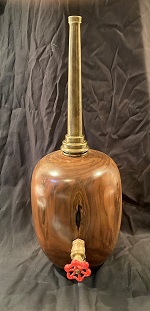
As I've shown here, sometimes black paint can become an end in/of itself. I do, however, try to avoid wood that has little or no "character"; preferring instead, highly figured/variegated material. I don't turn bowls much anymore, as I'm primarily an end-grain turner. Consequently, what I find as I peel off the years of the tree's life to get the piece to its initial round cylinder will have the controlling input of where and how to proceed to decide on a form.
As I'm working predominately with dry wood (knots and cracks don't matter much), I often do the roughing, then sand and shellac the piece to bring out the figure/color. I then let the cylinder sit on the turning bench for a while (some for a year or more) to consider the possibilities presented.
I don't carve or "augment" a piece, although I have used a dimpled finish (air-drive needle scaler) to hold light on a form.
My use of additional color is very limited, almost always by request, and never more than a single color; the exceptions being Box Elder and Ambrosia Maple where dyes are used to preserve the original colors of the wood which are part of the life story of the tree before I got it.
I suppose my time on a potter's wheel has influenced my approach to shapes and profiles. I don't, however, seek to invent a new form; they've all been done. As Bob Stocksdale is reputed to have said when asked about people copying his work " Yeah, the Chinese have been copying my forms for a thousand years."
I was heavily influenced by my parents. One wanted sterling silver flatware. The other said it had to be daily use. I was born with a silver spoon in my mouth. I never look at turned pieces without imagining a quart, or pint, of milk in them.
I was heavily influenced by my parents. One wanted sterling silver flatware. The other said it had to be daily use. I was born with a silver spoon in my mouth. I never look at turned pieces without imagining a quart, or pint, of milk in them.
As we consider form and function an old comment by Bill Grumbine [rip] comes to mind. "If it won't hold soup, its art."
Liked the Yellow Cedar, Boss; the shorter piece more than the tall. The shape flows nicely up to the neck and rim.
I did several similar pieces in clay as demonstrations for my classes. Unfortunately I didn't wedge as well as I should have so they didn't survive the bisque firing. Those served as teaching events as well.
Excellent replies here. Thanks to all of you, and kudos on some inspiring work. BTW, Tom, I recall Ric Stang but not Hilgendorf. Most of my career was spent in eastern PA and NJ. I haven't found many turners of note down here in Florida. David and Wendy Ellsworth are coming for lunch tomorrow, so that'll change.