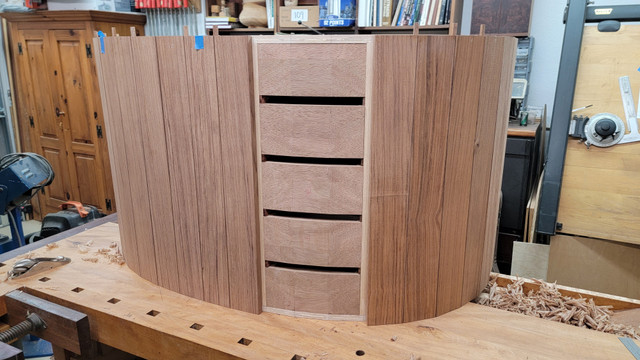
I've almost completed the carcase of our new vanity. The primary wood is a Mexican species called Pareto (a.k.a. Guanacaste) that I've never used before. It's very soft, stable, and easy to work, but the sawdust is noxious. I've been using a room fan and a full-face respirator with a HEPA filter.
Today, I will be attaching the final three staves to the drawer fronts and hanging the three doors. Next, I'll be making a 4"-high plinth, which will supply a toe kick. Finish will be three coats of Heirloom varnish. Granite top is due this week. Then the real fun (not) -- the installation -- begins. I'll post another couple shots when all is completed.
You may remember that I have a curved front vanity in the plans too - but my timelines are long. Look forward to a few more pics and details - i can always learn about new approaches.
Hi Derek, I talked a bit about this method of building curved pieces with staves in an earlier thread. It's a utilitarian way to create virtually any curve in plan and works very well for vanities. This plan was my best shot at a practical shape for our rather small bathroom, allowing for unimpeded foot traffic around it. You can vary the stave width to accommodate particular curves, or pick a width for all of them. I made the top and bottom of the plywood shell with a masonite routing template that includes facets corresponding to the stave locations. Then, wherever you want fixed staves, you biscuit-join the top and bottom of the staves to the plywood. A Domino would work here as well and would actually be perfect for staves that are narrower than a biscuit slot. Doors and drawer fronts are held in their curved shapes with faceted cleats behind. In this case the drawer box fronts are themselves faceted and the staves will be screwed on from inside the drawers.
Ellis
Added later 21 d 4 h 55 min 55 s:
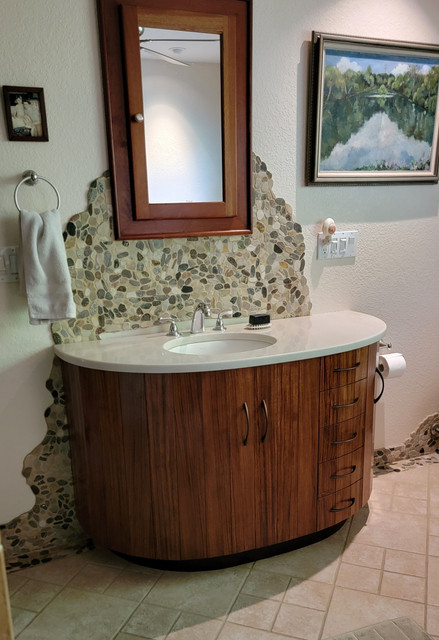
I apologize for not uploading this shot much sooner. I finished our vanity a couple weeks ago, but had to wait for our plumber to return from Argentina to assist with the installation. It turned out pretty much as expected, at least my better half is happy. I still need to figure out what kind of mirror/medicine cabinet to build, but at least we're up and running with the sink unit.
Curious about your reasons for the wood choice. Is there a particular property or properties of the wood that justifies using it despite it's downsides?
The cabinet design is nice and the wood color is striking.
Don, I almost hesitate to say why I used Parota (Guanacaste), but here goes...
1. I was looking for a wood that is reddish brown to complement the colors in our eclectic bathroom. 2. There is only one supplier of exotic species within comfortable driving distance, and he happened to have three 1x10s of quartered Parota standing against a wall, already S4S. So happenstance was a factor. 3. I downsized my shop drastically six years ago, so I tend to opt for simple solutions. 4. The wood was extremely light (27 lb/cu.ft) and appeared to be very friendly to hand planing, which I knew was going to be a factor in this piece, dialing in the bevels on each stave to follow the curved design. I couldn't imagine working with some really hard, gnarly species. Gettin' a little less ambitious these days. 5. It was cheaper than almost any of the other options.
In addition, I had never worked this wood in all my years and I had no idea it would have such noxious sawdust. I wore an N95 mask when doing dusty operations, and it wasn't such a big deal. Would I use it again? Maybe. Probably.
One interesting property of the wood, which I didn't realize when I bought it, is that radial shrinkage is only around 2% from green to oven-dry. That makes it potentially useful for applications where minimal radial shrinkage is desirable.