All
I have been asked to create a 'medium' length stick to hold open the grand piano lid. It has a low and a high height option, but not a medium. Aside from the engineering of this task (do I try to keep both existing options installed and add a 3rd? or do i replace one with the desired medium height option?), i would want to (need to?) finish that piece with a high gloss black lacquer.
Anyone have any experience with 'trying' to achieve that type of finish? (Piano gloss black)
I am going to try to achieve something close to matching the finish, but will not be obsessive about it (this is a small portion of the piano, that is generally hidden.
I am also not want to use traditional lacquer (solvent based) unless I have to.
As to the wood itself, I am thinking hard maple. Any advice om which species to choose? It will need to be super smooth
Henry
Piano gloss black?
Posts
Re: Piano gloss black?
Edited #2Closed pore woods; maple or cherry
Finish: Sand to 220, apply 1st coat of rattle-can black lacquer
Allow to dry 24 hours.
Sand lightly with 320 and wipe off, apply 2nd coat of lacquer
Allow to dry 24 hours
Sand lightly with 400, rub with 4x0 wool, apply light 3rd coat
Allow to dry 24 hours
Rub down with Meguier's No. 9
You may get this
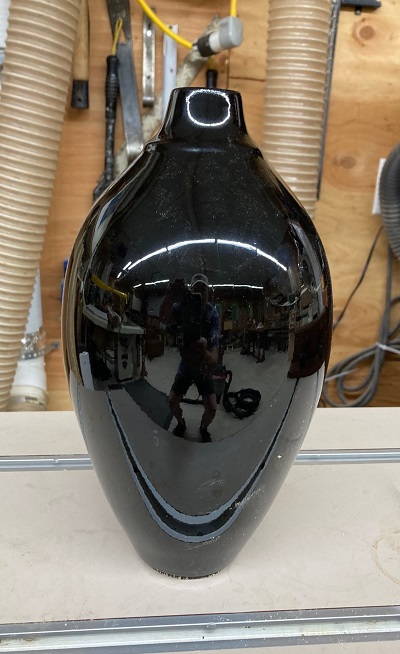
Re: Piano gloss black?
Edited #3

Don't know about wood, but show-car black paint on cars for a mirror finish is done by sanding to 400, sand-able primer, 400 again lightly, two coats lacquer, light sand, two or three coats clear lacquer, then the fun part. Lots of hand wet sanding from 400 (depends on orange peel if any) up to ~2000 - 3000, polishing compound, and wax. Tack rag between steps where paint is added.
Added later 03 min 46 s:
@Mark Mandell,
That's so shiny you could have embarrassed yourself had you not been wearing clothes when you took the photo. 
Re: Piano gloss black?
#4Don't reinvent the wheel, or 'stick' in this case. How is the original handled? Copy it.
Re: Piano gloss black?
#5

Mark, Nice finish. For those who want to achieve a similar glossiness, I have an article on my website under the education tab. Lower right-hand corner. I think I refer to it as the "Don Derry" finish. The key to a good finish is to completely level the surface so that no wood defects, pores, bark inclusions, etc. transmit through the lacquer finish. For a visual: If you lacquer a golf ball, your eye will still perceive the dimples on the ball due to how light reflects off the changing surface. If you completely fill the pores with whatever filler suits you, then sand back, you will have a "dead flat" surface with no dimple reflections to distract your eye. Only after you get to dead flat, can you achieve the piano finish. Additionally, Mark's naked reflection  is due to the quality of the polishing he did. When I teach the technique, I require a student to demonstrate the reflective quality of the finish by reading the reflection of a bottle or can. There should be no haziness anywhere on the surface.
All credit to Don Derry who showed me the technique that he learned polishing electric guitar bodies.
Re: Piano gloss black?
#6Good advice. Back in the day we made mirror frames with round light bulbs in them. Make-up mirror or Hollywood mirrors. What we did was sand the wood smooth, fill where needed with FamoWood. Coat with a heavy bodied primer, sand smooth, coat about three times with flat black and then about three times with gloss. We used rattlecan lacquer and made sure all the primer, paint and gloss coat were compatible. This was literally fifty years ago. I don't think water based low VOC finishes had been invented.
Re: Piano gloss black?
#7OK great; it really sounds like surface prep is the key - no real surprise there.
Thanks all
Henry


