Have any of you made multiple level raised panels in the style of Ernest Gimson? If so, did it involve forgotten tools or blood sacrifice to obtain the techniques?
Regards,
CJ

Multi-level raised panels (Gimson)
Posts
Re: Multi-level raised panels (Gimson)
#2

I asked GPT 3.5.
Me: Ernest Gimson was described as "the greatest of the English architect-designers". Much of his furniture had multi-level raised panels. Do you know how these panels were made using hand tools?
GPT: Ernest Gimson was indeed a prominent figure in the Arts and Crafts movement and is known for his contributions as an architect and furniture designer. His furniture often featured intricate multi-level raised panels, and these were typically made using traditional hand tools and craftsmanship techniques. Here's an overview of how such panels were created using hand tools:
Material Selection: The process began with selecting high-quality wood, often oak, as it was a favored material in Arts and Crafts furniture. The wood was chosen for its grain and color, and the panels would be made from solid wood rather than veneers.
Design and Layout: The design for the raised panels would be drawn on the wood. The layout was crucial to ensure that the panels fit seamlessly into the overall design of the furniture.
Rough Shaping: The rough shaping of the panel could involve a combination of techniques. A hand plane might be used to remove bulk material quickly. A panel saw could be used to cut the panel to its approximate size.
Marking and Carving: The intricate patterns or designs on the panel were marked out using a marking gauge and other layout tools. After marking, skilled craftsmen would use chisels and gouges to carve the wood away in a controlled manner. This process required precision and artistry, as the carver would create the multi-level raised effect by removing material at different depths to create the desired design.
Smoothing and Finishing: After the carving was completed, the surface of the panel was smoothed using hand planes, scrapers, and sandpaper. This process helped to create a refined and polished appearance.
Joinery: Depending on the specific piece of furniture, the panel might be joined to other components using traditional joinery techniques like mortise and tenon or dovetail joints.
Final Assembly: The panel would be incorporated into the overall piece of furniture, and other components would be assembled around it.
Ernest Gimson, like many Arts and Crafts furniture designers, emphasized the importance of handmade craftsmanship and a connection to natural materials. His multi-level raised panels would have been meticulously created by skilled artisans who had a deep understanding of woodworking and a commitment to preserving traditional craft techniques.
It's worth noting that while the above steps outline the general process, the specific techniques and tools used might vary depending on the piece of furniture and the preferences of the craftsman. Handcrafted furniture of this kind is highly valued for its attention to detail and the unique character that each piece possesses.
Me: Are you aware of any special tools he used to create the multi-level panels, as opposed to regular tools in use at the time for sawing, planing, and chiseling?
GPT: Ernest Gimson, as a prominent figure in the Arts and Crafts movement, primarily used traditional hand tools available during his time for creating multi-level raised panels. While there might not have been any unique or special tools associated specifically with Gimson, he and his contemporaries were known for their exceptional skill in using these traditional tools to achieve intricate and artistic woodworking. Some of the key traditional tools commonly used to create multi-level panels included:
Chisels: Gimson would have used a variety of chisels with different shapes and sizes to carve and shape the wood. These chisels would have been hand-forged and finely sharpened to create the desired raised panel designs.
Gouges: Gouges are specialized chisels with curved cutting edges. They are ideal for carving curved or intricate details on the wood and were likely used extensively in creating the multi-level effects.
Mallet: A wooden or rubber mallet would have been used in combination with chisels and gouges to drive them into the wood for carving.
Saws: Hand saws, such as panel saws or back saws, would have been used for cutting the wood to size and shape before the carving process began.
Marking and Layout Tools: These would include marking gauges, rulers, squares, and compasses to accurately mark out the designs on the wood before carving.
Hand Planes: Hand planes were used for smoothing and shaping the wood. They played a role in refining the surface of the panel after the initial rough shaping.
Scrapers: Cabinet scrapers or card scrapers were used to achieve a smooth, polished surface on the carved panels.
Clamps and Vises: These were used to secure the workpiece and keep it stable during the carving and assembly processes.
While these tools were not unique to Gimson, what set him and other Arts and Crafts artisans apart was their exceptional skill and artistic sensibility in using these traditional tools to create intricate, multi-level raised panel designs. The hallmark of Arts and Crafts furniture is the craftsmanship and attention to detail, with a focus on handwork and traditional techniques. Gimson's legacy lies in his mastery of these traditional tools and his ability to create furniture with a distinctive style and quality.
Re: Multi-level raised panels (Gimson)
#3I have not done anything in that style. However, if was going to start today I'd use a plunge router and templates. Since the different levels of relief are all rectangular, templates would not be too tricky to make. If you wanted to avoid the router it could be done with a rabbet plane. The tricky part there would be using the rabbet plane cross-grain without getting tearout.
With either the router or a plane, finish up with scraping and/or sanding.
Re: Multi-level raised panels (Gimson)
#4Clearly it can be done. I am simply at a bit of in an impasse with respect to figuring out how to route the require profiles and the stepped bevels/fields between the profiles without routing away the support for the router in the process.
If I were doing this by hand I would start with the innermost field and run rabbets into the surface to define that field. The appropriate molding would be applied to the inner edge of the rabbet. Thereafter the remainder of the panel would be lowered with planes in the same way one would when flattening a panel. Rabbets would be formed into the lowered field to define the next molding location and so on. Once the field of the panel was completely raised/lowered, the peripheral edges would be molded. I will probably do this a time or two just to have done it.
While I am kind of borrowing problems that have not yet popped up, I think that where the central field or boss or whatever one wants to call it is sufficiently small and sufficiently high, one would loose support for a router or router table. I expect that a CNC would be ideal for this if I had a few thousand dollars lying around. I could farm it out I suppose.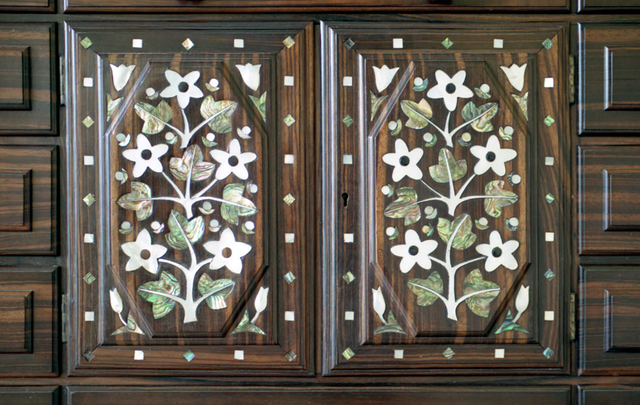
post image
CJ
Re: Multi-level raised panels (Gimson)
#5Using your second photo as an example, here’s what I’d do.
Let’s say the overall panel is 1” thick and each of the raised portions is ¼” above the surrounding surface. I’d start by cutting the outer rabbets ½” deep. Then I’d use an octagonal template attached to the drawer face by double-stick tape and/or brads where they wouldn’t show, like under the pull, and use a pattern-cutting bit (with the bearing at the top). Since the router base might not be enough to keep the router from tipping at the outside corners of the square, I’d use an extra-large temporary base for the router and support the outer edges of the router base using blocking that surrounds the drawer front. I’d start at the outside perimeter of the square and work my way in until the bearing stops the cut at the edge of the octagon.