A few years ago I decided to upgrade the precision with which I did joinery and stumbled across an online tutorial by the late Chris Hall for just this thing: making an andon or Japanese lantern. I won't go through the whole build but here are a few pictures. It is all Japanese interlocking joinery. No glue except for wedges for some through tenons and to attach the washi paper to the diffuser screens. There are over 100 pieces, mostly cherry for the structure, some red oak for the electrical pedestal, butternut for the removable paper screens, and some tiny ebony wedges.
I'm looking at it right now as I'm typing this. I didn't actually want to have an andon, but after making it is still one of my and my wife's favorite pieces in the house. 


A Japanese lantern
Posts
Re: A Japanese lantern
#2WOW - love it. I'm always drawn to Asian architectures and designs, and this is no exception.
Of course I'd love a step by step but that would be a book in and of itself.
Wonderful piece.
Henry
Re: A Japanese lantern
#3Thanks, Henry. I'm with you on Asian designs. Here are a few more build photos. Most of the joinery is hidden, which is one of the features of Japanese designs I like. This was my first attempt so not so perfect but good enough to encourage me.
The lantern has a base with joinery used for higher end tea houses or residences. It is mitered with a through and wedged tenon. The surprise is that it incorporates a sliding dovetail to resist twisting. This was a challenging layout. 
All four corners. The mortises are for tenons on the corner posts. 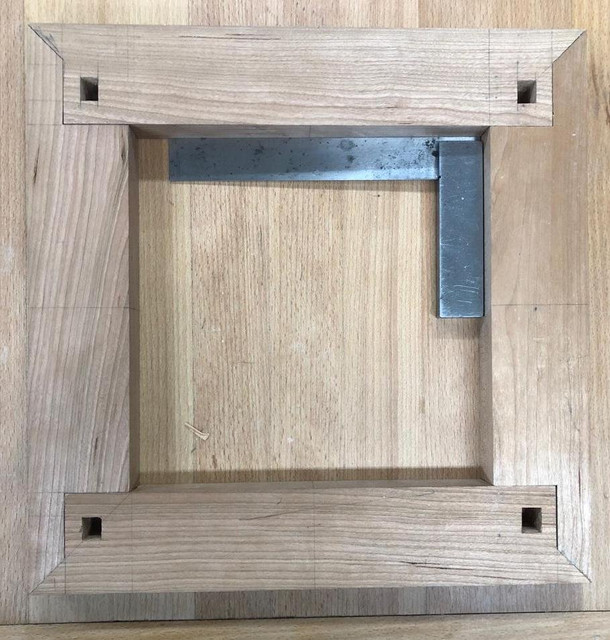
I'll add more pics later.
Re: A Japanese lantern
#4Gary, I like the diffused lighting and that it sits on the floor. My wife has asked about adding indirect lighting to our back deck that we are replacing. I’m thinking that this design would work. Are you aware of any material that would work for the screen (is it called “shoshi”?) or diffusion in an outdoor environment?
Re: A Japanese lantern
#5Don, there is an acrylic version of shoji "paper" that is reported to be weatherproof. It is expensive but has the look of paper. I have not tried it.
https://www.eshoji.com/waterproof/
I have seen someone else try to make a DIY version by sandwiching shoji paper between thin acrylic sheets. I don't know how well that works.
Frosted glass or translucent acrylic sheets are another option if you don't mind not having the look of paper.
Re: A Japanese lantern
#6Beautiful work. I've always wanted to make one although on a smaller scale (and a shoji screen too) but somehow never got around to even trying. Maybe some day...
Re: A Japanese lantern
#7Gary, Thank you for the link.
Re: A Japanese lantern
#8A few more build pictures.
The tenons on the kumiko. The laps for the kumiko were done on a jig and routed. 
Mortises for those tenons. These were also routed to rough them out, then chiseled square. Tedious layout and cutting but that's what I wanted to learn. 
The pedestal for the electrical parts was joined with a double mitered lap joint and captured in the base by mortise and tenons. Very clever. No glue required. 
The double mitered lap was cut before shaping the pedestal halves. 
Re: A Japanese lantern
#9

Gary Radice wrote:Don, there is an acrylic version of shoji "paper" that is reported to be weatherproof. It is expensive but has the look of paper. I have not tried it.
https://www.eshoji.com/waterproof/
I have seen someone else try to make a DIY version by sandwiching shoji paper between thin acrylic sheets. I don't know how well that works.
Frosted glass or translucent acrylic sheets are another option if you don't mind not having the look of paper.
I made a line of Japanese-inspired lanterns back in the old days and my go-to material was Wissmach White glass. It has a wonderful surface texture and a soft luminosity. Not exactly regulation shoji, but effective, and it solves the waterproofing problem. You can probably find it at art glass suppliers.
Ellis
Re: A Japanese lantern
#10Thank you Ellis
Re: A Japanese lantern
Edited #11Yes, thanks Ellis. That looks like an excellent alternative. I'm filing that one away.
A few more build pictures.
These are the removable screens, made of butternut because I had some. The cross bars line up with the kumiko horizontals on the lantern to avoid a shadow line. Mortise and tenon construction. I attached the paper with rice glue—just boiled rice mashed to a paste and diluted with water to glue consistency. Once the glue dries the paper is spritzed with water, which tightens the paper as it dries. I used a kozo paper, which is made of mulberry. It is supposed to brighten as it ages rather than turn yellow as other papers do. 


If you need to replace a paper for repair, as might happen if (ahem) you have a cat and there happens to be a bug in the lantern, just moisten the paper again at the glue surfaces and wait a minute. The paper peels off just like a post-it note. Glue on a new sheet. A 30 minute repair. 

Added later 1 d 36 min 58 s:
OK, I found a few more progress pictures.
Here is a better view of the double mitered lap joints used for the electrical pedestal and the lower and upper cap rings. 

And the joint used to connect the handle to the upper frame header/square.


