I've posted about two other pieces recently and at the risk of overstaying my welcome here are are few more that I've done in the last few years. These will be brief.
I have liked Greene and Greene for many years but they just would not have looked good in the house we used to live in. Then we moved to Oregon and into a house that was a better fit. So for a couple of years I dug in.
The first is a coffee table. The Greene bros never made a coffee table so that forced me/ allowed me to use their design vocabulary but let me play with it. I came up with this. African mahogany, ebony accents, silver and green abalone inlay. 


I think I got the proportions right. I'm kind of "meh" on the inlay design (looks better from a distance) but it does get a lot of interest when people see it. The inlay is proud of the surface just a little as on some of G&G's work and it invites a touch.
After that my wife asked for a table next to "her" chair to set a wine glass on. I had just returned from trip to the Gamble House in Pasadena with a stack of pictures and bunch of ideas. Seeing some actual G&G pieces in person (and making measurements) showed me that they are more graceful, subtle, and delicate that they sometimes appear in pictures. I used that experience to make this.

One feature that I've never seen described is that on some G&G pieces the legs are shaped with just a bit of entasis. They are a little narrower at the top, flare to the lower shelf, then taper again to the floor. It is difficult to see in pictures but it does make a difference. I added some green abalone inlay to match the coffee table. 
The drawer has an ebony accents anchored by brass screws that I filed and sanded flush. Another G&G detail. 
And finally, jewelry boxes for my wife and sisters. One in African mahogany, the others in European beech and sycamore. 


Some Greene and Greene
Posts
Re: Some Greene and Greene
#2Very Nice! A huge amount of work and well done.
Is African Mahogany an authentic choice? It's beautiful but is it something G &G would have used? The legs are great, a detail I will remember and steal at some appropriate moment.
Re: Some Greene and Greene
#3Mahogany was typical but not African. More likely in the 1920's it would have been Honduran or maybe Cuban.
The drawer handle design I borrowed from this piece from the Gamble House.

The leg and shelf design on the side table I borrowed from this G&G piece in the main bedroom of the Gamble House. The waterfall foot was common on several pieces there. 

Re: Some Greene and Greene
#4Gary......Have no fear of overstaying your welcome by showing examples of your beautiful work.......it's a pleasure following your posts. I noticed your workbench in some shots taken in your shop......I assume that you made your bench (always a risk to assume anything).......I'd like to see more pictures of your bench and shop if you'd care to show them.......I find workbenches interesting.
Re: Some Greene and Greene
#5

Really nice, Gary. I've been a G&G fan since the 70s and have also visited the Gamble House. I recall that they referred to the mahogany they used as Santo Domingo mahogany, which is the same as Cuban mahogany (Swietenia mahogani). I sometimes call it "Island mahogany" since it comes primarily from the Caribbean. Of course, most of the world's stocks of that timber were depleted in the 1800s when all the European and American cabinetmakers were crafting unbelievable furniture from it.
Two things occur to me in viewing your photos: One is the cloud lift motif. I don't recall seeing pieces with both upward and downward arches although your interpretation really works aesthetically. (Of course all my G&G books are on the other side of the continent at the moment, so I can't dig much deeper right now.) In fact, I don't know that I've ever fully understood how that detail is determined. I know that the ones made by the Hall brothers were quite sculptural in comparison to many of the formulaic versions you see nowadays in knockoff furniture. Their angles weren't so geometrically perfect and the edges were broken with differing radii, creating a quite lyrical appearance, almost imitating wear. The other thing is the entasis you described. As with the cloud lift treatments, it doesn't surprise me that legs would have been made with that degree of nuance. Entasis is a very subtle thing -- sometimes barely noticeable -- and may have been overlooked by people documenting G&G pieces. Maybe Gary Rogowski could shed some light on the subject for us.
A little historical footnote: I was fortunate to have enjoyed martinis with Randell Makinson in the Great Hall Bar of the Grove Park Inn back in the mid 90s at the annual A&C conference. If I had been onto these questions in those days, I might have picked his brain about them. Whatever you think about Makinson and his questionable purveyance of G&G artifacts, he certainly put Greene & Greene on the map, my map at least.
Thanks for posting.
Ellis
Re: Some Greene and Greene
Edited #6I think Daryl Peart in one of his books or a discussion somewhere said that there aren't really any rules for how to do the "cloud lift." The Greenes/Halls did them several ways, sometimes with one lift, sometimes with two or three, with different spacings and lift angles. And I agree the edges were always rounded to various degrees. One thing that some imitators miss is that the lift angles were eased or softened on all three sides of the lift angle.
And the lift direction could be up or down. I'm not sure if they ever combined up and down in one piece. The only picture I have of something close is this of the piano in the Gamble House. 
For my coffee table I played around for days trying the stretcher lifts in all the possible orientations and combinations to see which worked best with the aprons. Since the Greenes never designed a coffee table I felt free to choose whatever I liked. I still look at it sometimes and wonder whether I made the right choice, so there you go.
I spent some time a couple of years back trying to find the origin of the term, "cloud lift." The Greenes clearly took the design from Chinese and other Asian furniture where it had been a feature of table and chair stretchers for centuries. In China it is called a "humpback stretcher." I guess someone decided that "cloud lift" sounded more poetic. Does anyone here know? Did the Greenes use that term themselves, or was it a later furniture dealer or historian?
One feature I added to my side table that was not a G&G design but rather a Hall brothers design is the extra post that frames the front, back and side panels, and the drawer opening. Daryl Peart mentioned this feature in an article somewhere describing a small table made by the Halls that now belongs to one of their descendants. 
I have another G&G project (sideboard or console) floating around in my head. Maybe next year it will reach the top of the queue.
Added later 43 min 39 s:
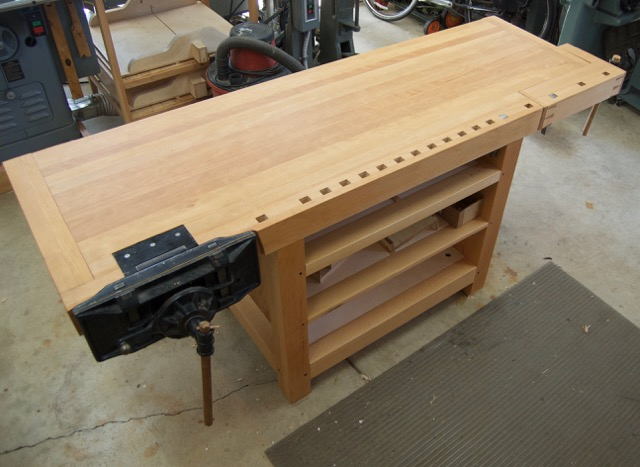
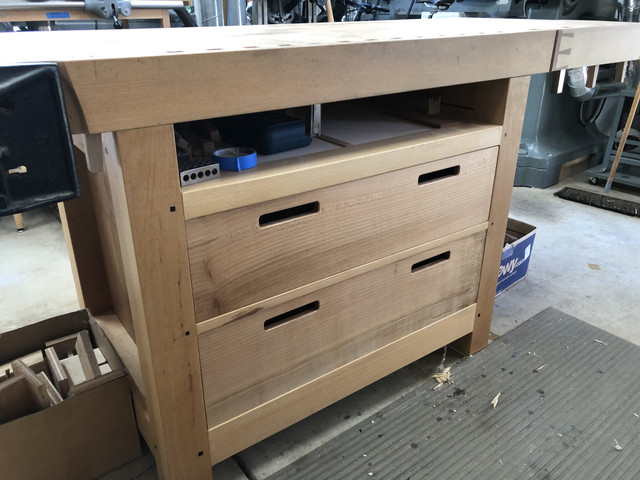
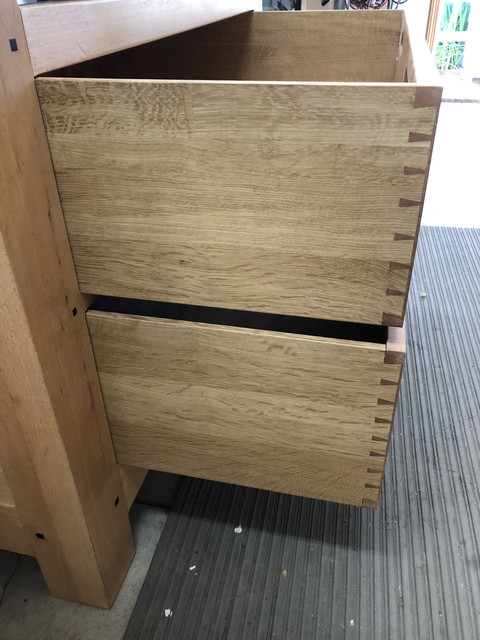
Roger, here is my bench. I built it several years ago as a retirement gift to myself. It is European beech with Oregon white oak and big leaf maple drawers and side panels. It has an Emmert patternmakers vise. The top is about seven feet long, 26 inches deep, and 4 inches thick.

Re: Some Greene and Greene
#7

Not being a woodworker, all of this is Greek to me, except the mention of entasis, the etymology of which is Roman.
https://en.wikipedia.org//wiki/Entasis
Apparently, it's even a factor in calligraphy. Hmmm, so it is based on aesthetics or structural integrity--or both?
Re: Some Greene and Greene
#8Very nice work. I see a 1,2,3 block tucked away on the bench shelf. I keep one on the table saw as well to serve as a removeable stop block.
Re: Some Greene and Greene
#9

Great work, Gary! Thanks for sharing your photos as well.
Re: Some Greene and Greene
#10Gary......great bench......we seem to have a number of features in common.......when I built my bench I used The Workbench Book by Scott Landis for guidance and inspiration and incorporated elements of benches by Michael Fortune, Frank Klausz, and the Shaker bench at Hancock Shaker Village.......
losel yauch
Re: Some Greene and Greene
#11Roger, yes,our benches do look similar. I wish I had done drawers more like yours. Mine are too big to organize efficiently. But I love the large top and the vises.
Re: Some Greene and Greene
#12Gary.......the large overhang of our tops on the left side was a feature of the Michael Fortune bench.......so, I felt that the rectangular base would be adequate to handle that overhang......and it has been with no issues at all.......this spacing also allowed for the free use/adjustment of your pattern makers vise (what a great vise) and the mounting of my Record......I suspect that your end vise might be patterned after Frank Klausz's vise which moves on wood ways......I built that type of end vise as it looked a challenge to make......and it has also worked well all these years.
We've both made use of rectangular metal dogs and dog holes.......now, most all modern benches use round holes to accommodate the hardware that is available......any thoughts on this.....round vs. rectangular??.......and we both have not made use of hold downs......you could.....but my top drawers prevent this.......although, I've found work arounds and haven't missed hold downs.......but, you don't really know what you're missing if you've never had/used hold downs.
I really like my graduated drawers.......I like having my hand tools right at the bench......just makes sense to me......so convenient.......I was very lucky with the sizing of these drawers as I made this bench years ago before I owned much in the way of hand tools......things worked out and these drawers hold everything from a #7 to a marking knife......I highly recommend that a person carefully thinks his tool storage needs out first and builds his drawers to a size that will accommodate his tool collection.
Re: Some Greene and Greene
#13I use the overhang by the Emmert all the time since it allows me to sit at the short side of the bench and have a place for me knees underneath. I didn't plan it that way but I find I use it all the time when I'm doing layout on small parts or chiseling dovetails and such.
I have since added a planing stop to that end as well. This was version 1.0 with one level for the stop. I was going to make another that more adjustable but haven't gotten around to it yet. I like the simplicity of this style.
On square vs round dogs: I used square because I was used to Ulmia dogs on my former Tage Frid bench. I got another set of Ulmias for this build. I also made a few rectangular wooden dogs to fit the holes. I find I don't use those much, though.
I bought a pair of holdfasts from Tools for Working Wood thinking I would use them on this bench. But they are about an inch too long and besides, I just couldn't bring myself to drill holes in the top. I see how holdfasts are handy but I rarely find I need to hold something that way that I can't do another way.
Re: Some Greene and Greene
#14I hope I've not taken away from your original topic of G&G by talking with you about benches.......people are free to discuss G&G if they so wish......please do.......but, maybe there is someone out there who is considering making a bench and might find some of this interesting.
Gary.......would you build the same bench if you had the opportunity again??.......I would make something similar to what I made......but, since I'm a more experienced woodworker with more skill, I'd make a slightly different bench......It is important to understand that a bench is made at a moment in time......and that bench accessories......vises......that existed then, may not exist now......and new things are now on the market. I'd probably use BenchCrafted hardware/vises now........and I'd expand my base unit to 12 Drawers and eliminate the left overhang......but, that's not going to happen and the bench I've got is the bench I'll keep.
Re: Some Greene and Greene
Edited #15I don't mind a little thread drift in my own thread!
I'd build the nearly the same bench. I would change two things. I would probably make it three shallower drawers rather than two tall ones, and I'd leave a better overhang along the back of the top so I could more easily clamp to the bench on that side. By the way, those drawers open from both the front and back of the bench since I use it from both sides.

Re: Some Greene and Greene
#16Originally, I wanted to have my bench assessable on all sides......however, as I was laying out my shop, it became obvious to me that there was not enough floor space to house all my equipment, walkways, and storage to have a bench out in the middle of the floor.......so, I had to design a bench that would sit against a wall. Locating the bench as I did, played a role in determining the dimensions of the bench......all these factors interact with each other and you need to keep that in mind to get a shop layout that will work well and accommodate the making of things you want to build.


