WoodCentral Forums

Est. 1998 — 27 years of woodworking knowledge

Need help with spherical turned elements

Posts

Need help with spherical turned elements

#1

Need help with spherical turned elements

Bill Tindall, E.Tn.

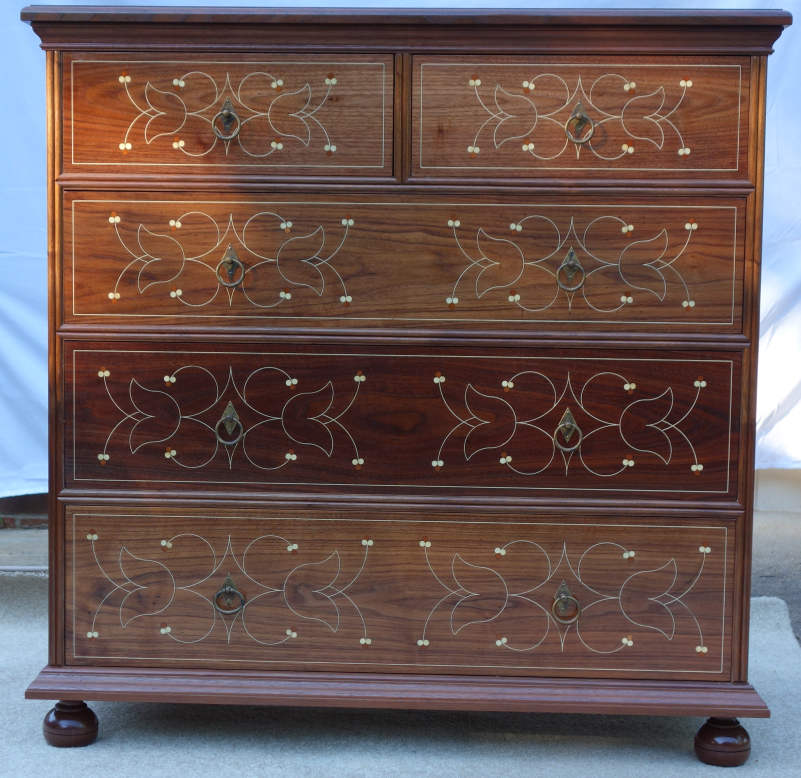
I occasionally have a need for some furniture part that has a spherical element. The current case is bun feet for a chest of drawers. My spherical elements never look just right.
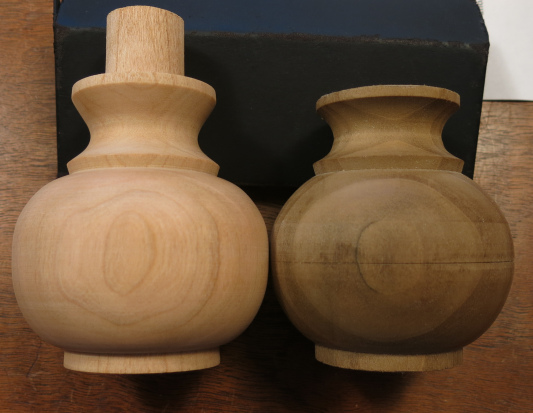

Several years ago I faced the need for bun feet while Alan Batty was giving a class nearby. What I was making just didn't look right. I took the foot on the right to him. He chucked it up in a lathe, removed what seemed to be a whisker from just off center from each side and it was perfect. Look closely and you can see the dull band at the equator from my tool and the shiny surface from where Alan removed material toward the poles.

I was astonished at what a small difference made in appearance. I should be able to do that with his model I thought. Indeed, the ones I made at that time did look ok, but not as good as the one Alan tidied up. But, not now.

I have made 8, need 4, and none look as good as the foot on the right. I have this same problem with any part that contains a spherical element. Does anyone know of any aids to getting spherical turned elements to turn out spherically attractive?

Another puzzle. At the time, I turned bun feet in pairs. I cut the pair in two and brought just one foot to Alan. Because I had cut it I lost the center on one end. Didn't matter a bit to Alan. He chucked it approximately in the lathe. While spinning he pounded on it with a mallet(? I think a mallet). Somehow it magically centered itself. I was so in awe I forgot to ask details about what he did, and how. Does anyone know how to center a "centerless" spindle in the lathe by this means?

Re: Need help with spherical turned elements

#2

Re: Need help with spherical turned elements

Philip Duffy

Perhaps your attempt just looks too big? Have you taken careful measure of both to compare? I do not see an appreciable difference but my instinct is to say the feet should be Less Round, with a flat (however slight) on the top and bottom. But one of the experts in furniture will know the proper answer. Philip

Re: Need help with spherical turned elements

#3

Re: Need help with spherical turned elements

mikeee12345

You can take a measurement from your good piece and use a compass to draw a template on a piece of cardboard or a piece of veneer that matches the diameter you want the sphere to be. You can hold the template up to the piece while turning and determine where you need to remove material from the billet.

The average person will never notice small variations in pieces that are a distance apart from each other.

Another option would be a duplicator setup on your lathe with a template setup to guide you on all of the dimensions for the spindle piece.

Re: Need help with spherical turned elements

#4

Re: Need help with spherical turned elements

Don Evans

You don't really indicate what you perceive as the problem with the one on the left, so I'm going to assume you wish the ball part of it to be more round?

What I see is what affects a lot of beginning turners and that is being afraid of going to far with a cut. If you look at the ball part there appears to be too much material remaining on the top left curve and also too much on the bottom left curve.

So divide the ball into quarters visually, mark the center again and cut more off at first, half way from center toward the top of that quarter then repeat on the lower half segment.

Centering: there should be a pip on the bottom where your live center was, chuck it, bring the center up really close and tap the turning to get the live center "center" again. Then slowly continue to tighten the chuck watching the center mark and tap accordingly. When you have it all tighten again bring the center up tight and take a little off at the time.

Another aid that you can use until you are turning 100 of these per day then you probably will not need it, is too: draw a circle on thick stock and carefully cut it in half then cut along the line to make an arced pattern use this to determine where you need to take off material to round the ball.

Don

Re: Need help with spherical turned elements

#5

Re: Need help with spherical turned elements

Barry Irby

I would go with Mikeee's suggestion.

Make a pattern that matches the diameter of the sphere. (radius at the equator) Make it about a 1/4 of the length of the equator. Then apply it to you piece at a meridian. I have made these by turning a piece of thin plywood on the lathe, cutting the hole to match the diameter and then cut it apart. Of if you have a hole saw the correct size you can use that to make the circle. The point it the pattern has to be an accurate section of a circle. It will reveal those whiskers Alan cut off.

I have made hundreds of spheres by turning it as round as I could and then re-positioning the "poles" on the lathe and using cup centers. Then you cut away the "blur". A fun challenge. What makes it even more interesting is to try to make a perfect sphere of a very specific size. I turned a set of croquette balls out of dogwood. Used a little pattern as mentioned to get them right.

I think the fact that you turn them horizontally and then rotate them to vertical makes it harder to visualize the end result.

Turn four table legs that side by side don't appear anywhere near perfect and then put them on the table and they seem a lot better. If you did a pretty good job nobody but another turner will ever notice and won't care even if they do.

Re: Need help with spherical turned elements

#6

Think of the side profile as an ellipse *LINK*

Dick Coers

Hold an ellipse template and site through to the side profile. Placing a piece of solid colored paper on the bed or behind the lathe helps a lot. For me, the challenge is removing enough material just off the profile. I think it's common to retain too much of the cylinder in that area. You might try using the shadow technique to cut to a pattern.


https://www.youtube.com/watch?v=1oMMIoARLt4

Re: Need help with spherical turned elements

#7

A day with Alan, billard balls

Bill Tindall, E.Tn.

Alan's visit was to the turning club where they wanted to know about threaded boxes and other Alan Batty specialties. I attended out of curiosity. I started asking "functional" turning questions and Alan took off on a nostalgia trip of his career as a journeyman turning, training and working in a furniture factory making drawers. Then on to his shop where he made what anyone needed from house parts to lamp parts, furniture parts and balls. One of his jobs was making billiard balls (I think he called them snooker balls?). In no time he chucked up a piece of wood and produced a perfect sphere with a perfect finish, ready for the game.

His speed and finish off the lath was astonishing. I realized that I could never approach his level of skill turning. It took the repetition of making hundreds or thousands of something. Fortunately this is not the case with flat furniture construction or I would acquire another hobby.

Re: Need help with spherical turned elements

#8

thanks helpful

Bill Tindall, E.Tn.

On the centering you speak of a chuck. I am normally turning between centers, as was Alan. How banging on the spindle while it spun got it perfectly centered was, and is, baffling.

Re: Need help with spherical turned elements

#9

Some aids and cheats

John K Jordan

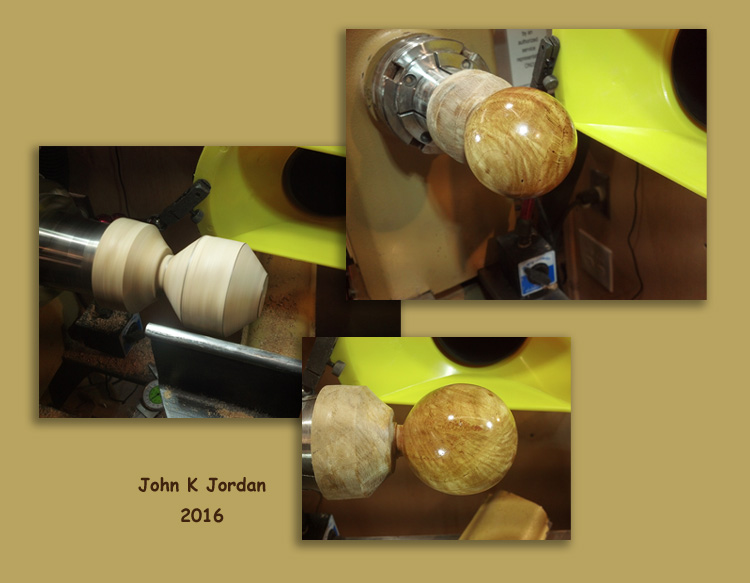
One useful aid is to make a ring maybe 1/2 the diameter, and flattened on one end. A piece of PVC or brass pipe works. Mark StLeger demonstrated this in VA and used a 1" ID ring with a bevel cut on the outside. He was turning 2" spheres.

Turn the sphere but don't get carrled away. Hold the ring against the wood and see if it fits tight all the way around or if there is a high place. Turn away the high place, again, without getting carried away. Repeat.

There is a cheat that works too. Instead of using a ring to gauge, use the ring to turn. Some have used a hole saw with the teeth ground off, held against the spinning work, moving back and forth to remove wood only in the high spots. You can start with a pretty crude shape and end up with a perfect sphere.

Long ago I used a piece of steel pipe to turn a bunch of small spheres. It was very quick. I prepared the pipe edge without a sharp bevel, used like a scraper instead of a cutter. The diameter must be smaller than the sphere diameter. Sanding was required to finish.


I have also used the template method.

Another way I've read about is the shadow method - use a bright point-source light directly and high above work. Draw a circle on a piece of white cardboard below the lathe. Turn the wood until the shadow matches the drawing.

Another method is to draw lines on the cylinder first, spaced with a special handy dandy caliper that costs money or with a bit of trig. The lines represent the radial points of an octogon when viewed from the side or top. Cut flats between the lines to make 45-deg bevels. Mark again and cut flats again to form a 16-sided figure. Round over the "points" to get a wonderful sphere. I made one this way after doing the math and it was easy.


Another way is to buy a sphere jig. Expensive and time consuming to set up but you get perfect spheres every time, no skill required. Should work on spindles as you showed with hand turning to get into the grooves on either side. I have the Vermec, ordered directly from Australia (cheaper than buying from the distributor with a favorable exchange rate).

Another way is to turn everything but the sphere then send the spindle to John Lucas to finish up. I personally can't afford this.

JKJ

Re: Need help with spherical turned elements

#10

Batty Demo

Bill Tindall, E.Tn.

Among the multitude of things Alan demonstrated was turning a sphere on the end of something using a tube as you show. Alan had a story to go with everything. Someone had taken a job to turn chest pieces with a sphere on the top. They were having a time of it and hired Alan to finish them off at considerable expense. They didn't know that this operation could be done in seconds with the tube trick.

I wonder if it would work with a 2" pipe :)

Re: Need help with spherical turned elements

#11

Re: Some aids and cheats

Bill Tindall, E.Tn.

Your suggestions will keep me occupied for a while. I am drawn to the "faceting" approach as that is how I make sections of a circle on moldings.

The simplest approach I don't understand- Mark StLeger. If too complicated to explain by typing can I call, or you call?

Re: Need help with spherical turned elements

#12

Another template idea *LINK*

Clifton C

My favorite method...

Myron Curtis is still turning at 98, just had a birthday last week...


David Reed Smith

Re: Need help with spherical turned elements

#13

Article: Four Ways to Turn Spheres *LINK*

Doc Green

On my website there are two articles that describe how to turn a sphere. These include the shadow method.

http://www.docgreenwoodturner.com/turnspherefour.html

However, if your desire is to turn bun feet, the "spherical" part is not really a sphere - it's a flattened sphere, a bun.


Turning Spheres

Re: Need help with spherical turned elements

#14

test ring method for checking sphere

John K Jordan

>>>The simplest approach I don't understand- Mark StLeger. If too complicated to explain by typing can I call, or you call?

A photo, which I don't have, or a pencil sketch, which I could make if needed, would be best, otherwise we could talk on the phone. When I get time to turn a test ring I'll post a photo but it might not be for a few weeks.

A planar slice through any part of a sphere will be a 2D circle so a perfect 2D circle will rest perfectly anywhere on the 3D surface of a sphere.

The test ring is made with a bevel on the OD of one end such that the working end is narrowed down to a thin line as it near the ID, but left "blunt" enough to not wear quickly. The ring is just a way to hold a 2D circle to check the 3D sphere. The edge made by the bevel is nearly a circular knife edge in cross section, like the bevel on a chisel. The entire edge needs to be in one plane and perpendicular to the axis of the ring. If not perpendicular it will define an ellipse instead of a circle. The edge lets you see the contact between the ring and the sphere.

Mark said he turns the test rings from corian. PVC will work but it will soften if held against a spinning surface for checking. Not a problem if you turn the lathe off every time.

If the sphere is perfect, the narrow edge of the ring will sit nicely anywhere on the surface, in perfect contact with the sphere all the way around the circle. If the sphere is not yet perfect, when placed on the sphere it will contact in two or more points and you can see light under the edge or it will rock a little depending on the shape. By looking at how it sits you can decide where to take off a little more wood. When you slide it around, the sphere is perfect if the narrow edge of the test ring touches all the way around regardless of where you put it.

This method should avoid the dreaded parabola-shaped bead usually made by beginners.

In practice, of course, a sphere on a leg or baluster only has to be close to look right. Since the size is critical, I would turn the cylinder to diameter and length then draw the pencil line in the center of the space before making the first cut. When done, the line should still be visible until sanded. At least that's what I'd do.

Also, I might even round the blank then turn the sphere first before spending time on the other details in case the sphere didn't go well, especially if there was a lot of other detail.

JKJ

Re: Need help with spherical turned elements

#15

Tube gouge/scraper

John K Jordan

>>>I wonder if it would work with a 2" pipe

As long as the pipe is somewhat smaller than the sphere diameter it should work. Too small would be a problem (such as 1" pipe on a 4" sphere).

I called it a "tube gouge" but it is really a "tube scraper." Don't grind it to a sharp cutting edge all the way around or it will dig in at the leading edge. If sharpened the leading edge needs to be dulled. Mine little pipe had a rough burr from grinding which made an excellent scraper. I beveled the OD a bit but ID worked better when rough.

In practice the pipe is aimed at the center of the desired sphere and swung in an arc. It will scrape off the high spots and not touch any low spots. The higher spots will scrape more quickly so it will make a nice sphere. It will keep on scraping and make a smaller sphere if you continue scraping after the surface is spherical.

I don't think I would try shaping a larger sphere entirely with the pipe. I forget if I mentioned it but I think I first turned the wood down to an ugly roundish blob then used the pipe to refine the surface.

BTW, when I last posted about this 10 years ago a thoughtful gentleman made and sent to me a couple of sizes of nicely machined tube bits threaded to fit the shaft of a custom handle. (The story is longer than that.) I sure wish I hadn't lost his name. The circular edge was sharpened to perfection. That's when I discovered a sharp edge won't work. It worked OK when I softened the leading edge and left the trailing edge dull. I will probably work better if I burnish a bevel on the bottom edge, curled towards the inside.

JKJ

Re: Need help with spherical turned elements

#17

Thanks to everyone

Bill Tindall, E.Tn.

I had no idea I would get so much helpful information. The only thing between me and perfect bun feet now is more practice :)

On bun feet......historically they came in many shapes from squat spheres, to spheres, to elongated spheres. I particularly like spheres so that is what I strive for. for example...... For some reason these turned out more attractive than the cherry. Armed with the tips provided I will try to tidy up the cherry ones.

👍 This page answered my questions

Your vote helps other woodworkers quickly find the answers and techniques that actually work in the shop.