smoothing with scrapers
John K Jordan
Someone asked me about how I make use of hand scrapers. I wrote this and included negative rake scrapers. This is the first draft, not well proofread or edited. Comments and constructive criticism welcome.
-----------------------------------------------------------
SMOOTHING WITH NEGATIVE RAKE AND HAND SCRAPERS
John K Jordan
11/30/18
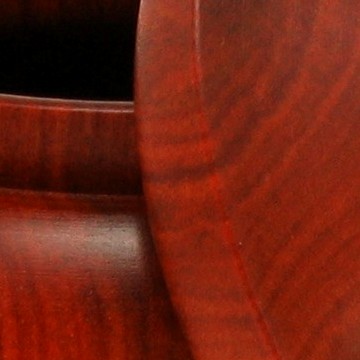
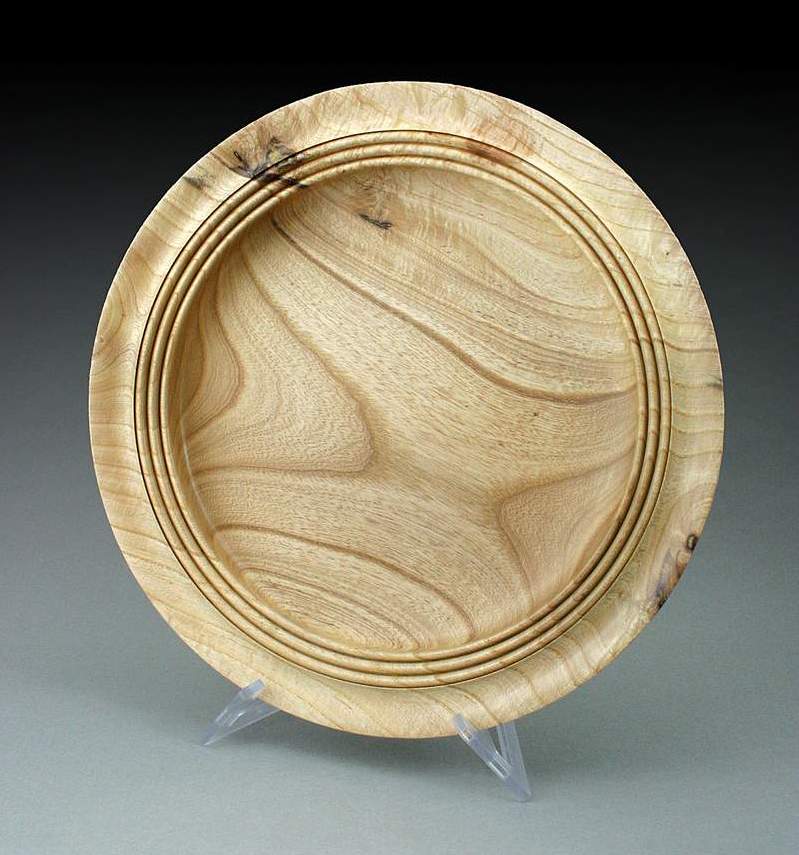
This small "squarish" dished platter is an example of how I make good use of both NRS and hand (cabinet) scrapers to smooth bowls, platters, and other turnings.

After the finishing cuts with a gouge or other tools (my favorite is the small Hunter Hercules), the scrapers can smooth the wood surface so very little sanding is required. I can usually start with finer grits such as 220 or 320 or even finer grits. I either sand by hand or use gentle power sanding with a pneumatic random orbital sander.
I want the surfaces to be perfect, or as perfect as I can get them. I won't tolerate uneven surfaces or scratches. Using the scrapers gives me a "perfect" surface every time, with surprisingly little effort.
NEGATIVE RAKE SCRAPERS
After the finishing cuts I use these negative rake scrapers to remove most of the tool marks. I ground these from Thompson scrapers and a skew chisel.

I grind the top and bottom bevel exactly the same, creating a 60-deg included angle. Grinding the top and bottom angles the same lets me use them either side up as needed without regrinding, simply by changing the burr.
Since there are no forces involved in use, I use them hand-held without handles. I also grind the tang to give me a few smaller negative rake scraper shapes for free.
I sharpen these on a 600 grit CBN wheel, hone off any burr from the grinder, then raise a burr with a burnishing rod. I mark the top side with a "T" to keep from picking up the wrong one. As the burr wears, I hone it away and raise a new burr a half dozen times before going back to the grinder.
I've seen other turners use scrapers like this but none ground with a short "almost" flat at the end. The combination of the side curve and the end flat lets me work on surfaces that are curved and almost flat.
These scrapers are use horizontally with the flat firmly on the tool rest. When properly sharpened and used gently they can remove the lightest whispers of shavings.
The bottom of the small platter is a good example. The first photo shows smoothing a curve on the bottom. The second shows using the flat on the wings of the squarish shape. I found this smoothes the wings far better than using a curved scraper.

HAND SCRAPERS
For me, smoothing with hand scrapers has some big advantages over rotary power sanding. For one thing, I dislike the clouds of dust from coarse paper disks on an electric sander. The scrapers make savings instead of dust and the finer grits on when sanding by hand or by the ROS produce little dust.
The biggest advantage is the scrapers can remove tool marks quickly without compromising the surface. Power sanding with coarse grit can abrade softer areas of the wood quicker than the harder sections. A curved hand scraper doesn't.
Hand scrapers will very quickly smooth away any ripples or undulations. Common center defects like small mounds or dips are easily removed.
I use several types and shapes of hand scrapers. These are some of my favorites (the grid spacing on the mat is 1 cm squares):

The one with gentle curved edges at the center left gets the most use on the inside of the small dished platters shown above. The smaller scrapers above are good for tighter spots such as inside a bowl, under a rim or around a foot. Some with flat edges are helpful on convex surfaces such as the bottom of a platter or the outside of a bowl.
The three at the bottom of the photo are from Stewart MacDonald, often bought by people who make guitars and violins. They are made from 1/8" thick tool steel, sharpened on a grinder and used without a burr. These are fairly expensive but are extremely useful in some cases.
The top two rows are from thinner, somewhat flexible steel. I grind these to shape from traditional cabinet scrapers – the higher quality and thicker scrapers are better. Shaping with a belt or disk sander heats them less than a bench grinder. To sharpen, these scrapers are ground, filed and/or honed, then a burr raised with a burnishing rod. More about sharpening below.
USING THE HAND SCRAPERS
These photos show one of the most useful shapes for smoothing the top surface of the small dished platters. Always scrape "downhill" relative to the grain, which on the top/inside means from the outside towards the inside. Often, scraping somewhat diagonal to the grain works better.
I use these with the lathe off and the piece removed from the lathe. Removing the piece make it FAR easier to see any defects than it is when bending over to look while the piece is mounted on the lathe. I keep the piece in the chuck and mount the chuck on a carving and finishing post (from Best Wood Tools). This mounts in the banjo at the lathe or in a bracket fastened to a workbench. The post allows the piece to be tilted and rotated easily. Before I got the post I still took the piece off the lathe and held the chuck between my knees while scraping and hand sanding.
The pictures, clockwise from left:
- the scraper
- scraping downhill
- using my fingers to protect the edges
- scraping a problem spot with an end of the scraper

I made several of these scrapers with different curves and choose the one that most closely matches the surface.
After scraping I wipe Naptha over the surface and look at it carefully in a strong light, moving the piece so the light comes from different angles. This makes it easy to see even very small surface defects.
SHARPENING HAND SCRAPERS
I sharpen the hand scrapers with a 600 grit CBN wheel. To make the edge exactly perpendicular to the sides I made a jig from 1/8" plexiglas (the top one at the left). This lets me easily set the tool rest on the grinder. I gently grind the sides of the scraper being careful not to overheat the steel.

After grinding, I use an extra-fine diamond hone to smooth the edges and the sides to remove any burr from the grinder. I use the carbide burnishing rods on the right to raise the burr and restore the burr when it gets dull.
>>> An article in the December 2018 issue of Fine Woodworking (page 20), "Sharpen and use a curved scraper" has the best instructions I've seen for sharpening a hand scraper. Author Peter Galbert not only explains how but why it is important to keep the edge precisely perpendicular to the sides and why the edge needs to be smooth. He also confirmed what I've long suspected, that raising the burr with a burnisher work-hardens the burr making it last longer.
ABOUT SANDING
When I do power sand, I usually use this Grex pneumatic random orbital sander with 2" disks. Sometimes I use 3" disks on a palm sander I bought from Woodturners Wonders. Both of these sanders can be used at reduced speed for very gentle sanding.


---------------------------------------------------------------------------------
JKJ