WoodCentral Forums

Est. 1998 — 27 years of woodworking knowledge

Bowl Transituation

Posts

Bowl Transituation

#1

Bowl Transituation

Jerry Lear

I have been turning for awhile but still have trouble on the inside of the bowl on turning onto the transition and across the bottom.� I use a side ground bowl gouge with a 60 degree bevel and the heel is relieved.

I know this is end grain but I was hoping someone could give me some pointers to help control the tool when making the transition.

Thanks

Re: Bowl Transituation

#2

Re: Bowl Transituation

david

I have in recent years used a 1/2" Thompson V-profile bowl gouge sharpened using Kirk DeHeer's sharpening protocol on a Wolverine Jig with a 55 degree angle. Recently started using a traditional grind similar to what Mike Mahoney calls a "bottom feeder", but this has not been an easy transition for me as am used to what worked for me in the past. I turn a lot of calabash shapes, and usually stick with one gouge, that mentioned first above. I think it is all in the angle of approach to the wood at any only point, and am over the bed of the lathe a lot to get at the transition between the walls and the bottom. I also clean up this area with the flute of my gouge at almost 9:00 o'clock position in a pulling cut. Final touch up with a teardrop scraper helps remove tool marks starting in the center, flipping the scraper in the transition area when needed for tip clearance.

Re: Bowl Transituation

#3

Re: Bowl Transituation

Ron Bauer

Use a round nose negative rake scraper and end your worries. You can get a hint of how usefull it is by laying your skew on its' side. It is a form of a NR scraper.

Re: Bowl Transituation

#4

Re: Bowl Transituation

john lucas

Jerry This is a common problem with new turners and even long time turners. It has to do mostly with the shape of the bowl. If the side turns abruptly into the bottom what happens is you reach a point where a normally ground gouge of 55 to 60 degrees can't rub the bevel through that point. I used to get around it by turning from the center out to the transition area, then turning from the lip down and then gently trying to clean up the transition area with a small scraper. Actually early on I did it with the gouge. If you hold the gouge so the handle is higher than the cutting edge and the flute is toward the wall and your gouge has a swept back wing, the lower portion of the nose and part of the wing acts as a scraper. That's not what I would recommend but I did it for many years because I didn't know better. Sometimes I would get a catch and sometimes not and I didn't understand why. Many years later when teaching I realized that I had been accidentally raising the handle as I went through that area and it was scraping. If I didn't raise it I got a catch.

What I recommend today is a couple of things. A negative rake scraper is excellent for this. There are lots of articles you can find by doing a search here for negative rake scrapers. The method most serious turners use is to regrind a gouge to a more blunt front angle of 70 or even 80 degrees. This steep angle is what many call a bottom feeder and is designed to cut this steep angle with the bevel rubbing. My favorite tools for this is a Hunter #5 carbide tool. It does take some practice learning to rub that short bevel but will cut super clean once you learn to use the tool.

The best thing to simplify this problem is to simply design your bowls so they have a more open flowing curve from the lip the bottom. Then your 55 degree gouge will rub the bevel all the way to the center and you won't have the problem

There was an excellent article in a magazine a year ago or so about turning what we affectionately call a Dog Bowl or a bowl with steep sides and flat bottom. Can't remember the ladies name off the top of my head but it was a great article. I'll try to look it up.

Re: Bowl Transituation

#5

Round-nosed Skew *LINK*

Doc Green

Jerry,

The following is a link to an article which describes a scraper with a 35 degree included angle that excels at what you are attempting to do. I jokingly refer to it as a round-nosed skew. It is good for tweaking a surface to get the exact shape you want.

It is described about mid-way through the article.

Even though I call it a scraper, it does not scrape; it cuts and make shavings. I would suggest you give it a try. ~Doc


Link to article on negative rake scrapers

Re: Bowl Transituation

#6

Your bowl design has a lot to do with tool choice.

Dick Coers

If you are turning more vertical walls and big flat bottom (dog bowl style), the transition is a lot tougher. Long radius sides and small percentage of flat on the bottom is a lot easier. I hardly ever have a flat on the inside of the bowl, and if I do, it's hardly ever bigger than 2". That's on a 10" bowl.

Re: Bowl Transituation

#7

This is a good application for a......

JamieDonaldson

......Hunter #5 tool with the carbide cutter used as a bevel rubbing tool. That quick inside transition from side to bottom can be especially problematic with a calabash shape.

Re: Bowl Transituation

#8

Re: Bowl Transituation

philip f Duffy

A simple, low cost round nose scraper will serve this quandary of yours perfectly. And, with a little practice, you will learn to roll the cutting edge up at a nice angle and slide it right around the corner from the center of the bowl to the edge. A scraper is a beautiful thing and we can all learn many uses for this old and tried tool. I have several, some made by me at a whopping cost of $0.001. Philip

Re: Bowl Transituation

#9

Re: Bowl Transituation

Don Stephan

First, as I turn the inside wall in stages, I no longer stop a stage in the transition itself - almost impossible for me to make the continuation from there.

Second, as already suggested the transition needs to be a large enough radius to make a smooth transition. Third, the tool rest needs to be as close as possible to the transition. I've had good luck angling my 14" tool rest into the transition so that I can cut beyond ideally a couple inches.

My 5/8" bowl gouge has a 50 deg bevel and in salad mixing bowls I'm guessing my typical transition has a radius of about 4". I do make smaller bowls with a radius perhaps that of a ping pong bowl, but these bowls aren't very deep.

Re: Bowl Transituation

#10

Re: Bowl Transituation

Barry L Elder

The easiest way is Practice, Practice, Practice, Practice, Practice! Nobody can tell you or show you or lead you, you have to practice. :D

Re: Bowl Transituation

#11

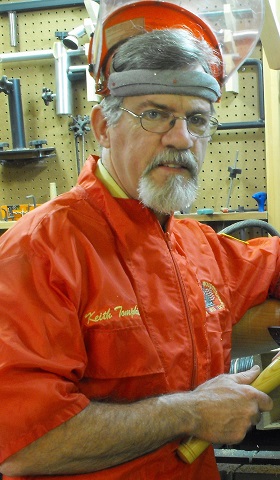
Keith Tompkins

Re: Bowl Transituation

Keith Tompkins

The easiest way is to eliminate the transition altogether; as a bonus, you get a more attractive bowl!

Re: Bowl Transituation

#12

Ditto what Kieth said.


👍 This page answered my questions

Your vote helps other woodworkers quickly find the answers and techniques that actually work in the shop.