WoodCentral Forums

Est. 1998 — 27 years of woodworking knowledge

Tailstock sliding, engineering design ?

Posts

Tailstock sliding, engineering design ?

#1

Tailstock sliding, engineering design ?

Dick Coers

Do you think that the lathe designers limit the amount of grip on the tailstock design to keep thrust loads at an acceptable limit for the headstock? They sure keep a short handle on the tailstock clamp on smaller lathes, and in the case of Jet, keep the area of the gripping washer under the bed very limited. I changed mine to a square piece of steel for more gripping area, but I also replaced the bearings once. Think we are exceeding design parameters by cranking down on the tailstock and changing the tailstock clamping design to reduce slippage? Oneway has an incredible clamping system on the tailstock, but they also have the bearings in the headstock to match. Just curious.

Re: Tailstock sliding, engineering design ?

#2

Re: Tailstock sliding, engineering design ?

john Lucas

There are a couple of issues here. One is the banjo surface meeting the bed and the other is clamping devices are too small such as on the Jet and other mini lathes. I replaced the clamp on my Jet with a rectangular one I made. It increase the clamp area from about 3/4 square inch to about 2 square inches or more. The base of the banjo could be larger which would also help this.

The tailstock has the same issue on many lathes. Here again the mating surfaces may not be flat or parallel to the bed. The clamping device is too small and the threads on the quill are too small. Many of us (me included) have gotten use to using the tailstock to seat the drive center into the wood. On standard threads like 99 percent of the lathes have his will wear the threads. The reason is the threads are ramp shaped (think 60 degree thread face) so cranking the quill feed really hard either wears out the male thread rod or the female thread in the quill. Powermatic solved this problem on the new 2442 by using Acme threads that are square shoulders.

there is actually another problem that creeps in on many lathes. The tool post lock in the banjo. If not tighted really hard many of them will slip. This is dangerous. I think a better locking mechanism should be used here as well.

Re: Tailstock sliding, engineering design ?

#3

I was looking at the new Laguna Revo ......

JamieDonaldson

....lathe recently at the local Woodcraft store, and noticed the manner of locking the tool rest. It is secured by cranking down a screw handle in a slotted sleeve that completely surrounds the rest post, very secure as long as some gorilla doesn't over stress the casting.

Re: Tailstock sliding, engineering design ?

#4

Re: Tailstock sliding, engineering design ?

robo hippy

I remember hearing some time back that one reason for not being able to totally get the tailstock locked down was the gorilla factor (thanks for that one...). It was/is actually possible to damage bearings and the headstock when too much brute strength is applied.

Getting the tool rest secure is an issue. I have never had success with the set screw type, even with my 3520A when I added another set screw. A longer lever is little improvement. I do think the sliding wedges on the Robust is better than the set screws. Not sure how to improve it from there. I have thought that a cam lock type set up might work, but can't make one.

robo hippy

Re: Tailstock sliding, engineering design ?

#5

Re: Tailstock sliding, engineering design ?

jake niedling

I designed alot of equipment over my career and in my opinion, the load the tailstock might place upon the bearings would not be a design criteria for the tailstock. It would be a design creteria for the bearing selection. The first and most important design requirement would be the tailstock sliding and locking. It is very critical for lathe safety that the tailstock lock ( as we all know). I think that either due to the manufacturing of the parts or a poor design, the tailstock slips. Things like chips getting under the tailstock clamp plate is frequently a problem and prevent the tailstock from clamping properly. So keeping these chips blown out regularly is a good idea. Bigger clamps plates are not always the solution. If the surfaces are not parallel or there is a rough edge, then you only get point contact. When you buy a quality lathe, these kind of issues are usually not a problem.

Re: Tailstock sliding, engineering design ?

#6

Blueprinting a lathe

Geoff Whaling

I tend to agree with Jake, however the better lathe manufacturers over size their bearings.

Some of the economy lathes have terrible designs and even worse quality control. Actually having a look at how well castings are made and machined and finished can tell a lot about the performance of the components.

Some lathes can be improved significantly by "blueprinting" if the fundamentals are there, others are simply basket cases and shouldn't even be on the market!

Re: Tailstock sliding, engineering design ?

#7

machinery designers

Dick Coers

I'd suggest that nearly all tailstocks will hold the live center in the wood just fine. But not work as many would like, to set the drive spur or to use with a safety center to drive the stock. I may be nibbling around the edges of a subject, do the designers of the low end lathes have an idea how the tailstock is actually used? Pretty sure I've never read, "Crank the wheel on the tailstock until the drive center is buried into the end grain of the spindle." "Then continue to crank the tailstock as you turn until the sound of the bearings change." I've seen it done very often! Very often during my last visit to SOFA.

Re: Tailstock sliding, engineering design ?

#8

And I cringe when I see turners.....

JamieDonaldson

......hammering turning materials onto drive spurs while mounted in the headstock MT spindle! Not the way to treat good spindle bearings! :(

Re: Tailstock sliding, engineering design ?

#9

Re: machinery designers

john Lucas

Dick I think I oversimplified how I seat the drive spur. I think I learned it from Lyle Jamieson. I tighten the tailstock a little, Then I lock the spindle and rock the turning. This enlarges the how for the drive center teeth. Crank the tailstock in some more and do the same thing. 2 or 3 times usually seats the drive center all the way and doesn't put as much pressure on the tailstock quill screw.

I've seen the same thing you have where they just crank and crank until the drive center is seated. not good for the tailstock quill screw or the headstock bearings I suspect.

I repaired a tailstock for a guy once. The drive screw instead of having threads that were 60 degrees on both sides it was like 30 on one side and 90 on the other. The threads were that worn from cranking too hard. It could have been that the threads weren't hardened properly.

Re: Tailstock sliding, engineering design ?

#10

Re: Tailstock sliding, engineering design ?

Roger Chandler

This is a great thread Dick, and the responses of the knowledgeable turners gives so much helpful information. Nice to see this level of expertise!

Re: Tailstock sliding, engineering design ?

#11

Does anyone oil their lathe?

Pete in Holland MI

A lot of these wear issues can extended with a few drops of oil from time to time. Anything that moves/slides/screws/rotates will benefit with routine lubrication maintenance ( other than sealed bearings). It also enhances locking mechanisms by not wasting your arm's effort with mechanical friction.

Also, when's the last time you greased the lead screw on your bench vice, a highly disregarded but used piece of shop tooling?

Pete

Re: Tailstock sliding, engineering design ?

#12

Oiled my step ladder . . .

Doc Green

and it helped it tremendously! No joke.

Re: Tailstock sliding, engineering design ?

#13

Re: Does anyone oil their lathe?

john Lucas

I periodically do maintenance on the lathe taking some pieces apart and putting some lube on, then wipe it off. I do this on the tailstock frequently. The banjo gets wiped down but not disassembled. Most other parts get cleaned and wiped down weekly.

Re: Tailstock sliding, engineering design ?

#14

Re: Does anyone oil their lathe?

John K Jordan

I like to use a dry lube.

Re: Tailstock sliding, engineering design ?

#15

Brad Vietje

Re: Tailstock sliding, engineering design ?

Brad Vietje

Just throwing one in from the cheap seats here...

David Ellsworth used to encourage all new lathe owners/users to turn some wet oak, and pile the shavings on the bed and leave them overnight. Come back the next morning and sweep them away to reveal a rusty bed. Spray with WD-40 and clean up with wet-dry paper to get rid of the new tool shine and replace it that old tool gun metal grey -- almost silver. Grip improved.

Now, these days, the better made lathes don't have the same problems the mostly spindle lathes of the 60's and 70's had when used for bowl work, but apparently some of the castings don't have enough surface area, and some lower-priced gear is not well machined, leading to poor contact and grip.

My lathe (PM 3520B) grips pretty well as far as moving headstock, tailstock and tool rest banjo go, but the single screw holding the tool rest post is inadequate, and the design is just not up to the same standard. I'd like to see them make an improvement there. And since I turn a lot of wet wood, and I often have condensation issues as the weather changes, the bed has been oxidized and cleaned up a number of times and I'm perfectly fine with that. WD-40 and Scotch Bright pads are kept handy.

Safe spinning,

Brad Vietje

Newbury, VT

Re: Tailstock sliding, engineering design ?

#16

Re: Tailstock sliding, engineering design ?

Dave Paine

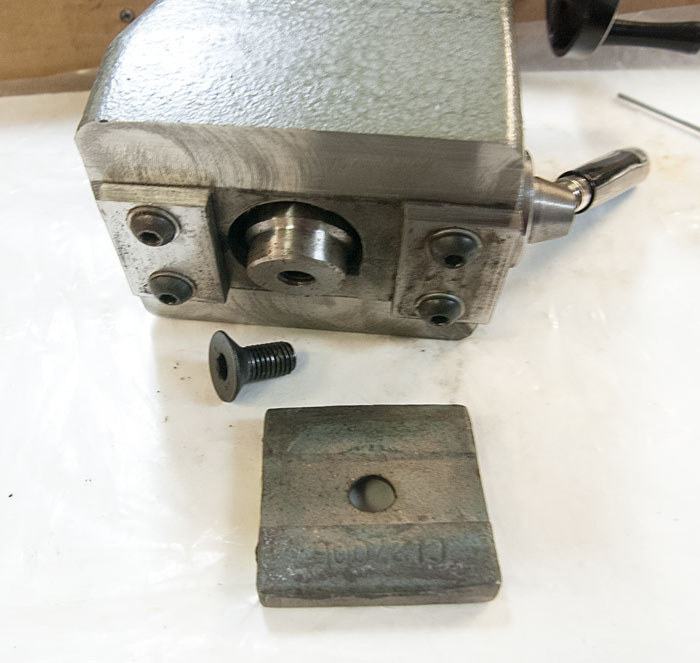
I do not know the designers intention for the tailstock locking plate on my NOVA DVR XP. This thread had me look at my locking plate. Same plate as on the banjo which I knew was not making much contact. I have a renewed frustration with Teknatool manufacturing, and perhaps design.

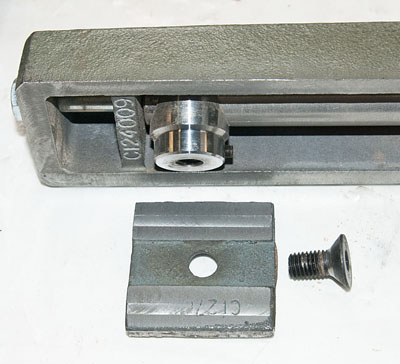
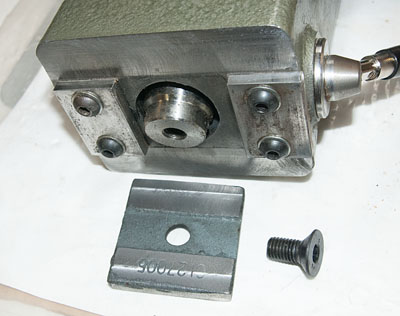
I took my locking plate out. 8mm hex key for the big screw, but there is a 3mm set screw in the tailstock hub which must be removed BEFORE loosening the big screw.

The locking plate removed. The small set screw is not showing in the picture.


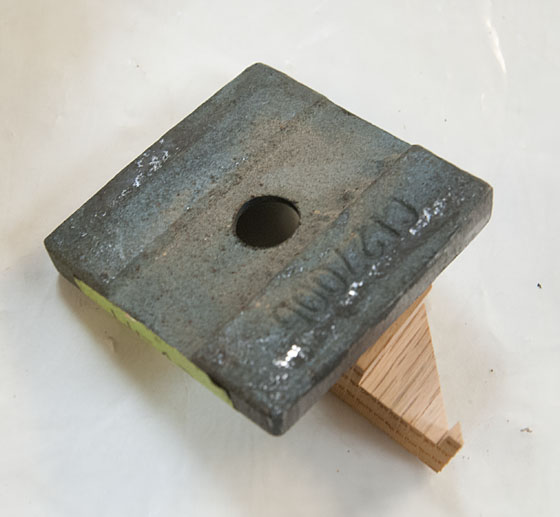
I tilted the locking plate so I could show the minimal contact the plate has been making with the underside of the bed rails.


A quick sanding with 100 grit paper on a granite slab. This is to show the potential improved contact. I will take tailstock and banjo locking plates to a friend with a mill to cut better contact areas.


Now that I have a metal lathe, I have been more aware of oiling parts of the wood lathe.

Re: Tailstock sliding, engineering design ?

#17

Re: Tailstock sliding, engineering design ?

Dick Coers

Wow! Surprised they used a cast piece for that. Putting all that pressure through a flat head screw doesn't impress me either. Hopefully it's not a brittle casting!

Re: Tailstock sliding, engineering design ?

#18

Re: Tailstock sliding, engineering design ?

Philip Duffy

Just to add to John's comment; the handle on the tail stock of a Jet must be moved forward, not to the rear, in order to get a max grip. I know not why, just that it is what it is! Phil

Re: Tailstock sliding, engineering design ?

#19

Reducing manufacturing costs

Geoff Whaling

Dick has a point about the stress placed on one countersunk socket head cap screw.

The photos prove that Teknatool places far more emphasis on reducing manufacturing costs than it does on tool longevity and ease of use in service.

One thing with that design though - it will permit the tail stock alignment to be adjusted relatively easily.

Re: Tailstock sliding, engineering design ?

#20

Re: Reducing manufacturing costs

Dave Paine

Dick has a point about the stress placed on one countersunk socket head cap screw.

The photos prove that Teknatool places far more emphasis on reducing manufacturing costs than it does on tool longevity and ease of use in service.

One thing with that design though - it will permit the tail stock alignment to be adjusted relatively easily.


I agree Teknatool are looking to save small monies on the manufacturing.

The tail stock alignment is not as good as it looks. There are two plates which are oriented between the lathe bed rails. They can be adjusted to touch one of the rails, but not both.

I have to adjust one plate to touch closest rail and the other to touch farthest rail. I then have to remember to twist the tailstock so the relevant plate touches the relevant rail. More slop than I desire if I forget to twist the tailstock.

Today I took the banjo and tailstock to my friends shop so we could machine the locking plates to be flat.

The banjo plate after machining. Took off about 40 thou on the high side.


The tailstock plate after maching. Took off about 15 -20 thou on the high side.

Machining cast iron is easy, just messy. Lots of small chips.


The metal removed is what I would expect to be machined from a cast item prior to putting into service. Shame on Teknatool for crappy manufacturing.

The banjo and tailstock are back in place and both now feel to be a much stronger contact with the lathe bed rails.

👍 This page answered my questions

Your vote helps other woodworkers quickly find the answers and techniques that actually work in the shop.