Thank you John, cracked wood is firewood
Re: Obtaining Good Wood for Turning
#26
Knowledge You Can Build On — Est. 1998
Thank you John, cracked wood is firewood

Phillip
Barry Rockwell
Email me. I would like to discuss trading some wood, like mesquite for ??? I will be gone for 2 weeks beginning Sunday (Norway Woodturning Cruise) but maybe we can put something together when I return.
Re: Cracks / grain pattern / who cares?
phillip Medghalchi
Betty, thank you. I am with you on that. the main purpose of the ware or the item we make dictates the quality of the final product. The again, choosing and selecting the right wood is another subject that needs to be learned and perfected for us just like learning how to use the skew properly that most turners fer about. I know there are some very knowledgeable turners here that they earn living by studying or even teaching the properties of wood. Of course the locality and species of the wood in different area dictate their behavior when it comes down to tooling them for final shape also.
Re: Phillip
phillip Medghalchi
Barry, check your email, plz. I just sent you info.

Barry, have a great trip!
Mike Stafford
Enjoy yourself and be safe.
Re: Obtaining Good Wood for Turning
Keith Newton
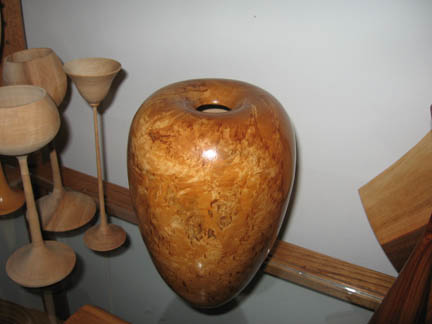
Brad, I like to get the wood from really mature large trees, so I'm always keeping my eyes on old cemeteries. I've got 3 within a mile of my shop, and have gotten trees from all of them. Real large trees will have a lot more interesting characteristics than smaller trees, but there are certain places which will be even more dramatic.
For hardwoods, the underside of where large, usually lower branches grow out at 90º or less, will produce lots of curl or fiddleback figure under the turn. The same is true at the stump where the roots turn out. Another place that is easy to overlook, at least around here where every 10 years or so, we have big ice storms that will lay saplings over, which then turn back up, will produce crazy grain under the bend as they get older and larger.
I suppose everyone knows that as a tree grows, the cells just under the bark, in the cambium layer divide adding layers upon layers to the outside. What happens over time, is that where there is an abrupt change in direction, or even long curves, those which were growing up, start getting crowded down their length by the ones going out, as well as those going out are getting crowded also. So they start to deviate in order to gain room, producing lots of figure.
Old home-places usually have large trees dying from old age, and or loosing limbs to storms, and not having the vigor of youth to recover. I try to find family members who grew up at these places to get permission, which is also a good way to pick up potential customers. I'll say something like how valuable it's shade was back before air conditioning, and families would gather to make homemade ice cream. I try to get them to remember the good times, then show them some photos so they know what I intend to use it for. The suggestion of having a nice piece in their home as reminder from those good times comes in handy at closing the deal.
Funny,,,,, or NOT actually, I've gotten a couple of walnut and cherry trees form an old place lately, with a couple of greater than 4' WOaks, and Sycamore offered to me. But back when this was a good working farm, the dad came home drunk one night,and chased mom out into the highway where they were both run down by a big truck. Their offspring would need to win the lottery to afford my work, so there won't be any sale to close with them. ha


