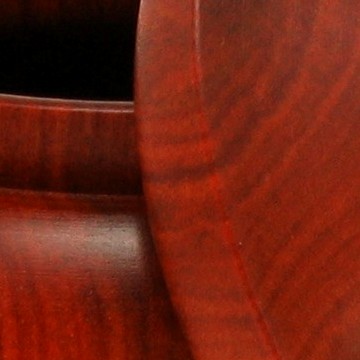
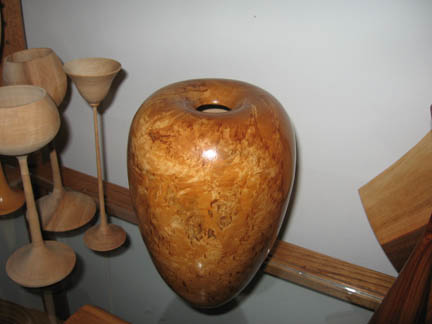
Been kicking around what I am going to do with this... want to make something that will last. I need to fill a crack and fill a hole where a knot fell out. Pinky sized hole.
Steve, I am glad you posted this question. I also have several that suffer the same problem. While I have not done it yet I am contemplating making a tapered reamer then matching plugs. I will never match the grain but it will be a "design" opportunity. I also look forward to seeing others solutions. R.
Is that some of the storm cherry? I use ground red shale and epoxy on cherry. Good colour match and have had no problems with it shrinking or anything. Could send some with one of our club members to TT at the end of the month. I can't go as we are hosting Mike Hosaluk that weekend.
I'd drill out the hole and use a tapered reamer. Turn a tapered pin of dark wood, and epoxy that in. For the void, dried used coffee grounds and epoxy.
If I want it to look like a knot I mix black powdered aniline dye with epoxy. I place painter's tape on the outside of the bowl covering the hole and position the hole so that it is bottom dead center. I pour in the epoxy until the hole is filled. Use a toothpick to poke at the epoxy to make sure there are no air bubbles.
Allow the epoxy to harden at least 24 hours then sand and finish like the rest of the bowl. It is very durable stays in place really well.
It works great and has been used for many year to fix cracks and knots in mesquite. Once finished the epoxy look like a black knot.
Use Duco cement (airplane glue) with some fine wood dust from sanding the bowl. Mix and apply. Dries quickly, sand as normal, does not stain wood like CA tends to do on some woods. Works for me!
I have had very good luck mixing coffee grounds with epoxy. Use good epoxy with at least a n hour of set time. Use some masking tape on the back side so it does not run out. It looks very much like a bark inclusion.I have this patch on a salad bowl that we have used regularly for over five years
Steve, I use a product named QuikWood. It's a wood repair epoxy putty, and comes in light tan and dark brown. You can also add dye to alter the color. I use it to fill voids, cracks, etc. You can either have it contrast with the wood you're filling or make it match. Doesn't stain or bleed into the wood you're patching. Easily sanded smooth and takes any finish like wood. Very good fix for the application you're looking for. Got it at Rockler but I know other places carry it. Try it, you'll like it.
Drill out the hole to round for easiest fit. Any wood in your box that has a tight pith (resembling the piece that came out) will do...turn it to fit the hole and glue it it. sand to finish. Oila!
Steve what I often do is mix a little color in the epoxy but I leave the epoxy mildly transparent. Then it picks up some of the color from the wood. For large holes like you have I will start the fill with a darker wood that will resemble the knot, then may use the coffee grounds and or my transparent epoxy. Of course sometimes I just go with black epoxy. Haven't had any failures filling gaps and holes.
I have had some failures due to wood movement when I use the epoxy as a ring around the outside. If it's captured in a groove it doesn't fail but I used it as an outer rim on a 12" platter to see what would happen. After about a year it came loose on one side and after 2 years simply fell off. It's obviously not as flexible as wood but when captured in a groove or used to fill a gap works very well.
I use Apoxie Sculpt. I think that it is an Epoxy modeling clay primarily directed at the taxidermy industry. Comes in multiple colors, but I use black for most repairs. Must be mixed very well and then mixed some more and then I allow it over night to cure. It is available from multiple sources on the web.
If you are trying to patch a hollow form where you cannot easily reach the defect from the inside, blow up a balloon inside to act as a backstop. After the patch sets, pop the balloon and remove.
It would have been nice to have the knot as that would be much easier to use to seal the hole.
I have used Devcon, Loctite, Gorilla brands of epoxy.
I like to overfill the void a little and then skim off the excess with a scraper or gouge. Then sand and finish as you usually do. I have never had a failure with epoxy. I have even used it to glue sections of crumbly manzanita burl back together during turning.
Epoxy is usually harder than the wood so if you try to sand it flush you almost always get a dip around the epoxy, or at least an unlevel surface. Using one of the round cabinet scrapers you can get it flush and then sand it with finer grits to avoid the lumpy surface.
Probably going to go the epoxy and ground bark route. I have plenty of cherry bark available, so making something that looks like a proper knot will be pretty easy.