Home Articles Forums Gallery Marketplace Videos

WoodCentral Forums

Knowledge You Can Build On — Est. 1998

THE WOODRAT IS BACK!

mind the cobbles...

Posts

mind the cobbles...

#1

mind the cobbles...

GaryG in MD

A number of years ago, when we were visiting Edinburgh Castle, we had an excellent guide who was very knowledgeable and also funny. He really knew his trade, which included keeping his little flocks from stumbling on the uneven, stony streets while paying more attention to the sights than to their feet. He would just say "Mind the cobbles." It has stuck with me as a phrase meaning 'Don't forget about details when paying more attention to the big picture.'

Well, I didn't mind my cobbles this week when I was in a rush to complete a piece for a club challenge. We were tasked with making rolling pins. I researched cooking sites online and found that the French version is preferred by far. Great -- that's by far easier to make quickly than the American version. I needed a 22-inch piece of attractive wood. I looked in my stash and found a beautiful piece of very unusual variegated padauk that I got on eBay many years ago. It was perfect for the project, so I used it.

I had this little voice in my head saying something about padauk maybe being a sensitizer, but in my haste, I didn't look it up in my toxic woods database.

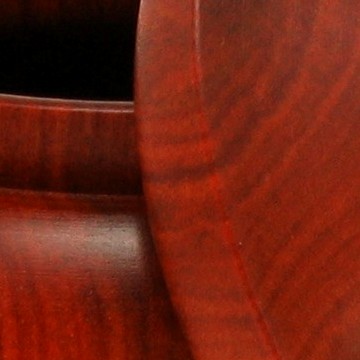
So now I have a gorgeous French rolling pin (photo) and little blisters on my hands, in my scalp, and down my back. Just like poison ivy! I'm itching like crazy. Now I look it up, and it's red lettered all over the place. It's as bad as cocobolo!

If you turn padauk, either don't, or take lots of precautions not to get it on your skin. Thankfully, I sanded it with nitrile gloves and a dust mask on, just on general principles, but then I wet sanded it with Watco Danish to fill the pores and later had to handle it before the oil was dry. The sanding dust was in the oil and got on my hands, with which I scratched my back. Now my back has lines on it. The combination of the exposure during turning and handling it later was enough to push me over my threshold even though I had never been in contact with padauk ever before.

The moral of the story is to look at the toxic wood database first (!) and then best reconsider turning the bad ones.

So I'm on Benedryl and still getting itchier and bumpier. I'm not sure for how long this is going to go on, but it could be weeks if it's anything like my reaction to poison ivy. It was not worth it! Lesson learned -- stick with local woods.

...GG

Re: mind the cobbles...

#2

Mike Stafford

Re: mind the cobbles...

Mike Stafford

Gary, padauk is the only wood I will never turn again. It started to affect my breathing and I stopped turning it. Your reaction is much worse. Hope you feel better soon.

Other woods may be added to my do not turn list in the future but padauk is no longer in my inventory.

Re: mind the cobbles...

#3

Steven Antonucci

i bet your paduak is tulipwood (a rosewood)

Steven Antonucci

Pretty sure that is your issue. Looks like tulipwood, as Paduak tends to have more of an open grain. Tulipwood is a rosewood... and would explain your sensitising reaction.

Welcome to the club.

Steve

Re: mind the cobbles...

#4

Mike Stafford

Could be, could be....

Mike Stafford

although I have seen padauk that looked similar.

Gary, did it smell sweet and floral as your were turning it? If so it was more than likely tulipwood.

Did the dust from sanding stain your hands and clothes like a dye? If it did it was more than likely padauk. Padauk has an astringent odor to me.

Re: mind the cobbles...

#5

NOW you tell me!

GaryG in MD

Thanks for the acknowledgment, Mike. ...GG

Re: mind the cobbles...

#6

Re: Could be, could be....

GaryG in MD

I'm afraid I wasn't paying attention to the smell.

It's fairly brittle and chippy. No ribbons at all -- just lots of tiny chips.

Sanding produces a very clinging red-orange powder consistent with the color of padauk.

The variegations certainly make me wonder what it really is though.

Whatever it is, I have some more of those beautiful boards. I'll certainly never touch it again!! What a waste. ...GG

Re: mind the cobbles...

#7

Re: i bet your paduak is tulipwood (a rosewood)

GaryG in MD

Whatever it is, it's still spreading and popping out all over my upper body. I'm heading over to the Walk-in Clinic right now to see about getting a cortisone shot. I don't get over poison ivy quickly, and I expect this will be the same if I don't take a pro-active stand. ...GG

Re: mind the cobbles...

#8

I'm in Steve's corner about the Tulipwood.

Re: mind the cobbles...

#9

Harry Robinette

Re: NOW you tell me!

Harry Robinette

If you have an allergic reaction to any part of the Rosewood Family then YOU are

allergic to ALL OF THE Rosewood. Get a Rosewood family chart and mark the reactions to each one and remember some of the reaction can be SAVIOR REACTION.

Re: mind the cobbles...

#10

Re: mind the cobbles...

robo hippy

From how much it spread over your body, I am curious if the dust collector was on when you were turning and sanding???

robo hippy

Re: mind the cobbles...

#11

Robo,

GaryG in MD

I turn outside only, so Mother Nature is my dust collector.

I got the chips from the roughing on my bare hands initially.

I also used the SRG for the final cuts, except for a little spindle gouge action on the ends.

I think the chips, which I didn't expect to be a problem (because I hadn't done my research properly!) began my journey to sensitization.

I sanded with a dust mask and nitrile gloves. The wind blew it onto my smock, jeans, and into my hair. It's a bright reddish brown and insidious.

I washed both me and my clothes after the fact, but undoubtedly more damage was done along the way.

The next day, I wet sanded to fill the pores, again with nitrile gloves.

It's cool in my basement, and the oil didn't dry completely overnight, so the next day I wiped it down with a paper towel to get some of the residue off that I hadn't wiped too hard originally, not wanting to take it out of the pores.

Unfortunately, I did that without gloves on. My bare hands had an oily residue on them. I think that's what did the damage.

I had unknowingly become sensitized from the turning and sanding.

After wiping it down, I scratched my back and side. The next morning I found a small patch of rash in the palm of one hand, my scalp was itching, and I had red marks on my back where I had scratched myself.

The next day I had a pretty general rash -- either it was a late arriving second-order effect, or it can travel in your blood -- not a doc, so I'm not sure.

The bottom line is that the toxic wood tables clearly list padauk as a very nasty business, and I just didn't do my homework in advance. I would say it's every bit as bad as cocobolo, but not as widely recognized as such.

I've got a lot of these beautifully variegated boards now and can't use them. It's a real pity. ...GG

Re: mind the cobbles...

#12

David, *LINK*

GaryG in MD

You could be right, but it was sold to me by a trusted, reputable supplier as padauk. I know that most of what you see around is one color -- a rusty brown. That's why I bought this -- because it was so strikingly different.

As a result of this conversation, I have looked online and seen rare samples of form with nice grain patterns.

Here's an example: http://www.constantines.com/padauk2.aspx

Now I'll admit that the color variation on my boards is more extreme than this, going almost down to a cream color and all the way up to a dark red. So yes, it really does look more like tulipwood.

I guess it's really a moot point because they're both off the scale in toxicity, and neither should be messed with without EXTREME protective measures.

I guess this means I'm going to have to toss all my cocobolo too -- I have some but haven't turned it. No way I'll touch it now. Shame.

I'll just to make myself happy finding pretty woods that aren't toxic.

BTW, for people who want to know IN ADVANCE if a wood they're considering is likely to be toxic, our club website has an excellent document that I put together from a number of sources:

http://montgomerycountywoodturners.org/Documents/Safety-WoodToxicity.pdf

I recommend that people check it out before turning a new-to-them wood.

It can save aggravation and doctor bills.

...GG


http://montgomerycountywoodturners.org/Documents/Safety-WoodToxicity.pdf

Re: mind the cobbles...

#13

Re: NOW you tell me!

GaryG in MD

Harry,

I assumed this to be the case, but thanks for the warning.

Want some nice cocobolo? ...GG

Re: mind the cobbles...

#14

Steven Antonucci

On a bigger screen... might be padauk?

steven antonucci

Can't see the grain on a cell phone, but on my laptop, it looks more like padauk? Whatever it is, you probably error on the side of caution now (no orange woods?)

Hope Monday is working out better for you?

S

Re: mind the cobbles...

#15

Thanks, Steve...

GaryG in MD

First, yes, I trust this seller, although, of course, people can make mistakes.

Second, yes, it started drying up today. The bubbles in the palm of my left hand, which was my first symptom, have turned dark and gone flat. The steroids are doing the job. Modern medicine to the rescue. I got off lucky this time. Never again. I'll be looking to find a new home for the remainder of this beautiful wood and all my cocobolo.

I have to admit being very sad and disappointed. I love the looks of those woods. They're very special. We have access to dozens of "nice" woods here in the northeast, but we take them for granted, and, frankly, as special as certain (rare) pieces can be, most just don't really hold a candle to the tropical woods. I've got more cherry and walnut and maple and oak and osage orange and dogwood and tulipwood (the new, correct name for what has been called "yellow poplar" in the past -- not the tropical), and hickory and sycamore and black locust and honey locust and elm and ... you get the picture... than I'll ever be able to turn. It's a shame to lose access to the dalbergias, but I'm not going to fool with them again. ...GG

Re: mind the cobbles...

#16

Ellis Walentine

Re: mind the cobbles...

Ellis Walentine

Hi Gary,

I've worked a lot of padauk and a lot of tulipwood in my day, and that rolling pin is tulipwood, if I'm not mistaken. Padauk is in the genus Pterocarpus, which is readily distinguishagle from Dalbergia genus, although African padauk can have sapwood coloration in it. If I could examine your wood, I'd tell you fo sure.

Anyhow, you might not have to avoid genuine padauk, if it is in fact a Dalbergia sensitivity you're experiencing.

Ellis

Re: mind the cobbles...

#17

Thank you Ellis, ...

GaryG in MD

for your usual common-sense reply.

I will have the boards in question looked at by Ed Karch, our MCW Wood ID guru, and we will indeed find out what it really is. And when we do, I will post it here, along with better photos of the boards.

Your point is well taken. I'll never be able to turn dalbergia after this, but "real" padauk "might" still be a possibility.

...GG