Home Articles Forums Gallery Marketplace Videos

WoodCentral Forums

Knowledge You Can Build On — Est. 1998

Exotic Hardwood, Personally Sourced Worldwide. Inspected at Origin. Shop Rare Stock.

finishing with lacquer

Posts

finishing with lacquer

#1

finishing with lacquer

eliot d

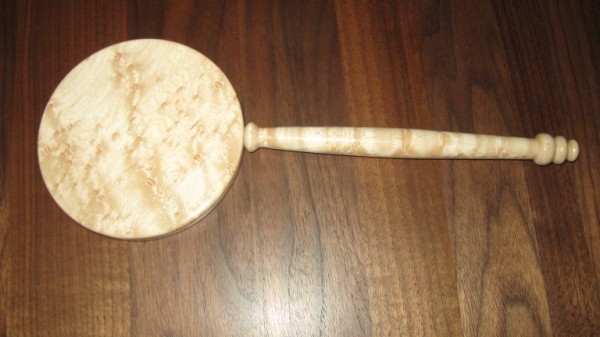
I'd like to get that nice glass-smooth look that I sometimes see when turnings are finished with lacquer( I'm actually thinking about Mathew Hattala(sp?)). So I just purchased some Minwax Clear Brushing Lacquer in the clear gloss variety. And I got some lacquer thinner, too. I do have a HVLP system as well( but I'm hoping that I can just rag the stuff on in multiple thin coats.) Am I wrong about that? Should I exchange it for some spraying lacquer? Can one spray with what I have? Do I need to spray? In the past, to tell the truth, my finishing regimen consists of sanding to very, very high grit and using whatever oils, shellacs, lacquer I have on the shelf with some paper towels. The finishes are O.K. but I really don't think they are anything to write home about. Any good thoughts. please?
Re: finishing with lacquer

#2

Re: finishing with lacquer

Dick Coers

Brushing lacquer has some retarder added to slow the drying, but it still dries fast enough that brush marks will be seen. Spraying it is fine, it will just be a little slower than normal lacquer. Rags or paper towels, unless it's really small, won't work very well. All finishes need to be finished for a perfect shine. Nothing is perfect out of a gun or off a brush. You need to level it with really fine (600 or finer) sandpaper, then with polishing compounds to make it shine.

Re: finishing with lacquer

#3

Re: finishing with lacquer

bob davis

deft in spray cans is good for smaller projects

Re: finishing with lacquer

#4

Re: finishing with lacquer...an article *LINK*

Doc Green

Here's a method that works for me. It involves buffing with the Beall system, or the equivalent, which, for me, represented a big breakthrough. Good Luck.

http://www.docgreenwoodturner.com/lacquer.html#

~Doc


Article on Applying a Lacquer Finish

Re: finishing with lacquer

#5

Re: finishing with lacquer...an article

Barry L Elder

Our club President, Jack Shelton, has been working with lacquer since he was a kid. His grandfather built custom cabinetry from mahogany and Jack's job was to rub it out. He has taught our entire club, at one time or another, how to get a glass finish on just about anything. You can apply brushing lacquer or spray lacquer but the next step, after allowing the lacquer to cure, is to mount the piece on the lathe at very low speed and wet sand the piece with mineral spirits and sandpaper, starting with 400, 600 and then micromesh through all the grits. If you don't get a glossy, glassy shine, you went to sleep! (It sounds kind of simple, but it's only simple after much practice!)

Re: finishing with lacquer

#6

Re: finishing with lacquer

mjonesrdg

I would definitely encourage you to read Russ Fairfield's "Russ's Corner" found in the "Articles" here on WC's main menu. That short study will help answer most of your questions. I will argue that, while it's true that you can spray brushing lacquer, you must give your brushing lacquer a couple of days to cure...even when it acts totally dry...before applying additional coats. Blistering occurs when you apply lacquer over a lacquer that has not completely cured.

For the deep look you seem to prefer, many coats are required, and spraying is much more efficient with lacquer than brushing.

Re: finishing with lacquer

#7

Roger in MO

Re: finishing with lacquer...an article

Roger in MO

Products and proceedures change. Sixty years ago the process was to sand wet with 400, rub with pumice and oil and finally with rottenstone and oil. I wonder if these are still used?

Re: finishing with lacquer

#8

Re: finishing with lacquer (long)

Doug Turner

For small lathe objects I sand to 600 grit and apply deft brushing lacquer with a small piece of paper towel with the lathe off. Rub off the excess, and then turn on the lathe and friction polish with the same small piece of paper towel for about a minute. Turn off the lathe and inspect. A second coat can be applied immediately if the finish isn't thick enough. For a high gloss wait 1/2 hour and use the Beal buffing system.

For a glass like deep finish you can comb your hair in I use high gloss Watco brand rattle cans from Woodcraft off of the lathe. After sanding thru 600 grit,I aplly a spray coat and let dry for several hours, spray another coat, let dry and repeat until I have about 10 coats applied. Wait 7-10 days for the lacquer to harden fully & then lightly sand all runs,and imperfections thru 600 grit until a uniform mat finish is achieved. I then apply guitar polishing compounds (from Grizzly tools)with a lint free cloth and hand buff. You should be able to comb your hair in the reflection.

Re: finishing with lacquer

#9

Re: finishing with lacquer

John Lucas

Elliot It really doesn't matter what you use the principals are still the same. You apply enough finish to fill all pores or little defects in the wood. Then sand this with finer and finer grits until you have the gloss desired.

What I usually do is apply enough coats to build thick enough to cover all voids. The easy way to know this is to sand with either 400 or 600 grit and look for shiny spots. If you have any you haven't applied enough finish. Once it's totally satin from sanding with no shiny spots apply one more coat.

Let this dry completely and then start working with finer grits. I usually sand to 1500 grit. I usually just hand sand with it off the lathe. It goes very fast after you get the finish level. I then use white rubbing compound and then polish and or swirl remover depending on what does the job.

How many coats it takes to fill the wood depends on the finish. I finished a gun stock with probably 75 or more coats of boiled linseed oil. I put one coat per day from about August until just before Christmas. It was a fabulous looking finish but far too labor intensive.

A thick build finish is Birchwood-Casey's true oil. I can fill Walnut pores with about 8 to 10 coats. This is almost a fool proof finish to apply. It takes me about 10 to 15 coats of Wipe on Poly to get a really deep gloss.

I have trouble spraying lacquer to get a perfectly smooth finish because I'm using a cheap gun and spraying outdoors. about 5 to 8 coats usually does the job but I almost always have a little orange peel so I have to very carefully sand it out with 600 grit finer to get it level. Then I proceed with the hand procedure mentioned above.

Re: finishing with lacquer

#10

Re: finishing with lacquer

Howard

I have always used minwax clear gloss with glass like finishes. I shoot about 10 coats on the project - I give it about 30 min to dry between coats with no problems. I then sand with 220 sand paper to get most of the pits out then shoot another 5 or 6 coats - again giving about 30 min between coats. then hand sand with 320 sandpaper then another 4 or 5 coats. Final sand with 0000 steel wool for a perfectly smooth finish. Then lightly shoot another 2 or 3 final coats for a finish that will give you the glass look you're after. Doesn't work as well in humid or cold atmospheres. Also the number of coats depends on the pores of the wood being finished. Try this process on maple. When finishing laquer on laquer, each coat actually fuses or melts to the previous coat so you'll find laquer finishing is very user friendly. This sounds like a lot of work, but try this and I think you'll be happy.

Re: finishing with lacquer

#11

Re: finishing with lacquer

eliot d

This process appears to be he real thing to me. I will try it. Thanks.

Re: finishing with lacquer

#12

Re: finishing with lacquer

eliot d

Wow! Along with Howard's process and some of the others I can't see how I can go wrong. I'll try some variation of these for sure.