Home Articles Forums Gallery Marketplace Videos

WoodCentral Forums

Knowledge You Can Build On — Est. 1998

If you sell to woodworkers, your customers are already here

minimizing checking

Posts

minimizing checking

#1

minimizing checking

Gary Smyth

Yesterday my neighbor brought me a 10 x 18 solid Locust log. It looks as if it could turn into something. I do not have a moisture meter, but it is wet. Perhaps mistakenly I removed the bark in order to fit it into my band saw at a later date. I painted the total piece with a good house paint to seal it, but now am wondering if I did the right thing. What should I do to minimize checking? I plan on turning this many months from now but....how is Locust to turn? Should I turn it green a bit, repaint, and then set it aside after I get it some what into shape? I'm out of my comfort zone here. Anything better than paint to seal? I don't have a way to paraffin dip or pot?

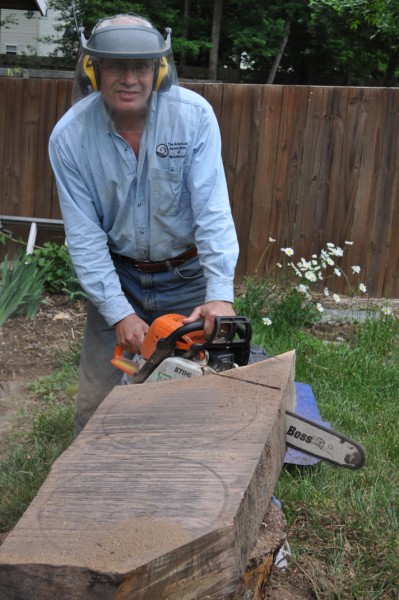
Re: minimizing checking

#2

Leo Cuellar

Re: minimizing checking

Leo Cuellar

I've recently been playing with some green Black Locust, using the denatured alcohol soak method after roughing out. This has prevented any cracking, but I've been having some significant warp issues. This might be due to the fact that my shop sees some significant temperature variations right now because our local weather is varying wildly.

Re: minimizing checking

#3

Re: minimizing checking

Skip Beardsley

I use wood sealer which is a latex/wax emulsion, I think. I have bought it from Craftsupply and Klingspor. Usually coat the log ends liberally with a brush. On open grain woods like ash I usually recoat after it is dried. It is best to leave your logs three or four inches longer than you plan to use so if there is checking you can cut it out.

Hope this helps

Skip

Re: minimizing checking

#4

Aage Rendalen

Nothing beats rough turning it green

Aage Rendalen

If you have the time, I would suggest you process the log now. Roughing out green wood is fast, and checking is minimal (at least if you live in a climate as humid as here in Virginia). I used to slab the trunk pieces and cut out the blanks on the bandsaw, seal the blanks and turn them later on. Now I rough them out right away. I usually bag them for a few days before I store them. Larger pieces I may seal with Anchorseal. It means I'll have less hard, dry wood to deal with when I finish-turn.Green locust stores fairly well. I don't think I've ever lost a blank of it to checking.

As for your log, it doesn't help much to seal the logs on the outside. Only the two ends need to be sealed, preferably with Anchorseal.

Re: minimizing checking

#5

Re: Nothing beats rough turning it green

Barry Irby

I agree with Age. I find I lose most (90%) of the log sections I try to store for more than a few days, but most (90%) of the roughed out bowls survive quite nicely. When I seal things, I use Anchorseal. When I rough turn I usually bag them in paper bags.

Re: minimizing checking

#6

Re: minimizing checking

Darryl

Turn the locust as soon as possible. It turns nicely when green but when it is dry it is pretty close to concrete. It is a very dense wood. I recently turned some green it is easy to work with. DNA it and let it dry on its own. Even after DNA it turns fairly well but is hard. Looks really nice and has a green orange coloration. Beautiful grain. When you let it dry it will check and from my experience even if you paint the ends after splitting out the pith it will check.

When all else fails it makes the best firewood imaginable because it is so dense. Once it is started in the fireplace it makes things so cuddly

Re: minimizing checking

#7

Store green wood?  Freezer.

Greg Haugen

The best and safest way to store green wood is to freeze it. I have many friends who are traditional green woodworkers who have freezers just for wood.

If I'm turning bowls, I either finish turn it green or rough it, seal it, and put it in my kiln.

For everything else; peppermills, ornaments, etc. I'll turn it into cylinders, seal the ends, and put it on the shelf or kiln.

The best way to prevent checking is to use it or freeze it. Everything else is a just a bandaid- it will work for a little time but not for a super long time. The further you process it (cylinders is ok, rough turned is good, and finish turn green is best) the less of a chance it will check.

If you're able to, by freezing it, it will be just as good in five years, if need be, as it is today.

Re: minimizing checking

#8

Re: Store green wood?  Freezer.

John Jordan

Its too late now, but all you have to do is cover it tightly with a tarp. This time of year, it won't even stain or get bugs in it until spring. Saw a few inches off the end, cut your blanks and cover it up.

As was mentioned, processing it is good, and I really like freezing a piece or two of some woods. I have a freezer just for that and keep some variety.

Peeling, painting waxing etc is not the best way, or the best use of one's time. :) What you plan to do with it is the main consideration.
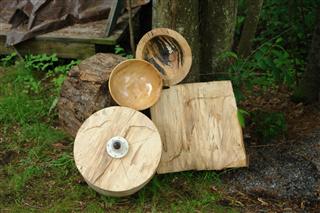
There are a couple of article regarding this on my website.

John

Re: minimizing checking

#9

Re: minimizing checking

Mike from St. Clair Shores

I find that the most important thing to do with a green log is to cut the pith out. After you do this you can cut some bowl blanks on the bandsaw and rough turn them to 10% for a wall thickness. Then coat them with anchor seal. All cracks start at the pith.I cut the log length way about 1inch on either side of the pith.

Once I do this I rarely have to deal with cracks.

Re: minimizing checking

#10

Brian McKearney

Re: Nothing beats rough turning it green

Brian McKearney

I'd agree - rough out at least what you can find the time to process and you'll likely be thankful that you did. Most of the bowls that I have roughed out and still stored in the shed (some years old) have no checking, but I've not had the same luck with squares and logs that I have attempted to store here in southern NH.

My personal experience is that I've had the best luck roughing and processing logs in the summer months (i.e. when it's still warm and humid) and I do my finish work in the winter months when its dry. I also have the best luck storing my roughouts and logs in my shed, as if I store them in the basement, it gets too dry in the winter (I use a pellet stove, so that also dries things out) and I tend to get lots of cracking.

Good luck and enjoy the new wood!

Brian

Re: minimizing checking

#11

Re: Store green wood?  Freezer.

Joe Meirhaeghe

I have a freezer just for wood also. It's usually full too. I have a hard time turning down free green wood when people ask me if I'd like some fresh cut wood.

It keeps a long time. I have taken pieces out of the freezer that have been frozen for a couple of years & it's been in excellent condition.

Re: minimizing checking

#12

Brad Vietje

Re: minimizing checking

Brad Vietje

I'll join the "rough turn it now" crowd, and season the roughed out turning for later. You can toss the rough-out in a box, or put it in a paper bag; its pretty forgiving stuff.

BL turns nicely when green, but some find it a little toxic (itching arms from contact with shavings, or irritation in nose or throat). It doesn't rot, which is a good clue that it has at least some low-level toxicity.

Like J.J. says, depending on the climate in your location, you could just wrap it and store it in a cool pace out of the sunshine. One reason to turn wood when fresh and green would be to maintain as much contrast between heartwood and sapwood, as sapwood in many species tends to get grey and dull if allowed to pickle in log form. BL usually has very little contrast between heart-and sapwood, but you can get a dark zone where the two meet.

Safe spinning,

Brad Vietje

Newbury, VT