I was reading Katherine Kowalski's article on crochet hooks in the current American Wood turner (great article!) and she makes a comment that really caught my attention: "...recommend using polyurethane glue such as Gorilla glue.... it is known to be more archival than CA glue."
I use CA glue for a number of my turned structures - I pretty much have to because of my process. I'm careful to use high quality semi-flexible CA. I know that CA is generally more brittle that other glues and hence can fail in some cases due to a shock type of force. Like all glues, there are considerations on what sort of environment it will be in and if it will hold up.
But I'm not aware of anything long term degradation issues with CA glue. In fact when I searched for info about CA durability, I found that the semi-flexible formulations were developed for archival purposes!
This is quite important to me as I'm making art work that is expected to last a long time. I'd like to see some hard facts to back this up or qualifiers.
I can't really address your issue "directly" so to speak. I haven't got any data to back it up.
A firm that I used to work for did an accelerated study on the durability of various adhesives. We tested 1 part and 2 part urethane adhesives, acrylic adhesives as well as others. We were testing the effect of various environmental conditions (sunlight, weather, moisture, heat, etc.) on the adhesives. We were adhering clear films (polyester and polypropylene) that were reverse printed to an opaque base film.
The 2 part urethane was better than the 1 part urethane. Both were better than the acrylic. However - we are talking about sheets of film with a lot of exposed area. We're not comparing apples with apples. You don't have the large area or the extreme environmental conditions.
I have some pieces still around from when I first started turning, about 10 years ago. They seem to be fine.
One of the considerations is how long have turners been using a good grade (not Wal-Mart) of CA. I am not sure the time has been long enough to have any kind of reliable data.
About ten years ago, I visited the Renwick Gallery (Smithsonian). My group was given a tour of the holdings in storage. The curator at the time (Ken Trapp) picked up a large hollow vessel and told us that the cracks that had been repaired with CA glue had all opened up. He asked us to spread the word that for archival-quality art work, please tell woodturners not to use CA glue for repairing cracks.
Years ago, two stands that I made fell apart where I had connected the parts with CA glue. The connections were structurally good and there wasn't much pressure on the joints, it was the CA glue that failed. I now only use epoxy, yellow glue, or a totally structural joint for my work.
Bill Blasic is working on an article about CA glue for American Woodturner journal. He may have more empirical information to share when he's finished with his research.
I believe the failure wasn't the glue, but the glue to wood bond as the wood continued moving over time. CA itself will not degrade over time (according to two chemical engineers I've talked with, and especially if your using a quality product). The issue is that wood will move and continue to do so over time, causing stress on joints and cracks that have been filled. I've had Gorilla glue 'fail' as the wood pulled away from it to the point that it separated from the glue. The glue itself was still intact, but there was still a new void in the pine to pine joint.
25 years ago, I was a RC-airplane builder. The vast majority of the construction (mostly balsa wood parts) was done with quality CA glue. The planes are still solid and in good shape even though they spent at least 15 years stored in an uninsulated attic - subject to what must have been extreme temperature swings (120+ to -20?) and probably a fair amount of humidity during the rainy season - the attic had a large screen opening on one end.
I have seen cracks filled with CA & (coffee, sawdust etc) fail. CA is a lousy choice for filling cracks. I've also seen CA inserts split or crack the wood they are connected to when the wood moved differentially.
I think part of the problem is CA glue was marketed as "SUPER GLUE" or "CRAZY" glue and hence people are include to believe it will hold anything together forever.
In the case of filling cracks, the crack is there because the wood was strong enough to pull itself apart. Unless the walls of a vessel have been turned thin and the wood can flex - it will probably pull apart again - either the glue will fail or the wood will break somewhere else.
Of course this single usage (crack filling) alone is subject to a large number of variables - thickness, strength of the wood (soft and flexible or brittle), glue to wood interface (porous, closed, oily etc.) - that it would be wrong to say *never* use CA as a filler. As I mentioned above, I think in general CA is a bad choice for filling cracks but there may be cases where it works or is even desirable.
What about other usages? CA is routinely used as a finish by pen turners. It is also commonly used to harden soft parts of spalted wood.
I would hate to see CA cast aside because of perceived longevity issues - CA is just another tool that we use. Like all tools when used correctly - there are things it can do, things that it can do well and things that it is simply the wrong choice.
Dave I used to use CA to glue my handles into my mirrors. I had a lot of failures. Probably due to wood movement. CA is not flexible, at least I don't think so. I started gluing them with Epoxy and have not had a single mirror returned with a loose handle.
I have also glue my ornament finials into the balls with CA. I have not had a failure that I know of but it is way to easy to break the joint free if I want to change a finial or replace a brocken one. I may switch to epoxy for this.
Those two things make me suspect of using CA for anything long term.
I have never had the flexible CA glues fail due to wood movement. I think they retain enough "flex" to move with the wood. But, I have had regular CA glue fail.
I use the flexible CA glues for a lot of things, including gluing new velcro on my sanding pads. Now, that is a flex workout! Even after several years of this kind of abuse, I have not been able to get the flexible-CA-glued velcro off the sanding pads.
Since day one (building airplanes 30yr's ago) I've used Satellite City/Hot Stuff in various thicknesses. Lately I've switched to Starbond which is labeled semi-flexible on the website.
I've had no problems with either of these brands and I believe both to be high quality. I don't know if Satellite City claims to be semi-flexible or not.
I have on occasion run out and tried to use stuff from the borg - with big brand names like "loc-tight" or "3M" in all cases it has been junk and not worth the money - I haven't had a good experience with any of that stuff.
Hopefully the article will shed some light on brands and differences.
Quiet a few years ago my son was involved in a creative problem solving competition called Odyssey of the Mind. The problem he and his team chose to work on involved building balsa wood structures that would hold as much weight as possible. The team had 8 minutes to pile weight on the structures or until the structure broke under the weight. My son's team held 1195 pounds on an 18 gram structure which was good enough for 6th place in the world. The team that won that year held 1565 pounds and did not break their 18 gram structure. They could not pile on any more weight because the weight stack would have exceeded the safety pipe that was used to prevent an accident.
All of these structures were built with balsa wood sticks which could not exceed 1/8" square in cross section. You could use 1/16"X1/8" but nothing could exceed .125" in thickness.
We started building the structures with wood glue and noticed how much extra weight was added to the wood by the wood glue and soon switched to CA. CA allowed the kids to build structures much faster and allowed the use of heavier wood, i.e. wood that was more dense. Not all balsa wood has the same specific gravity and more dense wood was used for upright members and lighter wood was used for cross supports.
We also learned how fragile the CA glue joint was. It was necessary for the kids to gently place the barbell plates on the structure because any jarring would shatter the crystalline bond of the CA. In some of our videos you could actually see the CA powder being expelled from a failing joint. An examination of the joint showed how the glue separated whereas wood glue would pull the wood apart at a joint.
At the end of the year we had a number of structures left that were built with wood glue and also some that were built with CA glue. After a year or two the kids decided to test the old structures with weight and get rid of them. The CA structures did not hold up as well with age as did the wood glue structures.
Of course this is just an anecdotal observation but nevertheless I learned not to use CA glue for something I would expect to be used a lot or that might be subject to stresses. That is why I never used CA for pens except as a finish.
For several years I used CA for ornaments as well as attaching both cabachons and stopper cones to turned wood until I began to see failures a year or more out. Since then I've used both Gorilla glue and epoxy with much better results, ie: no failures. The only thing I use CA for is glue blocks. There is a flexible CA but I have no experience with it. I liked your work that appeared, I believe, in Woodturning.
If you are concerned with the longevity of the bonds you are creating then change your methods and use a proven glue like epoxy.
The bottom line is that your glue joints may fail if you use CA glue (whatever flavor/brand...).
I looked at some pictures of your work. Very nice. Very imaginative.
I am not sure that your pieces need to last for 100 years. Glue of any kind isn't likely a good medium for longevity. Good mechanical connections backed up with glue are much more likely to stand the test of time. But the quality of artistic expression and longevity are not necessarily the same thing.
Frank Lloyd Wright was an artist with the structures he designed. His designs were often not supported by the available construction materials. Many of the homes he designed are falling apart.
Dave I had plenty and it was quick. I thought it would work because I had used it to glue a lot of things together.
I did a test one day gluing end grain to end grain. I usedd 3/4" square pieces of hard maple that were 6" long. I put one end in a vice. On the other end I clamped a long piece of the same wood. I put a 2 1/2 lb weight on that piece and then pushed it out the bar until the joint broke. I measured the distance.
CA glue and Gorilla glue failed when I just put the weight on. Yellow glue held until I moved the weight out about 6". The epoxy didn't fail until almost 2 feet. I had 3 samples of each glue and the results were practically the same.
Unfortunately that was not a long term test. I don't have a good test long term because I don't keep notes on what glues I use. I do have some long term yellow glue projects that have held together well for at least 20 years and still have some pieces done with epoxy that are that old. Consequently I trust these. CA is still an unknown for long term for me.
"If you attempted to shave a bead of regular CA it would just powder up as you cut it. If you did this with Flexible CA you would actually be able to shave pieces off of the bead without it turning to powder."
I was doing this today - scraping CA glue. shavings not dust. I don't know how many of the anecdotal observations posted here can say if they were using flexible CA, but at least now you can check if you are.
The advice I put in my article was from my own observations and those of professional woodturners that I've spoken to. I can only attest that my, and others' findings come from using "standard" CA glue, thin, medium, and thick. I have never used "flexible" CA glue.
I've found "standard" CA to be very brittle, even newly joined. I've heard horror stories of segmented bowls that have fallen to pieces, and other joints that have come apart over time.
I think your recommending the use of polyurethane glue or epoxy in the article is correct. There is also plenty of experience out there with CA being brittle.
My objection is the statement that it is not archival or long lasting when the reality is that most of the reported or anecdotal failures are the of it failing because of it's brittleness or bad joinery.
I think there are a lot people who just grab the "SUPER GLUE" when they need to stick two things together because it's quick and easy - and as we have all seen on TV REALLY strong!
This, compounded with a lack of understanding of joinery, leads to it getting used in all sorts of ways that it shouldn't. Why would anybody use CA glue on a segmented project? Clearly this person doesn't understand the joinery used.
I did some digging and found this excellent article on the conservation of ship models by By Dana Wegner, Curator of ship models, Department of the Navy - it has the following comments on CA glue (in addition to a lot of other interesting stuff)
"Regardless of the type, CA is nearly a class A substance whose magic lies in its ability to form superior long-lasting acrylic bonds between small surfaces.
CA does have some limitations. It is brittle and has little strength in shear, being especially sensitive to impact. Some types of CA are not waterproof, and, like all acrylics, CA generally has a small tendency to absorb water, though this has not been shown to be detrimental."
The article explains that for curators class 'A' is material that will last more than 100 years. CA was invented in the early 50's so perhaps it is to new to declare it 100 years+
As I said before this is a great topic and very important to me. I'm making work that is being collected, I want to be sure that I'm using materials and techniques that will hold up. CA glue fits this requirement when used appropriately. It will not degrade over time.
It's not the glue that isn't archival, it's using it in a joint where the two surfaces need to move relative to each other that makes the work not-archival.
Dave I'm going to start making my work with cross grain joints and brittle CA so that after 2 or 3 years it will self destruct. Then they will have to buy another one. If we make them last 100 years we will saturate the market and have to find a new job. We woodworkers have been going about this all wrong.
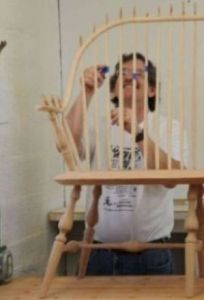
Of course we could build pieces that work like Windsor Chairs. No glue is needed on these. The joinery and type of wood were chosen to perfectly match each other and no glue was needed.
I see what you are saying about the flexible CA glue but I think we are missing the main point. That would be to have a mechanically sound joint first that has as much glue surface as possible. Grain direction of course is essential if possible. After that the glue doesn't have to be very strong.
On my hand mirrors I often have a cross grain joint with the handles. I could make them with long grain joints but the pattern of the figure in the wood decides where I drill for the handle and this often leads to a cross grain joint. What I do now is to cut notches into the handle tenon. Then I use a thick bodied glue (epoxy) which fills these notches. The epoxy then acts like a dowel that locks the joint together so even if the glue bond breaks due to wood movement the handle won't come out. CA might work in this case but I'm simply more familiar with epoxy.
I'm glad you mentioned Windsor chairs, the joint you use for your mirrors is notoriously hard to get right. How many of us have had the experience of repairing a dining room chair over and over and over?
You are making an item that is probably going to be handled daily, with a little bump each time it picked up and put down. On top of that, the joint you are working with allows little or no flex in the mating part - I'm assuming that the hole the handle fits in is in a relatively thick solid piece of wood. Add to that the mismatch of grain direction and, as you have learned, you need to pay a lot of attention to how you join it.
I don't know whether flexible CA would work for you or not (ask Bill Neddow what brand of glue he uses). They make CA flexible by adding rubberizers(sp?) no doubt the additives have other affects on the glue. How does flexible CA compare to other glues or other CA mixes? I don't know. CA by it's nature is brittle so it's probably not a good choice where the can be a lot of movement or impact. Don't use it in a gavel!
But that's not the point, the point is we are talking about joinery AND glue, TOGETHER. You really can't demonize a glue without discussing how it is being used. In particular, CA glue in and of itself lasts for ~100 years (OK, it has only been around for 60, but it essentially doesn't degrade).
I use CA glue in my basket works. The joints are quite small compared to what most people are talking about here - there is very little differential movement even in a cross grain joint of this size. In addition to this, the structure that I'm building is basically an mesh with plenty of room for movement - I suspect that the whole structure gets taller and shorter as the wood expands and contracts.
I have no way of knowing how these will fare over the next 100 years , but we have pretty extreme swings in temp & humidity here in NH (I don't air condition my house) and the pieces I made a year ago are doing just fine. I am quite confident that the forces created by wood movement on these joints is not enough to make them fail due to the brittleness of CA and that the CA glue will not degrade overtime.
Does using accelerator have an impact on the brittleness of CA glue? I've not had good results when using accelerator, so I've stopped using it and CA glue joints are more successful. I'm primarily using CA for gluing wood blanks to auxiliary blocks to attach to a faceplate, but what about accelerator for permanent gluing?
I use this to my advantage when making my mirrors. I glue a waste block to the mirror blank. When I've turned the mirror side of the blank I remove the wood from the chuck and then place a chisel at the glue joint. A sharp wack breaks the joint at the glue line and leave my mirror blank and my waste block in tack.
I have experimented with this technique by just hitting the wood with a mallet. If I don't use accelerator it will often pull wood along with the glue. If I use accelerator it will almost always break at the glue line.
I use a chisel not for the prying action but because it's hard to hit the waste block with the mallet without hitting your fingers. It's important to hit it sharply, not necessarily hard. I think it's the impact that shatters the joint.
Having read the various comments on this very interesting thread, there are several things that I see as a result of this discussion. First, the anecdotal comments are very interesting, but as pointed out, do not really resolve the issue--the question still remains: is CA glue ok to use, or not? Well, "yes and no," or "it depends" doesn't cut it either. Hopefully, the following will shed some light.
In my own case, I have used the standard commercial grade of CA glue for many years, and have not had any issues with it; however, that does not mean that problems will not occur in future applications.
In reality, like in so many other issues, CA glue has hundreds--if not more--formulations, each specifically tailored to work in specific applications. One only needs to do a search on "Cyroacrylate Glue" to understand the scope of uses for this material. Our source for the material is usually through retail outlets for what is probably one of the cheapest grades of CA glue available. It appears to work ok, and, if like me, most of us are price-conscious to want CA glue at the lowest cost, or that the high-priced special formulations are just that--high-priced.
One only needs to look at companies that make structurally-specific formulations to understand that we may be asking too much of the cheaper grade to solve all of our problems. The website of one such company--Loctite--is an indication of the wide variety of formulations that are available (http://instantsolutions.loctite.com/cyanoacrylate.php?gclid=CNDk3sur8aYCFRg8gwodlAmuHA). "Specially formulated cyanoacrylate adhesive solutions resist impact, shock, vibration and temperature extremes," is one of their lead-in statements on this site. You do not have to be an engineer to understand some of the basic information in their technical sheets: that (1) over time heat will weaken the bond, and (2) use of an accelerator will result in a slightly weaker bond as well. The extent of the weakening, of course, depends on the formulation. As you might expect, the specific formulations are much more expensive that what we are used to paying, and the prices probably sound extreme to most price-conscious woodturners for the quantity you get.
The degree of purity of a specific CA glue is also very important, and is also directly related to cost.
Then, when we discuss the use of expoxies, we are again talking about a huge number of formulations, from the least expensive "Crazy Glue" you can buy in a drug store, to the quite expensive formulations used in extreme structural and environmental situations. I remember seeing the results of a test of an expoxy designed to set steel bolts in concrete, where in a pull-out test, a huge chunk of concrete came out of the slab, with the bolt still intact.
Inherent in the successful use of any adhesive is to follow very specific instructions regarding its application. The bottom line is that if you are going to use CA glue for your work, you'll need to seek out the most appropriate formulation. And be prepared to spend extra for it.
accelerator can definitely weaken a joint. I believe that what is happening here is the accelerator causes the glue to harden from the outside-in so quickly that the gas from the reaction inside gets trapped and hence you get a lot of little bubbles or pockets, which of course will weaken the joint.
You may have experienced getting a foamy-glue bubbles on the outside of a joint that's been hit with accelerator.
Another thing is the white residue that sometimes appears, I've recently learned that this is a reaction between the glue and the gas that it gives off as it hardens. You are much more likely to see this happen on a joint that is in a confined space. A very simple solution is to work in front a fan that will draw air over the work.
This is a good idea anyway to avoid breathing the fumes. I set a box fan on low at on side of my work area so that it draw air over the work and away from me.


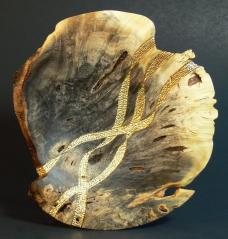
 If we make them last 100 years we will saturate the market and have to find a new job. We woodworkers have been going about this all wrong.


