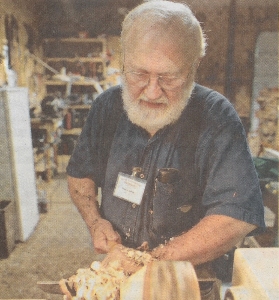
Please. no wise remarks about how a guy in his 80 s intends to harvest any Persimmon wood in this lifetime.
But -- because Persimmon trees are monoecious and the seeds come from female trees only, how does one determine whether a planted seed will grow into a male or female tree ?
We have two persimmon trees on our property, one of each sex, and we would like to know if planting the seeds is just a crap shoot or if there is an expected ratio of Male to Female offspring.
A farm-raised friend of mine would have answered your question this way: look under their tails.
Sorry I can't help. I never realized that about persimmons, and am now wondering where the male persimmon in our neighborhood is hiding, and how he gets over the fence to impregnate our two fruit-bearing persimmon trees without leaving tracks.
This ole country boy dun learnt something today. Like Bill Houghton said, I can't say I've ever seen a persimmon tree that didn't drop that nasty fruit all over the place, especially our driveway. I'm going out tomorrow and see if I can find the male tree. If I cut the male down will the females stop bearing? Of course my wife's horses love the darned things.
Bet you a dollar that you can't eat a whole one green.
I was probably about six when my big brother tricked me into trying. Yuck, I thought I would have to pull my teeth to get that coating out of my mouth.
This all poses another question: Why should a South Carolinian have to rely on a Kiwi for an intelligent answer ?
Am I bitter ? No, but the fruits of my persimmon are until they end up on the driveway. So far I have learned that there are two types of Persimmon trees, the astringent and the non astringent, and for those who would like to know, I live in Zone 7 which is the lowest number of zones where Persimmons usually inhabit, according to the California report that Terry linked me to.
Thanks, Terry, you do good work, and that is not in reference to your excellent and superb artistry.
Somewhat related to the topic at hand, persimmon is a wonderful turning wood. In fact, if limited to just one wood for the rest of my turning career (?) I would choose persimmon �- this member of the ebony family demonstrates great color/spalt variation piece to piece, is a delight to turn, non-irritating (emits an aroma of cracked pepper), strong, rarely warps, exhibits minimal cracking, and provides a beautiful smooth finish.
I have both male and female persimmon trees on my farm and whenever one dies or is damaged I cut it down seeking those wonderful black streaks and/or insect patterns. I have not been able to make any correlation between tree sex and the black streaks, but I keep looking for some way of predicting what is inside a particular persimmon tree.
I totally agree with you. If I had to choose only one wood to work with for turning and carving, it would be persimmon. It's a bit challenging to dry, however, as it wants to warp and crack. The most amazing piece I ever had was given to me by a local chapter member/friend. I turned and carved a plate, about 13" in diameter. The wood was about 2" thick to begin with and had no cracks, although it was slightly warped. Lovely to work with and beautiful gray and brown color.
Well coming from southern Indiana I grew up eating Persimmon pudding. Yumm. Will have to plan a trip to the folks house so My mother can make me some. I've also had persimmon bread that was quite tasty.
That's the marvel of the interweb: someone halfway around the world can provide the answer you need right there at home. I find myself wondering how anyone who follows obscure hobbies/professions ever survived before. The contributions from all over are much of the joy of WC. But I know you were teasing, Bill.
Besides, it's winter down there in New Zealand; more time for computer searches.
Bill, who purchased the bathroom door locks for his Queen Anne cottage in California from England, because no American company made an acceptable lock.
I have about thirty persimmons on 4 acres. They were all planted by the birds after a total bush hogging in 1978. They are 8" to 10" x thirty feet. The only one that I have cut was a hurricane damaged tree that lost its top at about 20'. The pieces split with audible cracks before I stopped the chain saw. They split into pieces too small for pen blanks! I used them for firewood. There was apparently way too much internal stress from 3 days of double storm paths.
How big do they need to be to have the black streaks? I saw none in the 8" diametr pieces that I cut.
I have a receipt around here somewhere, but it would be easy to find one online.
Of the Persimmon wood that I have used which had black. I am fairly certain that it was related to injury. If the bark is injured enough to expose the cambium, the air oxidizing the sap, not only ran up and down the trunk, it projected inward, but not along the radius, but about 15% to each side, which was a bit puzzling.
If any of your want to experiment with inducing the blackness. I would suggest that you choose a tree that you plan to harvest sometime in the future. Go out with a big hammer, and knock off small patches of bark around the base, and on up the trunk. Spring is the best time, since the cells under the bark are most fragile then. A hard lick with a 20 oz framing hammer hitting at 45� across the grain, is the easiest shear angle.
Or just touching the bark with the tip of a chain-saw, with a light side to side, can nibble it down to the cambium.
The goal should be to keep the injury small, so it can heal within the year. A large injury could induce rot if it is too severe.