I am trying Minwax Wipe-on Poly. Do you put it on an let it sit and then wipe off such as with a tung-oil finish? The instructions seem to indicate putting a light coat on but say nothing about wiping it off.
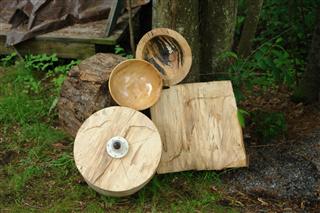
Any suggestions to stop my butternut end-grain from behaving like the world's biggest finish sponge?
Wipe on poly's vary on their application instructions. Some say to wipe on generously , let soak in for 15 min or so and then wipe off & let dry. Others have you wipe on thin and let dry. Always sand lightly between coats. I prefer the latter type but have used both with good success.
My limited experience with Minwax Wipe-On Poly is that it seems like a "watered down" version of their regular poly. That being said, I have always applied with a rag/paper towel in light/rubbed-in coats and let dry (just like their regular poly).
Based on this approach, I have found that the Wipe-On Poly produces a nice finish but takes many more coats. One of the benefits is that since the coats are thinner, there's much less chance for runs, etc.
I've used this product mostly on non-flat pieces (e.g. stairway railing, quilt frame).
As far as butternut or other end grain - I usually sand end grain to 400 or so and then put a even thinner mix of poly (or whatever) on the end grain. I'll sometimes wet sand it with 400 grit. I then let it dry.
A paper towel can shed tuffs of fibers and make a mess of the finish. A rag is less prone to do so. What I use is a small swatch of open cell foam rubber, the cheap stuff, hand held with a rubber glove. ~Doc
I just finished two small projects with that stuff last night. I must admit that I didn't read the intrsuctions, but I just wiped on a thin coat and let it dry. I sanded very lightly with micro mesh starting at 3200 or so between coats to get rid of the fuzz. Somebody mentioned paper towel fuzz - yup, I found that the paper towels were leaving a small amount of fuzz. Even more if you rub too hard with them (I was using Viva). I've used them before and not had that problem (or maybe I just didn't notice?). Anyway, I used old tshirt material for the final coats and that worked much better. I've never been a big fan of MinWax, but I do like this stuff. I read a review of wipe ons and saw an article that used this product (FWWW maybe?) and decided to try it because it is so easy to get. I've also always like their Antique Oil product. Ok, maybe I lied, I guess I do like MinWax products! Anyway, I think I ended up with 4 coats. I used gloss but rubbed it out and finsihed with wax. Looks real nice.
Coffee filters seem to be lint free, cheap, come in large quantities, and are easy and painless to throw away when you're done. Wear nitrile gloves to protect your skin -- exposure to such solvents can cause serious problems over time, even if you wash immediately afterwards. Also, use proper ventilation -- bad for those few working brain cells we still have left. ...Gar
I use MinWax Wipe on Poly on my pepper mills and bowls. After sanding to 600, I put on one coat of Minwx, let it dry overnight and put on a second coat, let it dry overnight and sand lightly with 400. I then put on a third coat, let dry and sand lightly with 400. I then put on a fifth coat, sand lightly with 600 and and put on a 6th coat if I feel it is necessary. Most times it is not.
I bot a double shaft 1/3 HP motor buffer with wheels at HF and then apply the brown wax from Hut on the wheel and wax the item. Then I put the white wax from Hut on the other wheel and finish buffing with that wax. It gives a beautiful finish to the bowl, pepper mill, etc and is a very fine finish.
I use it on my boxes. I apply with the synthetic steel wool pads (grey ones) then buff out with an old sock. It does generate enough heat so it will set, so doing a couple of coats is simple. If you let it sit too long, it will get very tacky, and you need to apply some more to rethin it, or mineral spirits. It isn't water proof, and can spot, either that, or I need many more coats.
One Caution on using gun cleaning patches is that they can vary in composition quite extensively. They range from cut-off bits of knit fabrics like T-shirt trimmings, to flannel, to a nylon reinforced twill fabric. Obviously, the higher end fabrics like the twill ("Tipton" is one such brand) are less likely to leave lint behind, while the cheaper fabrics like the flannel and t-shirt trimmings can leave "the fuzzies" and bits of the knitting all over a sticky finish.
Shotgun cleaning patches may be the ideal size, but be certain of the quality of the patches used.
Fred
Clear, with a few puffy clouds in Eastern Missouri
You want to put on enough to saturate the end-grain. It will soak it in, and there will not be anything to wipe off line on the face-grain.
There is not need to keep feeding it, because it will drink your whole can of finish, then take FOREVER to dry, if even then, so don't even try.
There are some things that you can do to help seal end-grain faster, like using a blow dryer, with hand rubbing, or with super fine wet-dry paper, then quick wipe, then palm rub. But it is best to get the surface to seal first before you try to build. Otherwise soft endgrain is a bottomless pit that you are just pouring good finish into.