Home Articles Forums Gallery Marketplace Videos

WoodCentral Forums

Knowledge You Can Build On — Est. 1998

Identify and use hundreds of woods

Hollowing tools (again)

Posts

Hollowing tools (again)

#1

Hollowing tools (again)

Steve C

I know we just went through a similar thread but in rereading it I am not sure if my question is answered.

I want to buy a hollowing system. I have not done a lot of hollowing but I think I would like to be able to reach at least 10-12 inches. I also want a laser.

It looks to me like there are two primary choices, articulated arm and captive arm. So what are the advantages and disadvantages of each. Ease of setup is important. I would rather spend my time turning rather than fiddling with tool setup.

Your guidance would be appreciated.

Re: Hollowing tools (again)

#2

Re: Hollowing tools (again)

Lance Kanaby

I have a McNaughton Hollowing system with a laser setup. To hollow to 10" to 12" you will need 3/4" tools such as the Kelton Hollowers or the John Jordan tools will work too. I have Jamieson system with a laser setup, but prefer to use the McNaughton, much easier and mor fun. I have 5/8" Proforme Hollowers and 5/8" Kelton Hollowers too. There are lots of hollowing systems out there so you will need to compare many of them with the type of hollowing you will be doing. I don't know how deep the articulated systems will go...

Re: Hollowing tools (again)

#3

Bill Blasic

Re: Hollowing tools (again)

Bill Blasic

Steve,

I have both the articulated and captured hollowing systems from Randy Privett. I have gone 9" deep with Randy's tools on the articulated version and the same depth with the 1/2" Kelton hollowers. The difference being the size of the hole to hollow through. Randy had an adapter that will allow me to use the 3/4" Keltons and I purchased different back plates that allow me to use the system on all my lathes. I just got all of John Jordan's hollowers to use with these systems too. I know that I must sound like a walking ad for the articulated system but it just works so good. The laser is an absolute joy to use and with the latest upgrade to it it is even easier to use than it was. Between the large Keltons and the large Jordans I'm looking to go a lot deeper. This is one system you should consider in your search.

Bill

Re: Hollowing tools (again)

#4

Steven Antonucci

A hands on opinion (from a guy who doesn't use em)

steven antonucci

I had the chance to talk to all of the vendors at the Hartford Tradeshow floor, and here is my unbiased opinion (unless you consider handheld vs. system a bias...)

By far, the best engineered system that I saw in Hartford was Randy Privett's Monster system. Smooth, sturdy, and very well machined. My only reservation with such a system is that it requires a longer bed length to allow the articulation to have room to move.

The laser system on the Stubby that Bill Rubenstein showed was unique in that it could be adjusted without tools very quickly. It operated on a mechanism that allowed it to swivel to adjust to the cutting tip. The only drawback was that it was only available with the Stubby system, which was based upon Lyle Jamieson's rig. If you own a system, you cannot retrofit it (yet).

Lyle Jamieson's rig is easy enough to build or buy. I think it's safe to say that there is sufficient evidence that these types of systems work, as they are the most mature, and you only lose a small amount of your bed length for hollowing depth. The downside is that you are looking at older technology that is still priced in line with newer technology.

If I was going to design a system, I would want something like Monster's articulation that attached at the end of the ways to conserve depth. It would have the new Stubby laser system to speed up the hollowing process.

Now if the system could also blow out chips...

S

Re: Hollowing tools (again)

#5

Re: Hollowing tools ( Don Geiger Report)

v

I have two of the Kobra systems. One is the Green model designed for use on mini lathes and I had Jerry, at Kobra, build me a system to support it on my Stubby. I also have a Red model system that fits my Stubby (16" over the bed) and Jerry has supplied me with what I need to adapt it to lathes up to 24" for my demos.

The Kobra has a thrust bearing at each joint which, if I remember correctly, is rated at 1,850 lbs of torque. The tension of each joint is adjustable and there is no slop, vibration or noise even when it is full extended. The Red Kobra comes with a 1" i.d. receiver that has two set screws for securing the boring bar. I have the 1" X 15" bar and adapters for 3/4", 5/8", and 1/2" bars. Additionally, I use a set of Trent Bosch bars and several others. The 1" bar that is supplied with the Kobra is center drill with a 1/2" hole to accept their straight, 22.5 and 45 degree tool bit holders and two scraper bits holders. One thing I really like about their tool bit supports is they have square broached holes to accept standard tool bits without having to round them first!!! This is huge! I buy a box of bits from a machinist's supply and sharpen both ends of each so all I have to do when one gets dull is to flip it around and keep turning. Also, not having to pre-round or purchase pre-rounded bits saves time and money. I have the tool bit supports for 1/4" and 3/16" square bits. I even have carbide bits with square shanks that fit into the holders.

Re: Hollowing tools (again)

#6

Re: Steve- your comment about....

JamieDonaldson

...the Monster being fit only for a long bed lathe is not accurate. I have been using a Monster on my Stubby without any additional bed length requirement, a process not possible with my old Jamieson style hollowers. I had cobbled together a Rube Goldberg bed extension for the old system, and the extended set-up required was a factor in my decision to buy the Monster system, which is a delight to set-up and use on "Studly."

Re: Hollowing tools (again)

#7

Steven Antonucci

Not exactly what I said

steven antonucci

I meant to say that the Monster "consumes" some of the usuable bed length- more important "comparatively" more than a Jamieson style system (captured outrigger) because the articulation needs a certain amout of room to function.

If you at any lathe of any length, the distance (without modification) that you can practically hollow is determined by the starting length, minus the distance of the furthest point back that you can set the system. Assume that you move it to the end, you now need to look at the closest point that you can set the banjo to support the boring bar, and you now have the practical distance that you can hollow over that lathe.

Using my Nova 3000 to illustrate, if I move the banjo to the end of the bed, I have 24" from the tip pf my chuck jaws to the edge of the toolrest. I need about 3" to mount a Jamieson style plate. Randy's looks more like 5". A difference of 2" from the start.

I suspect that the range of motion would also be somewhat impractical at that length, so I would guess that you'd lose another inch or two along the way. I haven't done a scientific measurement, but quantitively, I think it's probably 3-5" for the mechanism vs. hand held, and 2-3" vs Jamieson style.

Each system has it's tradeoffs, and none of them are "bad". If I had all of them to write a full opinion, I'd be happy to publish it.

Steve

Re: Hollowing tools (again)

#8

Ditto +

Mark Mandell - Gone Round In Jersey

I'll reiterate the vote for the superiority of the Kobra.

I made my own restrained hollowing rig, based upon the Jamieson idea, with some improvements.

My rig would take straight boring bars up to 1" diameter (18" depth) and stepped bars of any length. I also incorporated a laser boom with an articulated tip to compensate for parallax with off-set cutters. I sold the rig through the WC classifieds to Chuck Engstrom because I put in my order for a Kobra to fit my Stubby 1000. It worked quite well for hollowing in the 12" depth or 10" wide ranges. It did, however, have more vibration than I wanted with the longer bars which would aggravate my carpal tunnels and T.O.S./B.P. issues.

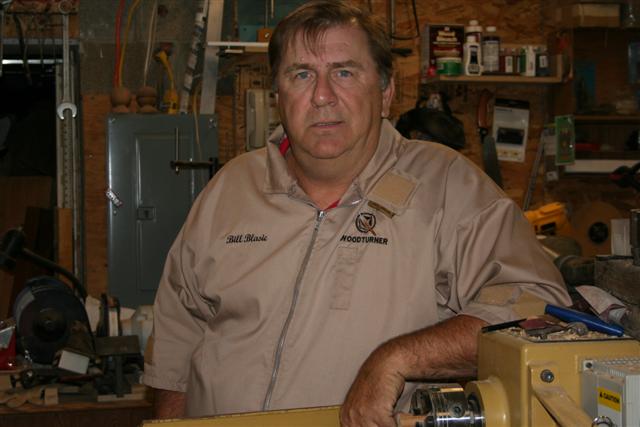
I recently got my Kobra. I chose this system over all of the other articulated systems because it allows a more "natural" turning experience with the rear handle, and because it eliminates what I see as a safety hazard with the others that use a scissors-type of arm; in the event of a catch or major problem causing a shock and kick-back, the laceration (or loss) of right hand fingers is a real possibility. The Kobra's thrust-bearing knuckles eliminate that issue, and make lateral movement of the tool completely free and totally supported even when presenting the tool at an acute angle. My Kobra is shown here with the new handle I fitted for greater comfort to my right hand.


The rear-mount handle (mine or the "stock" bar) allows me to hollow from positions at the left, end, or right sides of the lathe (270� to the workpiece) with full leverage on the boring bar.

The Kobra system, at about 40 lbs. total, is also more robust than others so it transfers any cutter vibration directly into the bed making it (almost) vibration free. The hardened "goal post" rest means that the boring bars will glide smoothly with no flex or vibration across its entire length, and again, works to suppress vibration. With adapters I have, the Kobra will take and hold every hollowing tool I have from 3/8" Ellsworth style, to John Jordan bars, up to the 1-1/2" monster I have if I want to go more than 22" deep.

My set is a bit of a prototype as Al and Jerry came up with a new pressure plate made so that the entire unit can be "dropped" into the bed at any point rather than having to remove the tail stock and then slide everything in from the end. For people with long-bed lathes, this is a great improvement.
Re: Hollowing tools (again)

#9

Re: The problem with a captured .....

JamieDonaldson

....type system is the extra length of bed needed to support the D handle capture equipment.

Re: Hollowing tools (again)

#10

Steven Antonucci

Agreed.  That's why I hollow by hand

steven antonucci

Any system reduces the practical distance over the ways. The articulated ones need a range of motion to be practical. If you look at the D-handle systems, they can move forwards and backwards with no other degrees of motion required.

Articulated systems need space to allow the arms to open before they will swivel. The reality is that most folks would never attempt to get that last inch out of their lathe, but then again, I am not like most people :)

S

Re: Hollowing tools (again)

#11

Re: The problem with a captured .....

Wally Dickerman in Arizona

After using my Stewart tools for over 20 years I finally am going to have a captured system. (I have had a Nichols system for really deep stuff for a long time).

Last year at Albuquerque I talked to Randy and examined the Monster articulated system. He agreed that he would make a left handed model for me, and that He could extend the plate so that I could use it on the 17 inch outboard bed on my Oneway. I ordered it a couple of weeks age. Randy said that it would take about 4 weeks to deliver it.

Wally

Re: Hollowing tools (again)

#12

Re: One more question.....

Steve C

Thanks to all for the insights. I am leaning towards an articulated system, either the Kobra or the Monster. However, most folks talk about using third party tools withthe systems. Is this necessary or are folks just using existing tools they already owned. Do the systems come with sufficient tools to get started?

Thanks

Steve

Re: Hollowing tools (again)

#13

Re: One of the reasons I bought....

JamieDonaldson

...the Monster for a student as well as for myself is that it is a very well equiped and complete system, ready to use right out of the box. The variety of shafts and cutters is excellent, and it's pretty too!

Re: Hollowing tools (again)

#14

Re: One More T-Shirt

Mark Mandell - Gone Round In Jersey

"I'm One Tool Away From Excellence"

There is no single tool that will do everything. Those who have been turning for a while have amassed a fair amount of iron in various shapes and sizes, and some of us have even added to those "store-bought" whiz-bangs with items of our own design and manufacture. A hollowing system is, after all, nothing more than a fancy tool holder. My choice (after making my own) was for a design that will let me use all the stuff in my tool rack with having to change to something that somebody else thinks is the Cat's Pajamas. I have my own style of working, and the tools in my rack reflect how and what I do. I use all of them

Do not buy any "system" with the expectation that it will be the last tool you buy. That mindset will land you in Frustration Land.

Re: Hollowing tools (again)

#15

Steve Kubien

Re: Steve- your comment about....

Steve Kubien

Jamie, I assume the trouble you had with your Jamieson rig was with the backrest and how it attaches to the lathe bed. If that is the case, Lyle makes a longer baseplate to fit short bed lathes, like my Nova 1624. I have this backrest.baseplate and it works nicely. Not sure of Studly's dimensions but it ought to work.

FWIW

Re: Hollowing tools (again)

#16

Don Geiger

Re: One of the reasons I bought....

Don Geiger

The Kobra is supplied with everything to hollow with. It has a 1" diameter bar about 16.5 " long which is counter bored with a 1/2" diameter hole the end. The counter bore accepts any of the three cutter holders (supplied) which are: straight, 22.5 and 45 degrees. The standard cutters are 3/16" square and there is a **square broached hole in each holder to accept the standard machine bits. This way the bits do not have to be pre-rounded and can be sharpened on both ends.

I also had the good folks at Kobra make me a set of holders for 1/4" bits. Also, they supplied me with two tear drop scraper blade supports. One is dead level, but can be rotated so it can be place into a shear scrape position and the other has a 6 degree drop so it presents the scraper in a negative rake position (REALLY SWEET!!!). It too can be rotated into a shear scraping position.

I have a full set of the optional adapters (3/4", 5/8" & 1/2") which enable me to use all of the hollowing shafts I already own. These really broadened the horizons of what I can do with the Kobra.

Jerry and Al have been really good about listening to my suggestions and employing them when it made reasonable sense to do so.

** I looked at the Monster system at the AAW and had a nice chat with Randy. It's a nice looking, well-built product too. I did notice that it too accepts square bits, but does so in a round hole not a square hole like the Kobra has.

Let me know if anyone has any questions.

Don Geiger

Re: Hollowing tools (again)

#17

Suggestion

Mark Mandell - Gone Round In Jersey

Steve,

Bring a piece of wood down here and try my Kobra. I'll bet you a cold Summer Ale you'll feel differently once you try this rig.

Re: Hollowing tools (again)

#18

Steven Antonucci

I have no doubt that it works great

steven antonucci

but hollowing with my home brew rig is such a sterile experience that I can only imagine what it would be like on one of the real ones!

Might as well set the machine up and go watch the game while it does the work for me. Do you think I could build one out of MDF?

S

Re: Hollowing tools (again)

#19

Re: Have no doubt

Mark Mandell - Gone Round In Jersey

The KOBRA ain't automatical in any respect, so setup the DVR! I learned to hollow Ellsworth style, by hand with 4 the foot handles. ;) Frankly, that's a great way to "connect" with the turning because you're working by feel and your internal biofeedback on body position to tell you were along the wall you are and need to cut. But the combination of "grabby" tools and vibration exacerbated several mus-skel conditions I developed over the years such that I thought I would have to give up turning.

As mentioned, I made my own version of a captured 'ring' rig, but, while it solved some of my issues, it did, as David might say, disconnect me somewhat from the process. I became more of a tool guide, merely standing in front of the lathe inching the rig into the form.

Working the KOBRA is a completely different process, and the 'feel' of working into the form is almost exactly like hand-held hollowing. I'm using large-muscle movements again and can literally stand at the end of the bed to work a push-cut while sighting right down the profile of the form, but without the stress and vibration on my shoulders and hands or worrying about whether I'm got the cutter at dead center elevation in the sweet spot.

Yes, I have a laser which, of course, is nothing more than a fancy caliper, but I don't use it until I'm at the point of making the final cuts.

Again, you're welcome to come down and take it for a spin using your favorite hollowing tools.

Right now I'm doing a 12" deep bowl using a 1" boring bar and Hunter carbide cutters to do the hollowing. Very nice way to make linguine shavings!

Re: Hollowing tools (again)

#20

Steven Antonucci

send me an invite

steven antonucci

Re: Hollowing tools (again)

#21

Lets make it a wood turning party NM

v

Re: Hollowing tools (again)

#22

Joe Fleming

Re: One More tool

Joe Fleming

I echo Mark's comments and add the following: My name is Joe Fleming and I an a turning tool addict.

Now that I have admitted that, here is what I have to offer the conversation.

1 - Borrow tools to find what you like. If at all possible try them before taking anyone's word.

2 - As Mark said, there are different tools suited for different hollow form profiles. You can never have just one :-) I have my favorite tools for 2-3" forms, 3-6" forms, 5-12" forms, and larger. I tend to use different tools for tall, slender objects, than I do for shorter, broader objects.

3 - There is a reason why hollow form turners don't deviate from the shapes they make. If you like a tool, you tend to want to emulate your success by doing it again. This also builds confidence that you will do it repeatedly successfully, and that tool has profile limits.

4 - Most tools have "tricks" that make them sing. Just the right approach angle, right at the axis (or above or below), different handles work better than others, etc. Try to find out what those are for your system.

I have (and have used) the following hollowing tools. It is likely I'm forgetting something, but you get the idea:

- I don't like it and don't use it

* Neutral. I use it when it fills a void, but probably not the first tool I grab.

+ Means I like it and use it a lot, depending on the hollow form dimensions

Scrapers:

-- Glaser hollower (I did not like it and it is not available anymore)

* Stewart straight and hooker in an arm brace

+ Jordan 1/2" and 3/4" used in an arm brace

+ Homemade 3/4" straight bar used in an arm brace

* Scorpion (3/4") straight and hooker by Don Pencil use in an arm brace

* Stinger (1/2") straight and hooker by Don Pencil use in an arm brace

++ Kelton 1/2" used in a straight handle

* Kelton 5/16" used in a straight handle

++ Packard mini hollowers with integral wooden handles

- Homemade 1/2" with 3/16" scraper (Ellsworth style) used in a straight handle

- Homemade 3/8" with 1/8" scraper (Ellsworth style) used in a straight handle

++ Don Derry captured system with adjustable laser pointer for pit orientation (one of the most compact systems out there). Also works with the lathe turning in reverse which makes WAY less reaching over the bed.

-- Sorby 1/2" swan neck

-- Sorby 3/8" swan neck

Cutters:

++ Exocet hooded ring tool - 5/8" straight

+ Exocet hooded ring tool - 1/2" straight

- Exocet hooded ring tool - 1/2" hooker (bad design)

* Sorby ring tool

+ Kelton hook cutter used in a straight handle

* Holsaluk hook cutter used in a straight handle

* Martel hook cutter used in a straight handle

- Hunter 3/8" straight tool (not very versatile)

* Jackofsky 1/2" straight and hook tools used in a straight handle

Re: Hollowing tools (again)

#23

Re: One More tool

john lucas

Joe I'm surprised you don't find the Hunter tool very versatile. I use mine all the time. It is the best tool I've found for cleaning up the bottom of vases, hollow turnings and boxes. I like the #5 the best for big turnings and the Various versions of the #1 for box bottoms. You can rub the bevel on the very steep pieces which is what lets you cut the bottoms. It's one of the best tools from removing the nub in the middle of hollow turnings because you can turn it at an angle to cut from outside toward the middle while rubbing the bevel. It lets you cut it right out.

When I have trouble with bad grain tearing sections on bowls I'll grab the hunter. It has a thinner edge than most other tools and is usually just what's needed to make a final cut through these bad areas. It has to be used with the bevel rubbing to do this.

As a scraping tools it's great. When you tilt it over with the face of the tool facing the wood it cuts with the bottom lip just like a bowl gouge. Since the edge is a sharper angle it cuts very cleanly as a scraper.

Mike has 3 new tools just for box interiors and Christmas ornaments. One has the tool tilted backwards as compared to all the other curved cutters. This allows it to rub the bevel when cutting from the hole toward the outside on small hollow vessels or undercutting rims on boxes. Then the other tool has a traditional angle to cut from the bottom toward the outside. With these two tools you can cut clean enough you could leave it unsanded.

Mounted in a Jamieson style swiveling boring bar head the #1 cutter is incredibly versatile letting you rub the bevel at almost any angle and getting a really clean cut. Great for long steep sided vessels and vases.

Re: Hollowing tools (again)

#24

Joe Fleming

Re: One More tool

Joe Fleming

John, You've given me some ideas to consider. I approached the tool as a hollowing tool and ring cutter. So, my assessment as a hollower stands, but for the non-hollowing tasks you list, I haven't tried them but will. Thanks for the ideas. Joe

Re: Hollowing tools (again)

#25

Re: Hollowing tools (again)

mike nelson

Why not just shell out for the CNC, go watch a movie, hire some cheap labor to run production? I make my deep tools, using a modified articulated one now (no hood) and carbide bits come a lot cheaper through alternate sources.
