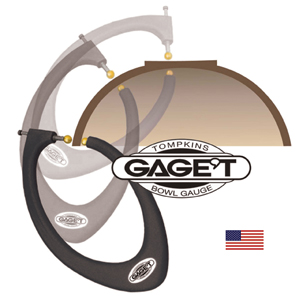
>Over the years I know i've purchased every thickness gauge on the market. This last week I purchased the Gaget and without a doubt it is the best I've every used. It will do to the center of a 17 in. bowl and very simple to use. I know which one I'll be grabbing to measure wall thicknesses from now on. It's a little pricey - over $70.00. I don't have anything to do with Keith Tomkins - I just love his gauge.
>I'm still new at using it so I'm not going to make a long response. It is quite easy to use and functions perfectly. The only downside for me so far is that it hits my chuck and won't let me read very deep into smaller bowls. By that point I've already made the transition curve so I know pretty much how thick it is anyway. All other measuring devices I have besides my tried and true framing square, will not read the bottom thickness either.
>Hi Marvin, Thanks for the kind comments. I try not to talk about my commercial ventures on the turning site since it would be a conflict of interest. However, I think it's appropriate to discuss costs; there are several others who contribute to this site who produce turning products or are considering it. The gauge is something that I developed and distribute myself; the "economics of scale" affect me a great deal. The market isn't huge, and I have to produce units in limited quantities, which drives costs up. (Several companies wouldn't even discuss producing runs of less that 10,000 units.) I could have the gauge produced overseas for far less, but I think it's important to support companies in this country. I think the big question for anyone thinking of developing a new product must be...Will I be able to recover the costs required to put the product into production? In my case, the cost of producing molds was prohibitive, but I was willing to take the risk. Many turners have let me know that the gauge has helped make big improvements in their work, that's a very rewarding thing to hear. Thank you, Keith
>Keith's Gaget has improved my bowls a lot, because I could never accurately gauge the bottom thickness until it comes off the lathe, which is too late or at least very difficult to do any more work to reduce bottom thickness. Also has helped me when the bottom was getting too thin. I do not use the gauge so much to quantify wall thickness but to measure realtive thickness at the rim of a large bowl versus near the bottom.
>It looks like everyone agrees with my opinion of Keith's Gage'T Bowl Gauge. There will be a review of it in the December 2008 issue of More Woodturning, which will be available to electronic edition subscribers by November 15. I really like the ability to run the gauge along the bowl wall and instantly see the areas with variation in thickness. Unfortunately, the balls for sensing are too large to reach between chuck jaws to measure the bottom thickness of a bowl while it is still in the chuck, this, however, is a minor item since it is pretty easy to use a depth gauge to determine how much wood remains in the bottom of the bowl. I was impressed with the took just as the others have been. I don't think the price it too high for the quality of product. Good show Keith.