Home Articles Forums Gallery Marketplace Videos

WoodCentral Forums

Knowledge You Can Build On — Est. 1998

100+ Wood Species + Full-Shop Services: Lumber, Veneer, Tools & CNC. Everything in One Place.

Actually, a word of thanks

Posts

Actually, a word of thanks

#1

Actually, a word of thanks

Bob Way, Canton, MI

>I don't mean to raise the design discussion that took place a while back again, but I did read those posts with a great deal of interest because they got me to thinking about a couple of things with respect to my turning. I am a hobbiest woodworker, and turning is one of the ways I like to spend some of my shop time. A couple of years ago, my wife gave me a chunk of big leaf maple burl for my birthday, and it sat in my shop as a chunk until a couple of weeks ago. Frankly, it was a wonderful gift. Problem is I didn't have the faintest idea of what to do with it since I normally don't do this kind of turning, and worse I didn't want to screw it up too badly when I did turn it. Then there was that great discussion of design a short time ago. So, I sat down, did some sketching, some math, some hanging of chains, etc. and actually ended up going through that process a couple of times. Anyhow, this is what became of that chunk after playing around with the ideas being tossed back and forth during the discussion on design. I know it's not quite where it needs to be, but it's still miles ahead of even where I figured it'd be when I started. I learned a lot, and the shop time spent on it was a real hoot. So, thanks for the insights and the good time. It's about 5" wide by about 4" tall overall. I'd appreciate your thoughts and ideas about it. For real. I work for Ford...I can take all kinds of news these days.

Bob Way

P.S. You'll have to forgive me, but I'm a segmented guy at heart and just couldn't stop myself from adding the ebony foot and rim.

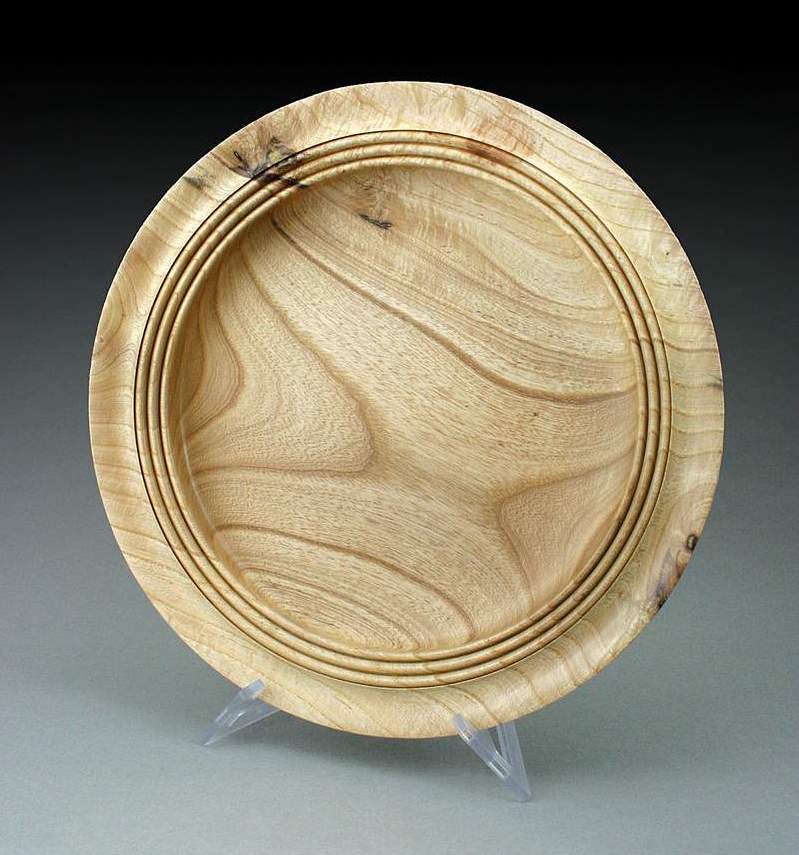

img

Re: Actually, a word of thanks

#2

Brad Vietje

Re: Actually, a word of thanks

Brad Vietje

>Bob,

However you got there, its beautiful.

Maybe I should get serious about design, and start planning my turnings more, but I usually only plan them in my head, and refine the shapes as I go. I usually only sketch out basic ideas, but I do draw actual plans for a commissioned piece. I'm not one who has much patience for the view that we "just see what the wood wants to be" or some such nonsense. Beginners may do that, and sometimes unseen cracks can change our plans, but I set out to make something, pick a piece of wood that's appropriate to the task (this isn't always easy), and make it. I have the big lathe, the sharpened and honed HSS tools, and the three-digit IQ, so if I select my wood carefully, I can usually outsmart it.

Anyway, enough about my rantings on design -- a very nice piece !

Safe spinning,

Brad Vietje

Newbury, VT

Re: Actually, a word of thanks

#3

Ric Taylor

Wow, That's Really Nice!

Ric Taylor

>

Re: Actually, a word of thanks

#4

Forgive you?!! For what?!!!

Jim

>I just wish I had something so nice to apologize for....

Nice job...

Re: Actually, a word of thanks

#5

Re: Forgive you?!! For what?!!!

David Galloway

>Bob, this is awesome. The key is the fact that you did some thinking about where you wanted to go, allowed the spirit to move, made you measurements, and dug in. I am inspired! What a great piece to share. You have inspired me to tackle some of those pieces of wood that sit on the periphery of my workshop and mock me for my lack of courage.

Thank you sir!

Re: Actually, a word of thanks

#6

Re: Actually, a word of thanks

bob davis

>how can anyone think a segmented piece could be more striking than ypur piece?

Re: Actually, a word of thanks

#7

Re: Actually, a word of thanks

Mike from St. Clair Shores

>Bob,

I think you really turned that gift from your wife into a beautiful piece. By the way, how did she like it? What are the dimensions and how thick did you make the walls?

Mike

Re: Actually, a word of thanks

#8

Re: Bingo, you're a winner Bob, and...

JamieDonaldson

>... each effort becomes more intuitive. Or as one of our famous horse trainers once said, "the more you practice, the luckier you get!"

Re: Actually, a word of thanks

#9

Keith Tompkins

Re: Actually, a word of thanks

Keith Tompkins

>HI Bob, Thank you for posting this. First I'll give my critique of this piece, since you asked. You picked a rather difficult form to execute well; as the curve reverses as it approaches the rim. You did a great job here, no flat spots or awkward changes. The foot and rim treatment are tastefully done, and the finish looks very well done. If I had a suggestion, I'd consider making the foot a tad smaller. It would add a bit of contrast to the size of the opening, and give a bit of lift to the form.

Now for the sticky part. I don't want to stir the pot either, since my post was what started the whole thing. But, quite frankly, I'm not surprised at your results. This is the sort of thing I've come to expect from the students participating in my design classes. Even a novice turner, armed with some good design concepts, is capable of good work right from the beginning...progress does not have to be measured in YEARS. I think your photo is proof of that.

We should be apologising to you, after all, for the way that thread was treated. This site is all about turning, and sharing our knowledge with others. This includes ALL turners...beginners, experts, traditional and even the artsy types. Whether we agree with them or not. All turners, and their participation, are welcome here.

Great Job, and thanks for posting your piece! Keith

Re: Actually, a word of thanks

#10

Re: Actually, a word of thanks

Wayne Leach-NW Ontario

>I think you did a real nice job of designing and executing. You and your wife should be pleased with the outcome.

Nice work!

Regards,

Wayne

Re: Actually, a word of thanks

#11

Re: Actually, a word of thanks

Mike Nelson

>Don't know what the political spinners (:)) would call it but I call it art!

Re: Actually, a word of thanks

#12

Re: Actually, a word of thanks

Ed Moore

>Bob,

I think you have pulled off a real challenge extremely well. As Keith said implicitly, the curve at the top must be done just right or things don't work. You did it -- and because you planned it out. Thinking is allowed and we shouldn't be surprised when it works. ;^D

Good job!

Ed

Re: Actually, a word of thanks

#13

Re: Actually, a word of thanks

Dinyar Chavda

>Hey Bob:

Hope things are ok with you at Ford. From having worked with companies that were going through this, I don't envy your current situation. I just hope that management has the sense (although, by definition, management rarely has any sense---and I used to be in it!) to get the decisions done and the announcements of the specifics made fast. Prolonging things is sheer torture. I'm sure you know this, but this experience will have an effect on you even if you come through it unscathed. I hope you have someone that you can talk to openly and honestly.

Moving onto your piece--I'm into the measurement approach (as you may have picked up from the discussions on the earlier threads). While I approach the wood in a fairly loose manner, in that I have an idea as to what I want to do with it, but am very flexible to changes as I go along, I find that measurements are very useful to me, as I do not have a natural eye, and I am using them more and more.

So, I looked at your piece from a numbers viewpoint. But, before I do that, I have to say that what you have done is very good---it is a difficult form, as Keith has said, and you have executed it well. And I certainly do not find the black rings objectionable---they seem to complement the natural cracks and whirls in the burl, perhaps because they create a clean boundary.

Onto the numbers. Your current piece, you say, is 5"W x 4"H. If you take the ratio of the two, that amounts to 1.25. If you remember the earlier discussions of the golden mean, the number, phi, is about 1.619, which is quite different from 1.25.

What I do when faced with a design issue like this, is that before I start hollowing, I take pictures of the piece, download it onto my computer, and print a few of them, i.e., reduce it to 2-dimensions, and to b&w---for some reason, this seems to help me figure things out. Then I use the numbers like phi, the rule of thirds, etc. (what I call Russ' rules--other than phi) to guide me as I play with making changes in the drawing using paper and pencil. It is amazing, but I find that it helps make things just easy to figure out, and the resultant figures are much nicer.

In your particular case, I took your picture, and asked myself what would happen if I kept the basic shape, but made it squatter, by taking material off the bottom, but still keeping the bottom curve where you had it, but just making it go to center faster.

Using a graphics program, I first went to a ratio of about 1.5, and this resulted in the following: (Forgive me, but it was just easier to get rid of the bottom ring while working with the program.)


img

Re: Actually, a word of thanks

#14

Re: Actually, a word of thanks

Dinyar Chavda

>Then I decided to move things even closer to phi, and made it even more squat from the bottom. I worked with the bottom, as I really liked the top curve, and did not want to mess with it. So, here's the result with a phi (ration of diameter to height) of about 1.61:


img

Re: Actually, a word of thanks

#15

Re: Actually, a word of thanks

Dinyar Chavda

>Are these better than what you created? That is a matter of opinion. My objective was to show you some options, as well as some tools that I use to explore options without taking any wood off.

One of the things that becomes apparent is that "my piece" uses a lot less of the wood than yours did. Being someone who considers the Scottish race to be hopelessly profligate (not an original line---I heard Phil Stott use it at an AAW demo to describe his region--I believe it is Lincolnshire), the thought of wasting wood by using only part of it tears me apart. I know, John Jordan, who is, IMO, a master of form, quotes Mahoney as saying that he will always sacrifice wood to form, but it still goes against my grain. So, what I now do is to make two pieces out of one. This means that you have to start planning pretty early in the game, and make these measurements and decisions quite early, but I've been doing it with hollow forms, and, rather than making a hollow form that is way too long for its diameter, I make two hollow forms instead with more pleasing shapes. I also feel delighted that I've outscrooged old Ebenezer, during his far more interesting "Bah, humbug!" days.

Anyway, hope this has been of some use, and good luck at Ford.

Re: Actually, a word of thanks

#16

Re: Actually, a word of thanks

Bob Way, Canton, MI

>Thank you all so much for your feedback and suggestions. Like so many of us, I tend to be me own worst critic. So, it was nice to hear you liked the turning. But, what's really cool is that the suggestions and alternatives will be kicking around in my mind when I move on to my next piece. I don't have a natural eye, so the various tools to help me refine the picture in my mind are as valuable to me as are the tools to turn the piece.

In response to some of the questions and suggestions:

Mike, the walls are about 1/4" thick except around the shoulder area. The inside profile pretty much follows the outside except in that area where it doesn't quite keep the same measurement. That is due to my hollowing skills still needing a little finesse. A couple of really nasty catches in that area not only contributed to a tad bit wider opening than I planned, but kind of spooked me as well. My wife, Jan, told me to tell you she loved it. I'm not sure if that included my getting any "man points" though. I may have lost them for eating the last piece of cake.

The foot. A lesson learned about light cuts when finishing off the bottom.

The finish. I wish I could say I got it right the first time. I ended up taking the first attempt off and redoing it. Second time was a charm though, and it is really fun to look at and feel.

Again, my sincere thanks to all of you. That was a really good discussion.

Bob Way

Re: Actually, a word of thanks

#17

Keith Tompkins

Re: Actually, a word of thanks

Keith Tompkins

>I think you have some good ideas Dinyar, but when you change the ratio of height to width, you must also take into account the emphasis point. That must be adjusted as well, or as in your second photo, it becomes too close to center, spoiling to balance of the piece. The form could be stretched as well, resulting in a tall, narrow form. Sometimes the golden rule becomes the golden limit if we adhere too strictly to it.

Re: Actually, a word of thanks

#18

Re: Actually, a word of thanks

Allen Neighbors

>Bob, thanks for posting this. I like it, too.

And thanks to the other posters for their input. I've learned a lot from this good discussion! :o)

(Wish I could put it to work now)

Allen

Re: Actually, a word of thanks

#19

I disagree with your conclusion

Dinyar Chavda

>Keith:

You concluded: "Sometimes the golden rule becomes the golden limit if we adhere too strictly to it."

Actually, if you apply another rule, i.e., the rule of thirds, that would force you to move the widest diameter higher.

I wanted to spend only about 5 minutes on each picture, so I just deleted the lower part of the hollow form by cloning the background gradient along a curve, and did not stretch the sides---I don't know what your experience is, but I find that it takes a long time to get the results of the warp tool to work nicely.

For those of us not blessed with a natural eye, these rules (Golden Mean, Russ' rules), if correctly applied, are a great help.

So, while your statement may be true, I don't think that it follows from these data. Come to think of it, isn't your comment about not having the "emphasis point.....too close to center", itself, another rule? :-)

Re: Actually, a word of thanks

#20

Keith Tompkins

Re: I disagree with your conclusion

Keith Tompkins

>Dinyar, what your second image did was to bring the emphasis point closer to the center. The form is closer to the "golden mean" but the appearance is not improved because the balance of the piece was altered.

Yes, I talk about the emphasis point, but it's something that is common knowledge...certainly not something I came up with. Just ask any painter or photographer. Same with the rule of thirds...it's been around for centuries, contrary to popular belief. As such, I have no problem discussing their merits...your arguement is not with me.

I have no desire to continue the debate over my own design ideas...that's a done deal.