WoodCentral Forums

Est. 1998 — 27 years of woodworking knowledge

Angle for skewed chisels?

Posts

Angle for skewed chisels?

#1

Angle for skewed chisels?

Hi All -

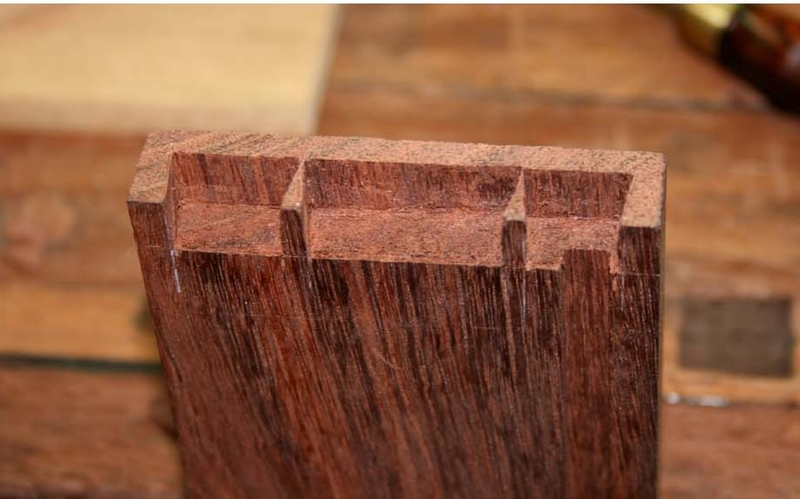
I'm set to work up a pair of skewed chisels for half-blind dovetails and I'm trying to figure out what angle I should use.  Not the bevel angle but the angle of the edge of the blade.  I've seen Two Cherries are ground to a 450 angle, and have seen one reference on the internet to a 600 angle.  Any thoughts here on the Board on what it should be?  For those that might have skewed chisels for this purpose what angle do you use and are you pleased with it?  What, if any considerations are there to take into account?  On the one hand I don't want to over-think this, but on the other I don't want to miss something for having failed to ask.

Best -


Dave


Re: Angle for skewed chisels?

#2

Re: Angle for skewed chisels?

I have a set of Aldi chisels earmarked for what I think you want to do. That is to take a square ground chisel and make a skewed grind from it.

If the goal is to use it for dovetails, I think a bit more angled than the most angular dovetail you expect to use would be a good angle. For instance, if your most exaggerated dovetails are 1:4, an angle equivalent to 1:3.5 or thereabouts would be appropriate. 45 degrees is way too much in my opinion.

The good news is that you are in charge and you can correct anything that deviates from your ideal. You get more than one chance.


Re: Angle for skewed chisels?

#3

Re: Angle for skewed chisels?

Dave, I agree that the angle of skew chisels is made without a purpose. One of the main purposes is to clear the corners of dovetail sockets, and ai will talk to this.

First, consider the alternative to a skew chisel, the fishtail chisel. The way the skew chisel is used is to push into the corner …

Now a skew chisel typically has a 20 degree (or greater) angle off square, and needs to be used with a sweeping action …


What I suggest is that you decide on the dovetail angle you like to use (7:1, 6:1, etc), and grind the skew so that it, too, can be used on the push. Pushing into the corner is a whole lot easier than sweeping/slicing. 

Or just make a fishtail chisel instead (my preference).

Regards from Perth

Derek


Re: Angle for skewed chisels?

#4

Re: Angle for skewed chisels?

Thank you, Steve and Derek.  This is EXACTLY why I asked this question.  Super helpful.

For those that may be curious, here's what I got, in terms of degrees from Steve and Derek's posts:

  • 1:4 = 14 degrees
  • 1:3.5 = 16 degrees (rounded)
  • 1:6 = 9.5 degrees
  • 1:5.5 = 10.5 degrees (rounded)
  • 1:7 = 8 degrees
  • 1:6.5 = 8:75 (rounded)

Now, I have a plan and all I have to do is decide on the angle I'll want for my blind dovetails.  Thanks!


Dave


Re: Angle for skewed chisels?

#5

Re: Angle for skewed chisels?

Thank you, Derek.  As I mentioned in my reply to Steve above.  You're replies were super helpful....your illustrations were particularly helpful.  Also your comments about pushing vs. sweeping.  However, I think I'll stick with the two skewed chisels rather than a fishtail because I think they'll be easier and I have two candidate chisels already.

Thank you, again.  I really appreciate it.


Dave


Re: Angle for skewed chisels?

#6

Joe Fleming

Re: Angle for skewed chisels?

Here's a question for you guys:  With the fishtail, the handle of the chisel is perpendicular to the socket.  With skewed chisels, the handle is at an angle to the socket.  Does the handle angle make a difference (good or bad) for attacking the cut?  The engineer in me thinks that being able to push the chisel in line with the handle (skewed chisels) would give better tool control than a fishtail that would require some lateral motion to work the too into the corners.

I have a completely different solution.  I don't do half-blind dovetails.  :)  


Re: Angle for skewed chisels?

#7

Re: Angle for skewed chisels?

Just get an 1/8" chisel.  It'll get into the corners of half-blinds just fine.  


Re: Angle for skewed chisels?

#8

Re: Angle for skewed chisels?

I made a skew chisel about 45 years ago, for making dovetail sockets, but did not use it more than a few times. We usually use a narrow straight chisel like Charlie suggests. I like 3/16 or 1/4 inch chisel.

We do use skew chisels for carving. They are usually quite thin with an equal bevel on each side, so there is no right or left. 


Re: Angle for skewed chisels?

#9

Straight chisel have limitations

Charlies and Warren, like others, suggest a straight chisel to clear the corners of a socket. This will work … if you like “digging”. Better would be a wider, bevel edge chisel used on its back along the socket walls. 

Digging with a 1/8” chisel into these socket corners  …

… is going to damage the web between these sockets. Should be less invasive if the web is wide.

Why do this the inefficient and risky way just to avoid owning one extra chisel?

Regards from Perth

Derek


Re: Angle for skewed chisels?

#10

Re: Angle for skewed chisels?

Joe, there is less effort and more control with the fishtail chisel than the skew chisel. The fishtail “wants” to move in a straight line, while the skew “wants” to move with the line if least resistance, at an angle. Think of a skew block plane vs a straight blade block plane, or a dovetail saw with set greater on one side of the plate. 

Regards from Perth

Derek


Re: Angle for skewed chisels?

#11

Re: Straight chisel have limitations

If you went into the corners with a 1/8" square chisel as suggested there would only be minimal overcutting into the front wall of the pin socket. Keeping the chisel registered to the corner of the pin keeps the chisel from cutting into the pin.

Unless one doesn't want to use such a narrow chisel there is little case made to use either a skew or a fishtail.


Re: Angle for skewed chisels?

#12

Re: Angle for skewed chisels?

Hi Dave,

16 degrees isn't much of an angle so that seems like a nice one size fits all shape.

There are other options mentioned in the thread and all make sense on some level. You'll know your preference after trying different ones.


Re: Angle for skewed chisels?

#13

Re: Straight chisel have limitations

Register chisel against pin face, push, register chisel against lap wall, push, and finally register chisel against socket floor, push. 

Corner waste gone.

Every time.


Re: Angle for skewed chisels?

#14

What?

Skew chisels are more efficient for dovetail sockets??? What blog did you read this on?

It reminds me of Rob Cosman and his kerf extender. He claims it saves tons of time, but when he wants to show how he can make a half blind  dovetail joint in seven minutes, he doesn't use it. Wonder why?


Re: Angle for skewed chisels?

#15

Re: Straight chisel have limitations

Register chisel against pin face, push, register chisel against lap wall, push, and finally register chisel against socket floor, push. 

Corner waste gone.

Every time.


Not that simple.   You first need a chisel with minimal lands, otherwise it cannot reach into corners. You can skew a chisel for some spots, but not all. You can pare vertically, but how do you get into acute corners horizontally without causing damage?


Regards from Perth

Derek


Re: Angle for skewed chisels?

#16

Re: What?

Warren, so every time someone has a different method from you, it is time to insult them. What a hero. You know very well that I do not rely on blogs for information. I post my work here for all to see and evaluate. I read that you are handy with chisels, but have not had the same opportunity to see your dovetailing. Perhaps you might post some examples?

Regards from Perth

Derek


Re: Angle for skewed chisels?

#17

Re: Straight chisel have limitations

Derek, I have to admit that to get into those small corners between pins found in lap type dovetails I use the tool Charlie first suggested, i.e., a 3 mm or 6 mm bevel edged chisel, and it sounds like from his later description he uses much the same method as myself. Warren apparently seems to use much the same tooling and probably a comparable methodology. It's been quite some time since I had to cut secret mitred or secret double lapped dovetails, but I got into those tight corners of both pin boards and tail boards with a narrow chisel, either a 3 or 6 mm chisel.

I suppose if I owned a fishtail chisel, or a couple of skewed chisels, I might use them for those odd corner clear out jobs, but it's always been trivial to me to do the job with narrow bevel edged chisels, so I could never persuade myself that I really, really needed alternative chisel types.

Still, you have got such tools and find them useful. It's just another means to the same end so not a controversy at all as far as I can see. Slainte.


Re: Angle for skewed chisels?

#18

Video

Richard, I do wish you had a fishtail chisel to compare with your 1/8". The problem in this thread is that I appear to be the only one (of you, Charlie and Warren) who has used a fishtail, skews and a 1/8" chisel to clear the corners of a socket. They all work (I have stated this before), but the fishtail is just easier and potentially less invasive with fine webs. 

Below is a video I made 4 years ago. The project was a 16-drawer bow-fronted apothecary chest. In other words, each drawer was curved, thus ...

I was experimenting with a palm router at the time to clear the waste of the sockets of the many drawers (I no longer would do this, preferring to just chop it out). The video is short and starts after the sockets have been sawn and a kerfing chisel has been used to deepen the side kerfs.

No, Warren, the kerfing chisel is not used because it is faster - I am not after speed - but because the result is cleaner and the waste is easier to remove ... as may be seen in the video. The corners are cleared with a fishtail chisel. 

No popcorn throwing, okay :)

https://www.youtube.com/watch?v=aUFUGYsG-t0&ab_channel=DerekCohen


Regards from Perth

Derek


Re: Angle for skewed chisels?

#19

Re: Video

I didn't throw any popcorn whilst I looked, Derek. It's obvious you find that fishtail chisel helpful. I suspect if someone were to gift me one of those, I'd try it out, at least. All the same, I'm happy enough to continue using my small 3 -6 mm chisels for getting into those corners because I suspect, having watched you working now, that I can clear them out just as effectively as you do with your fishtail jobby. 

As an aside, of the two types of chisel mostly mentioned here, I see no benefit in bevel edged skew chisels because two are needed to clear out each socket between pins, which means more handling, therefore wasted time. The fishtail chisel looks to me to be a much more useful tool. Slainte.


Re: Angle for skewed chisels?

#20

Re: Straight chisel have limitations

I'm not sure what "damage" you're talking about.  You take dovetails far too seriously.  Surely you aren't asserting that every competently cut dovetail throughout history was only done with the aid of a skewed or fishtail chisel.


Re: Angle for skewed chisels?

#21

Alternative method???

Asking in general. I’ve made very few half blind dovetails. 


What does the little bit of waste one would leave in the two bottom corners of the sockets using a standard chisel matter? Could you not just clip the bottom corner of the tails slightly to make room for that residual waste?  I can’t imagine that would affect the strength and it is unseen. 


Re: Angle for skewed chisels?

#23

Re: Alternative method???

Gary, a couple of observations: firstly, making a joint "look" a good fit is not the same as "having" a good fit. One is going to be stronger than the other. A rounded or chamfered edge will enable the boards to pivot. Secondly, if you are going to fake the joinery, rather use another method, such as biscuits or dominos. Making well-fitting dovetails is not difficult - saw to the line and chisel out the waste.


Regards from Perth

Derek 


Re: Angle for skewed chisels?

#24

Re: Video

May never happen, Derek, especially if no-one thinks to buy me one for a present, ha, ha. Slainte.


Re: Angle for skewed chisels?

#25

Re: Alternative method???

Derek, I’m not sure I understand what can pivot. If a 1/4” chisel is used to clean out the socket, then a sliver 0.04”x1/4” may remain in the bottom of each corner. Can probably be smaller than this. I am merely suggesting a slight chamfer to the bottom of the tail to provide space for this “unclean” corner. The rest of the socket is flat and clean. It is sometimes recommended to add a slight chamfer on the bottom of tails to make them easier to insert onto the pin board. What I am proposing is no different really - just a very slight chamfer on each bottom corner of the tail to make room for the small amount waste remaining in the socket.  


The remaining waste is the dark portion in the hand-drawn picture below of a 1:6 dovetail.  One in each corner calculates to no more than about 3% of the area of the socket walls (I assumed a 5/8” wide tail x 5/8” long for calculation purposes).


👍 This page answered my questions

Your vote helps other woodworkers quickly find the answers and techniques that actually work in the shop.