Skew block plane question
Bill Tindall, E.Tn.
From behind the plane if the open side is on the right side is this orientation a right of left handed plane? Curiously, the LV site does not define handedness.
Knowledge You Can Build On — Est. 1998
Skew block plane question
Bill Tindall, E.Tn.
From behind the plane if the open side is on the right side is this orientation a right of left handed plane? Curiously, the LV site does not define handedness.
Yes
Re: Yes
Steve D, in CT
Agreed. It is definitely right or left handed.
All seriousness aside...
Steve D, in CT
I just went to the shop to check my unused LN 140 in the box, which is RH.
If you are right handed, you would use it to make a rabbet on a board clamped to your bench because the pointy part of the blade, and removable plate on the plane, are on the right side.
If you had a LH version, you would use it to trim a tenon on the right end of the board.
Actually you would use it for neither of these purposes because the nicker is set too deep in the side of the plane and the manufacturer was not able to resolve the problem 
Get the LV and you should be fine. However, it's not the tool I would grab for to clean tenon cheeks. Perhaps a small shoulder, maybe 1/2" wide. Maybe a Clifton 400 or the non-bullnose version?
Not to disagree with Derek but some big differences between shoulder and "rebate" planes are the cutting angles and ability to clear shavings. Using a shoulder plane on a long cut with the grain will result in a big ribbon of clogged shaving in the throat. I would expect better results from a skewed rebate rabbet going cross grain than a shoulder plane cutting rabbets. Luckily, he doesn't need to check in with me on his daily activities;)
this is an RH
Steve D, in CT
https://www.lie-nielsen.com/products/skew-block-plane-right?path=block-planes&node=4072
Lee Valley seems to follow the same convention. Look at the captions on the photos to see.
https://www.leevalley.com/en-us/shop/tools/hand-tools/planes/block/65373-veritas-skew-block-plane
If you like A2, misaligned nickers, nostalgia and tradition, get the LN. O2 or PM-V11 and modern functionality, I would lean toward LV.
You will have more influence on the outcome than the tool.
Re: this is an RH
William Duffield
I don't use my LN #140 (skew rabbet block plane) for trimming tenons, because the nose of the plane is insufficiently supported on one side, allowing a small twist in the mouth opening. Therefore, it is very difficult to get it to remove a consistent thickness shaving, either cheek or shoulder. Thge Veritas rabbet block planes' engineering is much better.
Re: this is an RH
Steve D, in CT
I wouldn't do that either as a first choice but I am assuming Bill's two questions are related and his credit card is burning a hole in his pocket.
If the plane was on the bench and I had a tenon to trim I would try it but my expectations would be low. For 36 tenons I would look elsewhere.
Interest has passed, see below
Bill Tindall, E.Tn.
Thanks to all the offered help. Weaver reported privately that this kind of plane is largely useless. Delighted to not be tempted to buy it.
Re: Interest has passed, see below
Jack Dover
Any details on why exactly?
Re: Interest has passed, see below
onemanband
Without any details provided, hard to say how true a skew block plane is considered useless to someone.
The skew block is great for cross-grain work such as refining tenons, doing breadboard ends, etc. Others may use a moving fillister instead. The skew is bevel up if that matters as compared to a standard block.
I still remember a trade event demonstrator sharing that any chisel over 1-1/2" was useless. Was it? Probably yes for a dovetailer. A block plane is also useless to a lot of people although it's indispensable for the kind of work I do.
Interest may be renewed.
Derek Cohen (in Perth, Australia)
The skew block is great for cross-grain work such as refining tenons, doing breadboard ends, etc. Others may use a moving fillister instead. The skew is bevel up if that matters as compared to a standard block.
The skew block plane can be a very useful plane in the shop. The ones I use are the Veritas, which come with a fence and nicker, but now available is a depth stop as well.
In addition to breadboards and rebates, they are great on raised panels.
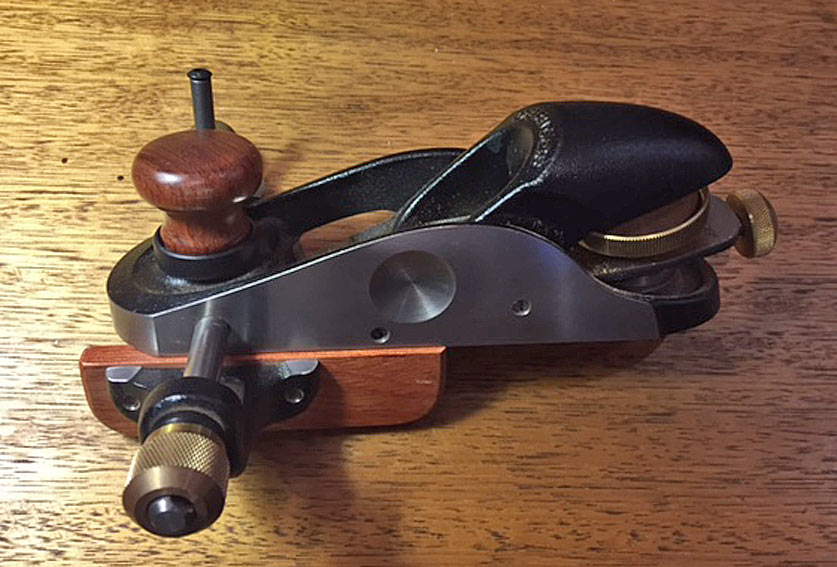
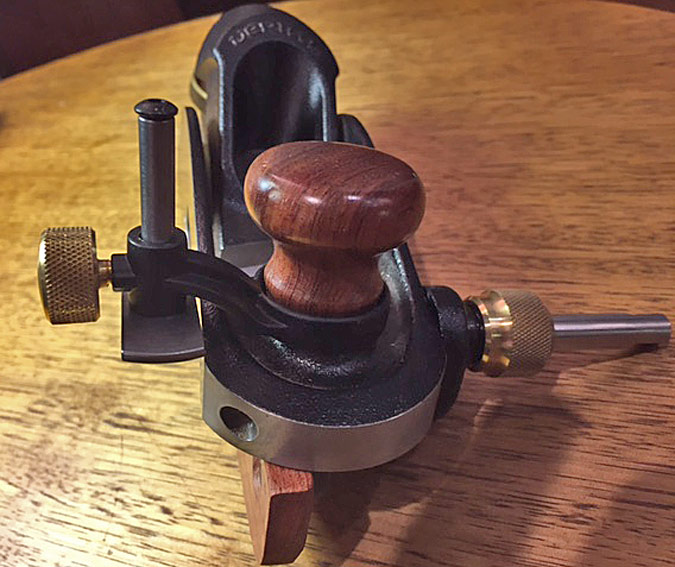
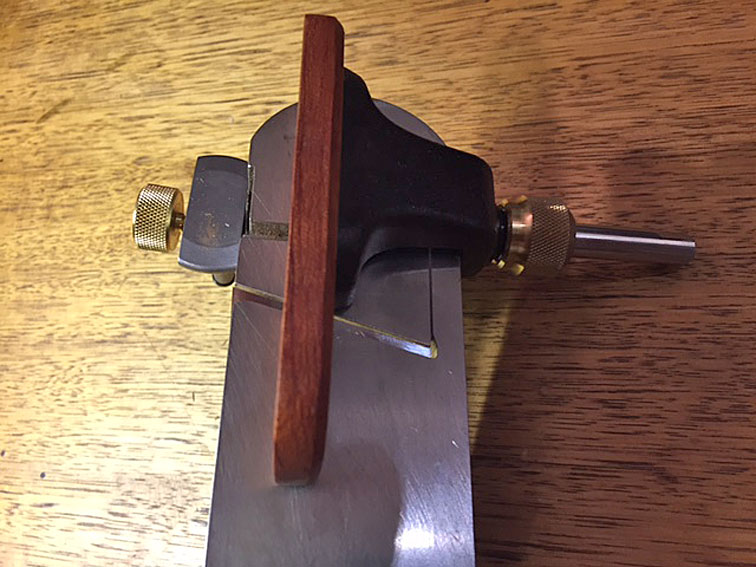
I do not use them on tenon cheeks.
Specialist planes. Not for everyone.
Regards from Perth
Derek
Re: Interest may be renewed.
William Duffield
If I'm going to go work in a wooden boat, I make sure I always pack the skew block plane second. My 2" slick is first. There's not much maneuvering room, so hauling in a large toolbox with a specialty tool for any eventuality is impractical.
Re: Interest may be renewed.
onemanband
Good point about carrying tools with you.
I certainly would prefer the skew block than its big cousin skew rabbet plane when weight and size became a factor. One skew block was all that I'd need as compared to a skew rabbet plus a low angle block.
I don't know anything about the interest thing but I'm never affected by what others think about certain tool as only I myself know what my needs (and skillset) are.
Just remember that a skew blade needs a different aid to sharpen.
Re: Interest may be renewed.
Derek Cohen (in Perth, Australia)
The one limitation of the skew block plane for rebating is that, like a shoulder plane, shavings are not expelled cleanly. They curl up and will get stuck in the side opening if you do not clear them early. I spent time yesterday building a box, and rebating parts using this plane. I am now looking at a modification.
Sharpening a skew blade is easy if you freehand on a hollow grind.
I’ll post some photos later.
Regards from Perth
Derek
Re: Interest may be renewed.
onemanband
Clearing the throat. That reminds me of Rob Cosman who unbelievably makes an effort to remove the shaving after each and every plane stroke. I don't know if he does that purely for the camera or it's his habit. He uses the skew to create a rabbet for the dovetail trick.
Re: Interest may be renewed.
Derek Cohen (in Perth, Australia)
Clearing the throat. That reminds me of Rob Cosman who unbelievably makes an effort to remove the shaving after each and every plane stroke. I don't know if he does that purely for the camera or it's his habit. He uses the skew to create a rabbet for the dovetail trick.
Rob Cosman takes such fine shavings that he must remove each one, otherwise it will be sucked under the plane. The shavings lack the strength to exit the plane on their own.
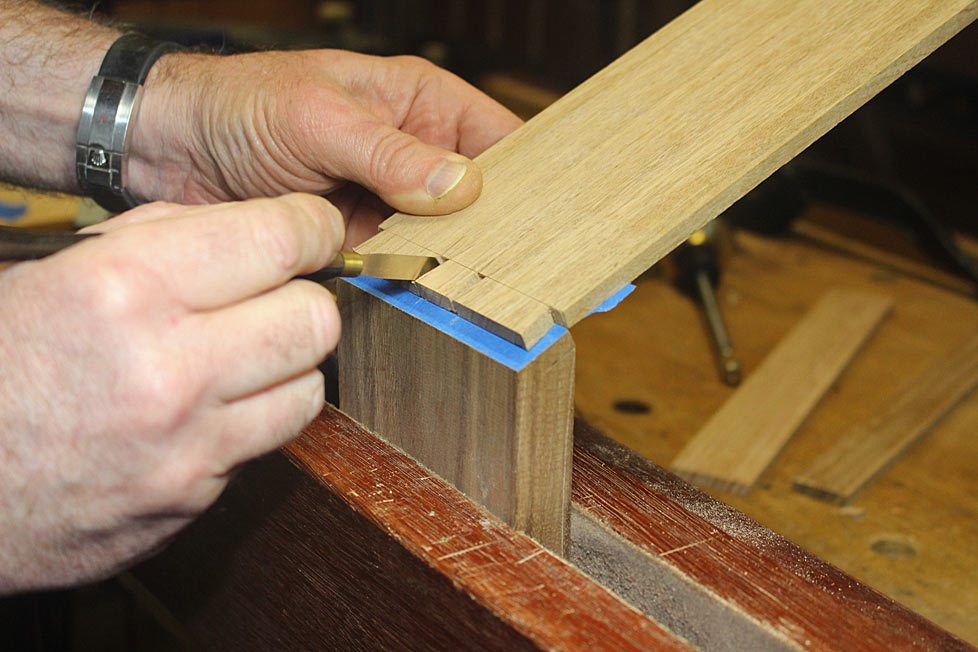
He no longer uses the skew block plane for the "140 trick" - so names as it was a LN #140 skew block plane he uses, a method taught to him by Alan Peters. Now Rob uses a method I developed (at least, I was the first to write about it as far as I know), using blue tape to create a fence. Non-invasive - that is, no cutting of wood involved.
The link is here: http://www.inthewoodshop.com/Furniture/The140TrickisDead.html
Some thief copied it off my website and sent it to FWW as a tip, which they published. Almost word-for-word. What is the world coming to?
Regards from Perth
Derek
Re: Interest may be renewed.
Warren in Lancaster, PA
We usually keep both hands on the plane and lift the plane between strokes. There is no problem with thin shavings getting jammed; they don't need to be pulled out.
I don't think Cosman has done a lot of hand planing.
Re: Interest may be renewed.
onemanband
I agree that very thin shavings getting sucked in was not why Rob Cosman pulled them out unless they were too long like the ones seen in Japanese plane contests. I never have had issues with very thin shavings. But his way seemed so inefficient to me. I aint 100 years old who needs a break after every push.
As for handplaning, he did quite a bit of his share in his younger days before youtube made him better known (given his 3 min dovetail episode?).
Re: Interest may be renewed.
onemanband
I've never tried or liked the rabbet trick...extra tool and extra work needed. The alignment board solves the layout problem more elegantly.
Re: Interest may be renewed.
Derek Cohen (in Perth, Australia)
I've never tried or liked the rabbet trick...extra tool and extra work needed. The alignment board solves the layout problem more elegantly.
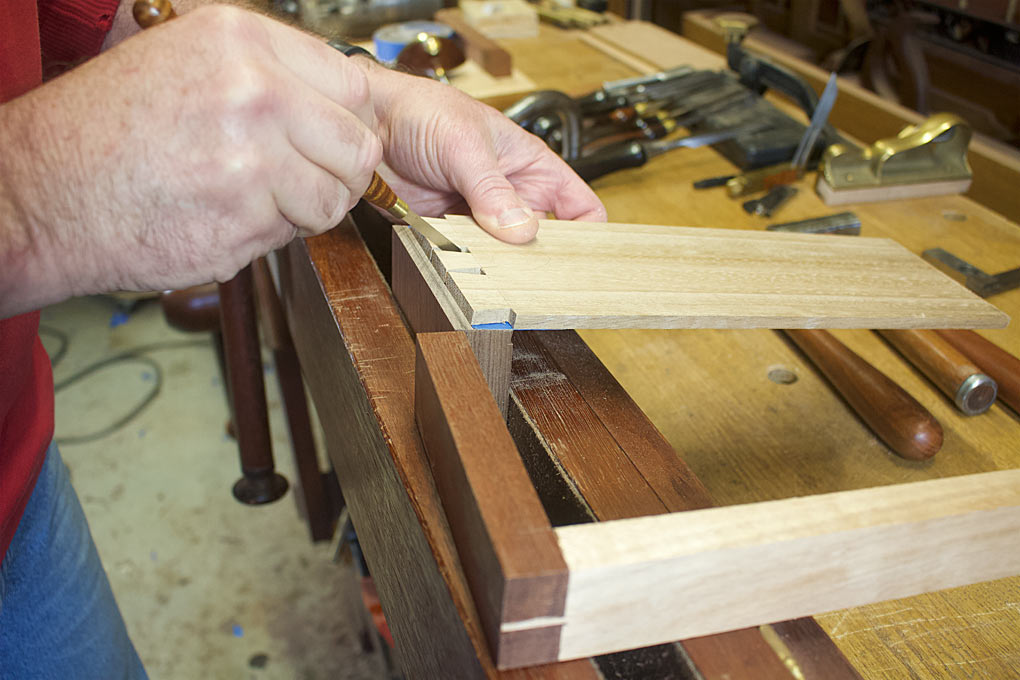
Not when you are marking dovetails that are compound angles ...
Regards from Perth
Derek
Re: Interest may be renewed.
Derek Cohen (in Perth, Australia)
...his way seemed so inefficient to me
Rob's main/only method for controlling tearout is to take ultra thin shavings. He does occasionally use a scraper or a backbevel for a high cutting angle, but rejects a closed up chipbreaker.
This is no doubt in some part his sales talk for his students.
Regards from Perth
Derek
Re: Interest may be renewed -Your blue tape
onemanband
I searched and found the FW trick you mentioned - https://www.finewoodworking.com/2020/10/08/workshop-tip-painters-tape-helps-with-dovetail-transfer
I can't tell if Bill Adams had seen your writing or not, though the reference to the use of three strips of blue tape in his trick was, to say the least, quite interesting. Why not two or four strips? If you asked me, two should work.
However, I'd caution against attributing what we see to an author even though his or her name may be there. Often, an editor changes or rewrites an submission......and he or she might use similar wordings seen elsewhere that do not belong to the author.
How thick a shaving
Steve D, in CT
How thick a shaving can you take with a closed up chipbreaker?
I see two factors against that concept. One is that the chipbreaker can't be set below the sole of the plane. Also, camber is mighty useful for heavy shavings because the corners aren't in the wood causing mischief. The camber depth limits how close the chipbreaker can be set to the edge.
I don't see close chipbreakers and heavy shavings coexisting. Am I missing something?
Re: Interest may be renewed -Your blue tape
Steve D, in CT
Once upon a time I saw a description of the "140 trick" and beside registration (which blue tape achieves) there was also a benefit of hiding the bases of the pins and tails to make the corner look cleaner.
Achieving this with tape would require applying another strip of tape in the corner after assembly, but it may not look very nice :p
Re: How thick a shaving
Warren in Lancaster, PA
Yes.


