Home Articles Forums Gallery Marketplace Videos

WoodCentral Forums

Knowledge You Can Build On — Est. 1998

The Donkey Designs a TS Sled

Posts

The Donkey Designs a TS Sled

#1

The Donkey Designs a TS Sled

eliot feldman


It was Roger Lance who suggested that I make a dedicated ZCI 45 degree table saw sled to make my beveled edge boxes -- instead of making a donkey's ear shooting board for the same purpose. But I made the donkey's ear first and posted it here last week. (And Bill Tindall followed up with an easier- to -use version.) And I went on and on about how to properly use my version by always keeping the reference faces and reference edges against the donkey's ear fence. I didn't have the sense that most here saw my point. ( Some did, e.g, Jack Dover.)

Anyway I went on to follow up on Roger's suggestion to make the sled. BUT..and it's a big "BUT"... this sled is not an ordinary one. Notice the fence is in the middle of the sled -- not the back, rear edge That's because this sled is inspired by the donkey's ear: the fence becomes the ear! HE HAW! You first position the reference edge against the front (far side ) of the fence in the usual way and push through the cut. THEN YOU KEEP THE REFERENCE FACE DOWN AGAINST THE TABLE AND ROTATE THE WORK PIECE 180 AROUND THE FENCE SO IT'S ON THE BACK (NEAR SIDE ) OF THE FENCE AND MAKE THE NEXT CUT. When the work piece is on the back, near side of the fence, you have to have some way to keep the work piece safely against the table and the fence; so I made four dovetail slots and use dovetail clamps to hold the piece down. The process is analogous to the working of the donkey's ear shooting board. It would be even more exactly analogous if one reversed the rotation of the table saw and PULLED the blade through the cut when the work piece is on the near side of the fence.That would actually work and would essentially be turning the whole table saw around and working from the other side. I purposefully show in the photo a work piece with an irregular natural edge to make my point about reference edges and faces. You can't use Bill's version in such a case without violating the reference edge issue. I actually intend to make some wrap-around beveled edge boxes with natural edges along the top using this sled. It's cool, isn't it!

Re: The Donkey Designs a TS Sled

#2

Re: The Donkey Designs a TS Sled

Steve D, in CT

I wish I had thought of that. I like it.

Re: The Donkey Designs a TS Sled

#3

Re: The Donkey Designs a TS Sled

eliot feldman

Whoops! In second paragraph I should have written, ".... and PULLED the work piece through the saw ..."

Re: The Donkey Designs a TS Sled

#4

Re: The Donkey Designs a TS Sled

Steve D, in CT

I missed that detail.

I would always push the material into the rotation of the blade regardless of the side of the cross fence.

If you're making a rectangular box you'll have two pairs of sides that need to be equal. Take all four and cut one miter close to the end. Then clamp a stop to the fence and cut the pairs on the other end using the flipped method. Move the stop to make the other length.

If your stop touches on the edge of the miter the thicknesses will have to be tightly controlled. If the face is used (45 deg) you can be looser with that. I would expect anyone making mitered boxes to have even thickness all around but I saw the live edge on your box sides and thought I would add that.

Re: The Donkey Designs a TS Sled

#5

It's cool alright !!.......

roger lance

Very creative.....Eliott......that brain of yours is working on all cylinders.

Were you lying in bed at night designing this sled in your mind?? It's hard to get to sleep when your mind is on some problem solving, creative surge. Most important, do you like using the sled and are you happy with your results??

I wasn't proposing that a table saw sled would eliminate a shooting board/donkey's ear.....still need to use one to refine that cut......but; a good, dedicated sled will make the process easier.

In the past, you expressed doubt that you belonged here......I'd say you're moving to the head of the class!!

Re: The Donkey Designs a TS Sled

#6

Re: The Donkey Designs a TS Sled

Derek Cohen (in Perth, Australia)

Hi Eliot

I completely agree that a reference side is centrally important when the thickness is not constant throughout. The irony is when boards are prepared with machines to achieve a uniform thickness ahead of hand planing the mitres .. and referring to this as handwork.

One can thickness accurately with hand planes. It just depends on whether one wants to do it all by hand, or use the best tool you have.

I think your idea of flipping the boards around a central fence is very creative. I love creative and thinking outside the box! But I struggle to visualise this method. How do the cuts become complementary? Can you explain some more?

Regards from Perth

Derek

Re: The Donkey Designs a TS Sled

#7

Re: The Donkey Designs a TS Sled

eliot feldman

The visualization of the method is not that different from visualizing the usual way one would do it by keeping the board flat on the table and rotating 180 TO THE SAME SIDE OF THE FENCE. But that requires the edges be parallel, usually no problem, especially considering that we're at a table saw. But that method does violate the idea that one should keep the reference edge against the fence. And it certainly can't work if the edges are not parallel or one is irregular. As for complementary, if you mean that slight errors in the 45 degree bevels cancel out to always make their sum 90 degrees, then I do give that up. But I can set the saw blade to exactly 45 degrees using one of those digital angle magnetic blocks. And this sled is a dedicated one -- just for making beveled edge boxes. So there shouldn't be much error in the bevel angles.

Another way to visualize this thing is by just changing your reference frame. Going back to the donkey's ear shooting board -- with the ear in the middle -- usually we see ourselves in the reference frame of the jig; and the shooting plane shoots past the us, first one way then the opposite direction. But it's just as valid to place ourselves in the REFERENCE FRAME OF THE SHOOTING PLANE, in which case IT'S THE JIG THAT "SHOOTS" PAST US. By the way, Einstein invented Special Relativity by thinking about observers in different reference frames moving relative (ha!) to each other and sending light signals back and forth. I was thinking along these lines when I came up with this new sled.

Re: The Donkey Designs a TS Sled

#8

Re: The Donkey Designs a TS Sled

eliot feldman


I mentioned to Claudia that people weren't responding to my last post on the new TS sled. She looked at my post an told me what an idiot I was to confuse everyone with reference frames and Einstein, etc. She said you guys just want to understand from a simple picture how the damn thing relates to the so-called donkey's ear and how to use it.

So here's a picture that I hope sums it up and makes the whole visualization thing O.K.

Re: The Donkey Designs a TS Sled

#9

Re: The Donkey Designs a TS Sled

eliot feldman


I hope these pics make it clearer.

Re: The Donkey Designs a TS Sled

#10

Re: The Donkey Designs a TS Sled

Ray Newman

A HA ! Now I get it. Thanks for the last two pictures.

Re: The Donkey Designs a TS Sled

#11

Re: The Donkey Designs a TS Sled

Ray Newman

A HA ! Now I get it. Thanks for the last two pictures.

Re: The Donkey Designs a TS Sled

#12

Re: The Donkey Designs a TS Sled

John in New Mexico

Yeah, a picture is worth a thousand words, and ironically, two pictures together are worth far fewer words :D

"To cut the other end, just move the piece to the front side of the fence"

Re: The Donkey Designs a TS Sled

#13

Re: The Donkey Designs a TS Sled

eliot feldman

Actually, this sled is a fu*&#ng dangerous contraption because it's DESIGNED to have the saw blade come right through the fence. Today I made an acrylic guard for it, which I'll show tomorrow. You would have to really work on it to get your fingers in the way of the blade with this guard in place.

I hope people noticed too, that for this sled to work properly, it's good to have a stop block on both sides of the fence positioned at the same distance on each side from the blade. I modified a Katz-Moses stop to do just that.

Tomorrow I will begin using it to make another wrap-around beveled box -- with an irregular natural edge top.

Re: The Donkey Designs a TS Sled

#14

Lots of tools for the use thereof

Derek Cohen (in Perth, Australia)

Eliot, your design is brilliant. Not fun to use, but brilliant as it plays by the rules.

This is a case where I prefer to use power tools. Having said that, from time-to-time I enjoy and have fun using hand tools ... even if the shooting board does not respect a reference side. :)

It would start with a mitre box and saw. This is a Miller’s Falls #15 ½ mitrebox I restored and then built the saw based on one by Groves ...


One might imagine that the classic shooting board of choice would be a Stanley #52 (which I have), but I have never found it particularly good for mitres, even on mouldings. It is, however, terrific for shooting the square ends of boards. Much better is the Donkeys Ear on this ramped board (which does require all sides to be parallel) ...


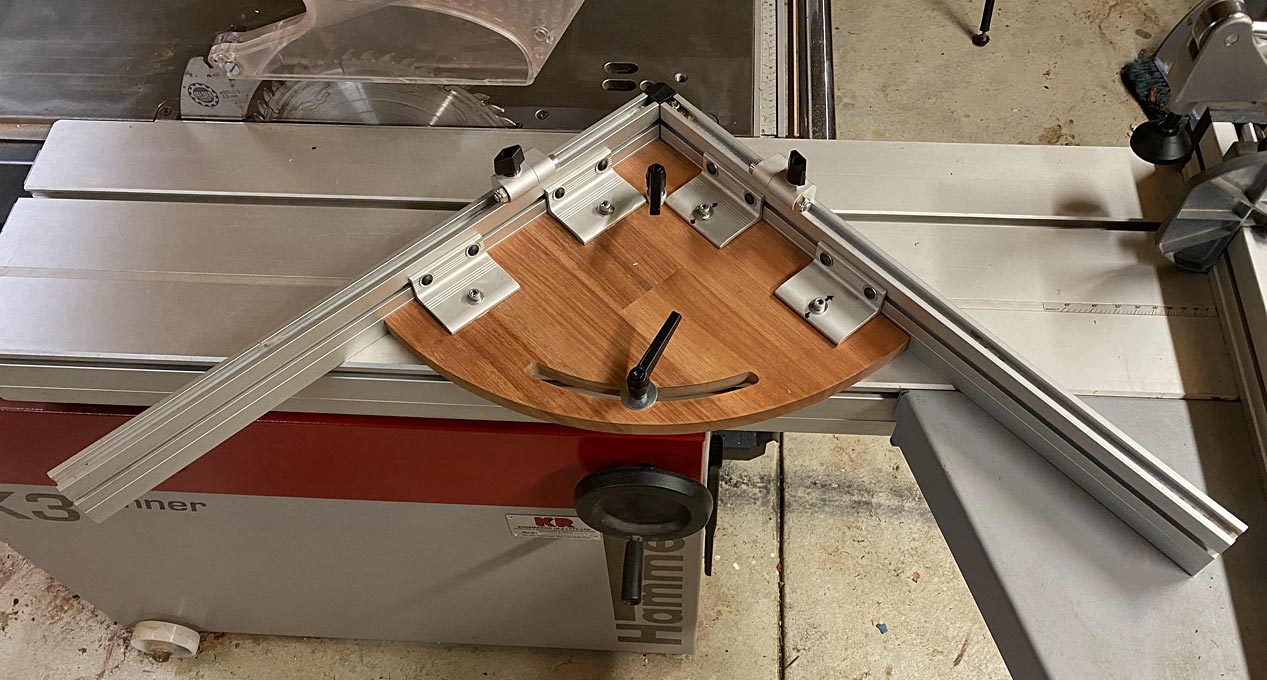
Most of the time I use a table saw. In my case a Hammer slider. For this I built a copy of a fixture designed by Felder (their's cost XXXX, and mine XX) ...


As you can see, this works on the complementary angle principle.

However, I do not recommend it to others as, while it does work very well, it requires absolute precision in three dimensions for accurate, and tightly fitting corners.

Keeping with the KIS principle, this is my go to for mitres. A simple mitred sub-fence and zero clearance (the Zero Clearance end along with a micro-adjustable stop at the other end make for precise sawing) ...


Again, unlike your design, all of the above rely on parallel faces - on all sides.

Accurate set up, however trumps "correct" orientation. While it may be done with hand tools - and clearly needed to be so for centuries - machines make this easier today .. joint, thickness, cut to length.

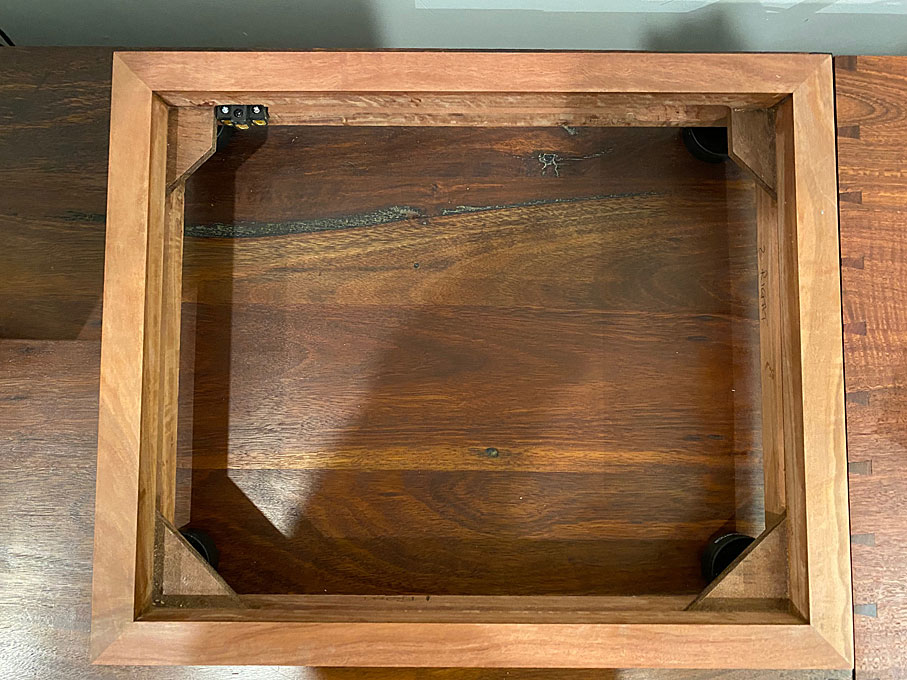
Turntable plinth in Jarrah ...


Compound mitres for an isolation table ...


Regards from Perth

Derek

Re: The Donkey Designs a TS Sled

#15

Re: Lots of tools for the use thereof

eliot feldman

Derek, .... I continue to be overwhelmed by your masterful woodworking! You have been my inspiration all along. But one point, still, about my method on the new sled: I plan to make some wraparound beveled edge boxes -- with irregular (bark) all around the top of the box. With my sled (as I show in the poorly photographed pictures) I can cut a bevel holding what will become the bottom edge of the box) against the front (far) side of the fence; then turn the piece around to the back (near) side of the fence with that same straight edge held against the back of the fence to cut the bevel on the other end of that board. My thought is that I have do it this way because I can't register the irregular edge against anything. I don't see how you can do that with what you have shown because of these irregular edges -- unless you want to hold the boards vertically as you would for a deep picture frame. Does that very precise one you made, which allows for complementary compensation, have enough height? I believe I could have avoided all this work, had I been willing to use my (Hitachi) sliding compound miter saw. I just didn't think the job would be accurate enough, with all that going from side to side and changing angles back and forth.

Re: The Donkey Designs a TS Sled

#16

Re: The Donkey Designs a TS Sled

eliot feldman


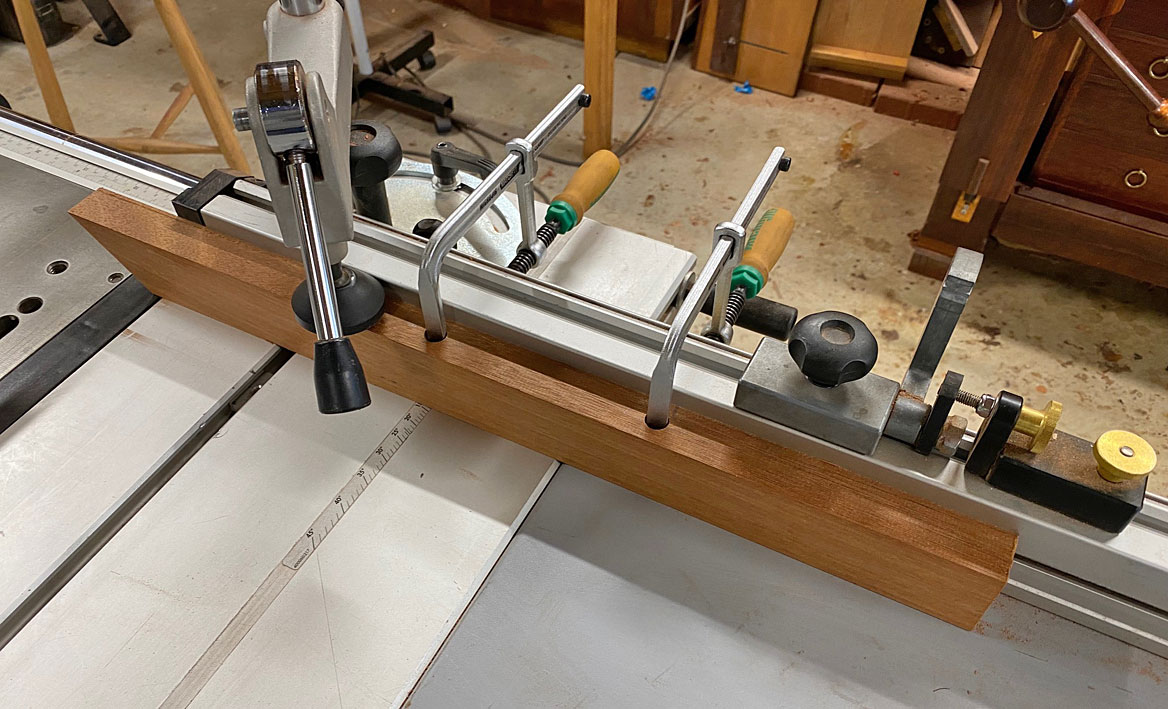
As promised last night, here's the final "Donkey's Ear" sled with the safety guard in place. I just sawed a small log lengthwise to get a board with natural edge bark on one edge, and I re-sawed that to get two book matched thinner boards. These I plan to use to make a wraparound beveled edge box -- with a natural edge top--using the new sled. I'll show it here if I can pull it off.

Re: The Donkey Designs a TS Sled

#17

Re: The Donkey Designs a TS Sled

roger lance

How will you get the natural edge to align on the joint of boards #1 & #4??

Re: The Donkey Designs a TS Sled

#18

Re: The Donkey Designs a TS Sled

eliot feldman

I think I understand your question. Boards 1 and 4 are originally the same board before the long board is re-sawn. So everything on these boards has to line up , including the natural edges. Perhaps I'm missing something. I just made a small one, and all seems well. I do have to confess, though, because the box i just made is on the small side--4 1/2 x 2 1/4 inches x 2 1/2 inches high, I found it very finicky to hold down the small ends when they were on the near side of the fence, where the clamps are required. I don't believe I will have any problem tomorrow when I make a larger one. I'll show them both when I get done.

Re: The Donkey Designs a TS Sled

#19

Re: The Donkey Designs a TS Sled

roger lance

Because live edge boards vary in width, the joint of board #1 & #4 maybe of a different width.....and might not align at the top of the joint.

Since you are making a continuous grain wrap around, joints #1 & #2, #2 & #3, and #3 & #4 will probably align at the top of those joints as the live edge width dimension should be very close.

But the widths of the boards at #1 & #4 have a real possibility of not being close with a live edge.

Or (my duh moment) are you laying out the parts for your box on your live edge board so that the widths at the joint of #1 & #4 are the same??......but, then the selection of the grain pattern would be secondary to making sure that these two boards had the same width at the joint.

Re: The Donkey Designs a TS Sled

#20

Wrapping 4 sides of live edge

Steve D, in CT

Let's say you want to make a 5x8 box with a live edge on the top that has a close match at each corner. The total length of material will be a little more than 26" allowing for the saw kerfs at the corners. At the end of the 26" board, before cutting, mark off the lesser height on the taller end and connect those points with a line and rip to that line.

At this point you can cut the 8", 5", 8" and 5" sides and the corners of the first and fourth will match, as will the intermediate ones. The grain may not be parallel to the bottom but if the edge is really wavy it wasn't going to be too even. You'll also have a grain match on 3 of the 4 corners.

Is this what you were planning Eliot?

Re: The Donkey Designs a TS Sled

#21

Re: The Donkey Designs a TS Sled

eliot feldman

Roger, We not be on the same wavelength. In order to get a true wraparound box where the grain matches ALL THE WAY AROUND -- not just at three edges, one takes a board and RE-SAWS it. It is then opened up end- to- end -- not side -to-side -- to get a book match at all four joint edges. The re-sawn faces become the outside faces -- the show faces --of the box. The outside faces of the original board become the inside faces of the box. (And these are the reference faces that are always kept facing down on the sled.) You could start with an original board that had the shape of a trapezoid-- three inches wide at one end and five inches wide at the other end, and after re-sawing it and wrapping it around, the #1 edge and the #4 edge would meet at three inches high. The resulting box would have a grain match at every edge, and the whole box would slope and look like a contraption to get someone in a wheelchair up a flight of stairs. (I"m not there yet; thank you Lord!)

Re: The Donkey Designs a TS Sled

#22

Re: Wrapping 4 sides of live edge

eliot feldman

Please see my reply to Roger. The key is the re-sawing. In your example, you wouldn't need a board that is 2 x ( 8+ 5) inches i.e. your 26 inches.You would need only a 13 inch board, which after re-sawing , would give you a total of 26 inches. (And these boards obviously would be half as thick.)

Re: The Donkey Designs a TS Sled

#23

That works too.


Re: The Donkey Designs a TS Sled

#24

Re: The Donkey Designs a TS Sled

roger lance

I'm not a box maker.....so, this technique is new to me.....and, it would also be new to Cosman who showed a wrap around box he had made in the past and he talked about how one corner would not have the matching grain effect (last Saturday's live show).

So, you're definitely one up on Rob.....and me......and a bunch of others as well.

Re: The Donkey Designs a TS Sled

#25

Re: The Donkey Designs a TS Sled

eliot feldman

I didn't invent the method. I also noticed last night that Rob Cosman said what you said he said about matching at only three edges. And I too was surprised. But how else can you match the grain at all four edges? One does have to stretch a little to visualize the end-to-end book match. This all fits together with my conception of my new sled for making a box with a natural edge all along the top.