Pins or Tails- definitely pins
Bill Tindall, E.Tn.
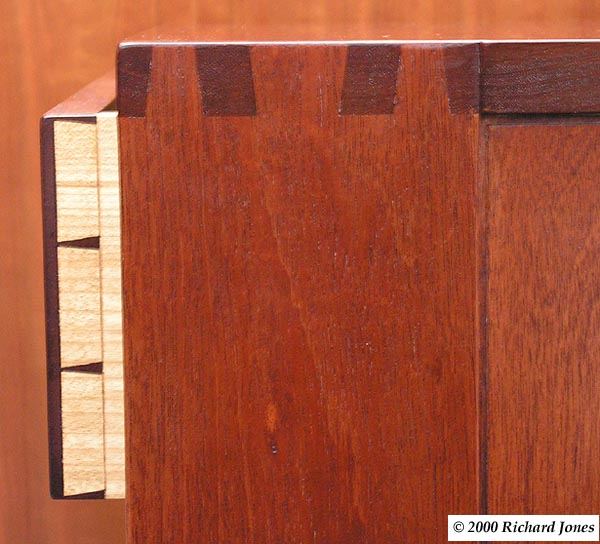
It would be a challenge to mark pins from tails with these dovetails.
Note the size of the half pin. Now that is bold, or simply confident from making hundreds of drawers.
Est. 1998 — 27 years of woodworking knowledge
Pins or Tails- definitely pins
Bill Tindall, E.Tn.
It would be a challenge to mark pins from tails with these dovetails.
Note the size of the half pin. Now that is bold, or simply confident from making hundreds of drawers.
Re: Pins of Tails- definitely pins
Derek Cohen (in Perth, Australia)
Bill, I do this frequently. It is not the slope - the difficult part is getting the knife through the narrow tip of the Tail in the transfer. It is why I advocate a thin marking knife. Blue tape also helps in that a single stroke records the stroke.
Here is a fun one ...
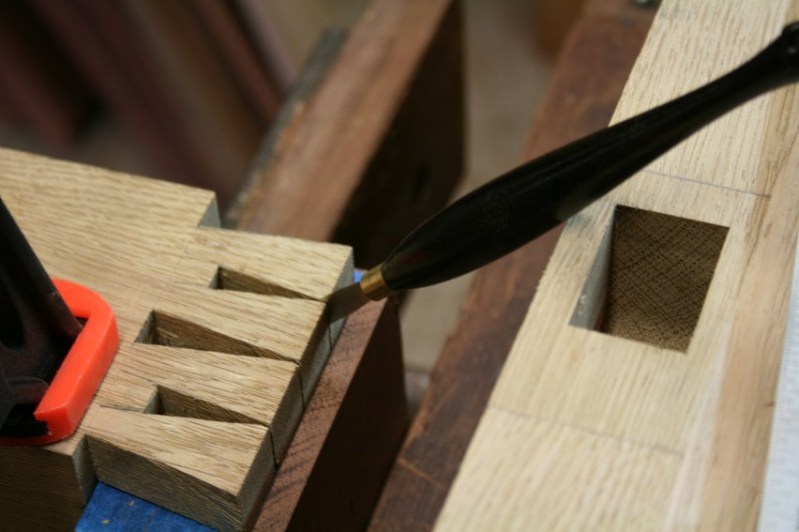
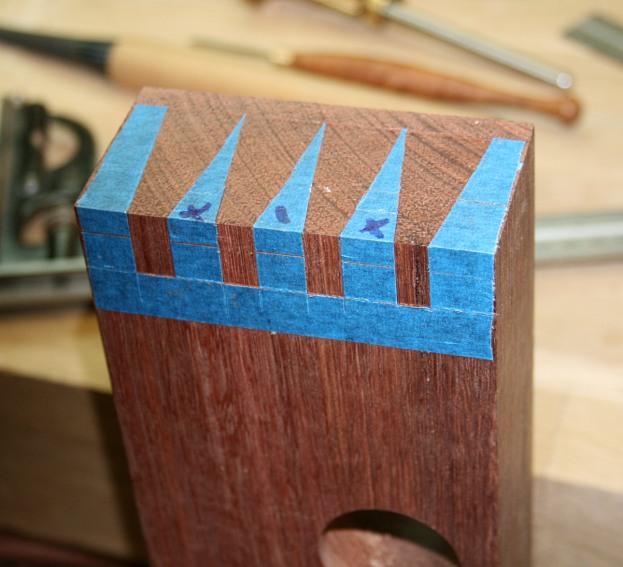

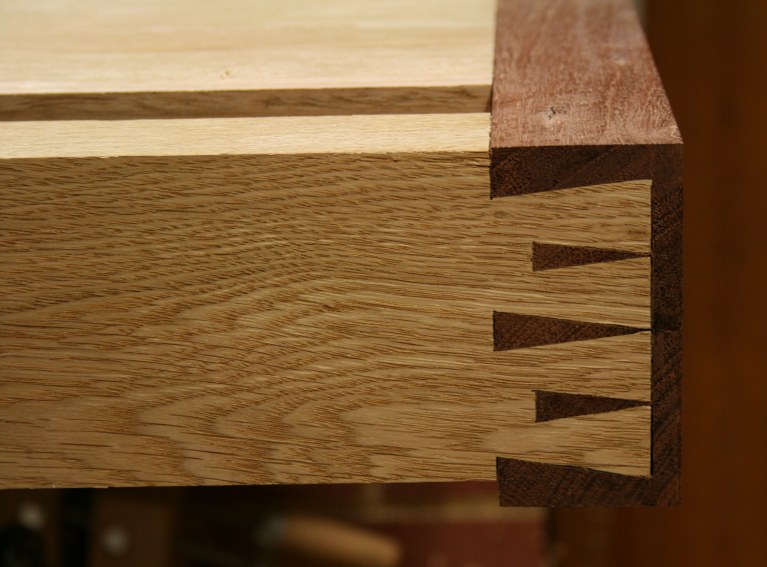
Here's a recent-ish piece ...

Regards from Perth
Derek
Re: Pins or Tails- definitely pins
David Weaver
I'd assume (if I were doing those small half pins) making the drawer front taller and then planing it down when done to get those delicate half pins at the bottom without risk.
If it's mahogany (forgot to look and can't see while typing this), it would be quick to plane off.
Re: Pins or Tails- definitely pins
Warren in Lancaster, PA
I have had to mark these Twiggy style pins sometimes. What happens is these delicate pins are too weak and break off, so the drawer comes in for repair. So when you replace the pins you have to mark them from the tails of the existing drawer side.
I would not call this high quality construction; it is probably not 18th century, maybe not American.
aesthetics....
David Weaver
....not trying to pick fights, but this kind of super thin pins reminds me of custom cars when you go to a show and you see things that are so pushed to the limit as a display of fabrication skill that they become unreliable or sketchy.
I associate the looks as being not better (or finer), but out of proportion, and when they are for a "peacock" reason rather than a functional reason, I don't really get it even from an aesthetic design point.
This can be seen on guitars from time to time, where joinery, cutaway and scrolls become extreme - they usually get broken from relatively minor mishandling.
Re: Pins or Tails- definitely pins
Jack Dover
That's extra work though, and you wouldn't probably get paid for it. It's probably just tons of experience and showing off, pretty much like those razor thin pins.
Re: Pins or Tails- definitely pins
Sgian Dubh
I'd cut those lap dovetails tails first, Bill.
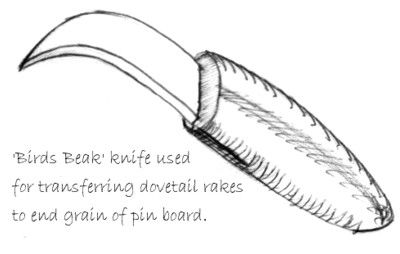
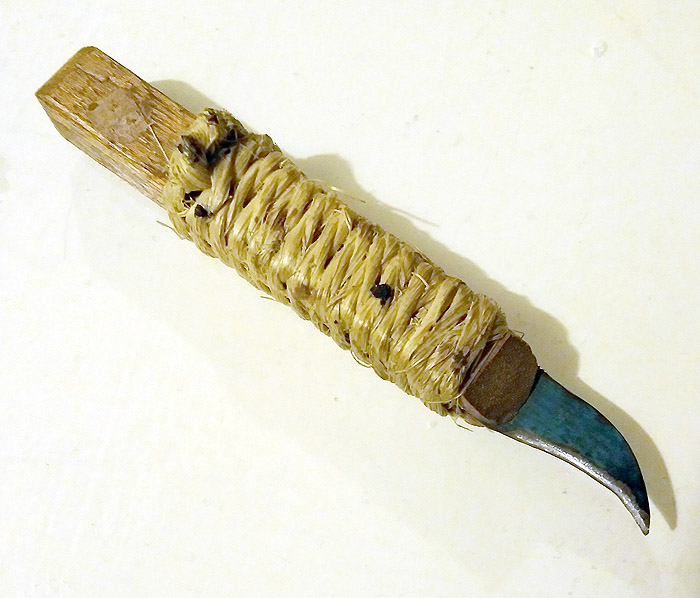
It's not really hard to get between the tails of even those set out for slender pins with a bird's beak knife. I don't have a picture handy of my actual knife, and the sketch below will have to do for now, but I used my home-made knife to transfer the tails of the drawer side below the sketch to the drawer front.
The actual knife is nothing more than an old hacksaw blade ground to shape, a slot in a handle out of a piece of wood, and some glue plus string wrapped around that. Slainte.
Re: Pins or Tails- definitely pins
David Weaver
could be - I can think of a way to cut it every so slightly loose and then close it on gluing. Anything done 1000 times can be gamed and then repeated almost without thought in a way that looks like fine tedium to someone else.
The half pins
Bill Tindall, E.Tn.
I'm impressed. That is one demanding fit.
Re: aesthetics....
Bruce McCrory
I think the obsession with "not looking machine-made" is more handicap than aesthetic. We know a photograph can point out a flea on a wolf but an illustration in paint reads "art" and scientific reference. So too, functional joint parts say, "I am useable craft, and art."
Re: The half pins
Sgian Dubh
Actually Bill, I don't normally aim for quite such a slender half pin, but on that occasion I did for some reason that I can't recall. I must admit I'm not particularly fond of the chunkier half pins I see many workers make, some even to the point where the outer half pins are more substantial than the full pins between dovetails. That's a look a really don't like. My preference overall is for the half pin to be, at it's root (the knife gauged base line), just slightly over half the root size of a full pin.
I thought I should quickly take a snap for your delectation of my bird's beak knife mentioned in my earlier post. So here it is in all it's glory. As you can see it's a masterpiece of elegantly sophisticated and considered design married to the mundane need of functionality (sic). Slainte.
PS. it does actually work very well.
Re: Pins or Tails- definitely pins
Wiley Horne
The main risk of those tiny half-pins is when you’re chiseling the waste after sawing. What I have done the once or twice I used those was—when ready to chisel—clamp the drawer front from half-pin to half-pin, for support at the weak (thinnest) spot.
Wiley
A question
Bill Tindall, E.Tn.
The tiny pin in the photograph was the smallest I saw in the Gallery. The most narrow point is the thickness of the saw blade that sawed it, and that was a saw blade more the thickness of a "Zona" saw and not my dovetail saw.
My US hack saw blade would not have fit in the opening. Bit even if it did and suppose it just did. With a bevel ground from each side the scribe line would be at the center of the tip of the pin hole and not at the edge. The solution would be two such markers beveled left and right. But you only have one. I don't think your marking gauge would have been able to transfer tails to pins in this case.
Do English dovetail saws typically have a thinner plate than US saws?
no, practical
Bill Tindall, E.Tn.
Alan Batty explained that the winning strategy to get 6 drawers done in a day was to minimize chiseling in the white oak sides. The tiny pin hole waste was largely removed with three saw kerfs, two to establish the size of the pin hole and the third largely removed the remaining waste. He reported that a pareing cut completed the pin hole. He also reported that he never knew of anyone that did tails first.
Re: Pins or Tails- definitely pins
Bill Tindall, E.Tn.
So when you replace the pins you have to mark them from the tails of the existing drawer side.
How are pins replaced?
Re: A question
Sgian Dubh
"Do English dovetail saws typically have a thinner plate than US saws?"
I wouldn't have thought so.
"With a bevel ground from each side the scribe line would be at the center of the tip of the pin hole and not at the edge. The solution would be two such markers beveled left and right. But you only have one. I don't think your marking gauge would have been able to transfer tails to pins in this case."
You've kind of lost me there. I'm guessing you're asking about the knife I use. Yes, it is bevelled on both sides to form an edge, and a sharp point. In use I simply angle it a bit to get the point either right into the corner or to follow the rake of the tail. I've always found there's enough room, but that's maybe because I've never wanted to do dovetails where the sawcut for an adjacent tail to the one just cut starts in the already existing sawcut - I have always moved the saw across by at least by the width of the existing sawcut, if you see what I mean. Slainte.
good saws...
David Weaver
I've had a few of the older english saws with fine plates. They weren't hardened as evenly as modern plates and had quite a lot of spring - I replaced them and can't check, but they weren't any thicker than the .018" plates that - i recall the spine being a little bit tighter on the new plate.
Unfortunately, it was so cheap to get 1095 stock and replace the plate and then sell the saws that I didn't want to keep that I have none of them...but..
.... I do have an older george whittles and co tenon saw, and it measures .02" exactly both at the back and the front of the saw. It's 14" long and by no means small.
My usual fascination is explaining things made the way they were with effort and economics, but I don't have any thoughts here, just what I've seen. I've not seen any first line saw with a fat plate, but have seen some of the late 1800s saws that copied earlier designs that then had plates another 20% fatter (sold all of those, too).
Bottom line, per given saw size, my experience ballparking plate thickness until more recently is that the english saws are about 80% of the thickness of the disston-type offerings in the states, and even those can be thinner than the late cheap bulky english saws.
Re: no, practical
David Weaver
That's my economic information....it may be apparent (from the whole double iron thing) that I have a fascination with the economic/effort component (which is also the drive with sharpening/steel, etc, in chisels - what takes the least).
That three saw cut big lines that out.
I'd be curious to find out why my older saws (1800s - at least one appears to be early 1800s) have fairly thin plates.
After seeing the cutlers grind palette knives, I now know how they could've easily made a very uniform sawplate without anything flat involved, and a sawmaker could've adjusted any issues with the plate that weren't perfectly flat.
The remaining saw that I have with its original plate is likely totally original, but the plates that I took out of my dovetail saws were definitely never remotely close to fat - surprising in how thin they are.
I think (in my experience) that as a plate gets thinner, it gets easier to start with aggressive teeth and the chance of sliding or moving from a cut goes down, and that's less effort.
Re: no, practical
Warren in Lancaster, PA
Allan Batty is not the only one who has made drawers professionally. A quota of six drawers in a day certainly does not seem remarkable. I think you have mentioned this quota more than a dozen times on this forum.
Re: Pins or Tails- definitely pins
Warren in Lancaster, PA
The pins are inlaid into the drawer front. As I mentioned, the pins have to be marked out from the tails in the original drawer sides.