Where did Unicorning plane blades wind up
Bill Tindall, E.Tn.
For the pedestrian planer is there merit in Unicorning either side of a plane blade?
Knowledge You Can Build On — Est. 1998
Where did Unicorning plane blades wind up
Bill Tindall, E.Tn.
For the pedestrian planer is there merit in Unicorning either side of a plane blade?
two types, still
David Weaver
...
doing it to the bevel side only requires chasing the angle down beforehand to make room (same low 20s secondary and then buff the edge). super bright surface finish, slight loss of clearance (you can feel it) but much stronger edge than apex of flat planes or the same stropped on bare leather, so if there's anything difficult in wood, the unicorned plane ends up planing much longer (especially true if you get to exotics or silica filled woods - no edge damage from the silica even in really cheap irons).
Other option is to do half of the buffing on each side. If it's done but not with a heavy hand, the result is a well finished edge that's not as tough as the above and lasts the same in a stroke test (of course, I tested this). very similar to just honing without buffing in terms of durability, but maybe the average person will complete the job more often with the buffer.
Can't make a great case for improvement other than the first method if someone is quick sharpening just on stones. The first method is a great trick to have in really nasty woods without having to blunt the flat side of the iron and plane hard to push.
in the unicorn article posted here, there's a picture of a cocobolo shaving from a board that's got visible silica (lots of it) and is SG > 1. I considered it almost unplaneable for various reasons, but the silica was one of them. After something like 50 strokes, the surface was still bright, despite the silica ($3 home depot plane iron - not close to dull. 20 strokes with magic wondersteel of any kind and an apex led to split shavings and nothing productive after that).
Loss of clearance
Jack Dover
slight loss of clearance
I'm losing quite a bit of clearance, for whatever reason. Could it be that a yellow compound is just too fast? An assumption was that on a small wheel it should take quite a bit to remove that much steel, but idk, so far unicorning plane blades wasn't very successful.
Still experimenting though.
I think so...
John in NM
I've done it for years on smoothers, but it never really occurred to me to do the same to the jack plane any more than it ever occurred to me to do it with a chisel.
For a smoothing plane a unicorned blade is the best way I've found of attacking difficult grain. Learned the lesson making drawer fronts of double bookmatched (or whatever it's really called) mesquite veneer. I'll go take a picture of the front, so you can see what I mean.
Next time I sharpen a blade for a jack plane I'll try it. Not planing a whole lot at present, so I go a year or more between sharpening.
It's kind of like heating steel with fast heat...
David Weaver
Not enough doesn't work. Too much can cause unusability and right in the middle there's an amount that's just right.
I use the yellow stuff - my observation at this point is that softer irons actually work better on the bevel side buff. I don't know why (avoiding the rabbit hole to figure it out), but if I had to bet at lloyds, I'm guessing it abrades off faster and flatter. Not sure what to advise other than trying.
Worst range for usability was the green iron (bill tested the brother iron - not quite M2, 65+ hardness) - still worked, but was less room for error. Home depot cheesy buck irons loved it.
I grew to like using the buck irons on the buffer better than XHP without -any stone, quick work on the bevel, buff the edge and not sure what the edge life is, but if it's 1/3rd of XHP, you don't notice because it would be self sharpening if it was any easier and you're always ahead of the damage.
Picture
John in NM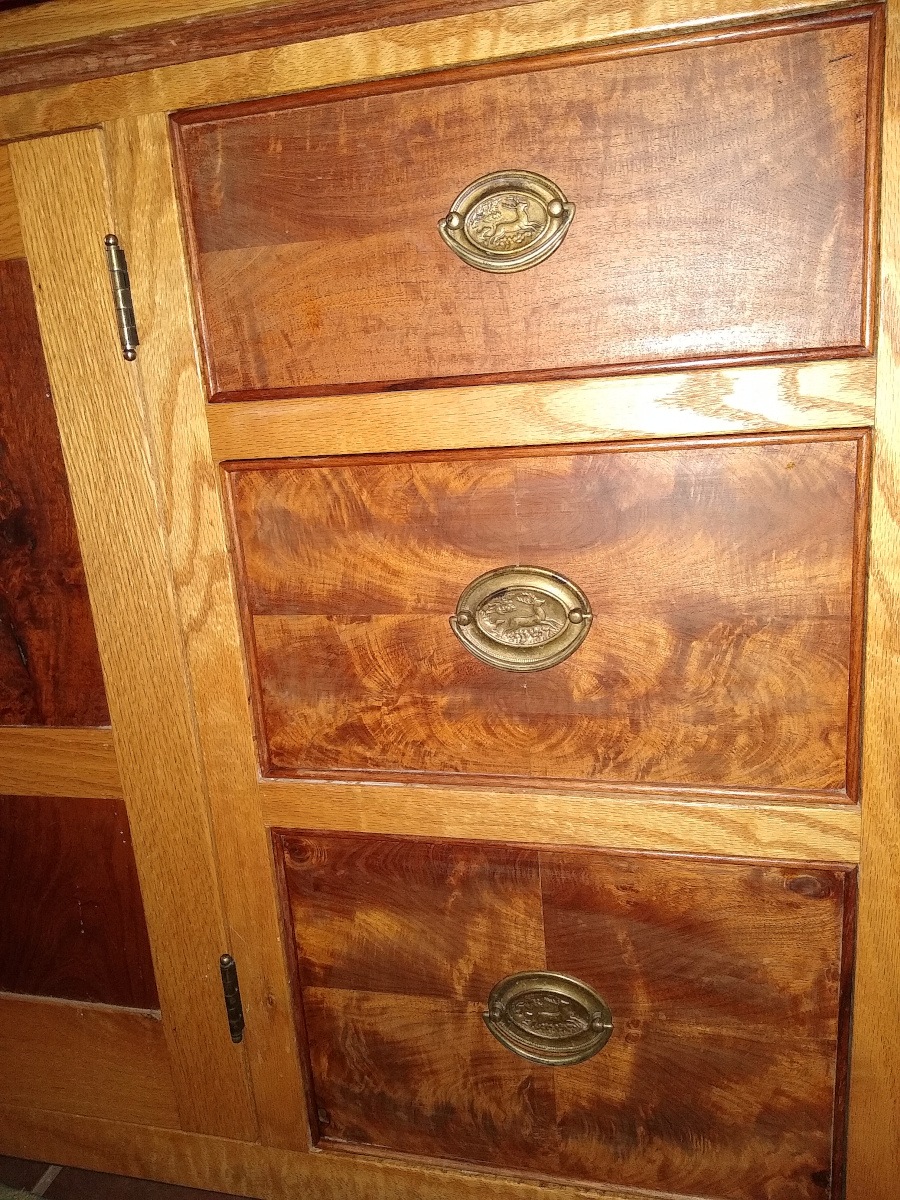
Shop sawn mesquite veneer. Mesquite often has a lot of nice figure, along with little tensile strength, making it pretty hard to plane.
tried it on drawer made with David's chisel
Bill Tindall, E.Tn.
A multitasking post.
David made a custom width chisel for chopping out my sized dovetails. Shown is the drawer made with same.
Also shown is drawer being fit with blade subjected to Unicorn Lite. David has spoken often of the need to completely remove wire edge for ultimate sharpness. I sharpened this blade as usual- hollow grind 30 degrees, fine diamond on fixed diamond plate, 1 micron diamond. After a few strokes at 1 micron I scrutinized the edge with 10X lens. Sure enough there were bits of wire edge still dangling. As an experiment I did literally a one second pass of the flat side of the blade across the buffer with the blade near tangent to the wheel.
My impression is that the blade was sharp, even though I spent less time on 1 micron than usual. I intend to continue exploring a brief pass of the flat edge across the buffer. For my needs I do not see any benefit of doing the bevel.
.
(using it to complete the process)
David Weaver
If you have rubbery, chewy, soft, etc. steel (or just something really tough that doesn't want to release the foil) it'll be very useful for that. Just light use.
Like a super strop.
When this first came up, I think I said something along the lines of not seeing the point since you can manage the angle and everything after that is abrasive wear. But I think you may have actually been one of the few people who said "yeah, go figure it out, anyway" and I expected to learn nothing and buff off all of the clearance.
finding a way to prepare a soft iron to plane through silica without chipping was a pleasant surprise. The lack of clearance feels different - if you're experienced, it will fool you into feeling like you have a plane that will be dull soon (as it's similar to plane that feels near the end of a sharpening cycle), but the edge lasts well longer than feel would first indicate. Just not as long as a hand honed blade in clean wood and there's no way around it other than backing off to light buffing with some on the top side just to try to match honing to an apex.
All of that removed as a need, the ability of the buffing wheel to take off yucky wire edges without doing much else is pretty nice.
I'm sure I've documented a million experiences (which is more like thinking out loud), but the test of an iron being sharp and free of a burr is identically easy shaving on both sides. Even if there is a little burr, you can palm strop it pulling your hand off of the flat side of an iron over the edge and push the burr to the bevel side and then plane (it'll come right off in work as long as it's not large or large and thick/strong).
I really resent...
David Weaver
..that home depot stopped carrying the soft "buck brothers" irons as they had a persistent wire edge due to softness, but the steel was fine otherwise (fine grained, predictable).
They love the buffer, the buffer loves them. I think the combination is more practical than any of the wondersteel irons for actual work as refreshing is never slow enough to cause one to put it off, the iron holds up great in heavier cuts and decent in finer cuts, and you're always ahead of the damage.
The downfall of the softness is that for anyone using any marginal abrasive (just like with a soft pocket knife) a big strong burr will be raised and almost anything will continue to create one other than the buffer....
(anyone here who has polished a stanley chipbreaker will remember how the burr just doesn't want to come off, but the buffer used tangent to the front will remove it cleanly).
Here's a thought....
John in NM
Somewhere out there are thousands, maybe millions, of Home Depot shoppers scarred for life by trying to get a decent edge on those Bucks Bros. irons. All you have to do is find some of them and offer a $10 bill for that horrible iron! 
Hopefully they won't look on ebay...
David Weaver
..there was a point where someone had half a dozen for $15 or something on ebay.
The last I checked, there were some in "vintage" packaging for $15 each plus shipping. A princely sum!!!
I would make a joke about making a $3 iron for $6 and doubling the price to take advantage of the market. Those irons were just punched out of some kind of stock and then rotary ground on one side. Just an example of how all of the things that I do the hard way are completely unnecessary.
(I did unload an O1 iron to someone on ebay, yesterday, though. I don't know if I can get a pro-card yet!).
(also, I think I have at least 4 or 6 of those buck brothers irons laying around. I wanted to make a ruse video about how fast they could be taken out of the package and made to plane cocobolo to a bright gloss without nicking, but foolishly prepared the last one when experimenting with the buffer thinking I just have more of them and then found none left. Someday, an antique picker will put 20 of them on ebay for $50 and I will take that opportunity to have enough to hand them out with business cards).
The planing board
Bill Tindall, E.Tn.
The drawer is hung over the salvaged top from a sewing desk I made decades ago. Not necessary for the board to fill the space in the drawer. Only need enough support to keep the drawer from tipping at the end of the plane stroke. The #5 enables several inches of over hang.
Re: Where did Unicorning plane blades wind up
Winston
I assume you're asking about bevel-down planes, but I'll also relay my experience with bevel-up planes.
For bevel-up planes, it makes it really easy to sharpen blades, and the edges are very durable. I had been using a blade that was at 25 degrees and then buffing it, but I've more commonly been using a 32 degree bevel and then buffing, since it makes the edge even more durable, reduces tearout, and doesn't really have significantly more resistance when planing. Here's a test I did regarding tearout: http://www.woodcentral.com/woodworking/forum/handtools.pl/page/21/md/read/id/495513/sbj/a-test-with-bevel-up-planes-buffing-and-tearout/
For bevel down planes, in my experience, buffing makes it easier to get blade in shape to create a really, really smooth surface. Sharpening is also a bit easier with a buffer than on stones, but it does require a bit more care than with chisels or bevel-up plane blades. I have been sharpening to 27 degrees before buffing.
I agree with David that using a buffer could reduce the amount of planing you could do before running out of clearance. However, it also makes for a stronger edge, and I've had fewer instances of edge damage that leaves tracks. The lack of edge defects also makes sharpening more predictable.
For a plane used for smoothing, I think it's a good idea to buff the blade: the limiting factor (at least in my experience) is not usually loss of clearance, but edge defects that cause tracks. By using the buffer, you can get an even smoother surface, and significantly reduce the chance of edge defects.
For a plane that's used for dimensioning and heavy stock removal, tracks aren't really a problem, and so it is more common to use a blade until it runs out of clearance. So a unicorned blade could reduce the amount of planing that could be done before needing resharpening. But even in that case, the reduction in edge defects can make resharpening faster (although I suppose one might argue that there's no need to completely remove edge defects in a blade used for this purpose).
Thanks
Bill Tindall, E.Tn.
That clarified the situation. What has happened is Unicorning has gotten known and people are assuming if it is good for chisels it will be good for planes. Twice in the past week someone has told me that they Unicorned a plane blade and, "it was sharp!". I think many people don't realize that plane blades get "dull" from loss of clearance, not a blunt edge. I am sure these Unicorned blades suffered clearance loss.
"Tracks" is not something that someone that owns sandpaper is going to be concerned with. More edge life I am concerned with. In the middle of fitting a drawer I suffered clearance loss and had to stop and resharpen. I despise this kind of interruption and strive to avoid it.
In general I can't be concerned with tracks you and David speak of. I see no practical application for these surfaces. I can't build a piece of furniture without getting scuffs along the way. It is not possible to plane to perfection a piece of assembled furniture. Anything I build is going to need to have its surface refined and repaired just before finishing. I have no motivation, or any practical need, to avoid sanding the assembled piece.
Depending on the amount of glue
David Weaver
It's hard for most of us to see planing through the lens of only trimming and fitting (though if any of that is done at a professional level, it's probably more common than more use).
Winston's comment about predictability is important if you're doing more with planes as an iron with a couple of nicks in one side and none in the other will cut less than evenly even if the plane is set to cut evenly.
Were I trimming furniture, I'd rather sharpen often vs. less.
I have found it fairly difficult to duplicate the results in practice, comparing the clean wood tests to actual edge life, but sharpening 3V and XHP without breaking the flow of work is a greater challenge. I don't mean just refreshing the edge, but keeping it damage free.
As far as toughness (Which is important in heavier planing), I haven't found anything that betters O1 or whatever is in ward's irons - those two are always the last to chip, the ward probably easily last compared to the O1. Its edge life in a wear test is fairly low, but its edge life in a try plane is multiples of my stamina in .005-.01" shavings and it usually gets to the stones again completely without damage.
(I don't have any "super" irons in any of my regular use planes right now, and that's not engineered - it's just what's in them from preference)
Re: Thanks
Warren in Lancaster, PA
I think many people don't realize that plane blades get "dull" from loss of clearance, not a blunt edge.
I concluded just the opposite 45 years ago, and I still hold that view.
We do have U tube gurus who demonstrate honing at 35 degrees or even higher; I can see that for a plane bedded at 45 degrees they might have clearance issues rather quickly.
On the other hand, we have people advocating bedding a plane at 50 or 55 degrees. In that case dulling is a lot faster because of the higher angle, but the clearance does not come into play, even if they do hone at a relatively high angle.
As I have suggested many times before, the office of the smoothing plane is to smooth the surface either just before glue up or just before finishing. Sanding is not needed.
Re: Clearance?
Bruce McCrory
What is this loss of clearance that is discussed here?
Re: Clearance?
David Weaver
the angle between the bevel and the board being cut. The wood has some spring back so a plane stops staying in the cut earlier than when that gets to zero.
You can feel how easily a plane pulls itself into a cut based on a combination of how blunt the edge is and how much of this angle remains. Bill mentions clearance as the reason a plane stops cutting, but that's true only if the edge is uniform (cocobolo with silica, etc, can create an edge that doesn't cut within about 20 or 30 feet of planing, or running into inclusions in maple ,etc).
In clean wood, a combination of wear and clearance do create the problem (the "problem" being when a plane doesn't enter a cut by itself.
The "unicorn" rounds the bottom of the bevel and makes this less conceptually easy to understand, and since it does that, the bevel (typically something in low 30s to prevent damage across iron types, or less if someone doesn't care about that) needs to be shallower before buffing the bottom - like 20 plus a couple of degrees.
bluntness and higher angles
David Weaver
I've never tested higher angles, but recall a rule of thumb is that they lose duration between sharpenings with higher angle and then increasingly quickly as the angle gets above 55.
Bringing that up is a good point as they'll be dull sooner with the same clearance. Actually, they'll be dull using the same total angle (meaning a 60 degree iron will dull much faster despite having tons of clearance - perhaps 30-35 degrees compared to 10-15 on a 45 degree plane.)
This...
Jack Dover
..., also maybe it will be easier to understand by thinking about drill bits and metal turning cutters. They need a "heel" behind a cutting edge to be relieved or they won't engage. This is why most of the "convex" free hand sharpeners have to re-grind occasionally: an angle becomes so steep that a primary bevel becomes parallel to a board planed, and a plane stops working unless some insane downward pressure is exerted.
I'm thinking there's loss of clearance exactly because my unicorned plane doesn't pull itself into a board (David gives an explanation to this), but I still can make a shaving by leaning on a front knob. Still experimenting though, it seems chisels are way more forgiving regrading overbuffing.
Re: Got it! Thx David, Jack...


