Home Articles Forums Gallery Marketplace Videos

WoodCentral Forums

Knowledge You Can Build On — Est. 1998

Dovetail and rabbet question

Posts

Dovetail and rabbet question

#1

Dovetail and rabbet question

Joe in a Cleveland suburb

Hello.

I'm building this small bookcase from a 1998 issue of FWW. February #128. Written by C. Becksvoort.

The top of this case in dovetailed to the sides. A molding is applied at the top of the case.

It will have a rabbet for the back to sit in. I've been struggling with this in my head trying to figure out how the rabbet and DT's will come together.

It's been a couple years since I've done DT's by hand. So I pulled out some pieces of scrap to mess around/practice/test with. Put a 1/2" X 1/2" rabbet on the pieces then did a quick DT.

See the below picture. Don't critique the DT it was literally the first one and I was making no attempt to be accurate. I just wanted to see what it was going to look like. Is that gap normal for this type of contraction? Should I do something different? If I look really hard at the pics in the magazine, I think I see the same gaps. They'll be covered by the molding, but it just seems odd to me.

I suppose I could use a router later after glue up to do the rabbet then chisel the corner square.

Thanks in advance. Happy Holidays.


Re: Dovetail and rabbet question

#2

think this through

Bill Tindall, E.Tn.

Stop the rabbet short of the edge. Chisel it square after assembly. Or use a half blind dovetail which is what one would use in a typical case piece and let the rabbet fall in a tail

Re: Dovetail and rabbet question

#3

Re: Dovetail and rabbet question

Warren in Lancaster, PA

In traditional work we plane all rabbets all the way through. However, when making the dovetails, we leave an extension on the vertical sides to fill this gap. Having a sample as you do, you can easily see where this extension of the side would be. In stead of making a 7/8 dovetail at the back edge, we make it only 3/8 or so, so that the side fills up the hole.

Another solution we sometimes see is when there are rabbets on the sides only, and the back boards go all the way to the top. We might see this solution when the top of the carcass is above eye level (very common on corner cabinets) or when a low chest has a secondary wood top dovetailed to the sides and a primary wood top covers over this sub top and the back boards.

Re: Dovetail and rabbet question

#4

We usually use half blinds

Bill Tindall, E.Tn.


We find them easier to make as well as they solve this problem.

Re: Dovetail and rabbet question

#5

Re: We usually use half blinds

Jack Dover

I know this book!

Also, what’s your opinion on mitered dovetails covering a rebate? I think half blinds are the way to go for backs, but a miter look a bit better when it shows.

Re: Dovetail and rabbet question

#6

Re: Dovetail and rabbet question

Jack Dover

Haven’t read the article but it’s totally possible they did it for work economy. All the proposed solutions — a half blind dovetail, a mitered dovetail, a half pin – are fiddly compared to just covering it with molding. Magazines often do this. Also sometimes the right way explained in writing, but not shown in a photo, or the other way around.

Re: Dovetail and rabbet question

#7

We always cover them up

Bill Tindall, E.Tn.

My family regards showing dovetails akin to going to the store in your underwear. My case pieces always have an applied front to the edge of the case to cover up drawer blade dovetails and all others. We think there are places where a mitered dovetail is appropriate.

Re: Dovetail and rabbet question

#8

Re: Dovetail and rabbet question

Joe in a Cleveland suburb

" making a 7/8 dovetail at the back edge, we make it only 3/8"

At the risk of sounding dumb :b what is meant by 7/8 dovetail and/or 3/8

Thank you.

Re: Dovetail and rabbet question

#9

Re: We usually use half blinds

Joe in a Cleveland suburb

Half blind would be easier I suppose, but I am trying to get to this and try the technique C. Becksvoort uses to install the molding on the top .

I think the top would/will look better not using half blind DT's.


Re: Dovetail and rabbet question

#10

molding

Bill Tindall, E.Tn.

I can't tell what is used but installing a molding on a top according to how it has been done for 300 years, that lasts for 300 years, is easy and requires no gimmicks. But it is hard to sell magazines year after year if you just repeat installing the molding the same reliable way. And the top will look better? Who is going to see it?

Re: Dovetail and rabbet question

#11

Re: Dovetail and rabbet question

Warren in Lancaster, PA

I was assuming a 7/8 inch thickness of your stock. On the pin board, you cut out the back at this distance from the top, which is what made the hole. If you had cut it only 3/8 or so from the top you could have avoided the hole.

Here is another way to visualize: make a small cube to patch the hole and glue it only to the vertical (pin) board. Then when you take it apart you will see what you need to make in order for the joint to work out.

Re: Dovetail and rabbet question

#12

Re: Dovetail and rabbet question

Derek Cohen (in Perth, Australia)

I've been struggling with this in my head trying to figure out how the rabbet and DT's will come together.

Joe, there are two ways to do this neatly with through dovetails (one could use a half blind dovetail, but it is more common to use a through dovetail).

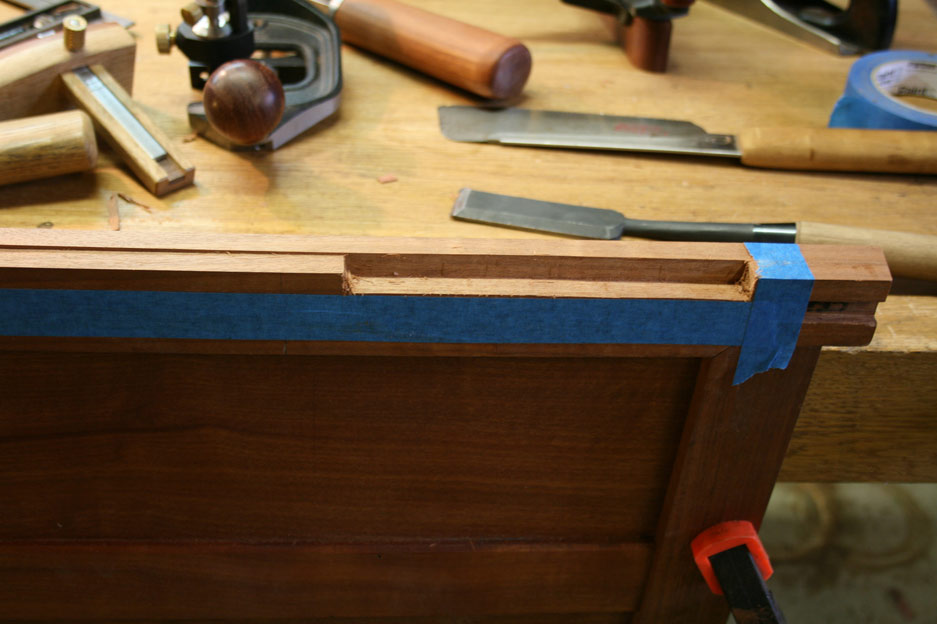
One way is to use a stopped rebate. To do this, stop the rebate short of the end ...


... and then complete it after glue up ....


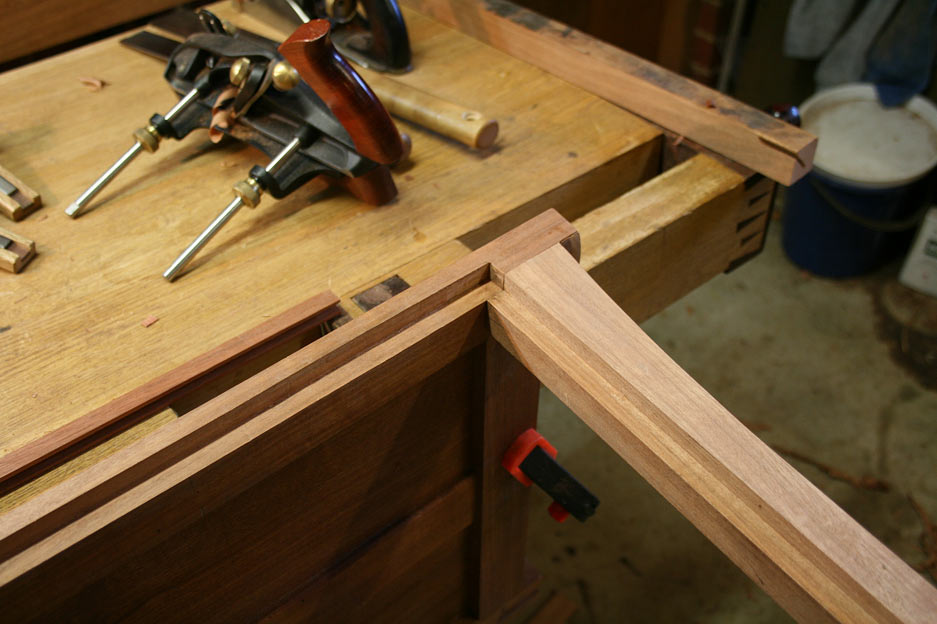
Here is another cabinet done this way ...


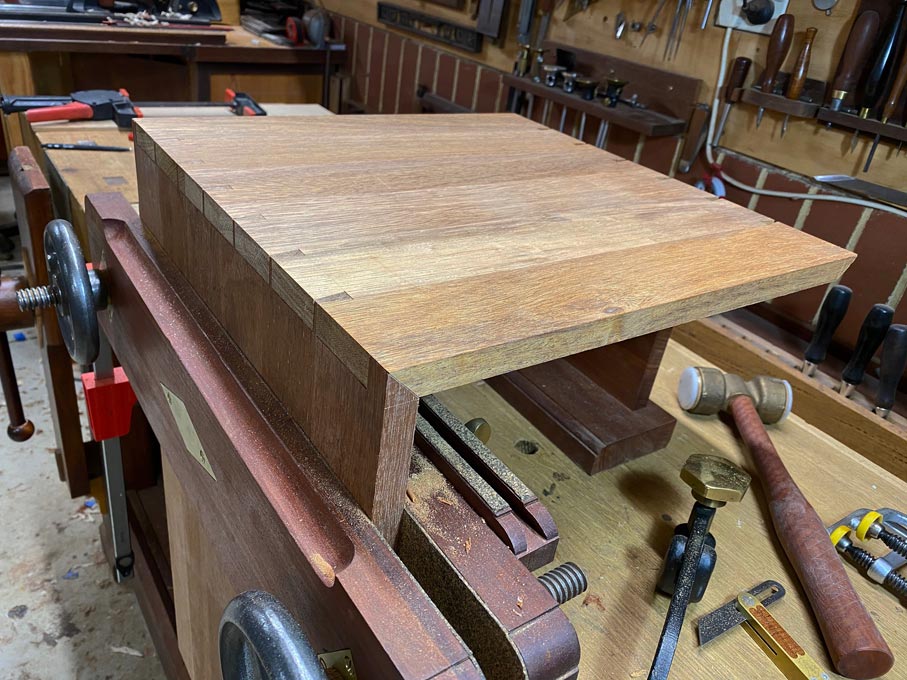
But this is quite a clumsy method. A more sophisticated way is to use mitred through dovetails ...


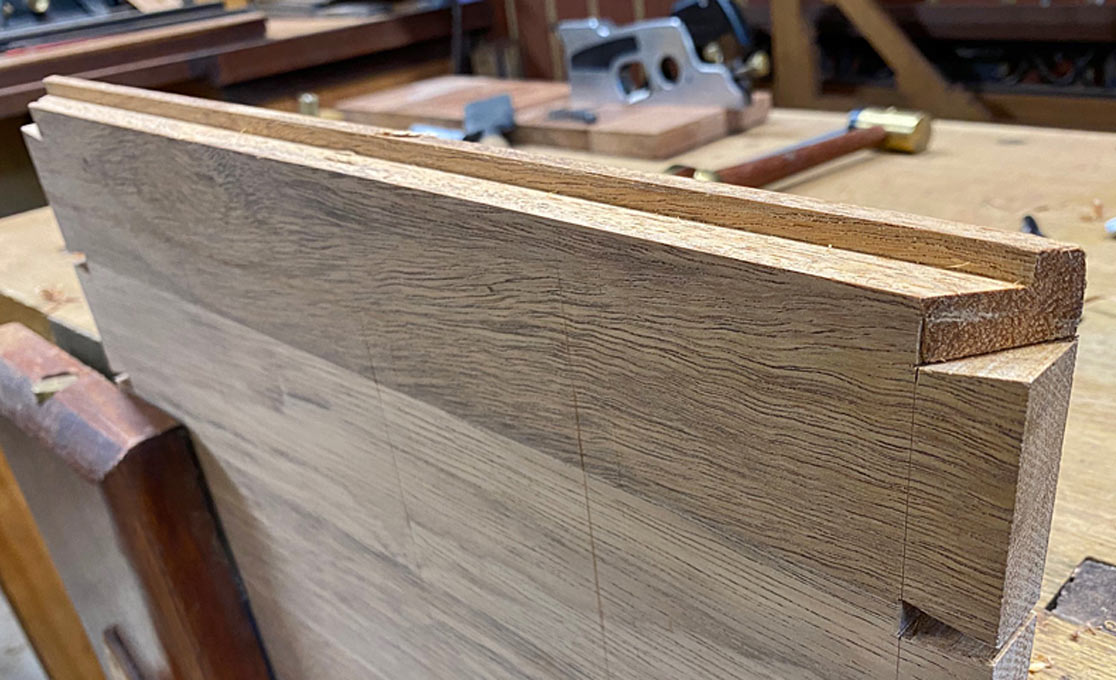
When you rebate them, you can plane all the way through as the mitre will hide the rebate ...


And the result is this ...


(The build of this cabinet is on the General forum)

Regards from Perth

Derek

Re: Dovetail and rabbet question

#13

I like a mitered shoulder

Steve Voigt

My personal preference is to use a mitered shoulder. See figure four in the post below:

https://blog.lostartpress.com/2018/07/22/special-dovetails/

It's tricky to wrap your head around at first, so do some practice joints. Once you get it, it is much easier and faster than doing a long row of half-blinds or mitered dovetails. Plus, if you're only doing it at the back, the miter doesn't have to be perfect.

Be wary of internet videos that show how to cut this joint…some of them use a different method that will work, but will give you a giant pin at the end that looks funny. I would stick with the Hayward method above.

The joint is also very useful at the front of the case, if you want a clean look with exposed dovetails--something that is not traditional, but looks great with Danish modern designs. Caleb built a nice dresser like this; here's a couple links. He does the spacing at the ends very well, which is tricky.

https://www.instagram.com/p/B9Kkpp7Jk5s/

https://www.instagram.com/p/B9NiEBAJ9w8/

Re: Dovetail and rabbet question

#14

Re: I like a mitered shoulder

Steve Voigt

Just to add: I didn't read Derek's post before I posted, but he's using the same joint. I would call it a DT with mitered shoulder rather than mitered through DT, but it's the same thing.