WoodCentral Forums

Est. 1998 — 27 years of woodworking knowledge

Flummoxed by Grinding

Posts

Flummoxed by Grinding

#1

Flummoxed by Grinding

Curt Putnam

I now have a Rikon half-speed grinder with CBN wheel so wheel dressing is not an issue nor grinder speed be an issue. What beats me up is setting projection and angle. I am using the BGM-100 and angle setting jigs but I find that to be extremely fussy. I do not understand how one can (for example) take a chisel with a primary bevel of 30° and a secondary bevel of 35° and then reset the primary bevel to 20° freehand. Would one or more of you helpful folks care to address the issue?

TIA

Re: Flummoxed by Grinding

#2

Re: Flummoxed by Grinding

Wiley Horne

Hi Curt,

Great choices for your setup!

The general rule is that the primary angle must be the lowest. Any micro or nano angle added on cannot be less than the primary.

So for example, I like a primary of 25 or so (by eyeball). That acute primary leaves a lot of flexibility to adapt the cutting edge to the task at hand, say, 27 for paring, or 30 for chopping cherry, or 33-34 for sugar maple. The flexibility is possible because the low primary has removed a lot of metal which would otherwise be in your way when you come to the the final hone.

Wiley

Re: Flummoxed by Grinding

#3

Re: Flummoxed by Grinding

Derek Cohen (in Perth, Australia)

I do not understand how one can (for example) take a chisel with a primary bevel of 30° and a secondary bevel of 35° and then reset the primary bevel to 20° freehand.

Curt, the simple answer is that you cannot. You can re-grind a 35 degree primary bevel to 20 degrees on a bench grinder, but I would not wish to do this freehand.

I am using the BGM-100 and angle setting jigs but I find that to be extremely fussy.

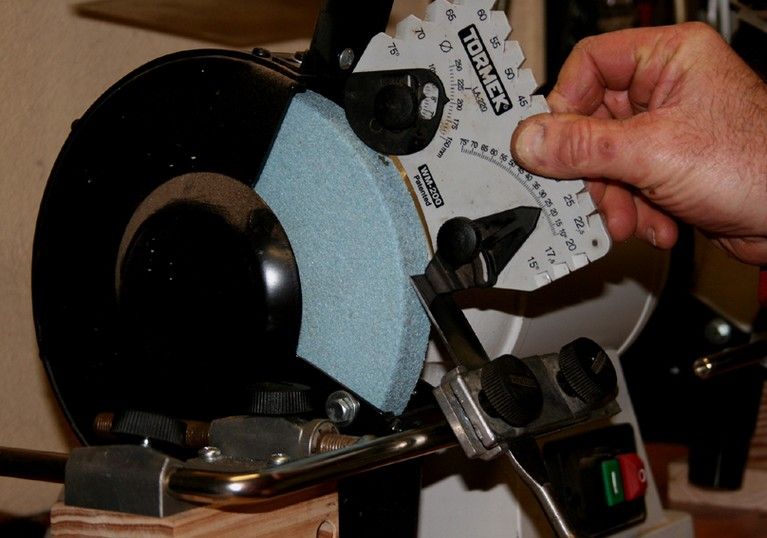
As you know, I have the same set up as you. Setting up a grinding angle on the BGM-100 is identical to doing so on a Tormek (as they use the same tool rest). The easy way to do this is to use the Tormek Angle Setter. If you are familiar doing this on the Tormek, it is a breeze on the bench grinder.

Here it is on the BGM-100 but a pre-CBN wheel ...


Regards from Perth

Derek

Re: Flummoxed by Grinding

#4

Re: Flummoxed by Grinding

Oskar

I would go about it as any other handtool operation. Like planing an edge square: you start by planing at what feels square. Then check. Then adjust.

Would do the same when grinding a 20 degree bevel. Start about at the right angle. Check if it is too steep or not. Adjust and grind on. And in the end the exact number for the primary does not really matter.

Good luck

Re: Flummoxed by Grinding

#5

Set the rest at 90 degrees

David Weaver

And use your finger as a fence against the edge of the rest to limit chisel projection. It's far faster and easier. You don't even need to keep the rest clean.

Re: Flummoxed by Grinding

#6

visual of this...

David Weaver

i don't remember what made this video go 20 minutes, but probably nothing good...

...in the middle here, I'd normally do this with a top hand to apply pressure to the bevel but it can be done one handed without issue.

https://youtu.be/n10x66X6Z9o?t=713

Also, at the outset of this, I'm showing laying the iron on the wheel and then turning the wheel to see where it's scratching. I don't actually do that, but it's a good tip if you're concerned about accuracy from the start.

This isn't exclusive to CBN wheels, all of my grinder rests are now set at 90 degrees. I don't remember why the brown wheel had the rest set, but it's not a wheel that I use for anything other than rough grinding and probably hadn't been used for years until I started grinding a cutout for chisel tangs lately (and it's set at 90 for that).

Just my opinion, but setting angles on grinders is an unnecessary pain and the rest itself gets in the way of levering pressure to the bevel (as in, it removes some of your feel/touch with the iron).

Re: Flummoxed by Grinding

#7

well said

Bill Tindall, E.Tn.

Start with what Wiley said and modify when you are experienced enough to detect something different could be a tiny bit better.

Re: Flummoxed by Grinding

#8

more sage advice

Bill Tindall, E.Tn.

And in the end the exact number for the primary does not really matter.

If you are using an angle setting device you are overthinking the process.

I change my tool rest for various needs so that when it comes time to grind a hollow on a chisel I have no idea what the present tool rest setting will yield. I stick the chisel on the rest and rotate the wheel by hand, then look to see where it made scratches. Adjust to get it more or less to match the chisel bevel and grind. Every year or so I get out a protractor and check that bevels have not wandered too far off the reservation.

Re: Flummoxed by Grinding

#9

Re: more sage advice

Bruce Mack

Bill's suggestion works best for me. When my eyes cannot discern the scratch pattern, I use a quick-drying blue layout fluid (Dykem is one brand) before making the scratch. If I have ground a favored blade to a favored angle, I may then measure the angle of the tool rest with the Clinometer app. on my iPhone and jot it on the blade with a sharpie. This gets me close to the desired angle on the next grinding. As always, your mileage may vary.

Re: Flummoxed by Grinding

#10

Izzat why your current grinder is on the floor? *LINK*

Jim Matthews

About 15 minutes in, the Baldor pedestal grinder rocks on its moorings a bit.

Did one hit the floor? Those things are like headless chickens - they can really go in a straight line...


img

http://bertiesinn.com/images/beltsander-races/2014_beltsander_race/full-size/2014_beltsander_race__000008.JPG

Re: Flummoxed by Grinding

#11

Re: Izzat why your current grinder is on the floor

David Weaver

There's an idea - as I'm thinking of throwing some things out that I have, I have one of those older locomotive porter cables (362vsk or something). I found the dust bag for it last night, and I'm sure I could find the sander without much effort. The kids are just about the right age to find that tons of fun.

:)

Re: Flummoxed by Grinding

#12

Re: more sage advice

Derek Cohen (in Perth, Australia)

If you are using an angle setting device you are overthinking the process.

I had better respond to this, since I do use an angle setter, and recommended one to Curt.

Bill, there are many ways to skin a cat ... or deer in your case ... choose the method you prefer, get experienced with it, and it will be fast enough. I feel bemused when someone writes that one method is “faster” than another, and the amount of time involved is a few seconds, at best, if at all.

Ask anyone here, who uses a Tormek regularly, whether they feel the setting up is slow. I think you will find that the consensus will be that it is fast. It is the grinding which is slow.

I could argue that adjusting the blade back-and-forth to centralise the scratch (from the wheel) on the bevel face takes more time than using an angle setter. Because it can, and generally does - I have used every which way in my time. Using an angle setter is not about setting angles obsessionally, but about setting things up efficiently.

One could have a debate about pink wheels vs CBN wheels as well.

Regards from Perth

Derek

Re: Flummoxed by Grinding

#13

Re: Flummoxed by Grinding

Curt Putnam

Thank you gentlemen!

From the responses I see that I should have pointed out that I am coming from the world of honing jigs where the angle is rather precisely set by the projection. It seems that what I failed to previously grasp is that you folks are just aiming to get metal out of the way - and are happy with eyeball accuracy.

I will not be able to just stick a chisel or an iron up to the wheel as David does in the linked video due to essential tremors in my hands - the more I try to hold a specific course, the more likely they are to randomly jerk. I am condemned to suing jigs or two hands for tasks requiring precision.

As always, I need more practise. Now I can do so with the idea of just getting metal out of the way. Once again, thank you one and all.

Re: Flummoxed by Grinding

#14

What I will build next *LINK*

Jim Matthews

I follow JSK-Koubou on YouTube.

There's hypnotism at work, much like Norm Abrams' early videos.

(I'm sure things will go sideways, somehow.)

The pivot arm allows for grinding laterally, with a fixture to manage "the shakes".

While I use 3M deburring wheel and Cotton buff for honing, I still grind on a diamond plate.

This gizmo should make short work of that step AND let me keep my fingernails!


Pivot arm jig

Re: Flummoxed by Grinding

#15

Re: Flummoxed by Grinding

TomD

As a general observation, woodworkers are too scared of grinders, and approach them as though they were about to stick their fingers in an electrical socket. When I started adult woodworking circa '78, I was fascinated with Japanese hand tools, which I rarely touch to a grinder, but I also was fascinated with turning, that pretty much required grinding. We were lucky back then, as VHS was just coming out and we did not have a million other inputs. I got the Raffan turning tape and pretty much just copied him. He stood to one side and could clearly see the bevel on the stone of the hard, dry, grinder. And given that most of the turning tools were HSS, you would not wreak them on a grinder, anyway.

Turning is also cool because it is basically grinding in reverse. Rub the bevel and reduce the turning object, while grinding you rub the bevel while reducing the bevel. Turning is fabulous practice for grinding. But even if it were not, in crafts like knife making, tyros, just like the person entering woodworking in awe of dovetails, who rapidly conquers them, in knife making you are going to conquer grinding in short order. I would recommend knife making videos if you want to learn to grind. Just as freehand dovetails are an entry level skill in woodworking, or maybe mid level, grinding a knife with perfect angles is routine in knife making. You just have to believe it. These would be Journeyman work in the ABS:


Re: Flummoxed by Grinding

#16

Re: 2 things for grinding

TomD

2 things for grinding:

1) Setup. having a grinder is one thing, but having it at the correct height is another. You want, as in turning, to have a natural stance. When making power level cuts (as opposed to something that requires a lot of hand manipulation like the curved end of a knife, or some gouges), you want to present the piece to the grinder, with the arms steady to the sides, the wrists locked out, and you grind with body movement, from the floor. This is going to be a lot easier if when you take up your power stance and present the workpiece, your wheel is right there at the correct level.

2) Learn to float the bevel. As with turning, you may need to find the bevel, not always be just plunging right in. You can heel in with the bevel and raise the stock until you can feel the whole surface in contact with the wheel. The floating part it you are in this position with the grinder running, even if it is 3hp, and has a fresh belt, and you are not removing stock. You will get more confident about presenting the bevel, but it is worth knowing you can find it when you want to and no stab at it, or have eaten up steel just finding it. Once you are running in place, your apply pressure to your cutting limit. Ideally this is light pressure and a sharp grinder.

If you are worried about burning the edge, just dip the metal in water, and usually a small stain of water will adhere to the top edge of the tool, and you just grind till it evaporates. Then redip. You can't get a ton over 200 F if you do that. As those laser thermometers are under 20 bucks, you could check for heat. I just keep at it till the tool gets too hot for my ungloved hands, then set it aside and work on another tool until the first has cooled. Generally I can get anything I want done in sort order before the tool gets too hot. But you have to be on the lookout as more acute cuts. duller belts, bigger chips to grind out, etc... will vary your mileage.
Re: Flummoxed by Grinding

#17

Re: What I will build next

Curt Putnam

Hey Jim,

I watched the video. That is one pretty ingenious gadget. I only have several issues with it. First, I am dubious about sideways scratches - perhaps unjustly. I know Derek tried a SideSkate and moved away. Don't know if the scratch pattern was part of the issue. My 2nd issue is that it solves a problem that I do not have. My tremors are only an issue when fine motor control is at stake. Moving an iron squarely across a wheel requires fine motor control. Pushing an iron or chisel clamped in a jig across a stone does not. A third issue is how does one create a radius with it?

Thanks for the link. I'll see if I can adapt it to my situation.

Curt

Re: Flummoxed by Grinding

#18

Re: Flummoxed by Grinding

Curt Putnam

Tin,

Thanks for all the advice. Those are some truly gorgeous knives. 'Tis funny but I do much better with a knife and a leather honing belt on a 1" grinder than I do on a wheeled grinder. Maybe, It is just practise.

Do you sell those knoves?

Re: Flummoxed by Grinding

#19

Re: What I will build next

Derek Cohen (in Perth, Australia)

Curt, side sharpening is great. I do use the Sharp Skate occasionally - great with Japanese chisels - but only to re-establish a flat bevel if it goes wonky. By choice I prefer to free hand hone. There are times when a guide makes more sense. I keep a foot in both camps.

Regards from Perth

Derek

Re: Flummoxed by Grinding

#20

Re: What I will build next

Curt Putnam

Derek,

Thank you for the correction re: side sharpening.

Despite my initial bounces, I am confident that, sooner or later, I will get the hang of grinding. Hope you are enjoying your improving weather.

Re: Flummoxed by Grinding

#21

I have a limited sharpening regime...

Jim Matthews

Only recently did I begin using powered honing methods.

I have a deburring wheel and cotton buff for the last steps.

There's no room for another grinding wheel.

I've never been thrilled with the results of free hand grinding, mainly because it isn't consistent. The idea of using this gizmo is to get repeatable results from the stuff I already own, at a faster pace.

The appeal of this is that the fixture relieves my creaky hands from doing all the work.

I find I can either have a full day of planing OR extended sharpening sessions, but not both.

Re: Flummoxed by Grinding

#22

Re: I have a limited sharpening regime...

Jack Dover

You might want to keep an eye on CL\FB marketplace for a small motor. I paid 12$ for an old AC motor and a few bucks more for two shaft couplers. These couplers connect two pieces of threaded rods (actually bolts with heads sawn off) of an appropriate diameter. This is totally sufficient for a de-burring wheel and a cotton buff, freeing your grinder for other wheels. Unless, of course, you're doing some heavy de-burring and polishing, but you would have another grinder anyways. You could get this for free if you don't mind cruising for a bit on a garbage day, just don't take vacuum motors. I was considering HF buffer too, but the cheapest option was around 50$, a bit too much for what they offer.

Re: Flummoxed by Grinding

#23

Space limitations

Jim Matthews

I'm at the limit of open space in my shop.

While I do have a few power tools in storage boxes - everything else has a dedicated "place".

It doesn't make my production faster, but I spend less time pushing stuff out of the way.

This gizmo would fit right next to my buffing setup.

Re: Flummoxed by Grinding

#24

Re: Space limitations

Jack Dover

Me too! My only hope today is making a good use of shelves and having sufficient discipline to keep some horizontal areas uncluttered so I could pull something out, use it and put it back. Small things are the way to go and small motors are totally adequate as buffers.

👍 This page answered my questions

Your vote helps other woodworkers quickly find the answers and techniques that actually work in the shop.