WoodCentral Forums

Est. 1998 — 27 years of woodworking knowledge

Hollow grinding tool bevels on a wheel grinder

Posts

Hollow grinding tool bevels on a wheel grinder

#1

Hollow grinding tool bevels on a wheel grinder

Bill Tindall, E.Tn.

In answer to this question:

White 100 grit wheel, dressed, medium to low rpm, fingers sufficiently close to an edge, still puts blue\brown spots on my just water cooled bevels so fast I can't catch the moment when to take a tool off.


At least part of your problem is from technique which I will address at the end.

To recap, I can/do grind thin Stanley plane blades to near the edge with a 3600 rpm Baldor grinder and a 120 grit pink aluminum oxide wheel, made with what I remember to be an H bond( but could be I). I have successfully taught many others to do the same on my machine with 100% success except the lady that stuck her finger on the spinning wheel to see if it was spinning. That did not end well, but I digress.

The Wheel:

Abrasive composition: Manufacturers recommend a pink aluminum oxide wheel, or the more modern “SG” aluminum oxide, for hard steel. White will do.

Particle size: I use 120 for historical reasons. Were I replacing, it would be with 80 or 60. This choice should be made based on scratch depth left to refine and control of material removal. My goal is to grind to near the tool edge, being careful to preserve the original reference edge to ensure it remains straight and orthogonal to the tool length (essential for plane blades). As I gained experience I found I could grind with a faster cutting wheel. I refine with diamonds which mow off any scratch depth from grinding.

Wheel speed: Affects rate of material removal which in turn affects control. I started with a slow speed, moving up to full 3600 rpm as I gained experience grinding to near the edge without going over.

Wheel Bond: Watt revealed the equivalence of work and heat. The abrasive particle milling out a chip takes work. Some of this work leaves as heat in the chip and the rest is deposited in the tool. Plowing a dull abrasive particle across the tool generates frictional heat and all of it is deposited in the tool. Hence, for coolest grinding a sharp abrasive particle is desired.

This situation can be achieved by fracturing the abrasive particle to create a new sharp edges or by ejecting the dull particle from the wheel surface. The SG abrasive fractures in a way to generate new sharp edges while largely preserving the particle size. White aluminum oxide fractures with more loss of particle size.

Another way to generate fresh sharp edges is to reject the particle and expose a new one, either by dressing the wheel or by sintering the abrasive particles together with a ceramic that is weak and lets go of the particles easily. The wheel’s “bond”, a letter rating system, reveals how tightly the abrasive particles are sintered together. A wheel with an H bond sheds particles readily from the pressure of the tool against the wheel. A M bond wheel is hard and its shape will hold up to heavy pressure grinding but with no loss of particles unless dressed.

Technique: Jam a 1 inch chisel straight into a 1” flat wheel of any kind and the heat will quickly accumulate at the edge and a burn will result. Consider the pilot landing practice called “touch and go”. The plane glides into the runway, touches it lightly, rolls along it to near the end, and lifts off. This is a technique that will guarantee cool grinding. The wheel must be crowned slightly. In a sweeping motion the tool lands on the crown somewhat past the leading edge of the tool. With the lightest touch the tool is guided across the crown and off the trailing edge. Then repeat going the other direction. Every few passes examine the result and adjust landing and take-off as needed.
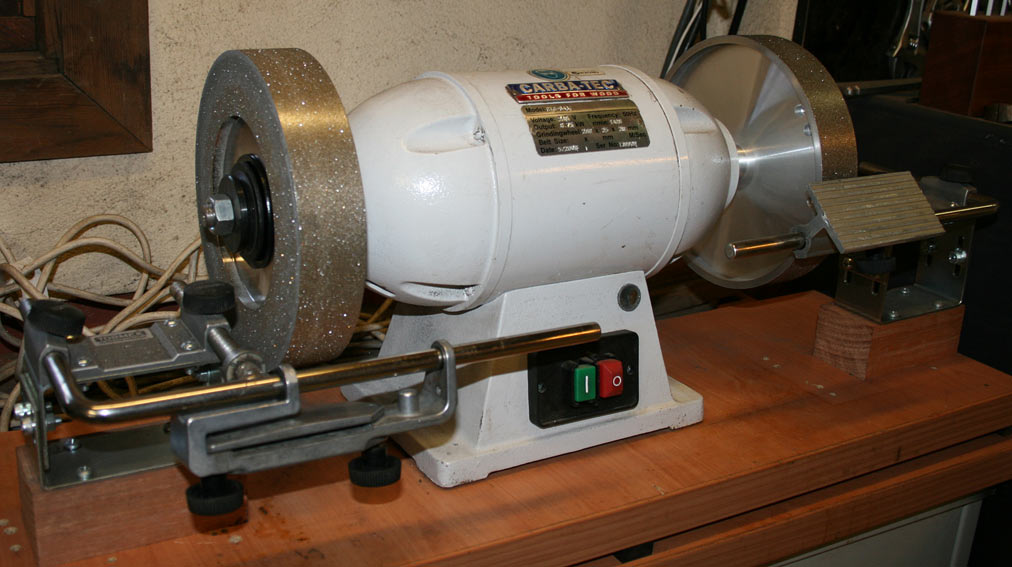
Re: Hollow grinding tool bevels on a wheel grinder

#2

Similar technique

John in NM

I have a brown SiC wheel on my grinder, very friable. Got to work at it to get it to burn and it's so soft that there's always high spots here and there after I grind something less regular than a blade. In spite of being so friable I've had that wheel for 20 years - it would have lasted about 2-3 years in a production shop setting, but I don't grind often.

Light touch and a soft wheel are the keys.

Re: Hollow grinding tool bevels on a wheel grinder

#3

grinding to the edge...

David Weaver

yesterday, I ground a ward large firmer chisel to the edge on the gray wheel with no significant noticeable heat.

Of course, 8" high speed.

The point of my comment wasn't to get into grinding theory. I was dissatisfied with my white wheel as it was the first thing I learned to grind with, I still have the wheel and could grind with it now, but it is slower to use than a coarse dressed gray wheel.

The point was just to mention that 8" high speed grinders are often advised against, but in practice, I find little difference in heat with a 36 grit gray wheel and a 6" 46 grit gray wheel dressed.

Both of those wheels generate less heat than a finer grit white wheel as long as they're dressed.

As for learning grinding, the easiest way for someone to learn to not burn steel is to give themselves a week or so, grind a few chisels and don't do whatever it is that causes a chisel to blue. My favorite trick is to grind a pass or two and drag the flat side of a chisel across your palm. The slower you can drag it, the cooler it is. On something like CBN, you can generally just put it in your palm if all you're doing is refreshing a bevel (except for high carbide steels - other than iron carbides) - those often don't spark well and resist the wheel more and get warmer.

Not a fan of soft wheels or expensive wheels, though (like seeded gel wheels, etc, that two would cost as much as a CBN wheel). A gray wheel can be used for toolmaking with annealed steel and then dressed and used to grind a bevel. softer wheels aren't suitable for the former - it just strips the abrasive right off.

Re: Hollow grinding tool bevels on a wheel grinder

#4

Probably a Norton 32A

Bill Tindall, E.Tn.

The description matches a Norton "tool room" wheel for machine shops.

Re: Hollow grinding tool bevels on a wheel grinder

#5

My favorite brown wheel...

David Weaver

.on the baldor, is numbered 57 at the beginning of the designation and N hardness. I'm sure this would be described as too hard for optimal refreshing, but it grinds annealed steel well and all alox wheels do well refreshing bevels they're freshly graded.

No clue what the white wheel is, it just says medium all purpose.

Re: Hollow grinding tool bevels on a wheel grinder

#6

Re: Hollow grinding tool bevels on a wheel grinder

Jack Dover

Thanks Bill! A few really good bits I wasn't aware of - had never paid attention to bond ratings, just went with "white wheels run cooler" never asking myself "compared to what?". Lighter touch when close to a final edge also seems obvious now, even though I wasn't applying heavy pressure. I don't think I was conscious about the fact there's less and less metal as we get close, so heat is not being evenly dissipated, and that trying to "catch" the heat will be difficult.

Re: Hollow grinding tool bevels on a wheel grinder

#7

crowned wheel is the main factor

Bill Tindall, E.Tn.

With a crowned wheel and "touch and go grinding" heat is generated over a small area for a small time, then this area has the opportunity to cool before it is worked on again

Re: Hollow grinding tool bevels on a wheel grinder

#8

you can crown or...

David Weaver

you can use the corners of a straight wheel. If you're grinding pretty much anything, the corners will get rounded a bit. I stopped crowning wheels after getting my first CBN (that sounds like a joke....).

I stopped crowning *non* CBN wheels when I got my first CBN wheel. you can't drown a CBN wheel (and I don't know why one would want to, anyway), but sometimes if something is a bit uneven (iron or chisel thickness), you have to work one side more than the other, and the way to do that is to tilt whatever is being worked just a little bit to use just the edge of the wheel.

This appeals to my selective cheapness, as I'm not grinding the wheel into a specific profile.

That said, I worked back and forth across the high speed wheel with light pressure and had no issue with heat. The crown isn't absolutely necessary (Even without the corners), but it will get a beginner going.

The rest set at 90 and leaving the wheel straight is faster than everything else and gives much better touch (and has indifference about tool thicknesses, etc).

Re: Hollow grinding tool bevels on a wheel grinder

#9

Exactly

Derek Cohen (in Perth, Australia)

I used a crowned white wheel many years ago, following Joel’s advice. It is a good method for its context. I know that Joel sells crowned CBN wheels and (sorry Joel) I have stated before that it no longer fits the context (which involved heat and grinding accuracy on vitreous wheels).

When I moved to CBN wheels, camber was no longer needed. CBN does not shed grit, does not change shape, runs cool, and never needs re-surfacing. It is an advantage to keep it straight, and there is no necessity to grind part of a bevel - one can do it all at once.

CBN is not only a game changer, it makes sense that you change your game as well.

Regards from Perth

Derek

Re: Hollow grinding tool bevels on a wheel grinder

#10

clarifying the crown

Bill Tindall, E.Tn.

It only needs to be slight. I achieve it with a Tee style wheel dresser by dragging the dresser over the wheel in an arcing motion. The arc only needs to be sufficient to limit the contact area on the tool. Given that only a tiny amount of steel is removed at each pass only a tiny arc is needed to achieve limited contact. The other consideration is the crown on the wheel needs to be sufficient to avoid engaging the leading tip of the chisel in the "touch and go" sweeps. If the leading edge hits first there is risk of overgrinding it. A casual glance at my wheel might not even detect that it was crowned.

I find a stable, flat tool rest essential for hollow grinding. This need precludes using the edge of the wheel as the crown.

My discussions have focused on hollow grinding between sharpenings where only a small amount of metal is being removed to deepen the hollow and extend it to near the tip. I want to preserve the original tip once it is established straight and orthogonal to the length of the tool. My main concern is loss of control that would grind past the chisel tip and alter the reference edge. I am establishing grinding conditions to avoiding metal going away too fast. If I ground more I would find ways to become more efficient. I suspect those that ground a lot would wind up at or near what David is doing.

Initially establishing a hollow ground bevel or rehabbing a tool bevel could involve more metal removal and call for more aggressive grinding conditions-coarser grit, faster wheel speed, etc.

Re: Hollow grinding tool bevels on a wheel grinder

#11

I think everyone's on the same page...

David Weaver

..mostly because every one of us who started grinding a decade or so ago saw Joel Moskowitz's blog and then the word of the crown spread like wildfire. It's slight.

My point is the center of the wheel can be flat and then both edges are similar in radius to the crown.

I learned by necessity with the CBN wheel (I have a radius edge wheel), which forces you to go to the edge as the center is flat. Then, I started to like the flat center (ftr, I ground that ward chisel on the high speed grinder on the flat, but since I've used that wheel for a bunch of heavy grinding already, it's not really that flat - it's minute undulations - but even there, the speed and coarseness allows such a light touch that it doesn't matter).

I never ground the crown sharply, because it wasn't necessary. Now, grinding the crown for me isn't necessary (or preferable). I have a lot of repetitions on the grinder, though. Both from doing a lot of work entirely by hand, restoring about chisels, 100 planes, making another 50 or so and others. My biggest danger has for years now been grinding the tool a bit warm and then putting my fingertips on it on the hone to find it slightly uncomfortable, but I've also learned how to get the stones to soak most of the heat out of the chisel if the first touch is a bit warm.

I think grinding with the rest square has a great deal to do with making the corners more accessible as the crown. I like the corners to be rounded from heavy grinding a little bit, anyway (it's favorable for all kinds of making to have the flat on the front and the two edges slightly rounded just by use.

I have no excuse about why I get so cheap with abrasive on a wheel - it must be in my blood. There's plenty of pound foolish to mix with that.

Re: Hollow grinding tool bevels on a wheel grinder

#12

A consideration

Wiley Horne

Hi Derek,

First off, I want to acknowledge and thank you for introducing us to CBN wheels. I’ve never looked back, and for all the reasons you list—cool, non-wearing, no grit slinging, no water (on Tormek)....

Regarding flat vs. crown, I use a flat CBN wheel on a Tormek, with the tool fixtured in a BGM-100. I believe you fixture the tool also, at least for typical jobs like chisels.

So. When one grinds a chisel on a cool wheel using a fixtured presentation, the flat wheel is perfect. Just lower the tool onto the wheel, everything is square, and we’re good.

Now, what if the tool is not fixtured. Suppose it is handheld on a rest. As I understand Bill is doing. And perhaps others—I don’t think everyone is using BGM-100 or similar. Then there are two issues: Issue 1= smooth engagement as the tool is brought laterally onto the spinning wheel; Issue 2= wheel pulling the tool away from you.

On both those issues, it seems the crowned wheel would be desirable, i.e., it would ease the entry, and would exert less pull since the contact area is smaller. Again, this is relative to handheld grinding—grind by touch—rather than fixtured.

For my purposes, like you I find flat is excellent. For the handheld, grind-by-touch folk, I can see the case for the crowned wheel, including Joel’s crowned CBN.

Wiley

Re: Hollow grinding tool bevels on a wheel grinder

#13

The compromise..

David Weaver

..the flat wide wheels with a radius edge are the nicest compromise.

I did find it a bit of a challenge to get the corner of a chisel onto the flat bit of a wheel and use the geometry as it is when used to the crown.

But at high speed, that goes away pretty quickly.

When I got my first wheel, someone mentioned that they wouldn't heat a tool, and yet someone else suggested if they were used heavily, the CBN would come off. The math about CBN tells you that the former is false. It transmits some heat into the wheel, but not all - more than al ox.

At any rate, Mel Fulks on another forum gave me two 1/2 inch millwright chisels. They're gorgeous. Curved on top, flat on the bottom - such an elegant shape. Cross section 3/8" plus at the business end (heavy chisels). One had the bevel ground on the opposite side (!!!), the curved side. I concluded the user didn't know what they were doing and picked the wrong side. Years of working more freehand suggests that someone may have done it on purpose as it was neatly maintained. At any rate 2 - I laid the chisel bevel on the CBN wheel and ground it with heavy pressure until the bevel went the other way. That resulted in big cherry of burning steel laying in the guard of my grinder and an orange chisel tip. not blue or brown, but orange.

It did take a bit of the snort out of the center of the wheel, but it's several years later now (4 or 5?) and the wheel has worn a bit over time but still works nicely.

The flat part of that wide radius edge wheel is awfully nice for:

* grinding lathe skews

* refreshing kamisori bevels (something that was probably not done on a high speed dry grinder historically) without threatening the temper or leaving a wavy internal bevel area

* sharpening drill bits

* grinding the bevel freehand on any curved turning tool (easy to do when the rest is set at 90 degrees)

I guess the thing to get used to on the flat part is laying the tool down on the wheel instead of introducing it across into the crown

Re: Hollow grinding tool bevels on a wheel grinder

#14

Re: Hollow grinding tool bevels on a wheel grinder

TomD

I agree with Bill for the most part. Though I do not think 3600 rpm is ideal. I can grind anything on anything, but it is a real game changer to run 3600 on the green wheels in a machine shop setting. They are basically designed to burn the steel off. The setup is ideal for those little "bits" that are still used in machine shop tools like lathes, shapers, and some milling machine tooling. Of course replaceable bits have mostly taken over, but the HSS bits are still sold. They are fantastic for wood actually. I have a cute osage mini plane I made out of one, and it takes years between sharpenings. They can be brazed to anything since you can't pull the temper.

But anyway, you get what the gear was designed to do when you run it on HSS bits, and realize how far it is from what we use it for in the shop grinding high carbon steels that are not heat protected. Those little chunks are like grinding diamond, and you press hard and watch the sparks fly.

All this grinder and CBN stuff is still missing the point which is the sooner you get to a good belt grinder, the happier you will be. Variable speed is also really cool on a grinder.

Re: Hollow grinding tool bevels on a wheel grinder

#15

Warning ..

Derek Cohen (in Perth, Australia)

David, when I started out with CBN wheels, I purchased a couple with radiused edges, from two different vendors. Both showed dips at the centre of the wheel face, and I could not grind flat blades in this area. Only a cambered blade would work on these wheels

These CBN wheels were made for turners at the time. Although CBN was well known by the turning community, I must have been one of the first flat woodworkers to specifically seek them out, and I guess that perfect flatness was not a major consideration. Not a large sample to conclude that this was a common flaw for the radius edged style, but I wondered whether the radius was machined/created later, and this could have affected the final result? My wheels were returned and replaced with flat versions, one from a third vendor, and these were perfect.

I was tempted to keep one of the radiused wheels for shaping, but realised that it needed yet another machine, and I still had all the old vitreous wheels, which (as you recently noted) could be reshaped to meet such needs.

Anyway, check - or request a check - of the centre flatness if you seek out a CBN wheel with a radius edge.

Regards from Perth

Derek

Re: Hollow grinding tool bevels on a wheel grinder

#16

Re: Hollow grinding tool bevels on a wheel grinder

Derek Cohen (in Perth, Australia)

All this grinder and CBN stuff is still missing the point which is the sooner you get to a good belt grinder, the happier you will be. Variable speed is also really cool on a grinder.

Tom, I appreciate the strengths of a belt grinder (having used a belt sander in the past). However, this is one of those examples where we may use the same tool and yet end up with a following different path.

A flat bevel is going to favor either one honing a full bevel (ala Japanese blades) or one adding a secondary bevel.

A hollow grind is also generally going to be used in two different ways: secondary bevel with a honing guide or freehand, and (as I do) honing the hollow. The hollow then acts as a self-aligning guide for holding the bevel, and without the extra metal which would slow down honing.

I do not think that one method is “better” than another, just different. Each has pros and cons. Choose the one that you find preferable.

Regards from Perth

Derek

Re: Hollow grinding tool bevels on a wheel grinder

#17

Re: A consideration

Derek Cohen (in Perth, Australia)

So. When one grinds a chisel on a cool wheel using a fixtured presentation, the flat wheel is perfect. Just lower the tool onto the wheel, everything is square, and we’re good.

Now, what if the tool is not fixtured. Suppose it is handheld on a rest. As I understand Bill is doing. And perhaps others—I don’t think everyone is using BGM-100 or similar. Then there are two issues: Issue 1= smooth engagement as the tool is brought laterally onto the spinning wheel; Issue 2= wheel pulling the tool away from you.

On both those issues, it seems the crowned wheel would be desirable, i.e., it would ease the entry, and would exert less pull since the contact area is smaller. Again, this is relative to handheld grinding—grind by touch—rather than fixtured.

For my purposes, like you I find flat is excellent. For the handheld, grind-by-touch folk, I can see the case for the crowned wheel, including Joel’s crowned CBN.

Hi Wiley

I agree with you that a fixtured set up benefits from a flat wheel. I discovered this early on with CBN wheels, and mentioned it again in this thread.

I will argue that CBN wheels are better flat than cambered .. regardless of the tool rest, fixtured or otherwise. A major difference between the CBN wheel and vitreous type is that the shape and surface of the CBN wheel does not alter. All vitreous wheels need to be dressed, both to release new, sharp grit, and also to re-shape the face. What you can do with a CBN wheel (and I have seen David do this as well on his CBN set up) is push the blade into the wheel, and not just slide it along the surface. My set up not only uses a fixtured tool rest, but also the standard version ...


As I understand, the cambered face on a vitreous wheel does two things: it focus’ the sharpening to a specific part of the blade, which is like using a gun sight (as I envision it). But it needs to do this to avoid the lumps and bumps that can develop on the surface. These can become glazed more easily, and which will generate extra heat.

CBN wheels do not need to work like vitreous wheels. If you did choose to replicate a radiused one with CBN, then it does not make sense to me to use a wide CBN wheel. Find one (if they exist) which is thin/narrow and a round face.

Regards from Perth

Derek

Re: Hollow grinding tool bevels on a wheel grinder

#18

I'd forgotten about that...

David Weaver

..the first wheel i tried to buy was from WTW on ebay. It was damaged on the corner and cheap because of it, but all the way around the corner at the edge on a spot I'd never used.

I contacted vince to mention that the wheel literally sold while I was clicking "buy" and he gave me a small discount on an undamaged wheel (and mine is flat).

I guess with the hollow in the center, it could be used like a double cambered wheel ,but it's nice that it's flat. As you mentioned above, when you have something narrower than the wheel, you can just lay it on the wheel with light pressure (as in a chisel) and in my case, vary pressure left or right if the grind isn't proceeding as evenly as one would like, or if there's an intentional bias to one side or another to keep geometry in check.

I bought an unradiused chinese CBN wheel off of ebay or $45 shipped earlier this year. it works OK, but it's only an inch wide and the sharp corners took a little bit of getting used to. I perceive a bigger drop in its capabilities than the better wheel had after a few months of use, too (i don't think the bond is quite as good), and it wasn't sized for my grinder, necessitating a bushing).

It's strange to guess what would've caused the dip in the middle of the wheels. one would wonder if they got hot while being machined and then cooled unevenly.

Re: Hollow grinding tool bevels on a wheel grinder

#19

Touch and go worked

Jack Dover

Spend last half an hour in a shop today trying to see whether I could figure it. What you have described in the last paragraph worked as advertised. I did a very slight crown on a white wheel, set rpm to lowest and experimented with a touch. Apparently it has to be extremely light, just enough for tool not to bounce back from a wheel. Managed to freshen up a hollow on a narrow chisels I used to have issues with. This time it felt very controllable, I could do a few swipes and water drops weren't sizzling.

Thanks a lot, Bill, and thanks everyone for the advice. I've got a bunch of new info in a just few days and learned something new.

Re: Hollow grinding tool bevels on a wheel grinder

#20

how we learned it

Bill Tindall, E.Tn.

every one of us who started grinding a decade or so ago saw Joel Moskowitz's blog Until recently I never heard of him and I don't do blogs. In my case it seemed a logical way to grind to avoid depositing a large amount of heat all at once across the entire edge. It also enabled "touch and go" grinding technique to avoid rounding corners.

Re: Hollow grinding tool bevels on a wheel grinder

#21

Re: how we learned it

David Weaver

I'd guess you're in the minority with that. I didn't have the chance to figure it out as the blog method was widely passed around on the forums as soon as I went to a dry grinder.

👍 This page answered my questions

Your vote helps other woodworkers quickly find the answers and techniques that actually work in the shop.