Home Articles Forums Gallery Marketplace Videos

WoodCentral Forums

Knowledge You Can Build On — Est. 1998

LN #4 Cap Iron Profile

Posts

LN #4 Cap Iron Profile

#1

LN #4 Cap Iron Profile

Curt Putnam

Would someone please post either (or both) a pic or pretty good drawing of the proper profile for an LN #4 cap iron. Mine is stock and I do not want to buy another one right now.

By proper profile, I mean proper for very closely set to control tear-out.

Thank You!

Re: LN #4 Cap Iron Profile

#2

Re: LN #4 Cap Iron Profile

Warren in Lancaster, PA

Here is a picture from Smith's key. Note rounded bevel:


Re: LN #4 Cap Iron Profile

#3

Re: LN #4 Cap Iron Profile

Curt Putnam

Thank You! My cap iron looks more like a blade with a bevel angle of somewhat less than the iron itself.

Re: LN #4 Cap Iron Profile

#4

Re: LN #4 Cap Iron Profile

Bill Tindall, E.Tn.

I have a LN#4 and I have not done anything but polish it. I presumed Stanley had decades to perfect the profile, and further presumed LN copied it. I'd suggest not screwing with it unless you discover it has some deficiency and assume for now it doesn't.

Re: LN #4 Cap Iron Profile

#5

Re: LN #4 Cap Iron Profile

David Weaver

If things haven't changed, LN used to send the cap iron with a flat bevel of about 25 degrees and a blunt tip. You more or less want to freehand round over the flat tip to a curve similar to the picture on smith's key. You don't need to round over the whole bevel, just the first several hundredths of an inch or so and then taper into the rest. If it doesn't control tearout, then you can do a little more.

Re: LN #4 Cap Iron Profile

#6

Re: LN #4 Cap Iron Profile

Bill Tindall, E.Tn.

My 4 1/2 has a "two part" bevel (I don't use it and have never polished it so it is as it came years ago). It starts steep and then abruptly changes to a more shallow bevel. It is crudely ground.

My LN #4 has a smooth bevel on the cap iron that is at least similar to Stanley. I have polished it but I do not recall altering the profile. Overall it looks more refined than the 4 1/2 which was purchased years earlier.

I have not noticed any difference in tear-out mitigation between this plane and a Bedrock 605 that I use more and fuss with refining more.

If you cap iron has a smooth arc with no steps in it, polish and use.

Re: LN #4 Cap Iron Profile

#7

Re: LN #4 Cap Iron Profile

Warren in Lancaster, PA

Bill, I recall you complaining in April, 2012 that you bought your plane just before the "improved chipbreaker". Anyone who bought their plane after that date has a very shallow flat bevel instead of the traditional rounded design.

Re: LN #4 Cap Iron Profile

#8

Two issues

Derek Cohen (in Perth, Australia)

The LN chipbreaker, as with others, such as the Veritas, come with a 25 degree angled leading edge. This is too low if you want to take full effect of the tearout control when closing the chipbreaker down. The common recommendation is to add a 50 degree secondary bevel. Further, I have been rounding this as well for the past couple of years, but have not noted a significant difference between the two profiles.

The second issue is that the only chipbreaker that works in the LN is, surprisingly, a LN chipbreaker. The reason is that the projection slot is 1/4” higher up than on other makes.

The standard LN A2 blade works perfectly well but, if you want to try a Veritas PM-V11, the thinner Stanley-replacement version works well. I have this in my #3. Veritas make a thick #4 for their BD plane, which may work as well, but I have not tried this (since I do not have a LN #4).

Regards from Perth

Derek

Re: LN #4 Cap Iron Profile

#9

Thank You Gentlemen!   


Re: LN #4 Cap Iron Profile

#10

One more

Derek Cohen (in Perth, Australia)

I have not been enamoured by the flatness of the new style LN or Veritas chipbreakers. What I do is add about 1mm bend (carefully to retain squareness!) between the screw and the toe. This adds a little spring, which helps resists losing position.

Perhaps I have been unlucky with the quality of the Stanley chipbreakers, but with the exception of just one or two, all have been too flexible, which causes the leading edge to open up when tightened down, or creep over the edge of the blade when tightened down. I know that Warren and David prefer the Stanley chipbreakers; I have not found a way to do so.

Regards from Perth

Derek

Re: LN #4 Cap Iron Profile

#11

Re: One more

Warren in Lancaster, PA

I have five cap irons. They were made by Stanley, Record, Ohio Tool, and Sandusky. All have been altered by me for better function. I have not used an unaltered cap iron since 1975.

Lee Valley and Lie Nielsen make vestigial cap irons that were specifically designed to be non-functional.

Re: LN #4 Cap Iron Profile

#12

two or three

David Weaver

I've had two or three stanley pattern cap irons that were no good (and that weren't worn - some are beat up and it's easier just to get another one).

Two that come to mind are one that was millers falls (it was very flat and bending it only made it a little better), and one that came on a currently made "footprint" set. Same thing, flatter and tension on the hump didn't translate well to tension at the front tip.

Both let shavings through too easily and really needed a press to improve the hump, not just to be bent in a vise.

The rest of them vary some - if the curve on a stanley cap iron is too steep, I can feel that the plane has more resistance in the cut and is less pleasant to use with the cap set (it's either resistive or not controlling tearout). The same is true of older wooden plane cap irons or new types of the same - if they have proper initial point (old ward and mathieson cap irons are great), they do their job well and don't increase effort much. If they are really blunt and tall (like the cap irons that emmerich puts in planes now, or some of the older cap irons), then they do a combination of increasing resistance planing and reducing space between the cap iron and the wear.

Never been a stanley type fanatic, so I don't know if the shape varies by era and not sure if it would matter now that a lot of planes no longer have the original cap iron and iron in them. Most are similar in shape - just the odd one here and there has a cap iron bent steep and it makes the plane jerky in use.

Once in a while, I will get shavings under the cap iron - it may be twice a year, maybe four times. it's not often enough to count, and it's usually junk wood that does it - probably grain orientation right back into the iron - I don't know. I used to think it was only hard wood, but I've planed a fair amount of rosewood and now the cocobolo test billet and macassar ebony earlier this year (dimensioned a neck blank), and no issues with those.

Just like plane soles, it's probably more practical just to keep the ones that work well and cast off the others vs. trying to modify things. I'm past that with soles, but never had enough bad cap irons to screw around with them.

Re: LN #4 Cap Iron Profile

#13

mmmmmm ...

Derek Cohen (in Perth, Australia)

I have five cap irons. They were made by Stanley, Record, Ohio Tool, and Sandusky. All have been altered by me for better function. I have not used an unaltered cap iron since 1975.

Well, that says that perhaps all chipbreakers need to be tuned to perform close to the edge of the blade - even Stanley need some work.

Lee Valley and Lie Nielsen make vestigial cap irons that were specifically designed to be non-functional

Warren, I did not get that memo.

The very first review I wrote was the new LN Chipbreaker. It was brand new at that time, so somewhere around 2003 (I am guessing). Back then all we believed was that the chipbreaker added stability to the blade. What did we know? :) However, I still have that chipbreaker, and have used it. I also have a LN #3 and #4 1/2. Their chipbreakers close up nicely, and the planes work beautifully. I do not see a lack of performance here ...


Veritas have two ranges of bevel down planes. I've never used the first version, however I have several of the Stanley-replacement blades and the Veritas chipbreakers in Stanley planes. These work very, very well.

Veritas brought out the Custom range of planes in late 2014. This date is significant.

As you are aware, Rob Lee frequents this forum and others. He was present when all the discussions about the chipbreakers was taking place in 2012-13. I was privy to the planning of the Custom planes. Originally, the aim was for a BD plane with a single blade and a range of frog angles. When I visited the factory in January 2013, that is the plane I played with. However, by the time these planes were released (as I said, nearly 1 1/2 years later), the design now included a chipbreaker. Why do you think that Veritas included it? For show?

This Custom #4 has a 42-degree angled frog. The wood in highly interlocked Fiddleback Marri. Here it is planing without tearout - and into the grain. Non-functional chipbreaker?
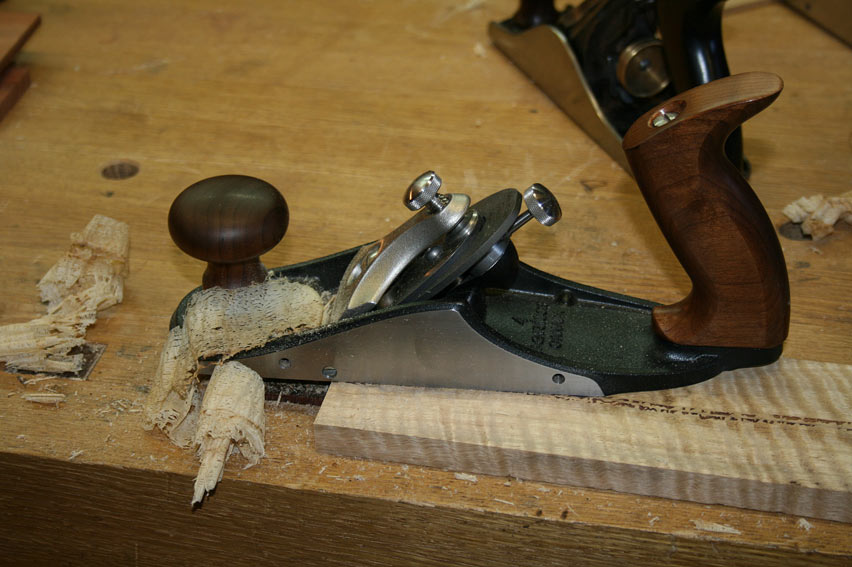

On one hand you say that you modify all your chipbreakers, and on the other you say LN and Veritas cannot get it right. Mmmmmm

Regards from Perth

Derek

Re: LN #4 Cap Iron Profile

#14

Lee Valley information confirmed

Bill Tindall, E.Tn.

I was a guest of LV as the new plane was entering production. I was shown a plane in final inspection. I asked Rob if it was made to accommodate a close set cap iron. He assured me it was.

I have not owned nor tested one in hand but I can't imagine an engineering department as talented as what I saw could not take the work of Kato and Kawai and make a functional cap iron. Derek has provided the proof one can see with their own eyes. Being able to post a picture establishes proof of a claim.

Re: LN #4 Cap Iron Profile

#15

vestigal vs. needing help

David Weaver

The LN cap irons work, but the way they're cut blunt on the front is intentional. I believe that it's probably for manufacturing efficiency to avoid having to finish the edge on a soft bevel (which can be a pain).

The english friend of mine who uses mostly power tools got instruction from them (this is maybe 14 years ago now) that the step was to be honed off by the user (a 90 degree blunt step is just about pointless for a cap iron - it goes from bulldozer to no tearout control in a very short span). My friend diligently honed the angle that was already on the chipbreaker and the first time he used it, something ran into the cap and bent the leading edge, rendering it useless for him.

He sent the cap iron back and LN said "you were supposed to make it steeper". Both my friend and LN were learning on the fly. They sent him a new cap iron, he honed the new one steeper and that's the last I heard of it, but being an engineer, he was a bit unhappy about the lack of specific instructions with the plane, and at the time (Before LN made youtube videos) that if he wanted LN's recommended sharpening instructions, he had to spend 20 bucks for the charlesworth video ("i don't understand why they can't include a 5 minute version with a $350 plane").

He still grinds his bevels with a king 800, which results in refusing to use the plane unless it's absolutely necessary.

At any rate, LN intended users to modify the cap that they receive - it's not functional as received, and as evidenced by many of their 2 3/8" planes, they never intended on most planes for the cap iron to extend to the edge in the first place. I guess one of those is intentional dysfunction without user setup, and the other was vestigal.

I personally helped them learn that their #8 cap irons didn't fit stanley planes. When I sent CS a message that one of their caps didn't work with a stanley that I'd purchased (the cap iron was worn through on that particular plane - it must've been fixtured in something or used for some abrasive abusive non-wood purpose), they were unaware of it and requested that I send my worn through cap iron back to them with theirs. They lost track of it and it took months to find it, but it was an oversight (it ended up on TLN's desk and got lost in the shuffle) - they've always been helpful otherwise.

They know their target market better than I do. These things must not matter much. My English friend has at least 6 of their planes. I don't think he uses more than one every two years, and maybe not that often any longer, but he likes his wife to give them to him as gifts).

Re: LN #4 Cap Iron Profile

#16

Re: mmmmmm ...

Warren in Lancaster, PA

Back then all we believed was that the chipbreaker added stability to the blade. What did we know? :)

What we know and what Derek Cohen knows are not always the same thing. We are not limited by Derek Cohen's knowledge. You don't speak for us.

Here is something Bugbear wrote on this forum in 2005:

Chip breakers are simply a way of keep the blade (and consequently edge) held firmly, and they also help the shaving "clear" the plane.

Despite loads of books and "the old guys" telling you different, in some cases with diagrams :-)

He certainly knew at that time that not everyone agreed with him.

Re: LN #4 Cap Iron Profile

#17

Re: Lee Valley information confirmed

David Weaver

Two things (LN based):

* the last LN plane that I got new before the recent BU is a bronze 4 - it had the step on the front of the cap iron that needs to be honed off (figure if you were making something out of mild steel, rather than hand finishing the edge, you square the front off on a grinder and call it good - just a little sliver of squareness - a few hundredths high or so). Unless they changed something between then and now, they still aren't usable out of the box.

* as far as LN making their planes so that the cap iron can be set, they didn't for a while at least on 2 3/8" irons - when we posted about the cap iron, a bunch of people (my LN 7 was a box queen by then) reported that the plane ran out of depth adjustment before cutting if the cap was set close. I took my 7 out, and sure enough (it was stowed before any research, and I had other lighter metal jointers), it ran out of travel on the adjuster just as it got into the cut unless the cap was set back. Adding depth to the cut resulted in the adjuster tip going forward and under the cap iron.

It was remarkable given the number of people who claimed they were already using the cap iron, and nobody had ever noticed that a huge number of LN's planes couldn't be set close enough for the cap it work without the adjuster running out of travel. They took them back, fixed it, and then proceeded to declare steeper frogs a more practical solution to control tearout -that and a slow working toothed iron that was probably intended to trim end grain when stanley made it.

Re: LN #4 Cap Iron Profile

#18

maybe this will help

Bill Tindall, E.Tn.


Picture is of my LN #4. I know I polished it. I don't think I ground it but could have. Ask Warren. In any case the arc is smooth and no deep scratches like on the LN 4 1/2 I have not messed with. The angle measuring thing is set at 50 degrees the angle Kato and Kawai used for nearly all their work.

If I have need to level a drawer divider and it has some grain reversal I have no fear using this plane to level it. I make no further claim.

Re: LN #4 Cap Iron Profile

#19

4 1/2 problems

Bill Tindall, E.Tn.

I don't use the 4 1/2 because if the cap iron is set close it fills the mouth and shavings don't come out. If I liked it otherwise I would file open the mouth. but it is a heavy boat anchor.

Re: LN #4 Cap Iron Profile

#20

outside of your back and forth..

David Weaver

...with larry and mention of the double iron, I saw only two references anywhere else to practical use of the cap iron before 2012. They were both on the UK woodworking forum, and in one case, a guy from finland said "it works for me, i don't want a fight about it".

As in, even claiming that the cap iron would control tearout led to heckling, so the guy who knew about it decided only to mention it and not say much more. That was around 2007 or so.

The rest of the thread where he mentioned it was filled with commentary about the superiority of bevel up planes and how revolutionary they were for controlling tearout.

I've managed to fiddle with the LN 62 on and off the last 4 or 5 days to get sets that equal the surface quality of a double iron in really difficult wood (ribboning, etc), but for planing in general, it would take as much effort to figure out how to get all of the compromises ironed out as it would to learn to set the cap by eye (probably more), and I have a better foundation for experimenting and feel that probably 99.9% of anyone using planes.

I'd be willing to bet there are a lot of really low mileage bevel up planes out there, and heavily used power tools in case any wood moves minimally after it's been dimensioned.

It's not hard to see why stanley never sold many. The feel is off, they dull faster (or stop cutting well at an earlier dullness point), and then reward the user with a thicker iron to sharpen and poor lateral adjustment.

There is a user on the UK forum who was working professionally at the time on one off furniture - he was trained at barnsley. He used our discussion to learn the cap iron and employed it in his work. He was trained a while ago, too (I understand barnsley is more modernist now, probably doing some hand tool training, but also training craftsmen to use stuff like manufactured honeycomb stock).

Re: LN #4 Cap Iron Profile

#22

Re: maybe this will help

David Weaver

I'd love to know why they think the new cap iron is an improvement over that design. That one is a bit overweight compared to the stanley type, but someone not setting it right may appreciate the rigidity - who knows.

your 4 1/2 could be solved by filing away the material inside the mouth without opening the mouth much (as in, filing an angle toward the handle at the top and leaving a couple of hundredths of unmodified mouth. That's how norris infills were made when they were made well - the mouth was tight, but the inside of the plane was filed away to make sure there was room to set the cap iron right at the edge if the user desired.

But, you're right - the 4 1/2 LN is a boat anchor for someone doing fairly little with planes. It's awkward for trimming work, and it's sticky feeling for smoothing work and too wide for most people to handle with a very heavy cut. The cast on LN's planes is more durable than stanley's as far as lapping goes, but it's less dry feeling and more sticky on work. The same is true of LV's cast. The difference in heavier work is remarkable.

4 1/2 LN planes sell really well, though. The beginner's draw is the assumption that a plane works better if you can't feel roughness occurring and the 4 1/2s do a better job of masking the feel of surface problems occurring while planing.

Re: LN #4 Cap Iron Profile

#23

Re: vestigal vs. needing help

Warren in Lancaster, PA

I remember also that some of the new LN cap irons were so short that if you put them close enough to the edge to be effective, the irons could not be adjusted far enough forward that they actually cut. The screw ran out of its range.

Re: LN #4 Cap Iron Profile

#24

Re: maybe this will help

Jérôme

The fact that #4 1/2’s are often an inch longer makes them somehow nicer for large hands (but still requires strong arms), as #4 alternative.

Re: LN #4 Cap Iron Profile

#25

Re: vestigal vs. needing help

David Weaver

That's correct - as I mentioned in a post in this thread, I'd put my #7 aside in favor of a lighter plane when learning to use the cap iron and found that mine would just barely be cutting at the end of the adjuster travel (as much depth as possible). When I say "at the end of the adjuster travel", I don't mean there was only a little room to spare, I mean the adjuster was coming out of the cap iron and no longer holding the cap in place.

I sold it instead (disclosing the issue, of course - LN was fixing the issue for everyone as I recall, so it was no detriment to selling).