WoodCentral Forums

Est. 1998 — 27 years of woodworking knowledge

Unicorning other steel

Posts

Unicorning other steel

#1

Unicorning other steel

Bill Tindall, E.Tn.

I have a table/buffet underway and about to dovetail the drawer dividers and blades into the blades and legs respectively (English terminology , I think). Seemed a propitious moment to prepare the chisels for this task with a Unicorn Profile.

Hollow ground at 25 degrees, less than the 28-30 normally used. Refined bevel with fine fixed diamond stone followed by 1 micron diamond on cast iron front and back. I may get there but for now I am not seeing any advantage for the multi angle bevels David advocates. After hollow grinding it is but seconds on the two diamond formats. Finally a 2-3 second pass across a 3600 rpm 6" wheel with 5 micron "yellow" compound.

One chisel is made from CPM 3V, an exceptionally abrasion resistant steel due to the 3% vanadium which forms one of the hardest carbides of any metal but tungsten. The other steel is PMV11.

Both chisels displayed the thin bright band at the tip, indicative of the Unicorn Profile. As best I could tell with out a microscope the two steels behaved equivalent on the buffer.

It has gotten late. Tomorrow AM they will be put to use.

Re: Unicorning other steel

#2

Re: Unicorning other steel

David Weaver

What the buffer does to the tip of the chisel is just about perfect.

I'll be interested in hearing what they do as I had a little more trouble accommodating V11, and I'll let someone else figure it out as I'm going to send the chisel down the road (nobody should read anything into that, I just have no use for a single non-matching chisel, especially when I prefer chopping with older english type chisels or japanese).

3V may be enough softer that it doesn't take much of the same kind of powdery tip loss that V11 does (I say powdery because it seems to break off in a different shape than carbon steel when carbon steel breaks off).

Re: Unicorning other steel

#3

CPM 3V Properties

Bill Tindall, E.Tn.

This steel was recommended to us by technical staff at Crucible Products as an ideal steel for chisels. It maintains toughness at high hardness. The steel is boggling tough. We were told by knife makers that at Rc 58-60 that a knife could be bent 30 degree and restraightened without snapping. Wire edges in sharpening don't break off, they just melt away with finer sharpening.

The deficiency of my chisels comes from them being heat treated to the low end of the 58-60 range. At 28 degrees bevel I get a small amount of folding damage when chopping, about on the scale of PMV11. I expect the Unicorn Profile will eliminate this deficiency. Will report upon completing the 4 drawer for this project.

Whatever the outcome, I will keep using these chisels because I like the ergonomics. At some acceptable level of edge life the ergonomics of the chisel for the task one does trumps other factors.

Re: Unicorning other steel

#4

Re: CPM 3V Properties

David Weaver

I know we've had this discussion already, but when I got wiley's iron and it was described as 61 hardness, I thought it was probably a little softer because of how the wire edge behaved, but it was still very slow honing on diamonds (i guess because of the vanadium).

It raised a pretty persistent wire edge with 1 micron diamonds (and some of that was assisted by honing on cast, which may bend the tip a little bit while the metal is being removed of it doesn't just come off neatly like carbon steel). I could feel it and had to strop some after 1 micron diamonds to get rid of it, and do light alternating top and bottom.

I think at 61, it would be more pleasant for woodworking and saw that it gains wear and loses about 20% of toughness when set at 61 instead of 59. that would be a good trade for woodworking. The kind of toughness that Bos is talking about (bending a knife over) doesn't always seem to translate to toughness right at the edge, and the more highly alloyed irons took more damage from the inclusions in maple than did the japanese and O1 iron - but all took terminal damage - it was just interesting to see that it was somewhat less deep on carbon steel irons.

Since then, working the junk pine recently, I've noticed that the ward iron (which doesn't wear long and would snap if you bent it) doesn't seem to be affected by the knots, but everything else that goes in the stanley smoother has some issue with the knots.

Re: Unicorning other steel

#5

Re: Unicorning other steel

Derek Cohen (in Perth, Australia)

Bill, I have added a unicorn profile to a variety of chisel steels: O1 and A2 (of course), but also PM-V11, M4 and 3V. The harder, more abrasion-resistant steels simply need a little different technique - more or less pressure, more or less speed, and a more or less abrasive compound.

In other words, the technique, per se, is not different, just that the set ups we use are different, and each one requires a slight variation. Bear with me as I describe my progression to date. This may help another starting out.

I've been using a half-speed grinder all the way through (when I set up the original stitched wheel, it was in a variable speed lathe but at 1425 rpm, the same as a half-speed grinder). The original wheel was a 6" and soaked in green compound, and it cut quite aggressively. Adding a unicorn profile to chisels was still okay, which goes to show how forgiving the method is with chisels.

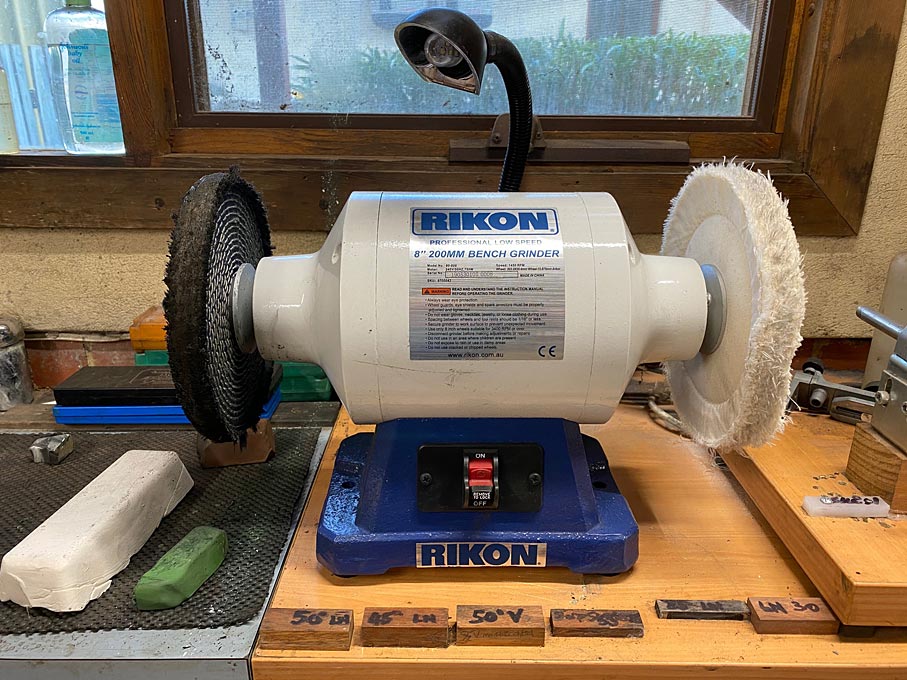
I started a new system using a new 8" half-speed grinder (I had already planned to get another grinder before David came up with this Unicorn nonsense, one to shape curved blades and lathe chisels). There was a new 3/4" wide stitched denim wheel, initially, and then I added a 2" wide version with eyes on plane blades.

The 2" wide wheel was a mistake. Not only are the denim wheels much harder than the less-stitched cotton wheels, but the 2" wheel was difficult to use as it did not remain flat. The 3/4" wide wheels are the way to go.

Over the past couple of weekend I have been busy with painting doors and restoring the brass hardware. The latter has involved buffing away lacquer and polishing the brass (before re-lacquering and re-installing). I learned something from this buffing: the white compound is far more aggressive than the green compound. One might think that it would be preferable to use a more gentle buffing action, but the hard denim wheels then needed more pressure, and this (I think) created a variable surface on plane blades. I was struggling to unicorn BD plane blades.

All the buffing of brass destroyed the 2" wheel, and I used this as an excuse to get two more wheels, a hard felt wheel and a soft cotton wheel. And a bar of white compound.
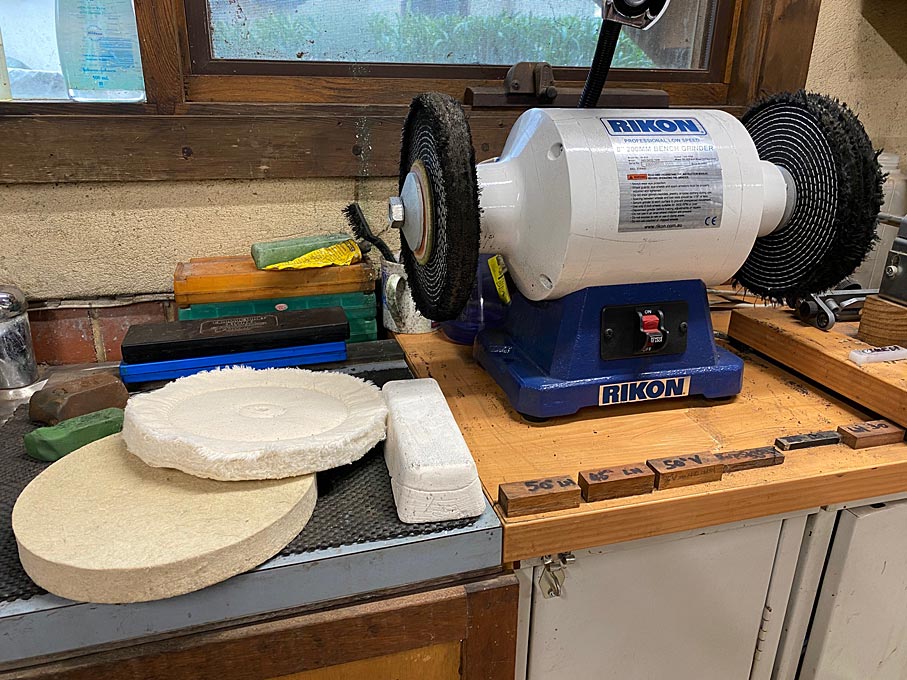

The hard felt was just too aggressive for my liking, and it was the final wake-up I needed to recognise that gentler is better. So now I have the softer cotton wheel on the other side. This is used with the white compound only ...

I spent a little time working on the technique for BD plane blades. The plane is a Bedrock #604, and the blade is a custom M4. The wood is Hard Maple ...
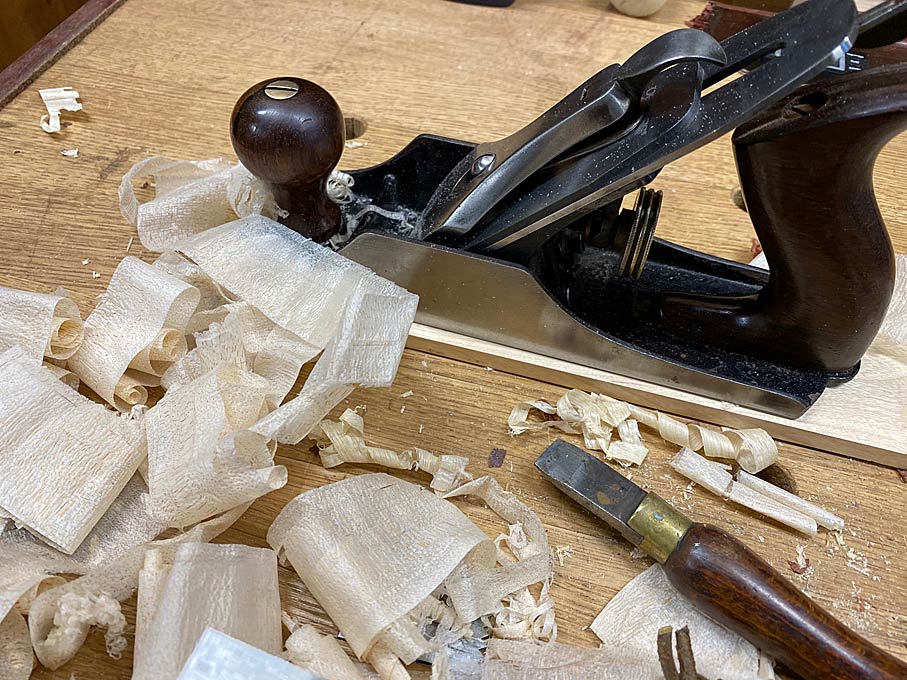

The blade has its existing 30 degree hollow grind. This was freehanded on a fine diamond stone (600 grit) to raise a wire, then smoothed a smidgeon on a worn extra fine diamond stone (possibly around 2000 grit. Then over to the wheel ...

I use the bottom of the wheel as it is easier to track the angle of buffing. I start with the primary bevel parallel to the circumference of the wheel. Then gently drop the end of the blade by about 10 degrees and lift the bevel into the wheel. This process lasts about 5 seconds. There is a very fine wire, which is removed on a hardwood-green compound strop.

The result was consistent full-width shavings with the existing very fine camber. I would call this a success.

Hard Maple is easy to do this ... :)


Regards from Perth

Derek

Re: Unicorning other steel

#6

Re: Unicorning other steel

David Weaver

The faster cutting the steel is, the shallower and longer the resulting bevel. I find the softer blades easier to buff. The harder ones have to be buffed a little bit more gradually and at less of an angle.

Wide wheels are a no-no, too - little control over getting the edge evenly buffed and backing off the amount of buffing too much makes it so that honing has to be carried further (no time is saved, no real change in edge strength - this just becomes the same method mike dunbar had in text years ago - honing to regular angles and buff stropping).

I didn't to much brass over the weekend, but interestingly enough, I had front door hardware (my wire repainted the front door) and buffed all of it on my yellow wheel and didn't have any issue with it.

Unfortunately, the mrs. didn't like the way it looked and after buffing it, I had to gun blue it to make it dark. There was a noticeable sheen from the brass left on my wheel but I figure it'll be gone soon enough. IT didn't become totally solid (or I'd have combed the wheel with a file card - for the uninitiated that might read this, the card is just a short tooth really stiff wire brush. not sure why they call them "cards").

Re: Unicorning other steel

#7

brass...

David Weaver

just noticed what is probably the difference...

...the brass that I buffed is unlacquered, just polished from time to time. I removed the lacquer from all of it years ago as once the lacquer gives up, it looks uneven. Nothing satisfies the mrs. either way.

Thus, the difference - even heavy compound would batter edges, so heated and cooled lacquer cake would be catastrophic.

Re: Unicorning other steel

#8

Is there an aversion to 23 degrees?

David Weaver

I see that you're using 30 degrees and buff stropping by your process description.

Is there an aversion to dropping a plane iron back to 23 degrees or whatever the magic number may be to get more room for clearance?

After your mention that we were just using easy planing woods here (I don't use much maple for shaving demos - it's kind of like a cheat code in a video game and we don't use it much for hand tool work), I put up a video with ribboned bubinga and cocobolo with specific gravity of 1.05. Both planed well - same $3 home depot blade.

In fact, I was surprised that the ribboned bubinga planed as cleanly as it did, and the cocobolo is a piece of wood that i considered unplaneable to a finish in the past (it's quartered), but it planed really nicely without resorting to super thin shavings.

I could see through some of the bubinga shavings, but it's fragile and interlocked.

Curious about the angle because I've found both types of buffing (Both sides of the blade or all on the bottom) on a 23 degree bevel to be tougher than my typical freehand angle was before (which I've measured at 33 or so).

It seems like people are making this a bit more difficult, but it's not that big of a deal. There's no great need for it on planes - it was winston and bill's insistence that drove me to get the touch and then provide the information about what I was doing, and in turn, I learned that I'll be sharpening my planes with the method going forward because the edge protective quality is still a wonderful thing (and it allows me to keep an even less clean work area).

It's doable on a japanese plane, too (typical 8/10 bu plane - as in, 38 degree bed plus iron taper, or around 40 at the edge), though that's pushing it a little bit. But same time savings - india stone to the iron in this plane, then light touch on hard arkansas and buff on the diagonal on the wheel (not heavily on the face) to do just a little bit of work on the edge.


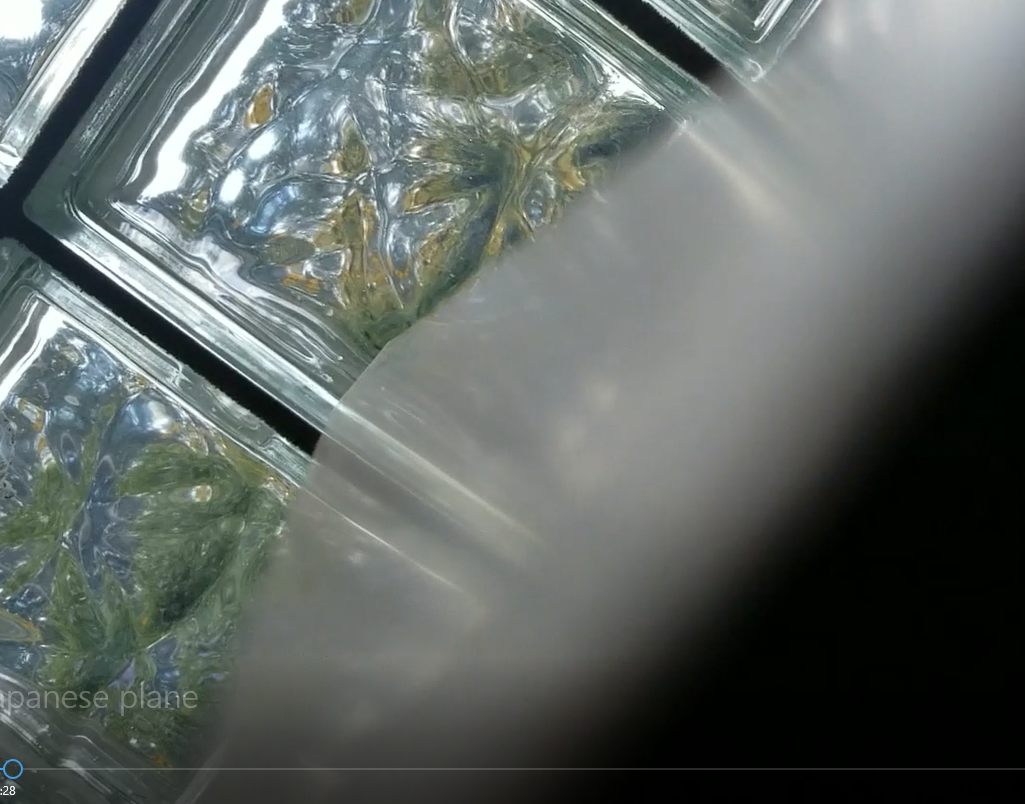
(oops - picture tilted - yellow pine, LEDs from the above light reflected on the wood - super bright finish on the hard bands in the growth rings, and less bright between them - nature of the wood itself).

Shaving from the yellow pine.


reflectivity on cherry is more uniform and convincing - the difference in finish between a stanley plane and a japanese plane is so small when both are working properly that it's not really worth the trouble to use the japanese plane):


I'd drive the bevel angle back a little bit more on this japanese plane to get more room, but I don't use japanese planes much these days and always thought they were a bit of a pain for keeping level surfaces compared to western planes.

Re: Unicorning other steel

#9

Re: Is there an aversion to 23 degrees?

Derek Cohen (in Perth, Australia)

Hi David

The reason I have been sticking to 30 degree bevels in BD planes is that I am curious to see how this goes, and whether the clearance is an issue.

I am also a little reluctant to jump in with all my planes and change the bevels since this is early days with the planes. I really do not want to be grinding a lot of steel until I know what I am doing.

The #604 (with M4 blade) went well. However, the Veritas Custom #4 (on a 42 degree bed) was erratic. It cut, but I could feel it struggling. Too little clearance here, most likely.

I owe you a couple of emails but have been struggling for free time owing to long hours in Telehealth.

Regards from Perth

Derek

Re: Unicorning other steel

#10

Re: Is there an aversion to 23 degrees?

David Weaver

No rush on the emails, put them at the end of your list.

I've had the same messages (re: clearance, and lots of folks who don't want to change the angles on anything at the outset). no problem for chisels, but things get harder with plane irons.

It's too bad that the orange borg here stopped carrying their cheesy $3 blades, because they already come with a shallow bevel like that and they can be resharpened quickly without worrying about ruining anything good.

I figured having Rob Cosman's name put in the same sentence with mine (!!!) just made for a good opportunity for some friendly competition.

Things do get much easier with the whole iron set up shallow first, though (bevel down, BU, it really doesn't matter) and the concern (i had some concern) about whether failure may be pushed further up the bevel with such a thin starting point hasn't materialized.

👍 This page answered my questions

Your vote helps other woodworkers quickly find the answers and techniques that actually work in the shop.