Home Articles Forums Gallery Marketplace Videos

WoodCentral Forums

Knowledge You Can Build On — Est. 1998

There could be a LV BU revival

Posts

There could be a LV BU revival

#1

There could be a LV BU revival

David Weaver

given the latest developments with relatively little press at all about LV BU planes, one of the things that we've discussed is that people don't really do what's needed to remove back wear, or they go straight to short cuts that they don't understand and end up limiting clearance with them. That leads to OWTs that the planes are unmanageable.

I never necessarily minded the planes (I minded their handles, which could be dealt with), but like derek, didn't see the point of having a bunch of differently ground blades vs. just adding the tearout control angle as a secondary bevel.

The temptation was always to really push the limit and try to use 25 degrees straight out to get really slick through wood, but at least on my bench, that led to problems on face grain (edge damage).

Yesterday, I sharpened my old stanley 18 to make a spoof picture for a magazine article (it won't appear in any such thing, I don't think magazines use dirty planes, etc), but I had a pamphlet from a bicycle chain that included a "missing link" to hold the plane together.

The iron on the 18 is a turd due to its ability to allow even a black ark to cut it deeply. It's soft. Then it retains the wire edge.

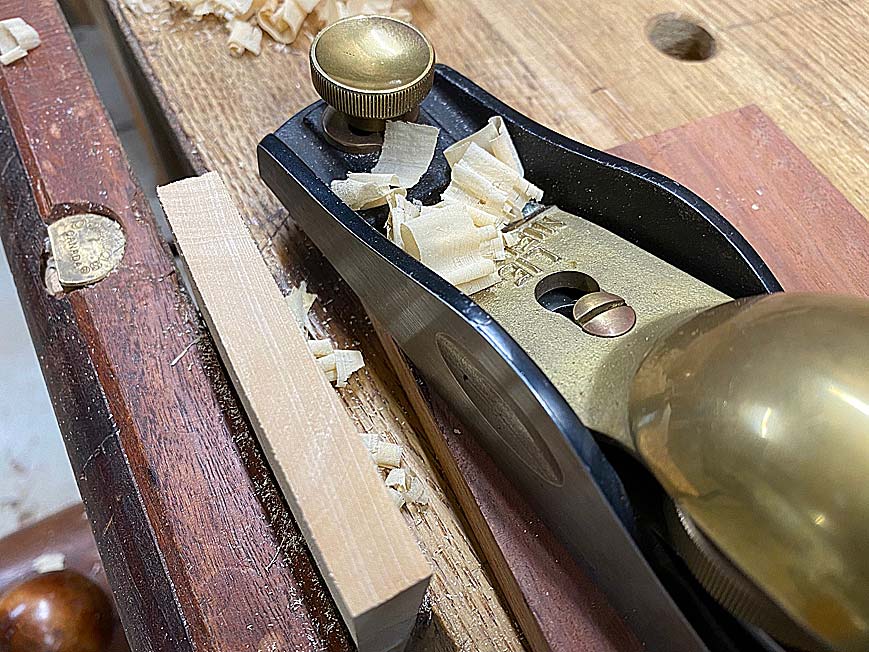
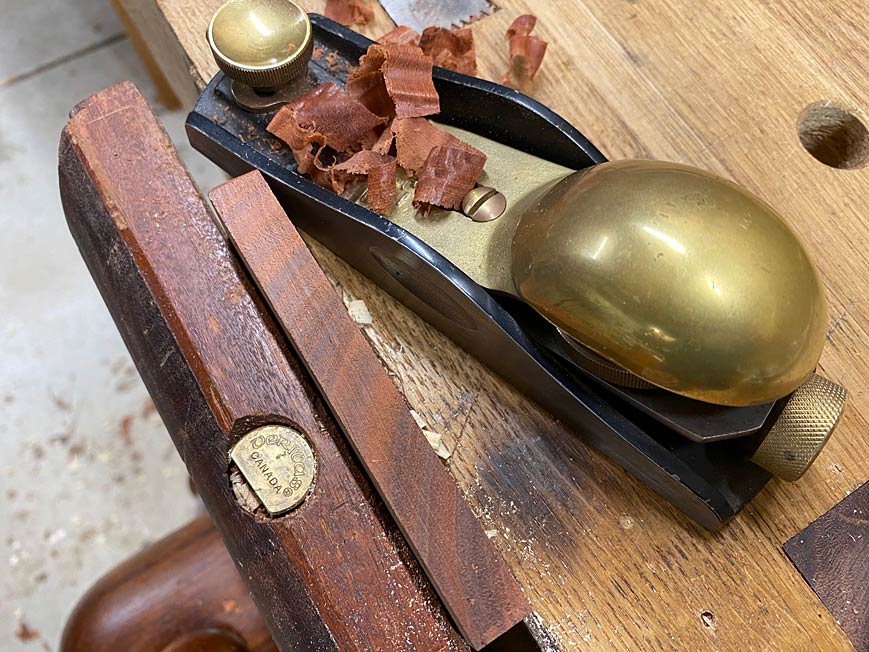
I gave it the unicorn whizz and could tell it was sharp. The plane wasn't up to the sharpness (the bed has a bunch of accumulated corrosion and the sole is very unevenly worn). I lapped the sole in a couple of minutes on 80 grit, whizzed the brashness off with a soft ark, wiped it off, and then suddenly, the block with the cured cheese iron and the still caked bed was capable of this (that's a cherry edge shaving fed back over the front of the plane to cover up the corny fact that we found the missing link :b ).


what this method does with bevel up planes honed at 25 degrees is no joke, though. A quick 10-15 second hone of a 25 degree secondary with a diamond hone, and then 5 seconds on the buffer and there's plenty of effort left in the tank to completely finish honing all of the wear out of the flat back for about 20 seconds on a reasonably fine stone.

The back of this one received nothing more other than the same washita stone used elsewhere in this whole study - heavy pressure at first, lightening off from there. The iron isn't perfect like my other irons, but it's close, so it may have gotten 20 seconds instead of 15. I know it didn't take more than a minute to sharpen.

I don't have an LV BU plane and no plans to get one to stage a photo with the right things, but it's always occurred to me that when folks spend lots of time sharpening unimportant parts, they don't have the steam left to focus on the important parts - especially if they're actually working and not sharpening for relaxation.

Relieving the user of having to focus much on the bevel side and encouraging them to spend significant time on the back is going to be a boon for many. And just as with other things sharpened here, all of the little nuances that I blather on about - managing the edge, not damaging the very edge by ripping off a big burr, getting through all of that to have a completely finished edge and not just a shiny one - as long as the buffer is the last step, it just does all of that.

The next curious thing will be finding out if the gap between V11 and O1 that was almost no gap in end grain can be restored to be similar to long grain by improving the tip of the edge toughness of V11 with the modified profile - in my experience since that test, V11 and its carpenter parent just doesn't quite hold its very tip as well as O1 and water hardening steel when something less than ideal is encountered.

Long story short, this may not only make the honing process easy, but it will bolster the edge and make BU planes with V11 fare much better between sharpenings. if it's not overdone, I don't feel any real difference in cutting resistance in the stanley 18.
Re: There could be a LV BU revival

#2

Re: There could be a LV BU revival

Derek Cohen (in Perth, Australia)

David, there is lots of potential here. You may recall these pics for some weeks back. The blade is A2 (I think ... it may be W1 -I bought this LN 60 1/2 a long time ago). The first wood is soft Jacaranda, and the second is Jarrah. Both are planing end grain ...


What I liked about this set up is that it has the advantage of a low cutting angle for end grain, along with the advantage of a high cutting angle for edge grain (where a low cutting angle can tear out when bevelling or chamfering).

Regards from Perth

Derek

Re: There could be a LV BU revival

#3

What is jacaranda?

David Weaver

I do recall that you showed those pictures. There's even more gas left in the tank than that with some experimentation. You can get the process of sharpening down to absurdly short, and the results are carnival-like in effect.

Jacaranda is an interesting name. If that word is on a customs list into the US, it can cause seizure as the name is used for dalbergia nigra (Braz. rosewood) in some overseas markets.

Curious as to what the wood is and what its characteristics are.

Re: There could be a LV BU revival

#4

Re: What is jacaranda?

William Duffield

The question "What is jacaranda?" is about as enlightening as "What is ironwood?" You may as well answer "42." :D

Yes, Brazilian rosewood" is one valid answer. On the dry side of Cuba, there is a small tree/large shrub called jacaranda that looks like a rosewood, with almost black heartwood and almost white sapwood. There is another legume tree that grows as far north as Central Florida, with smooth white bark, blue flowers and large, heavy bean pods that are tightly curved and distorted, resulting in another common name, "ear tree." I'm sure there are other examples, but less ambiguous scientific names are difficult to nail down. None of the "jacaranda" woods that I have encountered look anything like Derek's example, so his may be a native eucalypt.

Re: There could be a LV BU revival

#5

Re: What is jacaranda?

Derek Cohen (in Perth, Australia)

The Jacaranda tree is a native of South America, but has made its way to Australia via South Africa. It is very popular in Perth and Sydney. Our suburb has avenues of these wonderful trees, and we have a large example at the front of our house.

This is a photo from Google ...


The trees eventually shed these purple-mauve flowers, and the petals rain on the lawns. It is quite magical.

Several years ago we had a storm with very high winds, and a bough dropped from our tree, smashing the roof of the garage but fortunately missing the cars parked outside. I took my revenge by cutting it up and stickering it. I have just begun to turn my attention to the boards.

The wood is much like Paulownia - almost white and quite featureless. Paulownia is prized in Japan for boxes (my Kiyohisa slicks came in a Paulownia box). Although a light, soft wood, it is strong. Jacaranda has a closer grain and finishes better.

Why did I use it for the block plane? Because it was the softest wood to hand at the time. Because it would be nice to do some woodwork with it (I have been painting doors in the house, and stripping and buffing brass door handles).

Regards from Perth

Derek

Re: There could be a LV BU revival

#6

perfect explanation..

David Weaver

thanks! that's a gorgeous tree.

I've received a lot of japanese tools where paulownia was involved in presenting them - it's supremely soft, but when cleanly worked has wonderful visual depth.

I see you've created the left and right side of the soccer goal with those two woods - if it planes the hard stuff, good. If it planes the soft stuff without separating fibers and it planes the hard stuff, too. GREAT!

(i actually received a "Swamp ash" stratocaster kit years ago that I built into a guitar with an elephant profile on the peghead...we call it the blue elephant because I colored it with trans blue engine block paint before clearing it....it was..

...fantastically light because...

...it's paulownia.

Re: There could be a LV BU revival

#7

Jim DeLaney, Austintown, Ohio

Re: What is jacaranda?

Jim DeLaney, Austintown, Ohio

I haven't seen the wood, either, but the tree - identical in appearance to Derek's - grows prolifically in Southern California. Often seen as 'Boulevard' trees. They're beautiful in bloom, but messy otherwise. Also, the branches are quite brittle and are easily subject to wind damage - especially when the Santa Anas blow.

Re: There could be a LV BU revival

#8

Re: There could be a LV BU revival

Joe shelton

I think that when LN changed from W1 to A2, they began putting their name on the blade.

Re: There could be a LV BU revival

#9

Re: What is jacaranda?

David Weaver

it looks like jacaranda is a lot like saying ...hey, do you know Mr. Smith?

:\

Here I figured it was only something to avoid on guitars being shipped overseas.

Re: There could be a LV BU revival

#10

Paulownia

Bill Tindall, E.Tn.

It grows as a yard or weed tree around here. Periodically oriental buyers come through and buy trees out of yards and along roads. The logs get piled up in collection places and eventually shipped to somewhere. Good money is paid for the logs. Worthless domestically.

Re: There could be a LV BU revival

#11

Re: Paulownia

Derek Cohen (in Perth, Australia)

I have the remnants of a Paulownia log, which was taken from a tree we cut down in the garden. The Paulownia is popular in China. These trees grow extraordinarily fast!!!!! Within 6 months the one we planted as a tiny stalk was towering over our house and the branches were creating shade far and wide. The lawn was dying. So out it went, or so we thought! It sprouted everywhere, and finally we killed it with poison.

The wood is prized for furniture (and surfboards). The story goes that a tree would be planted when a daughter is born, and then harvested for all her furniture when marrying.

It is very light, not just in colour but also in weight (almost as light as Balsa). The box from my Kyohisa chisels ...


Regards from Perth

Derek

Re: There could be a LV BU revival

#12

Another thing I've found in Paulownia

Keith Newton

Beside them being able to grow anywhere, even a crack in the sidewalk, is that when they get large, the butt of the logs will get a very nice curly figure like chocolate melting then folding back on itself when it meets resistance. Any turner of vessels would be happy to get some of this.

The seeds can ride on the wind for great distances. The last time I hiked down into The Grand Canyon, I spotted one growing out of the side of the canyon wall when I was on my way out.

Re: There could be a LV BU revival

#13

Clint Searl

Re: Paulownia

Clint Searl

Paulownia is light, dimensionally stable, and easy to work and has an attractive appearance. It was commonly used in Japan to make tansu. I used it from a tree I harvested to make the drawer faces and frames for kitchen cabinet doors. I also made this box from the offcuts. The design on top is a stylized depiction of paulownia leaves and blossoms.


Re: There could be a LV BU revival

#14

Not worthless here

Joe shelton

For example, I have some very nice trim, on structural elements, that is paulownia, and benefits from its longevity in wet conditions.

'Course, you did say domestically, and it's a long haul from north Alabama to East Tennessee.

;)

Re: There could be a LV BU revival

#15

Re: Not worthless here

Warren in Lancaster, PA

Years ago I knew a sculptor in Maryland who used a lot of Paulownia. He used it for outdoor work, because of its rot resistance. He explained that it was expensive because it was a premier wood for Japanese gardens.

Re: There could be a LV BU revival

#16

Re: And it has wonderful scented purple flowers...


Re: There could be a LV BU revival

#17

It must be a marketing issue...

David Weaver

..the kits I've seen that have it specified as "Swamp ash", which it's not remotely close to, probably have a per-guitar lumber cost of about $5. They literally are sold including shipping, hardware, a maple neck with some kind of rosewood laminate, prefretted, etc. for $70 shipped, and that includes a retailer's margin.

It takes about 3-4 board feet of reasonably clear lumber to laminate a solid body guitar body, and it has to be 8/4 to start. Cheaper guitar bodies have more laminations in their width, but not since the 70s have guitars had laminations in thickness (electric guitars) on a regular basis.

I'm aware of the value of the clear stuff for japanese tools, though, having gotten a bunch of them in paulownia boxes. I'm surprised that the fast growth wood doesn't have bug or rot problems like a lot of our second growth wood (pine, mahogany, etc, where bug and rot resistance was great in old growth and is terrible in second growth).

Re: There could be a LV BU revival

#18

Clint Searl

Re: It must be a marketing issue...

Clint Searl

I had it stacked and stickered under a tarp for several years with no problem from bugs, but mice loved to build nests between the boards. No rot either.

Re: There could be a LV BU revival

#19

Re: Not worthless here

Bill Tindall, E.Tn.

My definition of domestically worthless is take a load of logs to the nearby commercial mill and try to sell them. If you are sent home with the load the load was "domestically worthless". I know a turner that scavenges bradford pear. Not worthless to him. Anything that will fit on a lathe seems to be of value.

Re: There could be a LV BU revival

#20

Re: It must be a marketing issue...

John Aniano in central NJ

Hi folks,

I thought that I'd mention another tidbit about Paulownia tomentosa. It was named for the Empress Anna Pavlovna of Russia and the "tomentosa" appellation is that the leaves have a fuzzy underside.

The seeds are the size of a tomato seed and are pretty easy to germinate. I have a Paulownia tree I grew from seed started in 1993. I had it in a pot and moved with it to our current location. It flowers each spring before the leaves come out. The scent of the flowers is an intense old fashioned "old lady" like perfume, in my opinion.

Lastly, the Paulownia is sometimes confused with the catalpa tree; both trees have similar growth, large leaves and flowers but very different seed pods. The former is a walnut sized capsule and the latter a bean-like pod.

John