Home Articles Forums Gallery Marketplace Videos

WoodCentral Forums

Knowledge You Can Build On — Est. 1998

Cr-Mn vs. Cr-V chisels

Posts

Cr-Mn vs. Cr-V chisels

#1

Cr-Mn vs. Cr-V chisels

Winston

Curiosity got the best of me and I ordered a set of chisels from Amazon that look almost identical to the Aldi chisels that Paul Sellers touts. These ones are labeled Chrome Manganese and were $10 for a set of 4. There's also a set that looks identical (even the same brand), except that they're labeled Chrome Vanadium, and they were $16 for a set.

Anyone know if there would actually be anything different between them, or would it just be the labeling that differs?

For the curious:

Cr-Mn chisels: https://www.amazon.com/gp/product/B082WJB4XK

Cr-V chisels: https://www.amazon.com/gp/product/B07TN57Z1R


Re: Cr-Mn vs. Cr-V chisels

#2

Re: Cr-Mn vs. Cr-V chisels

David Weaver

Chrome Manganese is the same trade name as the narex chisels. Narex said something somewhere on their site (or someone did on their behalf) that the hardening process that CrMn chisels allows tops out around 59 on the c scale.

(it's a different process and it doesn't sound like it requires any tempering, and there's less warping - I didn't go re-read, but I thought I saw mention of no post-hardening true-up of chisels. I could be wrong).

No clue if there is a typical standard for chrome vanadium but expect that it's quenched and then tempered.

Also no clue if there's an advantage to chrome vanadium steels other than the ability to go to higher hardness.

I have a harbor freight set of chisels that look a lot like those and they are in the same ballpark as the sorby chisels and the buck hardware store chisels in hardness (if there's much difference between those three, I can't notice it).

The HF chisels work well with unicorn, even in maple. With a regular bevel, they're not good. The roundover that preceded the unicorn did make them tolerable for making a plane, but the buffer is just better at the whole process.

The point where I posted the first obscure post about this and felt kind of ashamed for "talking about tiny obsessive tricks" that no real woodworkers obsess over is when I got this chisel to hold a low angle and the corner survived paring all or nearly all of the tenons on the tall cabinet that I made recently.


At one point, I mentioned these to George and he saw the picture of them and said that he'd seen continental european chisels that were identical to these and the aldis. These are from about 2006 or so, so I beat the rage. They are the "higher class" chrome vanadium, apparently. There is no way they are over 59 on the c scale.

They were on sale - $8 for 6 chisels. Shortly after that, HF went to a much uglier and more coarsely finished set. I kept these to play with figuring that they would become useful for something based on the theory of spontaneous junk. One of them, I ground to tiny hand cutting side bevels, but then the corners lasted even less long (long pre-unicorn).

My point with them, though, is that many of these look like the aldi chisels. But the aldi chisels look like the older HF chisels, and those probably look like something else and though we regard them as aldi chisels, they are a copy of something legitimate from long ago.

There is also a set of japan-made chisels with an identical look on buyee for about $30, for site work.

We've never been exposed to a lot of continental european stuff aside from some two cherries tools and a few boat-style planes (primus, ece).

I did find a stock picture of some reasonably nicely finished 4 piece sets of these when people were raving over how aldi could possibly sell them for $8, and I had guessed they were doubling the price. A search on alibaba found lots of chisels not as good, but one listing that looked identical to aldi for $3.80 per four pack, with roll, and that was the highest cost (minimum order size) - including surface freight to port in the US.

Asserting that Aldi was doubling the price at least wasn't a shot at how "terrible cheap" the chisels were, just the reality that to even bother selling something really inexpensive and giving it ad and floor space, you have to make double what you paid. Or more. Their buyers could've found them for $2 for all we know.

TLDR!!

Re: Cr-Mn vs. Cr-V chisels

#3

felt wheels in the background!!

David Weaver

https://www.amazon.com/gp/product/B07TN57Z1R

look at the picture of the guy at the bottom of the page! look at the felt wheel progression in the background. I don't invade the woodworking supply pages of carvers, so maybe that's normal (it's like a "dry" poor man's koch system).

Those are the folks who are going to crash the unicorn parade at some point and give us the napoleon dynamite line

"I already did that like 5000 times at scout camp".

Re: Cr-Mn vs. Cr-V chisels

#4

Re: Cr-Mn vs. Cr-V chisels

Winston

Now that I look at them more closely, there are differences in the handles between the CrMn and CrV ones listed. But the blades look the same as far as I can tell (other than the text on them).

Neither of them look quite the same as your HF chisel -- the way the grinding stops near the neck of the blade is different. And the Aldi ones that I've seen online look different still -- they have a flared conical neck, whereas these others have a "straight" conical neck.

So you're probably right that these all are copies of copies of something from a long time ago. I'll see how my CrMn chisels hold up once I get the prepped and sharpened (and unicorned, of course).

Re: Cr-Mn vs. Cr-V chisels

#5

They are essentially identical

Bill Tindall, E.Tn.

This steel is typically forged into wrenches, sockets and other hand tools. The composition of each is near identical. I suspect it was used for these chisels because it could be forged. This steel is especially tough, a good property when the cheap chisel may be used for prying and other non-chisel applications. As best I could find it is not hardened above Rc55, too soft for a chisel but great for prying.

Re: Cr-Mn vs. Cr-V chisels

#6

Re: Cr-Mn vs. Cr-V chisels

Warren in Lancaster, PA

I think chrome vanadium steel is used for Swiss made (Phiel), Two cherries, and Aldis. I have had some Swiss made carving tools for decades. They are certainly serviceable and preferred by many professional carvers, but not my favorites. Narex chisels are made from chrome manganese steel, but the term CrMn might be used for some other types of steel as well.

I think that if you have $5000 to spend, you can get a chinese factory to make a few thousand chisels from your choice of steel, and with your logo.

Re: Cr-Mn vs. Cr-V chisels

#7

Schlieper *LINK*

David Weaver

....most people would say this is becoming a sleeper, but I mean a german cutler (or cutlery/razor company - Carl Schlieper. I have or have had razors of theirs and they were made to a higher standard than the chisels).

Very slow memory recall made me guess that George had said he saw chisels like the aldi chisels in germany.

I'd imagine that there are more brands from solingen with the same view, and maybe austrian and swiss.

That solves this mystery.

I would like to boast that my HF set came with a box, and the same finish and grinding - of course, the exact same box - as the luban brand chisels .

I'd guess their hardness at 57 or 58, which is around where the sorby chisels are.

It's kind of appalling to see several listings of the same chisels as mine for $55-$70, though!!

Hope those folks read about the unicorn. I believe they're made of something similar to Cr100V based on some listings saying that, and even though that's the lower end of tool steels, it can be hardened to 60 or slightly above if someone wants to.

The steel on natural stones has the same kind of greasy feel as two cherries chisels, but they're not quite as hard.


schlieper chisel

Re: Cr-Mn vs. Cr-V chisels

#8

Result: not good

Winston

I was really pleased at how quick it was to set up one of these CrMn chisels. I was able to quickly work the back. No need to spend much time flattening it, since it doesn't need to touch the stones again -- just the part near the edge needs to be worked on the stone. I easily lowered the bevel from about 27 degrees to 25, then buffed.

Then I did my usual maple chopping with it. I think I cut off four pieces. And here's what it looked like.


Ouch. The parts that weren't horribly folded over still look perfect. I hope this means that the problem is just due to uneven heat treatment near the edge, and it'll go away once I hone it back a bit.

Re: Cr-Mn vs. Cr-V chisels

#9

Thanks!


Re: Cr-Mn vs. Cr-V chisels

#10

I've looked these up before...

David Weaver

..this is the set or a very similar set to the ones I got from harbor freight:

https://www.alibaba.com/product-detail/6-pcs-CRV-woodworking-chisel_62066697962.html?spm=a2700.wholesale.deiletai6.1.645345c1lBSQNR

Prices are up a little bit. $9.85 a set FOB, and then I guess in the US, you've got to go to the terminal to get them.

300 sets to get a logo, but some sellers require fewer.

I did still find 4 chisel sets FOB for about $4, but not that well finished.

I guess 0.5% carbon CrV and CrMn steels are the typical types.

They're usable. They wouldn't be anyones' first choice compared to vintage english chisels.

Re: Cr-Mn vs. Cr-V chisels

#11

same experience

David Weaver

early on with the chrome vanadium chisels, but they are seemingly better now.

I took a closer look at the edge of mine just now - after chopping maple with it last week, it's fine, but it does have a tiny bit of visible damage that perhaps even the sorby wouldn't have.

If buffing was cowbell, Will Ferrell would say "more cowbell".

Re: Cr-Mn vs. Cr-V chisels

#12

* ahem *

Jim Matthews

Christopher Walken

"I put my pants on, one leg at a time - just like the rest of you."

https://youtu.be/35jXfsO37kE

Re: Cr-Mn vs. Cr-V chisels

#13

I'll take "Pop culture references"

Jim Matthews

Pop culture references no one under 40 will remember for $200, Alex.

Re: Cr-Mn vs. Cr-V chisels

#14

Re: I've looked these up before...

Warren in Lancaster, PA

I have used Swiss Made (Pheil) and Aldis chisels. Both claim to be Chrome Vanadium steel. I don't see any reason to think the steel is any different in the two brands. Neither one has problems with chipping or folding.

Re: Cr-Mn vs. Cr-V chisels

#15

Agree...

John in NM

More buffing would help. Maybe a steeper bevel then a light buff would do the same.

I think the reason that the plane blades I would buff years ago for very difficult jobs did not hold up well is that they had a buffed edge on a very acute edge coming right off the grinder.

Some steels are going to need a steeper bevel to not fold while chopping. The polished edge makes it work well in spite of the steeper bevel. Just a guess.

Re: Cr-Mn vs. Cr-V chisels

#16

If the alloy is different...

David Weaver

..nobody is likely to tell.

I've used the pfeil version of these, the older style that look closer to the aldi chisels, and they are very good-honing chisels. A friend has them, and not me.

Out of curiosity last year, I bought the new expensive bench chisels (pfeil) looking for that same quality of dryness that those first ones had (the buffer kind of eliminates the fascination with that, but it is nice, still). They didn't have quite the same feel to them and held their wire edge longer.

There are so many different makers of these chisels in China, it could be 4 or it could be 40 - one can never tell. Mine look exactly like the ones (finish level, etc, different handle wood, perhaps) that being sold at the link I posted, and the same as the ones "Luban" (similar name to "wood river" sold elsewhere) sells for about $65. But they could be harder.

Willingness to spend has showed me a few times that some of these tools look the same, but feel different. I had a set of "woodcraft" bubinga chisels a while ago that were appreciably hard. Similar level of finish to these inexpensive chisels, but a pillow shaped bubinga handle.

It's just hard to tell - and maybe the point that I'm not getting to that well is two things:

* I haven't had any that are quite as good as the older pfeils or many of the pfeil carving tools

* There's no real way to tell how consistent the different versions are, as you can't tell what the maker may be doing (even Cr100V and 60V can be driven above 60 hardness) and whether the difference between one $15 set and another one sold at aldi is a different spec, or it's just variation because they're splashed when hardened

My HF set is very usable. If I'm being honest, I've only had one set of chisels that wasn't usable (boxwood marples where only 2 of the 10 in the set actually got hardened), and those rehardened in an oil quench just fine. It's a matter of accommodating the tools and then seeing if they are desirable to use once they've been accommodated.

Re: Cr-Mn vs. Cr-V chisels

#17

More than one reason to buff the edge

Derek Cohen (in Perth, Australia)

More buffing would help. Maybe a steeper bevel then a light buff would do the same.

I think the reason that the plane blades I would buff years ago for very difficult jobs did not hold up well is that they had a buffed edge on a very acute edge coming right off the grinder.

Some steels are going to need a steeper bevel to not fold while chopping. The polished edge makes it work well in spite of the steeper bevel. Just a guess.

One can use the buffing wheel to create a nano secondary bevel (Unicorn edge), or one can buff to polish an existing bevel. Both valid reasons to buff.

Here is a picture taken last evening ...


At the rear are two NOS Fujikawa mortice chisels (I believe that these were made when all Fujikawa made were mortice chisels). I spent Sunday preparing the 6mm, which involved flattening the back (which was low at the bevel end) and then changing the bevel from 35- to 30 degrees (30 degrees as it will receive a Unicorn bevel). That was a lot of work as the steel is very hard - much harder than I expected. Even the "soft" iron was as hard as most tool steel. When it was done, I tested the edge by paring end grain Jacaranda (the softest wood to hand). It did okay but not as well as I hoped (compared to a buffed bench chisel). I gave it a 2" lick on the buffing wheel, and the edge was transformed. Note that I was more interested in sharpness here and had honed to 13000 on a Sigma waterstone.

Yesterday (Monday) I did the 8mm mortice chisel. This was a Lot more work, with a 40 degree bevel (!) having to be ground back to 30 degrees. I did not have as much time by this stage, so stopped after a 600 diamond stone on the bevel (the back was polished to about 10000), and then used the buffer along with a nano (Unicorn) bevel. It simply reeled off shavings leaving a smooth, silky finish ....


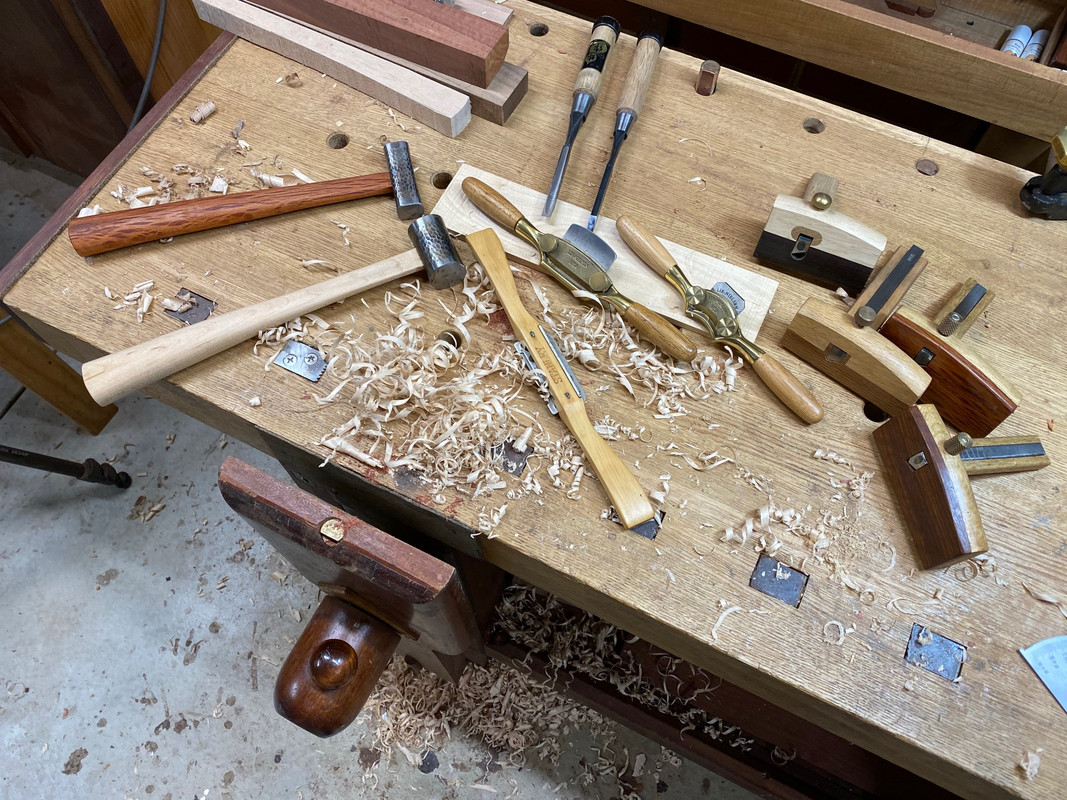
I made new handles for my two gennous. The previous handles were too skinny for my taste, and these are chunkier, more solid in the hand. To shape them I used three spokeshaves, two LN (one with a hollow blade, the other straight) and a Stanley #84. These were buffed on the wheel along the bevel. The result absolutely transformed their performance into the effortless!

I also honed blades for the cutting gauges in the same way, which is an interesting discussion for another time, suffice to note that the edges are sharp and the lines formed are cleaner than before (I have previously honed these by hand, many times, meticulously, and it takes hours to do right. Buffing took seconds).

None of these blades have a 20 degree primary bevel. The mortice chisels are 35 degrees. The spokeshaves are 30 degrees. My earlier post of Marples chisels which were Unicorned (can we make this an adjective now?) involved 20 degree bevels, however the Stanley chisel included at the time was 25 degrees, as were the block planes I did.

I have probably mentioned this before, but it is worth repeating: I used a Tormek leather buffing wheel for donkey years, and was never really been happy with the results on anything, especially curved blades, such as gouges. The wheel on the Tormek is hard, covered in leather with little give. The soft, stitched cloth buffing wheel is a different kettle of fish, and a game changer.

Regards from Perth

Derek

Re: Cr-Mn vs. Cr-V chisels

#18

I remember the tormek thing...

David Weaver

Jeff (can't remember his last name) was very good at being responsive and that drove a lot of attention to the tormek. He also demonstrated it well.

But the problem with it that I realized from the start was that everything on it was too slow. The grinding wheel was necessarily slow, which meant using it for fast cutting dictated constant refreshing (didn't have mine long enough to ever try CBN, but that should make it more usable), and the strop was slow and soft. It needed to be harder with some tooth to make abrasive work faster, or much faster (would've been better).

I also remember that Jeff would demonstrate the machine and he was very surprised that most of us had no interest in using it without sharpening stones.

Graham from the UK sent me a message stating that Mike Dunbar also advocates this, but I don't have the text and don't know if mike is buffing right on a 30 degree hollow and not honing, or if he's honing. I don't know much about mike but expect that he actually had part of his career making a volume of things. The picture I was able to find of his buff was wider and different looking, but I don't have the whole book.

Bill had a good point early when we were talking about this back and forth on email, that it makes things better just applying it to anything. It generally does.

My fascination with angles is that it has to be *better than what I was doing already* which was the same geometry with stones, but the rounding with stones never quite matches what the buffer does.

I do use it to strop the edges and buff a stripe on mortise chisels. They work better. Even with a single bevel and riding the bevel. But have been less loud about just buffing over everything as I think ultimately, it's worth needling in at the pre-buff geometry to make it work super well, be repeatable and then be usable on standard angle plane irons.

Bill's point was legitimate, though - he's preventing edge failure. His use of hand tools doesn't have the same fascination that mine does with efficiency. Efficiency and rhythm are the things that make dimensioning by hand doable, and something that warren would probably agree with, finding a way to work in a firm but not abusive way with hand tools in rhythm as a lot of things like wasting half blinds become as fast or close to as fast as working with machines.

I'm targeting a standard in my own self interest - what can I get out of it without threatening laziness, but it does seem to improve lots of things without going so far in specific specs.

Re: Cr-Mn vs. Cr-V chisels

#19

Re: Agree...

Winston

I honed off the damaged area and buffed it again, and got significant damage in the same areas after doing just a tiny bit of paring of pine end grain.

I think I'll grind it back by 1 or 2 mm and see if it holds up better. A lot of work to save a few dollars! For anyone whose time has any value, the Buck Bros chisels are a much better deal. That said, there is educational value in doing things like this.

Re: Cr-Mn vs. Cr-V chisels

#20

I was wrong about damage...

David Weaver

..i said yesterday that the chisel showed some extra damage at the edge from chopping maple (this is a sort of well used HF chisel - it's not like it's been used heavily, but it was beaten for house work early on which necessitated removing damage and grinding it back).

What was actually on the edge was mostly dirt. There's one deflection in the middle, and I can't guarantee that it wasn't already there. So all of the edge looks like the first picture except for a tiny dot of deflection about a hundredth long.

Too, there's no way this chisel is 60 hardness, but I don't know what it is. It may be an even match for the sorby.

I vaguely recall damage occurring on the edges of these chisels anew (Because I thought I'd regrind one with sharp sides to use as a dovetail parer) and then seeing less of it, and saying to someone "inside the chisel they sell you is a real chisel, but you have to remove the outer part that's not a real chisel". or something to that effect.

They're likely ground, induction heated and then splashed. The edges probably get hot faster than the rest of the chisel, or the center of the chisel is heated better - all kinds of things can happen in a fast process like that that don't look like an experienced blacksmith evenly heating a billet and quenching the entire thing identically.


Re: Cr-Mn vs. Cr-V chisels

#21

Note on Pfeil

Wiley Horne

Pfeil at their website and in all their advertising just say they use a custom-made high-alloy steel. No reason to think it doesn’t have some Cr and some V in it, but they’re saying it’s not in any standard series.

This made me look up whether there is a cheap XRF gun we could use to find out these secrets. And there were some that cost $250 and some that cost $25,000 and up! What’s up with that?

Wiley

Re: Cr-Mn vs. Cr-V chisels

#22

The missing variable...

David Weaver

..not that the other alloying elements wouldn't be interesting.

But my curiosity goes to whether or not any of these steels are hyper eutectoid.

Vanadium allows steels to chase higher hardness even in small amounts, manganese apparently decreases the critical cooling time (Which would lead to less variation in hardness in tools).

But the variable I"m curious about is the carbon, as iron carbides do seem to contribute to edge fineness. It could be that the bench chisels that my friend has are a bit soft.

Come to think of it, their proportions are a bit like the HF chisels that I have, but the steel would remind one more of carbon steel, and then in the bench chisels that I had, maybe not. Could be perception (this friend's stones are shapton, which would abrade those chisels, easily).

I was in the very early stages back then, but maybe it signifies some kind of deficiency (in fascination with edges, etc), I noticed that his chisels sharpened really easily and seemed sharper than the LN chisel (new at the time) that I hauled to his shop.

At any rate, I suspected extra carbon, with no way to prove it, and the XRF ignores carbon as far as I can remember.

Re: Cr-Mn vs. Cr-V chisels

#23

farting through silk...

David Weaver

...they'll be surprised the first time they hear about someone farting through silk...

...and by then, we'll be old enough to be sitting in our gold plated diapers

:|

The funny thing about the cowbell sayings is that any one of them is unique enough to bring up a picture of Christopher Walken and now the young folks have to have the urban dictonary to tell them what's up!

Re: Cr-Mn vs. Cr-V chisels

#24

Re: Note on Pfeil

Warren in Lancaster, PA

I have seen many sources over a period of decades that said Chrome Vanadium steel for Pfeil. I would not have written this without such.

Chrome Vanadium steel has a range of values for various elements, so they could customize a bit, but the Chinese companies would be able to analyze this as well as you or I could.

I think the differences in price are from economy of scale (the Chinese are often putting out 100,000 per month for one factory), cheaper labor, and marketing. Higher cost chisels probably have higher percentage marketing costs. Drop forging is probably the cheapest way to make a chisel, but large quantities are needed to make it so.

Re: Cr-Mn vs. Cr-V chisels

#25

Thanks Warren.