WoodCentral Forums

Est. 1998 — 27 years of woodworking knowledge

photomicrographs

Posts

photomicrographs

#1

photomicrographs

Bill Tindall, E.Tn.

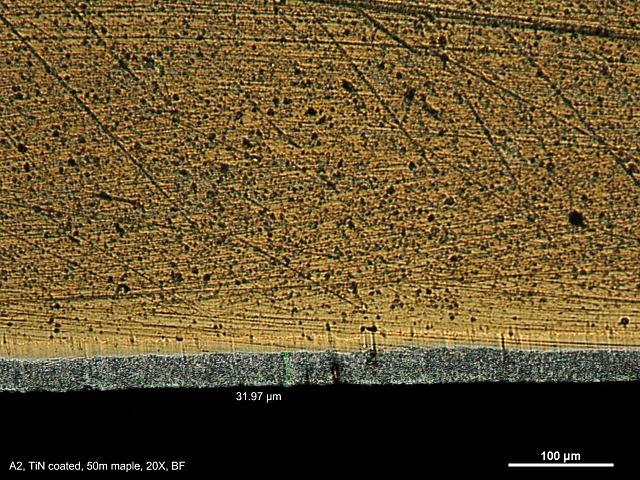
Some impressive photomicrographs have been shown recently. I thought it could be useful as a stake in the ground to show what can be done with state of the art Nikon metallurgical microscope and a trained operator (not me). The picture is the edge of a titanium nitride coated A2 blade after planing some maple.


the 20X refers to a lens used. It is not the magnification of the picture. These scopes run off a data system that provides a scale on the picture. The wear bevel is 40 microns.

Re: photomicrographs

#2

PS

Bill Tindall, E.Tn.

I don't want this post misunderstood by those making pictures, and others. The objective here was to show the best that can be done at looking at an edge. If, with your equipment, you are able to see what needs to be seen, and I think you are, as a practical matter you are doing as good as this $40,000 piece of equipment. You do lack the nice scale on the pictures, but hey, you need to get something for the big bucks. :)

Re: photomicrographs

#3

many ranges...

David Weaver

..when I got my first hand scope ($12), it showed me what I need to see. The pictures are a little blurry, but you can hold it in hand and snap pictures with it.

When I broke it (or it refuses to communicate with win10, can't remember), I got another one. The second one has never worked, so I got a third. You can see everything you'd ever need to study sharpening using one of those.

The metallurgical scope takes OK pictures, but it can be a pain to use if something doesn't fit neatly on it and at its cost, it has no view depth (so you can't really get pictures of curved things.

We are very lucky now as easy as it is for us to see small things (I use the metallurgical scope to grade japanese stones and confirm that razors are properly set up before selling them - it cuts the time that you need to do things because you can see when an edge is finished and not keep battering on, but the confirmation is important if you say a straight razor is honed because a lot of people buying are beginners and have zero hope of correcting anything).

The color and grain fineness on the picture you took is something I'll never be able to get on the metallurgical scope, that's for sure!!
Re: photomicrographs

#4

The titanium nitride experiment

Bill Tindall, E.Tn.

TiN is used on all sorts of cutting tools to lessen dulling. Would it work on a plane blade to prolong edge life? Plain old maple is surprisingly abrasive. In only 50' it wore off this coating to the distance shown in the picture.

When I was investigating something or another I was searching for the coefficient of friction of wood on steel. The value is surprisingly high. It is high because it was found that wood will chemically bond to steel (probably the lignin) with some weak but significant bonds. The objective of these papers was friction, but friction and wear are close cousins.

Re: photomicrographs

#5

metal?

David Weaver

I've never studied metalworking tools of any type other than misusing files and body files on my own stuff.

Is there a benefit to TIN of making the non-critical parts of the tool more friction resistant to soak heat away from the cutting tip? I'm sure if it became popular, it proved itself out well.

The first spiral router bit I ever got years ago was HSS with TIN coating. I don't know that it was actually intended for wood (a friend got them) and I bought carbide after that.

Re: photomicrographs

#6

not just for metal

Bill Tindall, E.Tn.

My son in law cooped at a place that makes the signs for Lowes, and others. They cut the shapes from paper, plastic, etc. with CNC routers. Their cutters appeared to be TiN coated.

When I was researching this field I talked to a company in MN that sold tooling. They used a Vanadium nitride? coating for wood tools to lessen corrosive wear, I was told. I get a trade journal and tooling for CNC wood machining is advertised. Invariable the tool is coated with some material for some purpose that promotes longer edge life.

Re: photomicrographs

#8

Comparing Microscopes

Steve Elliott

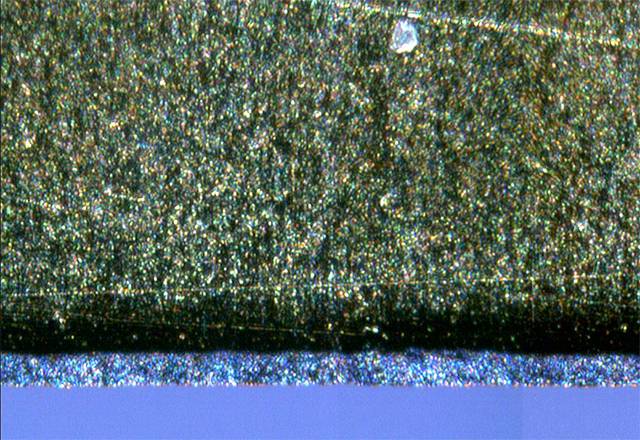
After the TiN test the blade was returned to me. I put it under my little USB microscope ($250 or so) and found the same portion of the blade edge. By resizing the image I was able to superimpose it over Bill's image in Photoshop until I was sure I was looking at the exact same part of the edge at the same scale.

Here's the image from my little microscope.

The lab microscope image is much better but for practical comparison of edge wear for the purpose of improved tool use, the cheap little microscope tells me almost as much as the expensive scope.

My first microscope was a $30 toy and I probably learned more from it than I learned later from the $250 scope.

Just using a jeweler's loupe will show most of what you really need to see. Watching and feeling how the blade performs in use is really the gold standard for performance but visual inspection helps if you want to understand what to change to get better performance.

Re: photomicrographs

#9

Re: There's an App for That

William Duffield

you can't really get pictures of curved things

It's called "Photoshop."

There is a feature built into Photoshop that will build you an in focus deep depth of field image from a stack of photomicrographs each with very shallow depth of field. My son uses it all the time for photos of bugs, seeds, etc. You need a very solid microscope support, so all the photos are aligned, and you need to take lots of photos, so each part that you want to be in focus is sharp in at least one of the pics. The process takes a lot of data, many gigabytes, and a lot of processing power (or a lot of time), but it is eminently doable. If you can't afford PhotoSho, or don't want to steal it, there are other software packages that are much less expensive that will also do the job, but have quirks or bugs of one type or another that you have to learn to work around.

Re: photomicrographs

#10

Re: There's an App for That

David Weaver

yeah,alignment isn't going to occur since I'm usually tapping chisel handles into view (the scope bed is just big enough to balance a plane iron, but barely (it sticks off of the end).

the hand scope does a decent job, but has a tiny lens so high magnification is somewhat lacking (the sensor in a $12 microscope probably adds to that). I'll try taking a picture of the bevel side with a hand held type in the near future (it doesn't really matter, of course) along with something that can be measured in size.

👍 This page answered my questions

Your vote helps other woodworkers quickly find the answers and techniques that actually work in the shop.