Home Articles Forums Gallery Marketplace Videos

WoodCentral Forums

Knowledge You Can Build On — Est. 1998

Drawer planing fixture

Posts

Drawer planing fixture

#1

Drawer planing fixture

Derek Cohen (in Perth, Australia)

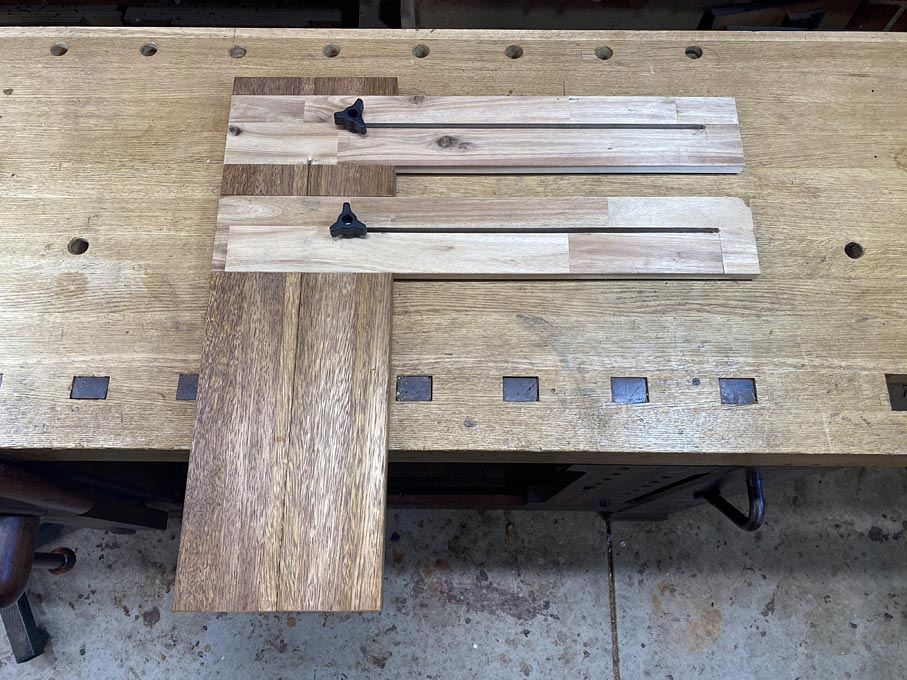
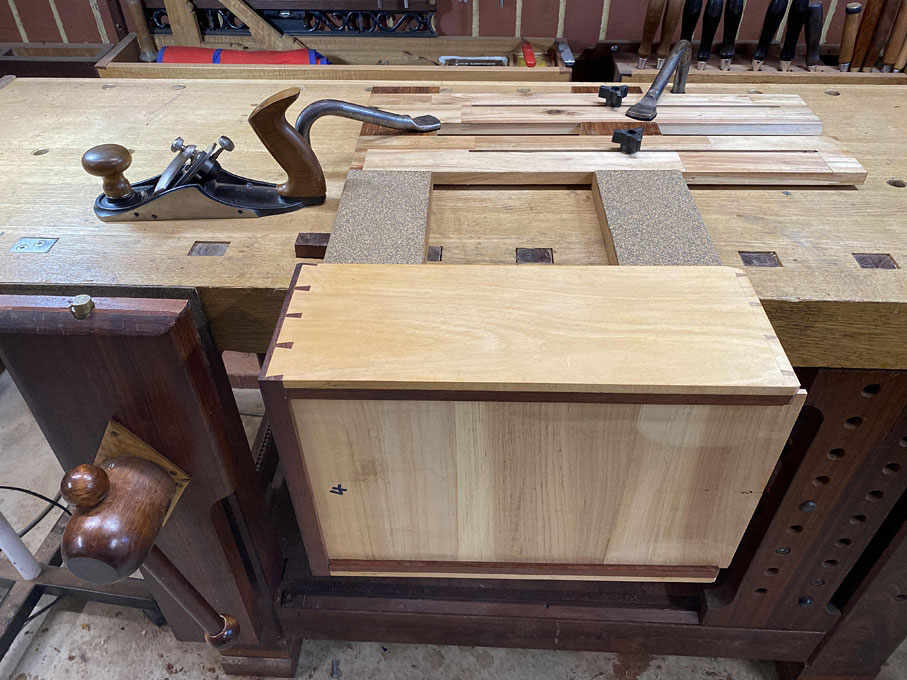
This concept is not original, but I breathed on it to make it adjustable and rigid in use.

This is the basic design ...


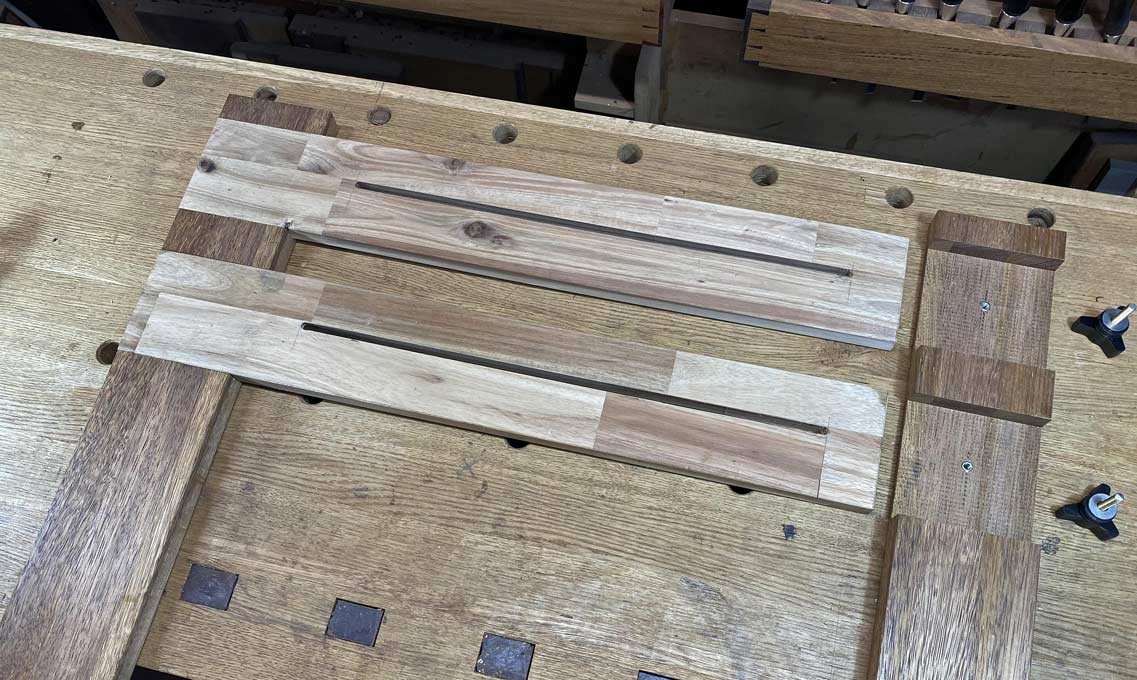
The legs can open to 24" and close down to near nothing ...


The arms slide in wide mortices, and are held by screwed clamps into threaded inserts ...


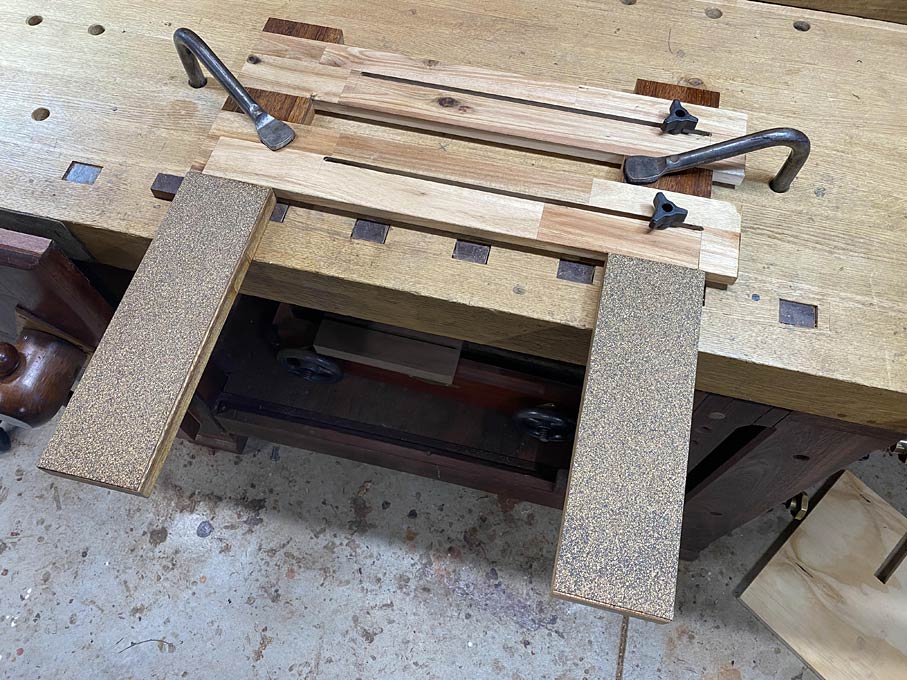
To complete the build, the legs are covered in cork-rubber. This protects the inside of a drawer. It has the extra benefit of being a superb non-slip.


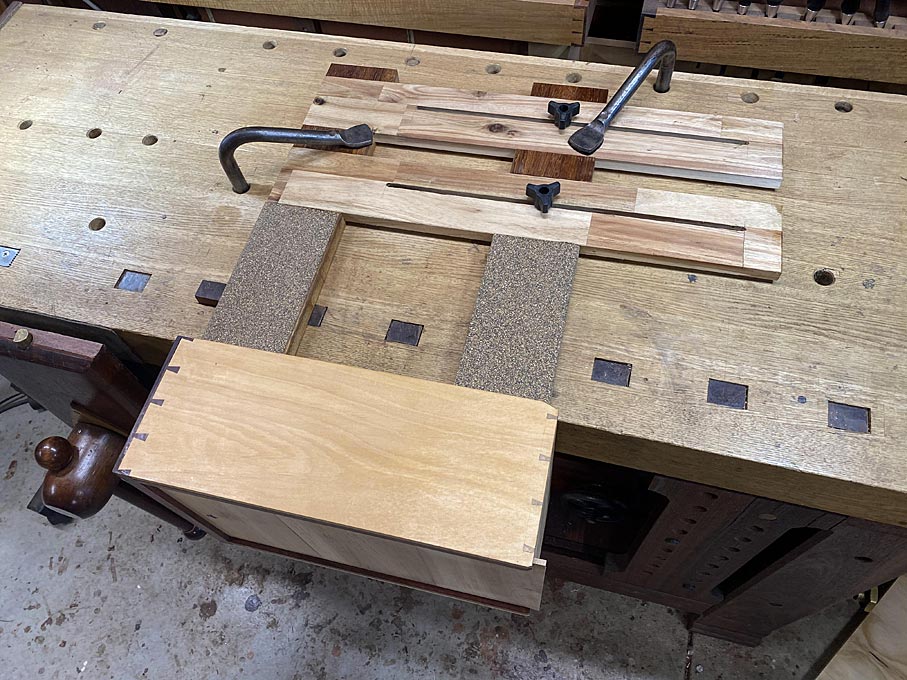
In use ...


Regards from Perth

Derek

Re: Drawer planing fixture

#2

comments

Bill Tindall, E.Tn.

An elegant solution to the need.

Directed to those that have never planed a drawer side hung off something of this nature, yet may need to some day........

The drawer would normally be planed with the bottom removed so that the drawer could be slid up against the bench for stability. Planing goes from front to back with a chamfer on the back edge to keep from blowing out the edges of the dovetails.

While it could be enjoyable to build this adjustable drawer holder the need might arise when there was not time to build it. Just a piece of 3/4" anything clamped to the bench works as well to meet the need. I keep on hand an 18" piece of MDF for this need. (so far I have avoided cutting it up for some other need at hand :) )

It is not necessary to "lock" the drawer in position and in fact it is not necessary to even have the support as wide as the drawer is deep. The drawer will plane with the support a few inches more narrow than the drawer depth. These facts may not be apparent to those that have not planed a drawer.

Because the support does not have to be as wide as the drawer is deep one may be able to find a piece of 3/4 MDF or plywood around the shop to serve as the support.

Re: Drawer planing fixture

#3

Re: comments

Derek Cohen (in Perth, Australia)

It is not necessary to "lock" the drawer in position and in fact it is not necessary to even have the support as wide as the drawer is deep. The drawer will plane with the support a few inches more narrow than the drawer depth. These facts may not be apparent to those that have not planed a drawer.

Because the support does not have to be as wide as the drawer is deep one may be able to find a piece of 3/4 MDF or plywood around the shop to serve as the support.

Bill, this is a matter of preference. I find there is so much more control when a work piece is secure and does not move, rock or vibrate. The control from a well-fitted support is noticeable. A short board inside the drawer is not the same - I know. That is what I have done for years. The cork-rubber addition is just amazing. Really, try this before you scoff.

Regards from Perth

Derek

Re: Drawer planing fixture

#4

Re: Drawer planing fixture

roger lance

Derek.....this jig is based on one shown by Virgil Johnson (who will have to credit his source for this idea).

I like that you have taken Virgil's idea and improved upon it.....which, is my hope when I show a jig: someone will improve it in some way (and show the improvement).

Nice use of what appears to be scrap flooring.

Re: Drawer planing fixture

#5

Re: Drawer planing fixture

Derek Cohen (in Perth, Australia)

Thanks Roger. I recall seeing something similar, but could not remember where or whom. I would have wished to credit the original inspiration.

Regards from Perth

Derek

Re: Drawer planing fixture

#6

works for me

Bill Tindall, E.Tn.

I have planed dozens of drawers in the past decade in sizes from large chests of drawers to Spice Box size. They didn't "move, rock or vibrate" for me when simply hung over a piece of plywood of width up to a few inches less than the drawer depth. I would not have recommended that anyone try it if I had found it lacking in any way.

The force of planing forces the side onto the support and the bench keeps the drawer from skewing from this force. This spartan approach is not unique to my way of doing things. It is what I saw being done in professional shops. I just copied it because it was easy to do and stayed with it because it worked.

But each will find out what works for their needs and where they want to spend their time. My objective was to encourage those that had not settled on a means of planing drawers to try the most simple means if simple suited their mood. If found deficient you provided something that is sure to work.

Re: Drawer planing fixture

#8

Re: Drawer planing fixture

John Jardin

Thank you again.

Your fixture design is just in time for me. I will start making one this week.

For over a year now, I have been working on a pair of 4 draw serpentine dressers, a reproduction of a Nathan Lumbard piece built around 1800. With the carcasses glued up, I'm ready to start the drawers. This week, I also got my first infill plane, a #2 Norris smoother, from David Weaver which I will be using on the drawer sides.

Also you have inspired me to add a second Veritas Hold Down.

Question: what program do you use to reduce pixel size?

Re: Drawer planing fixture

#9

Re: works for me

William Duffield

If your fixture can lock the drawer in place, and has a non-skid surface, and your plane is giving you tearout, you can use it with a random orbital sander, instead. :D

…ducking and running, but it's not that I prefer the forked-tailed apprentice; I'm just exploring alternatives for a wider audience.

Re: Drawer planing fixture

#10

planning ahead

Bill Tindall, E.Tn.

My drawer sides are not fashion statements. I pick drawer side material that I can plane easily and orient it in the drawer so that I will be planing into up sloping grain. I haven't built a drawer from anything but poplar in a decade of more. It is not hard to find poplar that planes reliably.


(this drawer needed tidying up after the slip was installed so I could not slide it against the bench where I prefer it.....but no matter it works anyway.

Re: Drawer planing fixture

#11

I love Poplar

Jim Matthews

Lovely stuff. Reliable. Cheap. Durable.

Overlooked by most starting out, me included.

Re: Drawer planing fixture

#12

Brilliant,  as always.

Jim Matthews

Your shop fixtures are better looking than my finished furniture.

Kudos

Re: Drawer planing fixture

#13

quarter sawn poplar

Bill Tindall, E.Tn.


These drawer sides were an accident. I whacked billets for about 150 drawer sides out of a salvaged large log. When I rift sawed the sides from the billets a few pieces were perfect quarter grain. These pieces would have made a nice jewelry box. In fact they will make a fancy sock drawer.

Re: Drawer planing fixture

#14

Re: Drawer planing fixture

Derek Cohen (in Perth, Australia)

Question: what program do you use to reduce pixel size?

John, I am on a Mac (MacBook Pro), however the same software is available for Windows.

Up until about two years ago I used a Canon DSLR, and then moved to using my aging iPhone 6. For the purposes of the photos I take, a phone camera is capable of excellent photos. Lighting and composition are the two added ingredients needed. This past January I purchased an iPhone 11, partly as I heard such good reports about its camera.

Most photos, whether from a DSLR or phone, are produced way too large to use for a forum. They are generally about 1-2 Mb in size. I reduce mine to around 120-150 Kb. In the past, before speedier Internet connections were possible, most forums had a 100 Kb limit per photo. Even that was tough for anyone on a dial up connection.

The software (“app” today - do you remember when they were “programs”?) I use is Photoshop Elements, which is a cut down version of the full Photoshop.

Each photo is fine tuned by cropping to the area wanted (removing sections that would distract the eye), then resizing to either 23 or 24cm in height, and fine tuning the sharpness or lighting. Then I save them and reduce/increase the pixel size to 120-ish.

A long way around to say the name of the app, but it is not just plain re-sizing that produces an image here.

Regards from Perth

Derek
Re: Drawer planing fixture

#15

Re: quarter sawn poplar

Derek Cohen (in Perth, Australia)

With stability in mind, bearing in mind that I aim for tight tolerances, I now only use quarter sawn timber for drawer sides. The woods in Australia tend to be rather unstable Eucalypts. Tasmanian Oak is a Eucalypt, inspite of its name (British settlers to Oz named it after what it resembled, which is an oak). If rift sawn, it would twist and shake. Consequently it is quarter sawn, and may be purchased at the local borg this way, where it is still reasonable in price. I keep a decent stock on hand just for drawer sides.

The drawer side in the photo is not Tasmanian Oak, however. That was just for illustration. The side there is Kauri Pine, which is simply wonderful to plane and is stable. I built these drawers a decade ago, and they have not moved one iota ...

Re: Drawer planing fixture

#16

Re: question

Derek Cohen (in Perth, Australia)

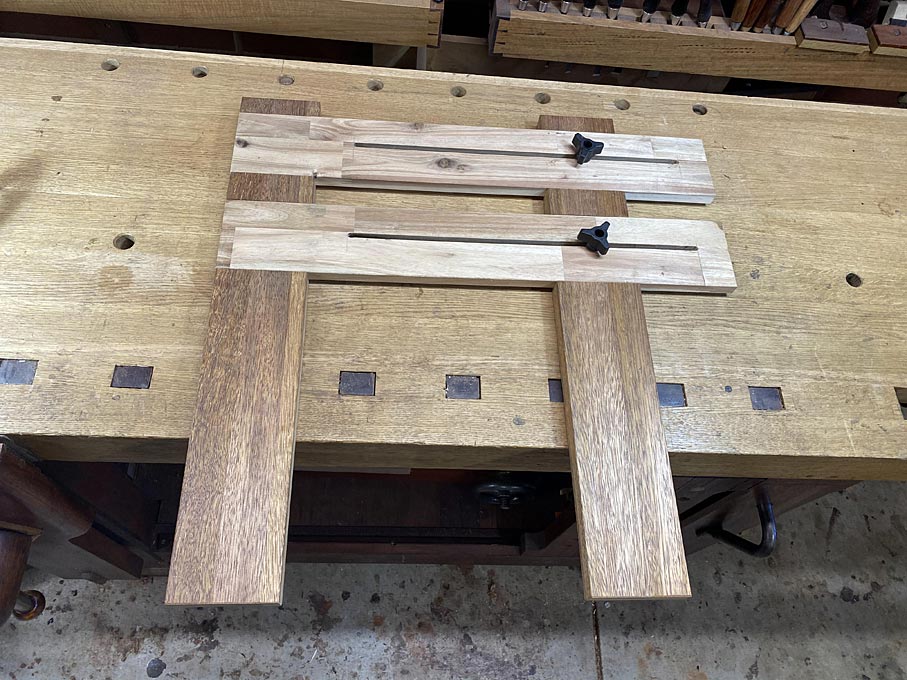
Bill, the slot was cut with a router using the fixture below.

This is a great fixture for mortices. The best I have seen or come up with for a router. Very flexible. I do not have a photo of the actual slot-making, but here I was morticing for drawer pulls. The slots in the arms of the fixture in question simply required clamping on a sacrificial board along which they ran ..


Regards from Perth

Derek

Re: Drawer planing fixture

#18

Thank you Derek


Re: Drawer planing fixture

#19

Re: quarter sawn poplar

William Duffield

Gorgeous! That drawer is way too fine for my socks, but I don't pick them to be "fashion statement" socks. :)

Re: Drawer planing fixture

#20

Re: works for me

William Duffield

No! The horror!

Not the drawer planing jig, the belt sander. While I like using my Festool Rotex sanders, I could never manage the Porter Cable 362VS 4x24 belt sander that we used for flattening panels in the shop where I used to work. I called it "Cujo". It was probably one of the main incentives for learning how to properly use a Stanley jointer for that purpose.