Home Articles Forums Gallery Marketplace Videos

WoodCentral Forums

Knowledge You Can Build On — Est. 1998

plane vs. sand - khaya

Posts

plane vs. sand - khaya

#1

plane vs. sand - khaya

David Weaver

These are big images. Please ignore the color differences and slight misalingnment with orientation in a couple of these. Camera automatically adjusts color, I think (phone) and it's difficult to get orientation identical with time between finishing.

Finish is amber shellac - not going to do a full french polish.

Strangely, this wood as far faster and easier to plane than it is to scrape and sand. Scraping tears up the ribboning and makes it very rough and sanding takes a while. Planing is a two step process - one with a heavy chip and then several passes with very thin shavings.

This is on the lower density side for khaya - intended for guitars, right around 0.5 specific gravity.

https://i.imgur.com/yRpn0O8.jpg

https://i.imgur.com/YGwJmdI.jpg

https://i.imgur.com/Y3Zjxpq.jpg

I believe the planed wood may have absorbed a little bit more shellac, the opposite of what i see in cherry, and that may also have something to do with the color difference. the dust left in the sanded piece may have impeded some finish absorption.

I was very surprised how much more scratchy (before sanding) the scraped ribboning was than the planed ribboning.

Re: plane vs. sand - khaya

#2

Re: plane vs. sand - khaya

Wiley Horne

Hi David,

This is ambitious, even by your standards. The planed khaya certainly outshines the scraped/sanded, maybe for the reasons you described.

I suspect most peoples’ jury will be out, until we can see comparisons involving cherry, walnut, maple—our traditional woods. I would also be interested to see what happens if you take the comparison to 320g. Although I do understand that 240g is the woodworking magazine Scripture.

There are some great photos in your set, especially those showing unfinished/finished and sanded/planed side by side. Really tells the whole dtory in a single collage.

Thanks for your effort!

Wiley

Re: plane vs. sand - khaya

#3

Everybody goes after the crazy ones, at first

Jim Matthews

Eventually all the drama is exhausting.

Shellac straight on the final surface?

Wonder how it would look sanded at 220 after shellac, then waxed.

(Not that wax is appropriate for strang-ed thangs.)

Re: plane vs. sand - khaya

#4

Comment

Derek Cohen (in Perth, Australia)

David, many thanks for your photos. This topic brings to mind an article in FWW magazine, which compared surfaces after a finish. The conclusion was that no difference could be detected between sanded and planed.

I have tended to be sceptical of these conclusions since I have first hand experience that there is a difference. There is a condition involved, and this will take us to your example.

The issue is 'how was the sanding done?'. There are three areas about which I want information:

I am not simply referring to the grit level used - often I hear/read that the woodworker stopped at 120 grit or 240 grit. For finish surfaces, I would not stop until I get to 400 grit. What type of sand paper? I use Abranet mesh - more on this in a while.

The second area is whether this was done by machine or hand? Hand sanding makes it easier to finish with the grain. Even the best machines can leave marks, and I have an excellent power sander in the form of a Mirka Ceros.

The third area is dust control. Some may imagine that dust control is simply to protect your lungs, but it is much more than this when sanding finish is involved. If the dust created is not immediately removed, it becomes an abrasive, and swirls under the sandpaper, and may be forced into the grain and/or leaves scratches and marks. The reason I use Abranet is that it is superb at allowing all dust to be sucked away by the vacuum cleaner.

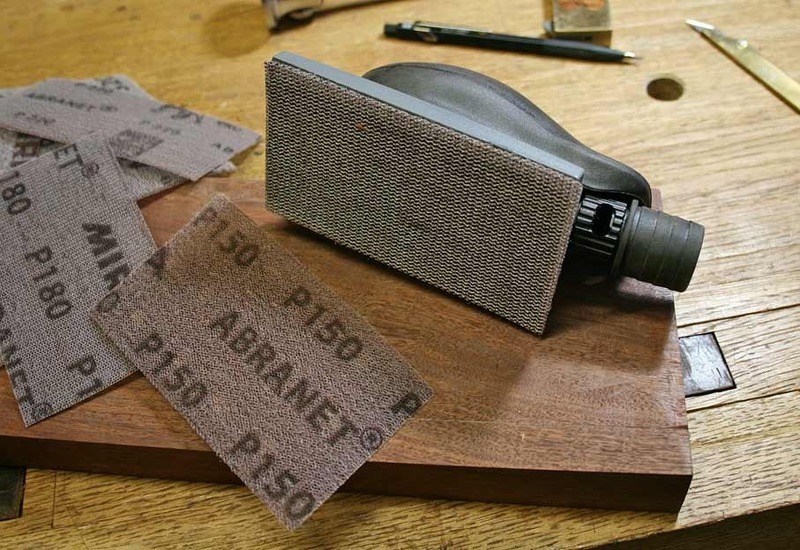
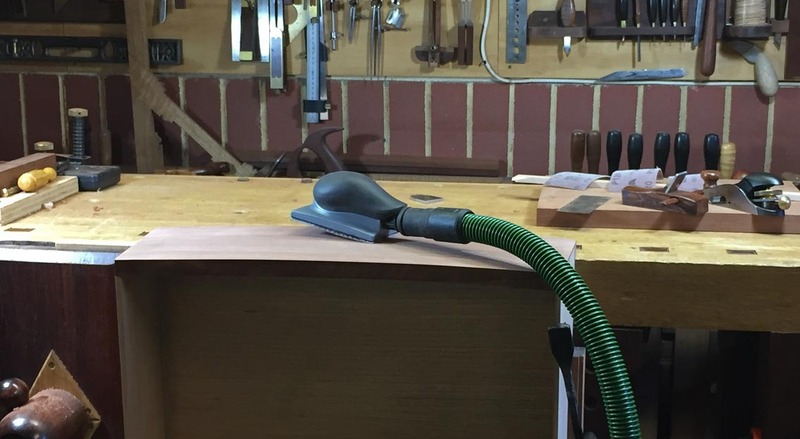
Dust control needs to be used with hand sanding as well (also keeping in mind that the dust from hand sanding is as hazardous to your lungs as off a power sander). For hand sanding I use a Mirka hand sander also along with Abranet mesh ...


This example was taken when I was building a bow front chest which had curved drawer fronts. The curve could not be planed without leaving marks (plus the figured Jarrah was highly interlocked). The face was shaped with planes, and then sanded to 400 grit to smooth it down.

I was not happy with the clarity of the finish from sanding, which I thought obscured the figure. Consequently, I used a cabinet (card) scraper to finish the sanding. Now scraping does not create the same high level of clarity which planing does, but you can see the difference below, and this is not a high resolution photo ...


I apologise that this is such a long way around to comment on your example. What I notice in your excellent photos is a dirty surface in the sanded examples. It is quite grey in the fibres. That suggests that your sanding was not cleanly done. Also, as mentioned earlier (and by Wiley as well), a higher grit may have produced a different result. I suspect, however, that higher grits are contaminated by low levels of dust removal.

Comments on my comments?

Regards from Perth

Derek

Re: plane vs. sand - khaya

#5

Re: Comment

David Weaver

Hand sanded after scraping to 220 grit. Linear along the grain length only. Strangely enough, my very first project was sanded with a power sander through 220, and I sprayed it 15 coats and saw fishhooks on the top and had to redo it. I finish sand when I sand to 320 on an ets125 or hand sand linearly to 400 and then vacuum the dust off.

I sanded this to 220 because that's more typical for someone finish sanding or staining.

I rarely sand, so I don't do much dust control when hand sanding.

I think that I could even out the color on these by adding more layers of shellac.

As far as clarity, this actually looks good either way in person. The camera phone allows you to see far closer than you can see by eye.

I have no agenda on showing one to be better than another, just taking pictures to collect data at this point. If I use a round over on a guitar, I generally sand so that the finish uptake is even. Otherwise, the router bit smashes the wood some and the finish uptake is uneven somewhere on the whole deal leaving some spots lighter than others.

My thoughts about these two pictures is that I like the color on the planed piece a little better but with completed French polish and pore fill, both would look good.

Re: plane vs. sand - khaya

#6

carnauba car wax

David Weaver

....any time you ever listen to tips and tricks for guitar care, they always warn about not using car products "in case you take your guitar to someone to be refinished"

That's funny.

When I french polish these guitars or varnish them (the varnish dries extremely slowly - at least my varnish), I will sometimes use mothers carnauba - it's brighter once you buff it out, and the guitar isn't big enough for the physical effort vs. other waxes to be a problem.

It feels funny, though. I don't always do the same thing before i apply it. With varnish, any little bit of dirt that starts on a guitar (Even sanding dust) will grow to a large dot of finish as the varnish seems to accumulate around any irregularity, so some of the carnauba polishing is to hide the fact that I knock those nibs off with a scraper and can't wait a year for the finish to fully harden to finish.

Anyway, 400 git sandpaper maybe (probably not), but usually a fine steel wool on shellac - like #00 or #0000. I don't know if it makes a difference with the carnauba.

No wax in these tests for two reasons:

* most people probably don't put it over a build finish

* I'm lazy. It still took an hour to do both of these, even though sort of a half arsed french polish process lets you get close to a gloss fast.

(filling pores completely, letting dry, doing again - finish shrinks, pores come back, waiting again another month and doing it a third time....way different).

Re: plane vs. sand - khaya

#7

I don't suppose...

David Weaver

modified pore filling techniques are useful with french polish, but I've figured out how to fill the pores as the first step with sandpaper only (and shellac and oil) and no pumice or the time that it takes to get the pumice on.

the secret is to sand the wood with a fairly large amount of shellac and then as the shellac is drying, be unsparing with oil (and add a little bit more shellac if necessary). Let dry to a tack (half an hour) and the little mounds of left over stuff smeared above the pores can just be scraped off.

This is what I did with the mahogany in this test, but I didn't scrape all the way down to the pores because I didn't want to scrape off the sanding efforts.

Re: plane vs. sand - khaya

#8

Re: plane vs. sand - khaya

Warren in Lancaster, PA

I did a little test last night. I planed a small board and then sanded a five inch section in the middle of the board. I applied shellac.

The sanded portion was cloudy, lacked the depth of color, clarity and liveliness. The biggest difference was that the planed surface was still slick, but the sanded area was rough.

When I abandoned sanding in 1978, I had been planing and then sanding with 320 or 400 grit only. Not only was the sanding a waste of time, the appearance was better without it.


Re: plane vs. sand - khaya

#9

Lots of shellac

David Weaver

someone gave me a gift certificate to ace a couple of years ago. What I ended up with was not finding much to buy, and got two cans of amber/orange shellac (they didn't have sanding sealer in stock at the time or it was some nutty price online compared to local...can't remember).

That boils down to being able to do this test many times without worrying about wasting anything other than time. I keep mahogany, rosewood and khaya offcuts for reasons I can't explain - rosewood is great, you can turn it, sand it, mix it with BLO and make gaps in infills disappear, etc. But the others, the kids usually marker or do something with - pointless to go on about that other than that I hate to throw such nice ribboned offcuts away.

Anyway, the short point about having all of this shellac is that I can explore another sanded surface today and we can see how it turns out. When you posted your comment, my train of thought before that was that the biggest difference is:

1) the planed surface has no residual on it, so the now common method of clogging the pores at the start isn't what I did (it would sand the wood). It takes a while before it stops taking in shellac. I could experiment further with thin coats to start and then starting the french polish process further after that

2) sanding, i can actually use the sandpaper to develop the cake and the initial process is very fast (the cake is there just from sanding - one could really get it out of the wood vacuuming a bunch and such, but I didn't do that because I wanted to speed the pore filling process and knew I could rub the cake into the pores and voids and get moving fast

For practical purposes finishing a guitar with khaya (which has gigantic pores), it's much easier to make this paste and use it.

I'll scrape the shellac off and do one more round, but removing the dust and not making a cake. For purposes of consistency, I may still use 220 grit with dust absolutely cleared so we can see just that difference and not two differences. I'm sure higher grit sanding looks better.

But in my head before your comment was how similar these two samples look in person when you can't compare them side by side. Once you have the pictures, you can see difference and the finish absorption by the planed piece made it look nicer. So I'm surprised that the comments so far emphasize the differences rather than to state how similar they look.

This test piece is vivid, too, which may mask some of the differences between planing and sanding.

The most useful thing to me so far is two fold:

* if rounding over a guitar (Back side or back and front detail) the guitar will still look great sanded if the wood is nice

* The planing of this wood is very fast. silica is the only challenge, but you can overcome it for the very final planing by sharpening one time and not taking any more thick shavings after the initial work is done. This only takes a couple of minutes. For a home shop person, to do coarse to fine sanding on this takes longer

Industrially, these come off of CNC, anything that's chipped heavily is tossed aside, probably for paint instead of a clear finish (it can be bodyfilled) and the good bodies are either very quickly linear sanded at high speed or go through a progressive disk or drum sander. So the fact that this doesn't scrape well because of the softness and sanding it a full progression over a large surface would be agonizing has zero commercial implication.

Most small hobby guitar makers buy a performax type drum sander because they don't have the skill to do much (they come to the hobby to make guitars, they don't come to hand tools, get good with them, and then make guitars later). I hate having those kinds of tools sitting around as they're expensive, they resell like crap, something never works quite as well as you want and the more floor space you lose, the more organized you have to be.

So, anyway, I'm surprised that the responses weren't more like "they look the same to me" and will do one with dust vacuumed out, even though I think most folks french polishing would like to push that dust into the pores and use it. It's actually far faster to do that than it is to use pumice and you don't wear a hole in a linen rubber like pumice does (I hate that).
Re: plane vs. sand - khaya

#10

one of the reasons I like planing so much...

David Weaver

..is that I seal everything with shellac, even if it isn't the top coat. It takes several more coats of shellac to get a sanded surface to not be rough.

The results in time were only reversed because I allowed the dust to remain and clog the surface of the khaya. It takes much longer to sand this khaya in a small shop without a drum sander and too much sanding would threaten flatness (I have large sanders - including a dual mode bosch 6" sander that I use when redoing floors in the house).

I couldn't do a test of sanding the entire scrap from start to finish because I'm not sure that I own a full progression of sandpaper. Just 80 grit and 220 grit psa roll for toolmaking on a lap, and then a bunch of fine sandpaper (and some really unsuitably coarse disks from floor work).

Re: plane vs. sand - khaya

#11

Your result was to be expected

Bill Tindall, E.Tn.

If I understood the experiment correctly you did not use a sanding-finishing schedule that sanders would typically use. In fact, the finishing goals of someone that employs sanding are likely so different from yours that comparisons of what result is "best" are uncomparable.

Undeniably, perfect planing leaves a surface free of mechanical damage. This surface can be wet, steamed or finished and remain smooth with little "grain raise".

Sanding leaves a more or less damaged surface, the damage being torn wood fiber and perhaps, if not likely, dust in the pores. Steam, wet, apply shellac that contains water, or even just a solvent based finish and these damaged fibers and dust soak up water/solvent, swell and stick above the wood surface. The appearance will be dull as a result of scattered light from the damage and the feel rough, to rough as a cob.

The typical finishing schedule doesn't stop at this step. Subsequent finishing steps deal with light scatter and this "grain raise" to eventually yield a more or less bright, glass smooth surface.

Not uncommonly, the result is judged too bright and the surface is rubbed more dull with abrasive and/ or wax, or dulling agent is added to the finish itself. Colored wax may be employed to enhance pore contrast. Glaze or shading finish may be part of the schedule to emphasize some surfaces. Etc. The finishing goals are so different as to make comparisons irrelevant.

In the case of David's experiment the question to ask is not whether anyone can detect a difference for this finishing schedule. Rather, are the results significant to what ever we are finishing. We all get to decide the answer on our own.

Re: plane vs. sand - khaya

#12

when taken to a full french polish...

David Weaver

..I can't see the differences as much.

If the task at hand is to oil and wax something (like a hand plane), then it's not contest - surfaces straight off of the tool are far nicer.

I'm not comparing polyurethane on these because without separate staining, it looks dead as a doornail on mahogany, limba or khaya (all sort of similar woods for these comparisons).

This is a close up of buttonlac on a guitar - I brought this to gloss twice french polishing, but didn't wait a month to put it together, so some of the pores are back a little bit (may not show up in the photo).

This guitar has a round over on the back, so it's sanded (or the finish uptake on the roundover is different than the rest of the guitar. If I plane the back of the guitar and sand the roundover, then it's also different).

I don't know if it's dulled or not, but I think it looks wonderful (and this guitar, even though it's solid, is acoustically astounding - just luck picking a wood sample - if I were to sell it to someone who had half a dozen telecasters, they'd probably complain that the finish isn't nitro and can be damaged, and then they'd notice the acoustic strength of it and how weak it makes their other guitars sound and not care at all about sanding).

But, I'd much rather plane it to finish - it would just require binding front and back instead of just the front to be able to plane both faces and then address the edge of the guitar separately.

On purchased furniture for any moderate price, I can't see a buyer having much leverage to complain about much.

(different piece of wood - I don't think any perceived dullness in it is due to sanding, rather the build of buttonlac with an appreciable amount of wax in it).

https://i.imgur.com/cwDn9cm.jpg

https://i.imgur.com/b50ph1j.jpg

https://i.imgur.com/BUlPisb.jpg

It's already got dents on the body - which is something people would definitely notice.

Re: plane vs. sand - khaya

#13

Plane vs. sand - black cherry

Don Stephan

The professional finisher where I live has only sanded to 220 for many years, because the pre and post cat finishes he use say only sand to 220. And he questioned why I bothered to hand plane and sand to higher grits when using shellac finish.

To show him why I hand plane and sand to higer gritsf, I found a 2 foot board of gorgeous black cherry, hand planed both sides, crosscut into two 1 foot pieces, and then hand sanded with the grain on one using 220 grit. I labelled the ends, then padded on blond shellac over several days.

When I showed him the two boards, neither one of us could distinguish between the two.

I still hand plane often, because I think it is faster than sanding through the grits. If preparing a piece he will spray, I then hand sand with the grain using 220 (and he does as well, because he stands behind his work).

Re: plane vs. sand - khaya

#14

Re: Your result was to be expected

Warren in Lancaster, PA

Certainly I expected the result. The question David asked was not which is best. The question was can you notice a difference. Yes, you can. And more so if you know what you are looking at.

Years ago a fellow set up a taste test at a Vermont country store on a Saturday morning. He had people taste three syrups: Grade A maple syrup, Grade C and Log Cabin.

The Log Cabin got the most first place votes, followed by grade C and then grade A.

But of the few people who could identify all three syrups just by taste, all picked grade A as their favorite.

If people are not discriminating, it doesn't much matter what you do. A lot of people like Wonder Bread.

Re: plane vs. sand - khaya

#15

added sanding - but with dust removed

David Weaver

220 grit sanding, hand sanding in the direction of the grain, but removed all of the sanding dust instead of using it to cake the pores shut.

Took seemingly forever for one of the ribbons to start to fill (and I still didn't complete it). This will show as a deeper amber color (i believe - haven't compared the pictures yet as of this post, but saw the finish in person, so no need). deeper amber color because of continuing t add finish until all of the ribboning started to close.

image 1 https://i.imgur.com/kyuqGDy.jpg

(with prior comparo below for easy browsing)

https://i.imgur.com/yRpn0O8.jpg

https://i.imgur.com/AbYafik.jpg (with comparo following):

https://i.imgur.com/YGwJmdI.jpg

https://i.imgur.com/5wQzZWU.jpg (with prior comparo following):

https://i.imgur.com/Y3Zjxpq.jpg

Re: plane vs. sand - khaya

#16

found the same...plus...

David Weaver

I found the same adding heavier finish as I'm doing in these comparisons. I think the torn surface and difference in absorption makes it easier to see sheer finish differences. When the finish builds, then it really obscures the differences.

The plus is that often, we read of the need to sand to stain. In cherry, at least, I really haven't seen much difference between the planed and sanded surface when it comes to stain. If the wood is curly cherry and the curls run out into the surface, it'll look about the same either way.

When making stuff out of cherry (that aren't going to be rubbed out), I like to pad shellac and then wax. It seems to work better off of the plane, but that's not a high build finish. Just a simple finish that looks nice and is easy to repair.

Re: plane vs. sand - khaya

#17

Re: added sanding - but with dust removed

David Weaver

just looked at the comparisons after posting this for the first time, and notice two things:

1) I think the amount of shellac dumped on the surface makes the difference as the amber color is what looks nice

2) with that much finish on the surface, but without filling the pores, it's still nasty looking

I may try the sanding and pore cake method next time I finish a mahogany guitar just because it's quick. The pictures tell me that just because it seals the surface reasonably well, that it'll be worth adding more shellac, anyway for better color.

The mrs. saw this test piece sitting on top of the slowly-moving living room cabinet project. She's wary of what the color of that will be. She said "that's disgusting looking, you can't finish the cabinet that color". It's ribboned khaya in a scrap sitting on top of a cherry cabinet - and should be obvious that the two have little to do with each other, but to her, it's all just wood.

Re: plane vs. sand - khaya

#18

Re: added sanding - but with dust removed

Wiley Horne

David,

Do you fill pores by wet-sanding with shellac, or by adding a filler?

Mrs. is taking no chances.

Wiley

Re: plane vs. sand - khaya

#19

Re: added sanding - but with dust removed

David Weaver

Wet sanding and some oil to allow continued sanding. Cake that accumulates above pores is the scraped off lightly.

I just tried that to expedite this test, but have used pumice on the sanded guitars.

Re: plane vs. sand - khaya

#20

Wonder bread

Joe shelton

That's a hoot!

I'll start looking for your comments now.

The world needs more ascerbic comment...

Re: plane vs. sand - khaya

#21

100% agree

David Weaver

I have seen the literal syrup example in real life with some well heeled friends of ours. We tried to give them maple syrup in a gift basket one year and they took the gift basket but brought the syrup back. Their kids (and I suspect the adults, too) will only eat log cabin.

I'm not sure I save as much in retirement savings each year as they spend on vacations, so it's not a money issue.

Re: plane vs. sand - khaya

#22

Re: added sanding - but with dust removed

Wiley Horne

When you use the pumice, is that also wet sanding with oil, but with pumice sprinkled in? Does the pumice improve the process? How?

I have done the wet sanding with BLO, down thru the grits to 4000g and it leaves an amazing finish to the touch (don’t know how it would compare side by side to a planed-only finish).

Thanks! Wiley

Re: plane vs. sand - khaya

#23

Re: added sanding - but with dust removed

David Weaver

I followed the "online 20th century" -21st? - french polish process - this is something relatively new to me so I am no expert on it.

That means I used the pumice to make a cake that goes into the pores that is a combination of pumice and dust. I try to keep that relatively dry and not use more oil than needed as I'm guessing that the more the cake is dust and pumice and the less shellac and oil (especially the latter if it can sink into the wood around the pores), the less the pore shrinkage will be.

But you can get greedy and lazy and have some build up on the surface of the wood and negatively affect clarity, so I try to avoid that - continued pore filling will take place with subsequent coats. I think a side of a cherry case can be completed in a pretty easy half hour if one isn't looking for the kind of finish that goes on a $15,000 classical guitar but there are some trade offs in perfection vs. speed. Khaya presents a greater challenge because of the size of the pores and how much finish/cake is in them - I've found that even filled twice over a week, there will be substantial shrinkage as the shellac dries.

Re: plane vs. sand - khaya

#24

I was not clear

Bill Tindall, E.Tn.

I got off tack with the question I intended to ask.

Expected that a single coat of shellac over this test piece would result in a difference anyone would feel, and see, even across the room. But nobody stops at a single coat.

More meaningful to the discussion is when the test piece was finished with a typical shellac schedule would there be a difference? In the case of a surface that began with sanding the 1st coat of shellac would always be sanded before the second coat was applied. The second coat will be glass smooth if done right.

I don't know if one could see a difference compared to however the planed surface would be finished to completion. Everyone I know would abrade the 1st coat of shellac no matter planed or sanded and add 1 or more coats by some means.

I worked at a sugar bush in my youth. Substitute Grade B for your C and I can understand the result. The "old" grade standard A is pretty, and pretty tasteless. But Grade C. Ghaaa! that stuff is nasty. It is made, if it is made at all, at the end of the season. We could not sell it and never made it.

Re: plane vs. sand - khaya

#25

Re: I was not clear

Warren in Lancaster, PA

We don't usually use the word typical when talking about finishing. A close friend is a long time professional finisher. He runs a Venjakob machine that is 130 feet long and about thirty feet wide, spraying lacquer and paint. Another professional finisher I know uses shellac, spraying, brushing and padding in a room that is about 9X10. Here in Lancaster County there are 2,000 woodworking shops within 20 miles of me and lots of variation in technique.

In the Fine Woodworking article someone referenced earlier, the fellow started with thin coat of finish and then sanded the samples. Even the supposed "plane only" samples were sanded before they had enough finish to protect the wood. When I pointed this out on this forum, somebody who knew the author said I should not be so hard on the young fellow.

I have never read a book or article that talked about finishing without sanding, and I am skeptical that any of the authors knew how to use a smoothing plane. For myself I typically don't use any sandpaper in finishing. When you are starting with a good surface it is not necessary.