Is there a rule of thumb for the depth that the tails would go into a carcass side when those tails are full length on the end of a solid shelf?
E.g., half the thickness of the sides on a 7/8" side, or 60% or whatever else may be the case.
it seems counterintuitive to make them too deep, but if they are compressed and glued into the case side, I'm sure strength of the case is first more than it needs to be and second not that compromised with a tight joint.
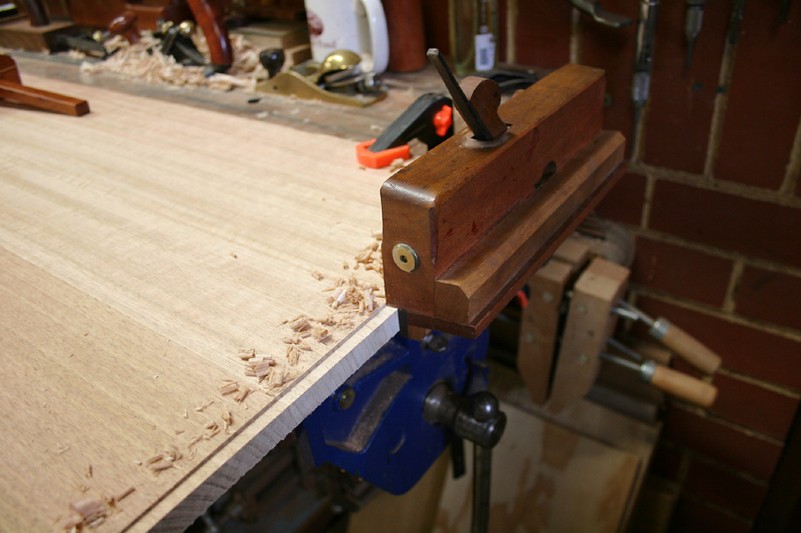
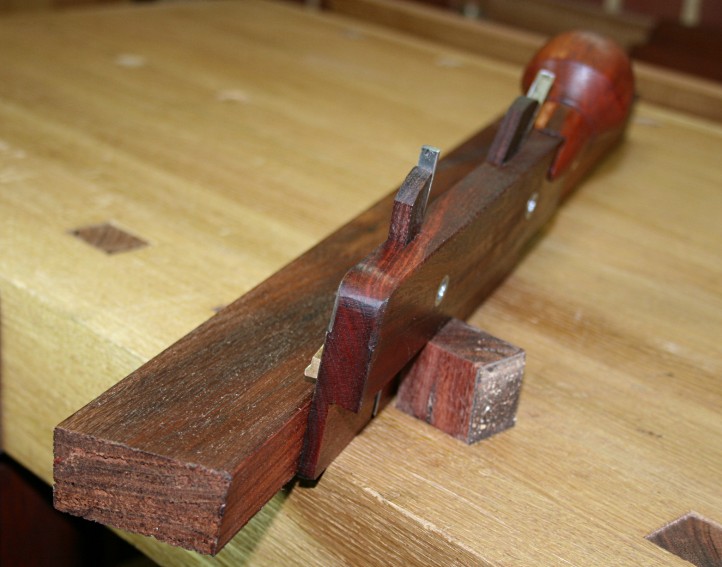
I'm asking this a little bit too late as i've already made a quick dovetail plane to cut the tails on the ends of my shelves (it will go about half depth on a 7/8" side). Strength either way won't be an issue, this is a question of aesthetics.
..has always been to HB dovetail the top of a case, through dovetail the bottom, wrap the bottom in a base to hid the joint and the top in moulding.
Then dado the shelves between and put trim on the front of the case sides.
I don't follow furniture rules, but this is probably a standard thing.
In the "case of the case" that I'm making now, it's a lower and an upper, nothing special (storage for the living room) and the mrs. wants max space in it and she wants me to stain or dye it (yuck), so it will be a strange build of sorts. It'll have the base, mouldings around the top of the bottom piece, the second piece will sit flush on top (and the bottom shelf will instead be dovetailed in as will the center shelves in each piece).
The reason that i'm moving to dovetails, aside from the desire to use the shelf in the top case (on the bottom) as structural is that I am a one-man glue up shop, and something always goes wonky with the dadoes if they're tight. The glue starts to set and one's not at full depth, or I pull the dovetails together and one of the dadoes that was full depth gets out of line and then it's a race.
I'm thinking that ever so slightly loose dovetail shelves will allow me to use less glue and get things together square and with less malleting and swearing.
Since I need max opening width and the mrs. wants no frame in the middle of each case piece, the doors are just going to be mortise and tenon doors with flat panels (but the panels are resawn solid wood), and they will go all the way to the edge of the case and be mounted with euro hinges. Tasteless, but i'm not looking to make this difficult when it's just going to be stained dark, anyway.
the same - my recollection from seeing older furniture was that they were deeper, and in my opinion, looked better. My case at this point doesn't need to look great, just decent. The doors will hide the joint unless they're open, anyway.
Just curious for future reference as I could easily make more of the dovetail plane type that I've made in a couple of hours each.
1/3 - 1/2 the thickness. The answer to your previous question. Immaterial as you have already begun
The reason that i'm moving to dovetails, aside from the desire to use the shelf in the top case (on the bottom) as structural is that I am a one-man glue up shop, and something always goes wonky with the dadoes if they're tight. The glue starts to set and one's not at full depth, or I pull the dovetails together and one of the dadoes that was full depth gets out of line and then it's a race.
I'm thinking that ever so slightly loose dovetail shelves will allow me to use less glue and get things together square and with less malleting and swearing.
Tapered sliding dovetails. That is the answer to all your woes. Yell out if you need input.
Thanks, derek. I figured I'd introduce bias in the joint to make it easier to assemble (as the assembly is a large part of the reason for moving to it).
My dovetail plane is made without a depth stop, so I don't have a condition where biasing the tails with taper will be difficult to do.
I wonder if these joints were ever cut with minor taper and the center of the tails (on the shelves) intentionally planed a shaving deep so that they don't have as much purchase as the ends.
Want a rule of thumb? Don't do it. Sliding dovetails are rather rare in period furniture. I have never seen a sliding dovetail for a shelf in period work.
What we do see is a shallow dado, on the order of !/8, with a dovetail housing at the front. The dado goes all the way back to front, but at the front there is a dovetail housing, roughly 2 inches long, and going to maybe a quarter inch of the outside of the case. So on a 7/8 inch case you have 1/8" dado, 1/2" dovetail, and 1/4" to the outside of the case. On some early case pieces, the dovetail goes all the way through the case, but then they are usually only about and inch or 1 1/4 long from the front of the case.
This dovetail helps keep the front of the case from coming apart at the dado; A tiny gap where the dado joint has come apart does not look good. At the back of the case, the backing boards help hold the case together and rigid.
Some think they must certainly be more knowledgeable than 18th century craftsmen.
I'm guessing the setup you're talking about is miles easier to execute (especially excavating a shallow dado vs. a deep dovetail along the length of a case) and assemble.
I checked some of my stuff and a bit over half thickness is what I use. I usually cover them up so looks becomes irrelevant. The joint is so strong I don't think the tail depth matters whether it is half or more.
When we did a shelf in the Headly shop it was as Warren described, dovetail for just a bit in front. That said, Wil Neptune demonstrated a slick way to make a sliding dovetail shelf that only used a chisel and saw and a guide block. I presume he would not have demonstrated the joint if it was rarely used for this application. For a case with a back a dado obviously works. For an open book shelf, maybe not. Might need the dovetail to hold the back together, or not have to use clamps.
We'll see how the full length dovetail on the bottom of the case works - it's actually structural, the others don't need to be.
My plane works so incredibly slick - I thought about chiseling, but figured if I chisel 6 of these, by the time I did that on cherry (vs something nicer like mahogany), i'd be able to make the plane and cut the tails. It takes less than a minute to cut each tail side dead on with the plane, and the cut line is like a laser.
only problem is I got in a rush to make the plane (ugly type of plane), and it's a lefty plane - but I can plane left handed reasonably well, so the mistake isn't that costly.
Learning to make tools was one of the better problem solving investments I've made in the shop. It doesn't equate to more furniture, but it equates to making something rather than endless searching to buy something (the plane takes about 3 hours to make without the use of power tools - it cuts on the skew and has a nicker and is fixed tail length and angle).
I just recalled we made a Federal wall cabinet in the Headly shop whose bottom sat up off the floor and was installed with a sliding dovetail. It was a perfect application of this joint. We did not taper it. Rather, I learned my most important lesson from the shop. Sliding joints need to slide together in the dry EASILY. Steve implored us to fit the joint where it could be assembled with hand pressure. I assembled the cabinet with yellow glue uneventfully.
This is what I'm going for, and what I go for cutting HBs that will be covered with moulding off of the saw. If they go together easily (but not horribly ugly) dry, they will go together about right with glue.
I set my plane up (no power-tool like perfection required from end to end, rather ability to control a little bit of extra cut in the middle) so that I can excavate the joint and then finagle the tail to be snug at the front and somewhat less snug after that, but not sloppy.
If it's not attainable, I'll make some additional compensation to fit somewhere that it doesn't show.
David, you must do what you must do .. which is what you choose to do.
However, do re-consider a tapered sliding dovetail if the joint is to be structural, which I believe yours is. This is not only extremely strong (I chose to do so for the legs of the base for the current build), but also very easy to slide together ...
Use a power router (which you have and use with your guitar bodies) to excavate the waste ...
... and a chisel or router plane to clean up ...
I can almost push this together with fingers. A light mallet tap closed it up. VERY strong ...
If an 18th Century furniture maker did not do it, it was simply because they were not bright enough to think of it
There is somewhere that I'll be doing that type of joint; the case joint between the top and bottom. If my first shelf joint doesn't go well, I'll quickly see your way.
Just a thought, David. That joint described by Warren is really beautiful. Because you don’t just have a dovetail into the case side. The shelf inserts into that 1/8” dado housing, then the dovetail extends beyond. There’s a drawing in Jeffrey Greene’s book if you have that.
I assume if you go that way, that you insert the 2” wide dovetailed section from the front, and then the rest of the shelf from the rear. And decide whether you want to tongue and groove or spline the two shelf pieces for alignment.
Warren can straighten this out if I’m assuming wrong, but it is a beautiful join to look at from the front. I would think the mrs. would be pleased.
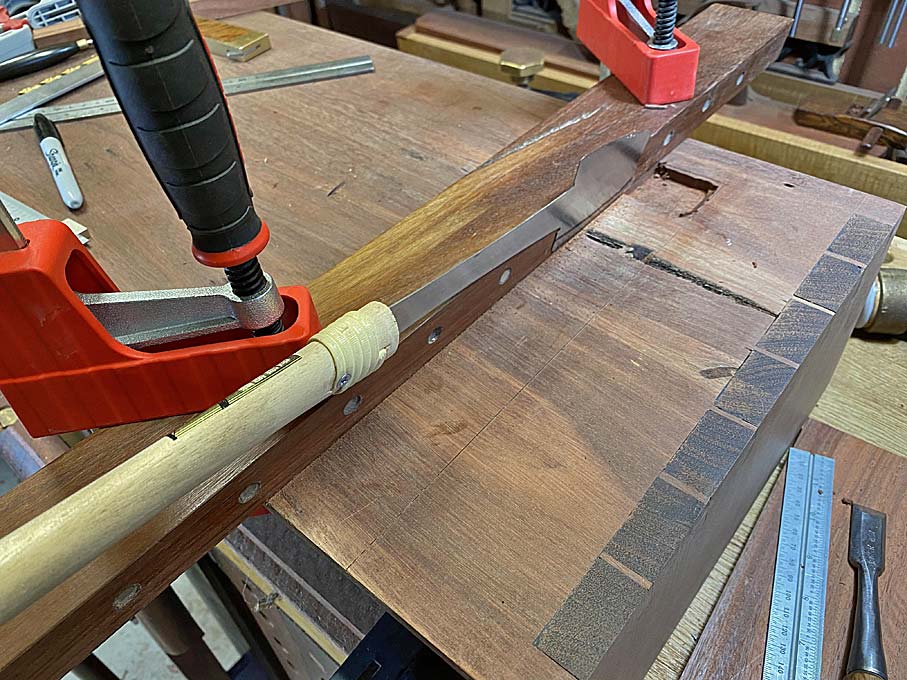
I built this plane just for one job, and then will throw it in the rack.
I didn't think much about it - at first it was just going to be an open sided skew plane, but I glued a side on it. I figured I'd screw the fence on because that would be easier (though it would be easy to make a mother plane like this to make a solid version of this one-piece).
I set the skew toward the back at the open side thinking it would take the corner of the board near the end of the cut and cut back toward the middle (less chance of chipping the corner off).
I think the 15 degree tails and the skew only slightly greater than that may partially cancel each other out, but it works OK on wood. I also wanted to bias the feed toward the outside so that it wouldn't jam and I wouldn't have to think long about shaving escapement. I think that's in my imagination.
I mentioned elsewhere, but I laid the original part out quickly, drew lines, and then sawed out the center opening (mortise now with the sides on) and realized when I picked up the plane to test it, it's backwards (left handed). Ooops.
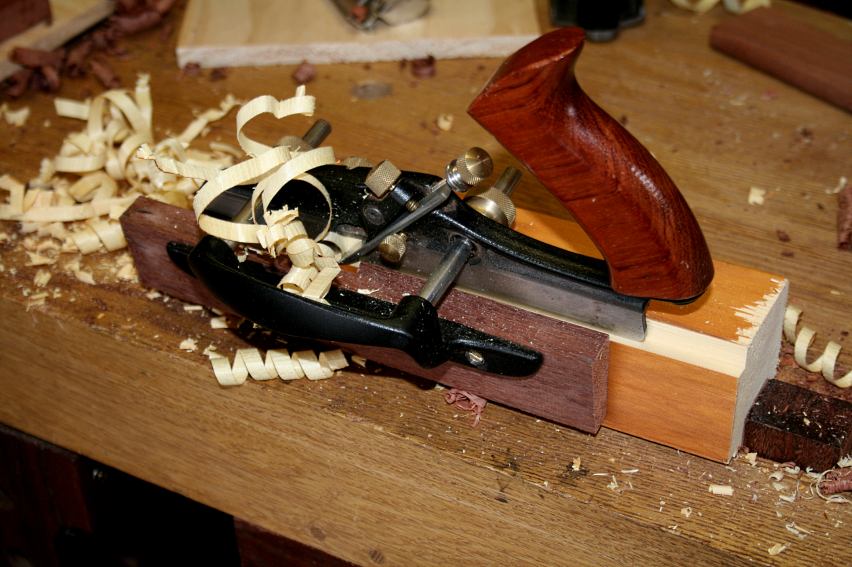
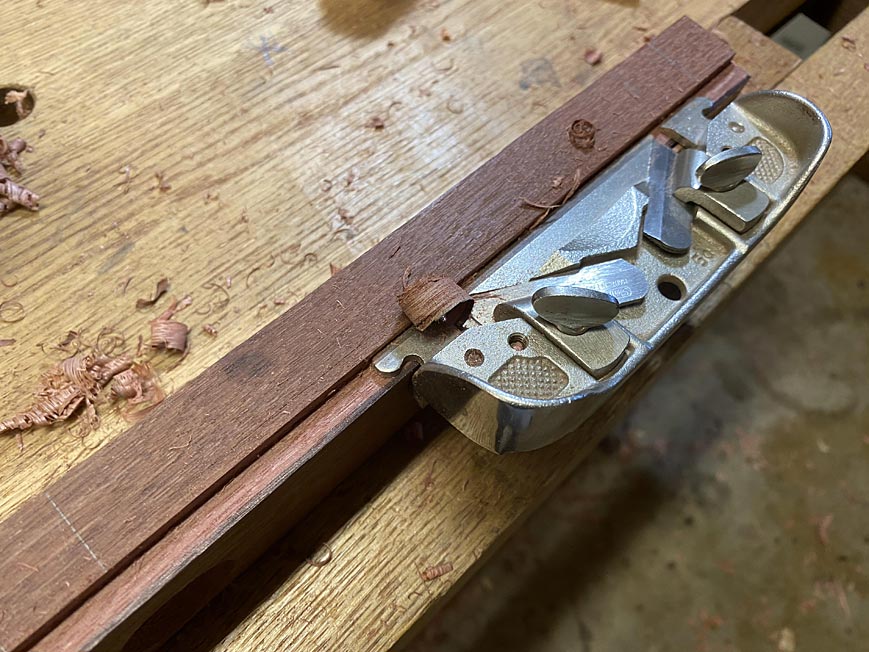
Curious for anyone who has a dovetail plane, which way does the skew go?
I could be wrong, and maybe the skew and angle doesn't cancel itself out, but rather than thinking about it and being wrong, I'll just stop mid cut later and see what the shaving looks like.
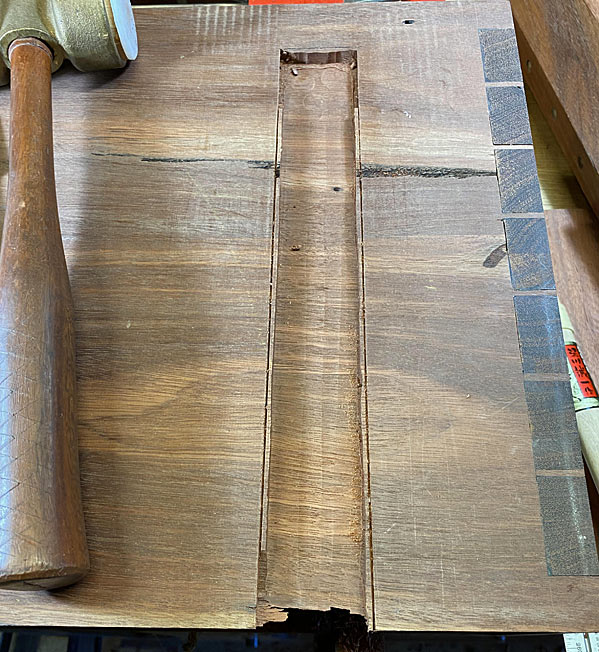
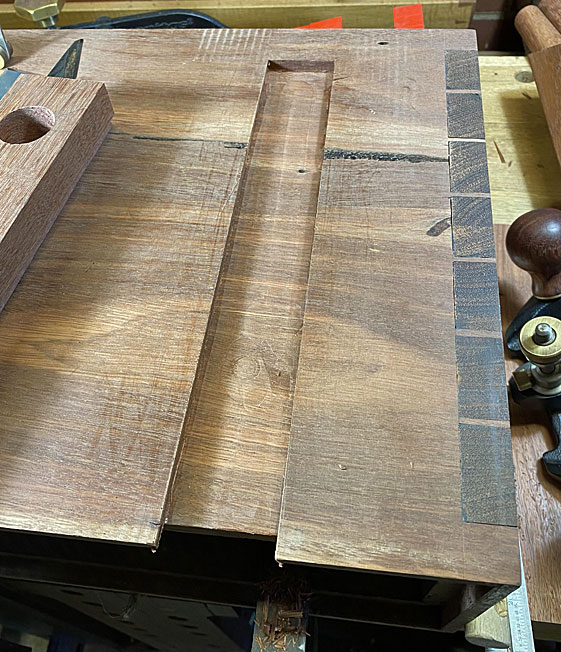
The full depth writing surface and the bottom of the slant front desk I'm building are joined to the sides with full housed sliding dovetails. I was worried about the 7/8" solid walnut sides cupping over time, so the full width dovetails seemed like a good idea. I housed them to achieve a nice, clean appearance on the surface. it's a long joint: 22 ". The effect is identical to the joint Warren described, but the joint I chose turned out to be a lot of work and stressful to achieve.
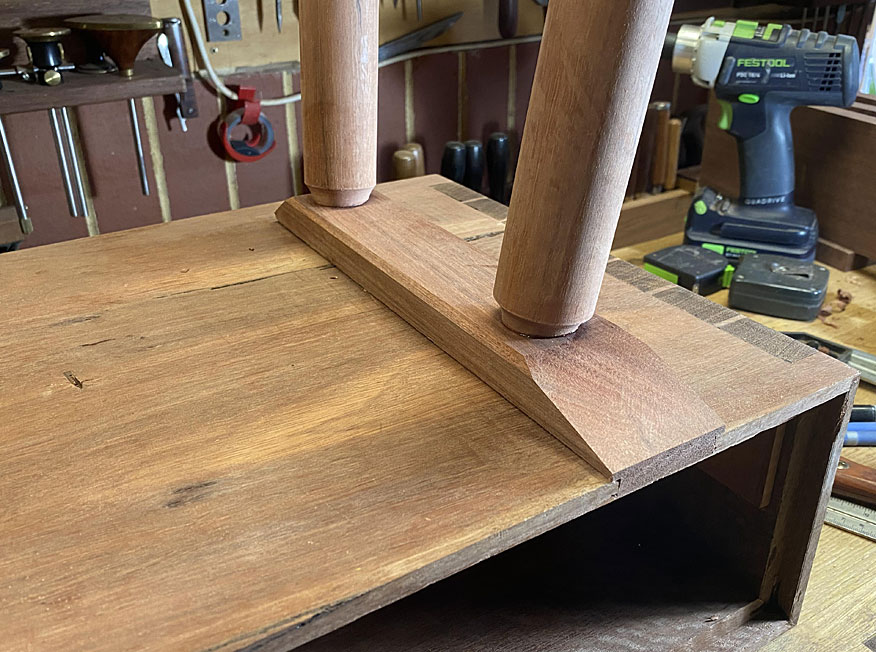
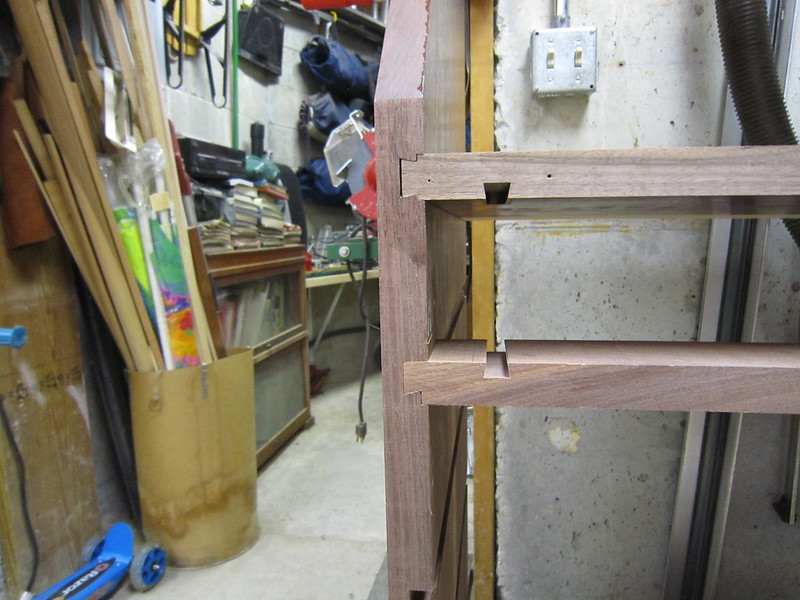
Bill is correct, to make the joint work it needs to fit loosely and go together with modest hand pressure. My first attempt on the upper writing surface was too tight. I ended up gluing the first 5 or 6 inches and the last 5 or 6 and having to crank the panel in place with heavy Jorgy bar clamps. The glue started to seize before I got it fully flush, but I managed to coax it almost into place. I can fix the tiny offset. I thought for a minute I'd made a gigantic mess. Here's a couple of photos:
[url=https://flic.kr/p/2gL9W6D][/url][url=https://flic.kr/p/2gL9W6D]IMG_4486[/url] by [url=https://www.flickr.com/photos/158680038@N03/]Hank Knight[/url], on Flickr
[url=https://flic.kr/p/2gL9ZSw][/url][url=https://flic.kr/p/2gL9ZSw]IMG_4490[/url] by [url=https://www.flickr.com/photos/158680038@N03/]Hank Knight[/url], on Flickr
Note that the tail doesn't reach all the way to the bottom of the socket. I did this on purpose thinking it would help avoid glue buildup that would hinder the slide into place. The entire joint will be covered with applied plain molding so the gap won't show. The depth of the joint is approximately 50% of the thickness of the side. I have no historical basis for that depth; it's just what I came up with.
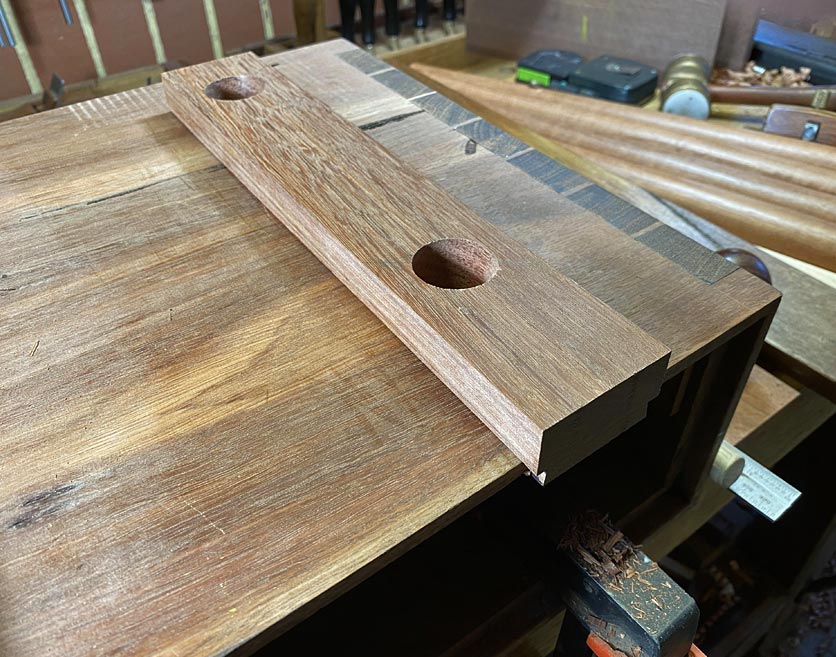
Also note the drawer divider below the writing surface is joined with the half tail method Bill described. The joint was cut with a saw, a chisel and a paring block, and it turned out better than the machine cut joint above.
Finally, last week I joined the bottom panel to the sides with the same full housed sliding dovetail. I followed Bill's advice and cut the joint looser than I cut the previous one. With liquid hide glue as a lubricant, it slid into place easily with hand pressure. The result is a rock solid, square case. Had I known then what I know now, I'd have used Warren's method or Derek's tapered sliding dovetail method. Either one would have been a easier, and Derek's tapered joint would have accomplished the stiffening the sides to prevent cupping that I was looking for, without all there drama and stress of the full housed sliding dovetail joint I used. I did it the hard way, but that's how we learn.
I made my dovetail plane the same way, if I understood your description of the skew correctly. The skew is not pulling the plane into the cut, but the opposite. So that the acute corner of the dovetail remain clean.



 [/url][url=https://flic.kr/p/2gL9W6D]IMG_4486[/url] by [url=https://www.flickr.com/photos/158680038@N03/]Hank Knight[/url], on Flickr
 [/url][url=https://flic.kr/p/2gL9ZSw]IMG_4490[/url] by [url=https://www.flickr.com/photos/158680038@N03/]Hank Knight[/url], on Flickr