Home Articles Forums Gallery Marketplace Videos

WoodCentral Forums

Knowledge You Can Build On — Est. 1998

Blast from the Past for XHP/V11

Posts

Re: Blast from the Past for XHP/V11

#26

The problem with Grace screwdrivers

Bill Tindall, E.Tn.

The first time I fussed at LV about lack of screw drivers the Grace were the answer. In fact, I reviewed them here on WC. They fit screws perfectly with a handle designed for applying torque. The nearly square handle is near impossible to turn one handed, an essential feature when installing a cabinet door, for example.

I tried taking one apart to install a round handle. That failed. I don't know how the shaft is fixed in the handle.

Re: Blast from the Past for XHP/V11

#27

Screw lube

Bill Tindall, E.Tn.

Lube not only has to have low friction, it has to stick to the screw. In this regard soap is seemingly ideal, but not. While it is not hygroscopic, it does retain water, and it is a good conductor of electricity, which leads to it being the equivalent of storing the screw in dilute salt water.

Paraffin is a good lube but it doesn't stick well. Bee wax is good at lube and sticking. But best of all by a wide margine is the tube of wax used to lube the blade of a metal cutting band saw. These tubes, about 1 1/2" x 12", are available from any machine shop supply, MSC for example. This sticky wax adheres to screws and the difference in driving torque is remarkable. You might be able to beg an inch or two of the remains of a tube from your local machine shop. That's where I got mine.

Re: Blast from the Past for XHP/V11

#28

I don't anticipate....

david weaver

Anyone is going to work through that site and buy any of the steel and attempt to harden it (because of price), but I'd say that it's *not hard* to work with, but definitely a step more difficult than O1 in some respects due to the need to not heat any parts of it while working it and then the need to get another 400-500 degrees higher heat than O1.

But for someone who has the ability to generate 1850-2000 degrees of heat, it's there and accessible and is going in everything in my shop that it'll work in. I think that's about the thickness of the blade in LN's spokeshave, too.

Not directed at william - but anyone else who has never worked, hardened and tempered anything previously, it's not a good first choice, but a good choice after the first choice is mastered.

Re: Blast from the Past for XHP/V11

#29

Blades 4 and 5

david weaver

exhibit the same behavior as the prior three. Blade four I used only one torch, which is meaningless to the forum other than that I could only get heat up to probably the very bottom of the acceptable range and not even maybe (1850).

A single torch in the can forge will do anything O1, even shootenstein's gigantic skew iron (2 3/4" roughly and 1/4" thick), but XHP seems to be (to get the steel to proper color -very bright orange bordering on dull yellow) a two torch affair. It's not so much the gas that makes that an expensive addition, it's the fact that you need two good torches (like the TS4000 type) that output more heat than some of the tiny pencil torch types that are really inexpensive. Torches of that type with an igniter will lose the igniter instantly in the forge due to the high temperatures, but I've been using a TS4000 type as one of the torches sans igniter (easy enough to strike it lit) for dozens of irons now and it shows no other ill effects.

Long story short, the slightly underheated iron shows no difference at all in feel or on stones or diamonds, nor on wood. A testament to the forgiving nature of the steel (of course O1 also does this as long as you get it to temp - if you get it briefly over temp, even well over, it doesn't seem to suffer much in terms of ill effects, but it may warp more).

The wear resistance of XHP is evident when flattening, but I've seen much worse.

Irons 4 and 5 again love the washita as a finisher - there is something about their functional hardness and the particular stone that I've used that creates a very clean edge (it's a little harder to get absolutely defect free off of cast and diamonds because the surface is unforgiving of any contaminant, buried or loose) and a supreme mirror brightness on wood that I cannot get out of the same hardness iron in O1.

Not a suitable iron, though, for anyone using mostly or all natural stones due to the wear resistance to grinding and heavier stone work. It's just a strange combination of resistance to the speed of stones, but still showing good edge fineness without the rubbery feeling with the wire edge.

Grinding is near sparkless when establishing a bevel or refreshing it (i.e., not maintenance bevel refinement), which is not remotely similar to carbon steels.

Re: Blast from the Past for XHP/V11

#30

Re: wood-database-how do I use it

Derek Cohen (in Perth, Australia)

Maybe you test these unknown to the western world species because they are relevant to woodworkers in your area. The US exports hardwood lumber throughout the world. It will be easier for most to interpret results of testing techniques and tools if testing is done on stuff most people use.

Bill, the use of Jarrah does not invalidate the studies I performed. It would not have mattered what wood I used. I preferred a wood that was abrasive since this would hasten wear (no doubt a reason Lee Valley used MDF). I used Jarrah, partly because it is abrasive (that was the reason for my link to Wood Database), and partly because it is available in my neck of the woods.

If I had used USA Hard Maple (a wood I have come to use quite a bit over the past 4 or 5 years) in place of West Australian Jarrah, would it make the results more intelligible to you? Is all Hard Maple the same?

Again I emphasise that it is irrelevant what wood I used - what was relevant was simply that I used the same wood for all blades (whatever the research in question was). This holds constant a vital variable in the research process, and all blades are measured against this one variable.

Warren frequently posts how he obtained a Jarrah board and outperformed with his vintage chisels anything I could with the modern chisels I was using. This is so wrong on so many levels, but I will mention just one: his findings have no place in scientific research. How can he compare his Jarrah board to the one I used? Ironically, Warren frequently chides us for treating "White Oak" as if it was just one species with just one temperament.

Regards from Perth

Derek

Re: Blast from the Past for XHP/V11

#31

Re: wood-database-how do I use it

Bill Tindall, E.Tn.

If I had used USA Hard Maple (a wood I have come to use quite a bit over the past 4 or 5 years) in place of West Australian Jarrah, would it make the results more intelligible to you? (In fact for the end grain I think you did not use Jarrah.)

Intelligible is not the correct word. I don' t have any problem understanding your reports. Unlike some others, they are adequately documented.

Relevant is the meaning I want to convey. The closer the experimental conditions are to actual use the more relevant the data might be...all carefully chosen words. I do not question the relevance of the results to the wood used, nor conclusions for the experimental conditions investigated.

There are at least 4 important metal attributes- hardness, at least two kinds of abrasion resistance and toughness. I don't know whether a hard silica containing wood like you used for the end grain study challenges these variables equivalent to wood I typically use. So to be forthcoming, when you report on a tool evaluation, or technique, using one of these atypical furniture woods I have some reservation about the conclusion's relevance to what I do, again carefully chosen words. A reservation means you got my attention, but, I need more data to reach a conclusion.

Is all Hard Maple the same? Essentially yes for planing studies. White oak, no. We have sold thousands of bdft of each, usually power planed, so I have considerable experience how each behaves. Hardness can be judged by the sound of the load on the motor. Oak has soft and hard portions, the ratio depending on growth rate. Hence, growth rate has a huge effect the resulting hardness of the wood. I have seen white oak so soft it works like poplar. One can drive finishing nails in it without pre-drilling. And I have seen it so hard that tempered flooring nails bend when driving.

Re: Blast from the Past for XHP/V11

#32

Maple

Steve Elliott

Is all Hard Maple the same? Essentially yes for planing studies.

I once bought a piece of hard maple with the intention of using it for a series of blade tests and the first time I tried to take a shaving it seemed like I'd installed the blade upside down. It took so much force to take a thin, wide shaving that I didn't want to use it for any kind of hand tool work. Its density was higher than the range given on the charts but otherwise it seemed like ordinary maple. I bought another piece of cherry to use instead.

The maple was OK to work with power tools.

Re: Blast from the Past for XHP/V11

#33

Re: Two times...

Mark Hooper

David, after reflecting on my outburst some days ago, I realize that those comments were uncalled for. Your exhaustive research and diligence are to be admired. Please excuse my poor behavior.

Mark

Re: Blast from the Past for XHP/V11

#34

Pretty much the case...

david weaver

..for maple in general for all work. Warren uses the term musical for it, and I don't know if that musical stiffness and ability to carry vibrations makes it so painful to do more than just light work on, but it offers a lot more resistance than something like ash or beech without really having any more density.

The tensile strength of the shavings is astonishing. They burned out the leaf blower that I use to clean the shop - first time I ever experienced anything like it. They could probably be used to braid into a rope.

The here and there iron punishing flaws in it make for a crappy test bed, too, but the good parts of it do make really smooth pleasing shavings.

It's just not a very nice wood, and for an end grain test, I wouldn't think it would be very good, either.

When I made the shooting plane i use, I couldn't tell much difference or any in longevity between it and the V11 plane that I had (the LV skew). But in playing with them, I shot cherry. There may be a harder wood where the V11 would separate itself or who knows? I'm sure that results will vary by wood type because toughness can be an issue.

I have a piece of brown purpleheart (it's brown through and through, or very close to it - not sure how) that I used to make the shooting plane infill and wedge, and it worked well for that. For whatever reason, it's extremely dense, easy to burn and the end grain resists everything. In an effort to see how it would plane with V11 and the O1 iron that i made, I destroyed the edges of both blades almost immediately.

Point of that being that choosing more difficult woods that seem like good test beds because of their ability to dull an iron risks lacking the ability to prove that the results will translate elsewhere.

Of course, beech is easy planing for its hardness, from the test results, it can lead to outsized amounts of weight planed, but it doesn't leave much of a question about whether or not an iron is being destroyed by atypical wear. Beech and cherry to me plane like they're related, one just seeming more dense than another. The shavings have a similar quality and the pictures of the edge off of either are also similar.

If someone had stock to waste and a planing machine that could work through large numbers of feet of it, more could be tested about the relationship from one wood to another, and the importance of hardness as wood gets more dense, but none of it would outweigh experience using a plane and getting more out of the most mundane setup. It would still be interesting to see years on after I've taken my lumps with some of the punisher woods, and to see what things I may have been imagining. I took my end grain experience with V11 and a comparison to a very un-like plane in long grain and came up with the wrong conclusion.
Re: Blast from the Past for XHP/V11

#35

No big deal..

david weaver

I've done the same thing. I think I've even done it to Bill and I know I've hassled someone on another forum who is a diligent researcher (but sometimes off the market about what he's looking for).

I'd love to offer the magic solution for forums to get to the point that they're only positive and they are filled with design and construction of things, but I've never figured that out, as anything I've gone to the trouble to document building generally is seen and disappears into the ether pretty quickly due to lack of response.

I think the issue with it is that for a lot of people, it's really not relatable. Only the odd (fascination) and the simple (relatable) are.

The sharpening and steel topics are punishing for those not involved, and the natural tendency (for everyone) to focus on the negative first draws everyone in. If that wasn't the case, pro wrestling wouldn't have used heels to draw people in. I'm not wired like the average person and tend to repeat things that I find fascinating over and over to continue to get more resolution or explore further, and that adds to the punishment. I like constructive negative reactions from people, too (non-constructive, not so much, but tending toward indifferent), because people tend to say what they think when they disagree with you, and you can learn.

(i forgot - people like topics that encourage them to buy things, too. It's a false sense of improvement that takes almost no effort to go along with "just tell me what to get, what to do...don't tell me to go experiment and figure something out").

In fairness, it's a bit of an understatement to say that I don't excel at responding to people who offer open ended criticism without arguing a particular point, either. Part of it is just bad behavior/temper, and part is the hope that egging people on will result in them sharing something I don't know.

Re: Blast from the Past for XHP/V11

#36

Jarrah and Maple

Derek Cohen (in Perth, Australia)

Steve, all Hard Maple in Perth is imported from the USA. It sells here for about the same as new Jarrah. Our measuring systems are different, and this makes it difficult to compare prices between our countries.

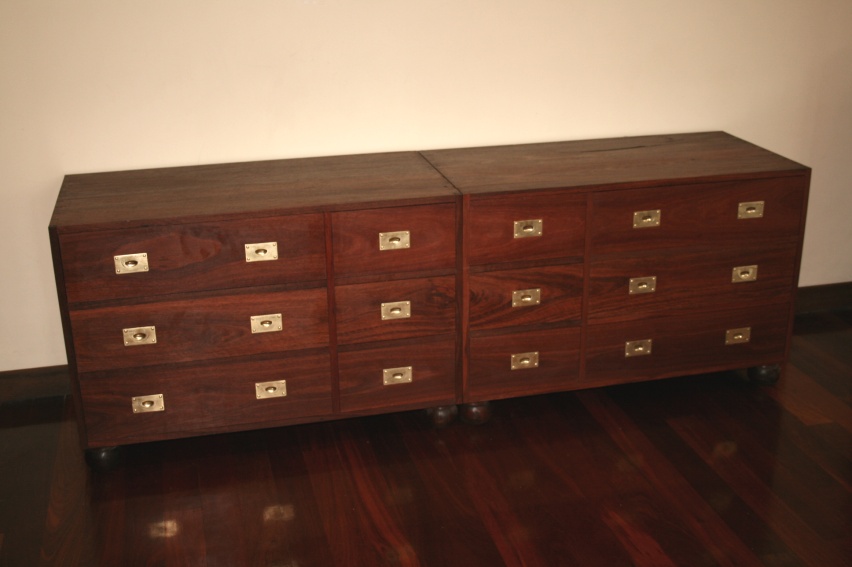
Much of the Jarrah I use is recycled or from urban salvage. I do not want to purchase from forests since it is getting close to decimation. One of the reasons I used Jarrah as much as I did in years past was because there was so much around from recycling.

Jarrah ...


In recent years I have been using a number of other woods, and I have grown fond of the clean and fresh look of Hard Maple. I built our kitchen from curly maple about 4 years ago ...


This was prepared by machine for the large part, but finished by hand plane.

Since then I have turned and planed it for three or four pieces, more recently the Harlequin Table which I posted here a month or so ago. Dovetailing the carcase was "fun". :)


For both woods, there is no give in dovetailed sockets to compensate for a too-tight a fit.

Is Maple harder to work than Jarrah? Planing Maple is similar to Jarrah, although Jarrah can be harder - the Maple I have been exposed to does tend to be uniformly hard, while Jarrah can vary a little. Some of it feels twice as hard as Maple, and it is also abrasive to steel. Some cuts like butter. The two woods tear out differently. Jarrah is inclined to be predictable and you learn to watch for reversing grain. When it tears out it does so more gently than Maple, which seems to "erupt" around knots and reversals.

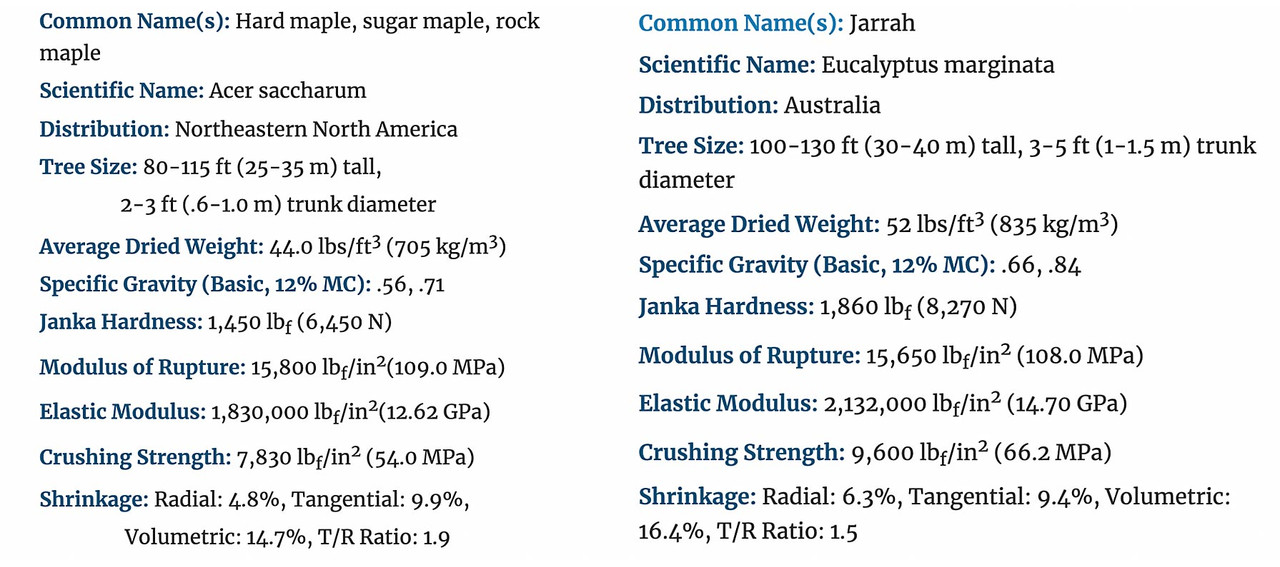
For what it is worth, here is a Wood Database comparison of the two woods:


Regards from Perth

Derek

Re: Blast from the Past for XHP/V11

#37

Re: wood-database-how do I use it

Derek Cohen (in Perth, Australia)

There are at least 4 important metal attributes- hardness, at least two kinds of abrasion resistance and toughness. I don't know whether a hard silica containing wood like you used for the end grain study challenges these variables equivalent to wood I typically use. So to be forthcoming, when you report on a tool evaluation, or technique, using one of these atypical furniture woods I have some reservation about the conclusion's relevance to what I do, again carefully chosen words. A reservation means you got my attention, but, I need more data to reach a conclusion.

Bill, you must not compare my research to that of David’s. David went above-and-beyond. It was a mammoth effort, and he covered a lot of bases. Clearly, David is certifiable! :) By comparison, my effort is small stuff. The goals I aimed at 8 years ago were more modest. Frankly, I do not know if I would now want to do anything even like that again. It is exhausting - not just the woodwork, and not just the writing, but finding that you cannot please all.

Regards from Perth

Derek

Re: Blast from the Past for XHP/V11

#38

Great description

david weaver

of how maple is. It's mirror clean, and then there will a spot that is just sh*t.

It's not even good with a cap iron across those spots until the final passes with thinner shavings (though the cap makes those spots tolerable in heavy work and prevents the shaving from coming apart).

never worked jarrah here, but in my flawed imagination of woods, I envision it being slightly softer purpleheart, which is fine to work until you plane the endgrain. Fine doesn't meany easy, but tolerable.

The fact that the good areas around maple work to such a high polish makes the little wrinkles in it stand out more.

Re: Blast from the Past for XHP/V11

#39

Re: Band Saw lube

William Duffield

I'm off on a tangent again, but this seems like a good place to ask my question, since it has some relationship to a few of the subjects we have been discussing lately.

I have been working some purpleheart lately with a mix of power and hand tools. I have had lots of curves to cut on the bandsaw. (Maybe I should be using a metal cutting bandsaw on this stuff :D ) The purpleheart is oily and abrasive. The sawdust it produces tends to clog the teeth of the saw, so cutting slows down and more heat is produced, turning the purpleheart black. Of course, none of this is good for the bandsaw blade, either. It doesn't seem like the wax you recommend is correct for this application, but I've tried beeswax and PTFE, and am dissatisfied with the results. Currently, I'm stopping the cut every few inches and cleaning the blade with a wire brush.

Any better recommendations for keeping the teeth clear?

Re: Blast from the Past for XHP/V11

#40

TPI?

Bill Tindall, E.Tn.

Is the solution to your problem simply fewer TPI? What TPI blade are you using?

Possibly totally unrelated....or not.


I cut up a massive amount of holly recently. The gooey sap stuck to the blade to the point it stalled it in the guide. In desperation I squirted WD40 onto the guide as the blade passed through it, coasting to a stop. To my amazement the blade was clean and stayed clean for several more cuts. An occasional squirt and I completed sawing and in the end the blade was clean.

Re: Blast from the Past for XHP/V11

#41

Re: wood-database-how do I use it

Bill Tindall, E.Tn.

I'm having difficulty writing clearly for you are not interpreting what I write accurately.

I'll try again.....When you describe a test of a material or procedure done on a wood whose properties are far removed from the wood typically used for furniture I, and maybe others, will consider the result, because I believe the work is done reliably and reported accurately. To accept the conclusions for typical furniture wood I want to see the experiment repeated on a typical furniture wood. You will have to judge whether my view is common, or not, and proceed accordingly.

Why you use this or that is irrelevant to how I interpret results. It was not my intention to compare your work and David's. The work is complimentary. Complimentary work is added to, not compared and contrasted.

Re: Blast from the Past for XHP/V11

#42

Re: TPI?

William Duffield

Purpleheart and holly are quite different beasts, but I'll give the WD-40 a try. It is a lot slipperier than a lot of other lubes I've tried, and I have used it before on bandsaw blades. It is more volatile than wax, and the sawing creates a lot of heat, but I don't know if overall that is an advantage or a disadvantage.

Re: Blast from the Past for XHP/V11

#43

Re: Threads Per Inch???

William Duffield

Oops. I missed or misinterpreted your first question. I thought you were asking about the screw thread pitch. Doh!

The bandsaw blade is 3/16" - 10 tpi. You are right, it's too many teeth for most of what I am cutting, especially the more difficult cuts which are as much as 1-7/8" thick. But some of it is 5/8" thick (which is about optimum), and there will be some more curved cuts in 3/16" thick stock.

Re: Blast from the Past for XHP/V11

#44

not close to optimum teeth per inch

Bill Tindall, E.Tn.

Unless you are sawing very thin stock the blade should be 6 TPI, or 3 or less for thick cuts. 6TPI is a good general purpose blade except for resawing.

Feedback on teeth can be found in the kerf. If the kerf is full of sawdust after a cut it means the gullets are full and not carrying it away- too few TPI.

Re: Blast from the Past for XHP/V11

#45

Clarification

Bill Tindall, E.Tn.

I don't think WD40 lubed the blade. Rather, it cleaned it and maybe a clean blade get gunked up slower.

Re: Blast from the Past for XHP/V11

#46

Reliable/applicable

Bill Tindall, E.Tn.

I do not question the reliability of what you report. Unlike some of the "results" that get offered here your results are well documented and hence credible. I do have what I think are reasonable reservations to what extent results on wood of greatly different properties from what I use apply to what I use for furniture. I do not intend to discourage your work. However, if you were to ask if the next effort should be on maple or something hard and containing silica, you now know the answer.

Re: Blast from the Past for XHP/V11

#47

Re: The problem with Grace screwdrivers

David Bassett

Bill, have you tried the Magna-Tip hex bits (in a driver of your choice)?

Brownell's sells them as an alternative to Grace screwdrivers. I'm not expert enough to say Magna-Tip is equal to Grace, but they certainly play in the same league. (The majors, while some of the bits I've gotten at the home center are struggling in Little League in comparison.)

Dave B.